

Plant Care Products: How Long a Watering Globe Lasts
One fill of a Little Green Leaf globe lasts up to about two weeks. It runs shorter for small globes, large pots, warm rooms and thirsty plants, and longer for the 350 ml size, so no fixed number of days applies to every pot.
Why do buyers ask plant care products for a calendar promise when the pot, soil and room set the pace? A globe doesn't release water by the clock. The useful question isn't how many days a label claims, but how long a fill lasts in a specific pot, under specific conditions, and how an owner can measure that before relying on it during a trip.
Table of Contents
- How Long One Watering Globe Fill Lasts
- How a Watering Globe Releases Water Into Soil
- Globes Compared With Spikes, Drip and Self-Watering Pots
- Which Plants and Pots Suit a Watering Globe
- Overwatering and Underwatering Signs and How a Globe Helps
- How to Set Up a Little Green Leaf Globe Before a Trip
- Stopping Clogs and Cleaning a Globe Safely
- Watering Globe Questions Answered
How Long One Watering Globe Fill Lasts
Two weeks is the best case: a 350 ml globe in a cool room holding a slow plant. The same globe on a warm, bright sill over a large pot can empty in a few days. Little Green Leaf sells the globes in 100 ml, 200 ml and 350 ml, and capacity sets the ceiling while the pot, soil, room and plant decide where inside the range a fill lands.
A Worked Example From a 12 cm Pot
Say a 200 ml globe goes into a 12 cm plastic pot holding a pothos on a shaded desk. Checked each morning, the bulb empties on day nine. That nine is now the planning number for that exact setup. A week away is covered. A twelve-day trip needs the 350 ml or a second globe in the same pot.
Change one variable and the number moves. Swap plastic for terracotta and moisture escapes through the wall. Repot into a 20 cm container and the reservoir faces more roots and more dry mix. Each change shortens the interval, so a measured day count belongs to that pot, that plant and that room, and nothing else.
Why a Fixed Day Count Misleads
Watering intervals can't be specified reliably from reservoir volume alone. Demand varies with exposed surface area, pot material, temperature, humidity, growth stage and substrate composition, as outlined in Colorado State University Extension guidance on container gardens.
Container sides expose growing medium to evaporation. Porous clay and wood lose moisture faster, and even plastic pots need more frequent watering as plants grow into them. A seller who promises one duration for plant care products that respond to soil conditions is ignoring the room, the pot and the plant, which is the variable owners notice first once growth speeds up.
What Cuts a Fill Short or Stretches It
- Stem set at the wrong angle: the angle of insertion changes how quickly the globe drains, and a shallow stem releases water into dry surface soil that loses it to the air.
- Terracotta walls: porous clay wicks moisture out of the pot itself, so the globe keeps pace with evaporation the owner never sees.
- A root-bound plant: once roots colonise the whole pot, they pull water far faster than a newly potted specimen does.
- Heating or air conditioning airflow: moving dry air strips surface moisture and pushes demand up in both winter and summer.
- A moisture-holding mix: the one variable that stretches a fill, provided the medium still drains and never sits saturated.
Measure One Fill Instead of Trusting a Label
Run the test before it matters. Fill the globe, push the stem into already moist soil, and check the bulb each morning. The day it empties is the true number for that pot, plant and room.
At refill, probe several centimetres below the surface rather than judging by how the top looks. If the root zone is still wet when the bulb empties, an immediate refill can keep the mix saturated longer than the roots want.
Practical rule: Treat the first fill as a measurement, and let the second fill carry the planning.
Repeat the test when the season shifts. A fill measured beside winter heating can mislead in July, and owners who record pot size, globe size and empty date learn quickly which setups drain a small globe before a trip even starts.
How a Watering Globe Releases Water Into Soil
A globe works like a slow tap that opens only when the soil asks for it. There is no timer inside. Release is controlled by soil dryness at the stem.
The system has two parts. A hand blown glass bulb holds 100 ml, 200 ml or 350 ml of water, and a long stem carries that water into the soil. Fill the bulb, push the stem into already moist soil, and the exchange between air and water does the rest.
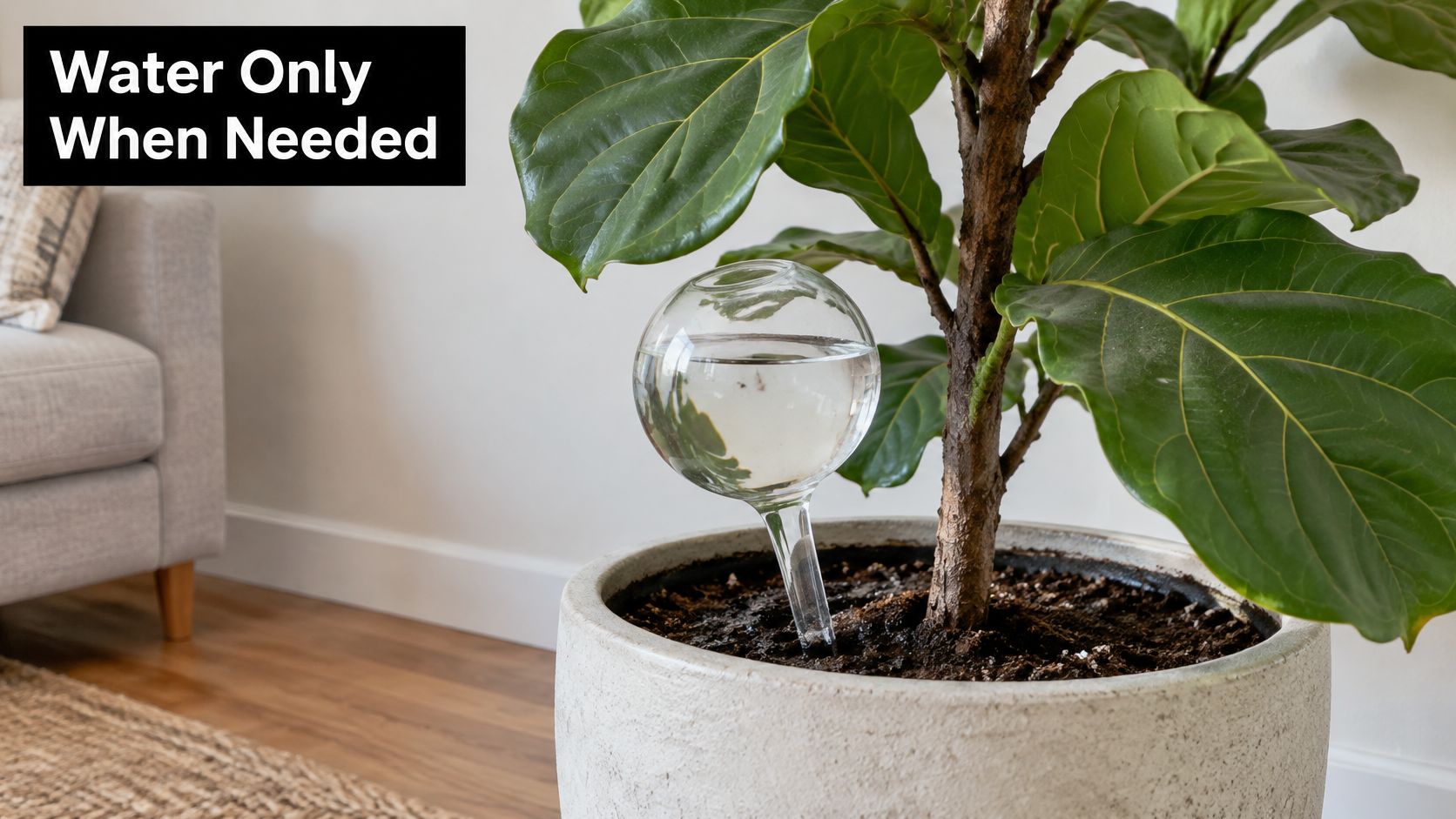
As the soil dries, oxygen enters through the stem and gently displaces water from the bulb into the root zone. Wetter soil slows that exchange. Drier soil lets more air in, so more water moves out. The flow stays gradual because the soil's own dryness sets the pace.
The drier the soil gets, the faster the globe empties.
The Oxygen Limit Owners Can't Ignore
Roots need air as well as water. Excessively wet potting media lack the oxygen required for root growth, and excess water can damage fine roots, as explained in University of Nebraska Extension guidance on root zone oxygen.
Keep the pot's drainage holes clear so surplus water exits and air can move back into the larger soil pores. A pot without drainage turns a modest reservoir into a saturation risk, no matter how slowly the globe releases.
Placement matters too. A stem pushed deep into compact, clay heavy medium can hold moisture around the root ball even when the reservoir is small. If the medium stays wet for several days, pull the globe out and let the pot breathe before refilling.
Flow moderation and optional anti clog sleeves keep release controlled, and they do real work in dense mixes. For everyday use the sequence stays plain. Fill the globe, insert it into moist soil, and check the pot yourself. No batteries, timers or apps are involved, so observation is still your job.
Globes Compared With Spikes, Drip and Self-Watering Pots
The right choice depends on plant count, trip length and tolerance for refilling. The table below compares the main plant care products used for gradual watering on the same criteria.
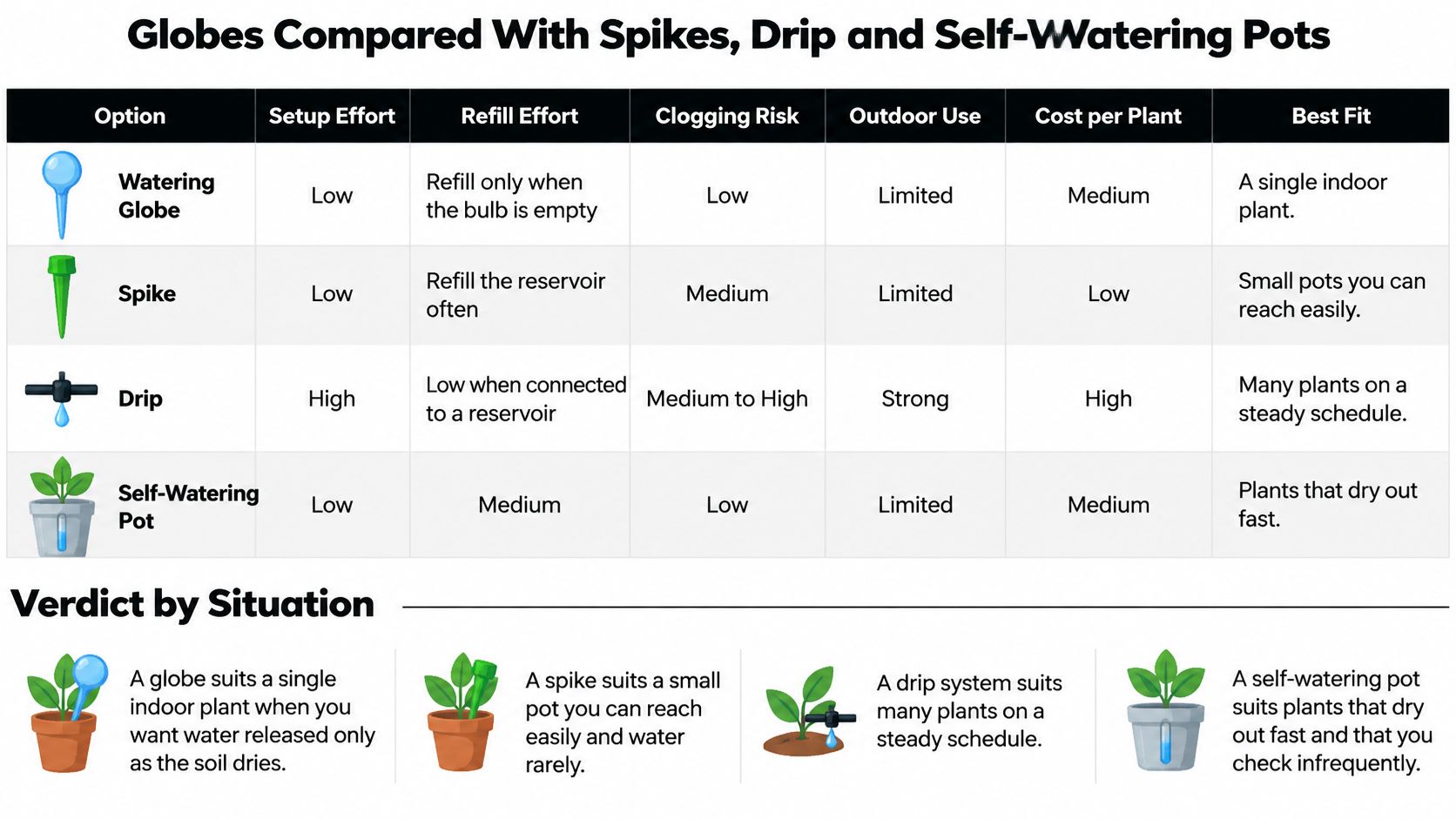
| Criterion | Watering globe | Spike | Drip system | Self-watering pot |
|---|---|---|---|---|
| Setup effort | Fill and push stem into moist soil | Push spike into soil and fill a bottle | Install tubing, emitters and often a timer | Set up the planter and fill its reservoir |
| Refill effort | Refill the globe when the bulb empties | Refill the bottle | Little if the tank is large and on a timer | Refill the reservoir as it empties |
| Clogging risk | Possible in dense soil; anti-clog sleeves help | Low to moderate | Emitters can clog | Low |
| Works outdoors | Yes, containers and hanging baskets; check in summer heat | Yes, check in summer heat | Yes, a common outdoor set-up | Yes, suits containers |
| How long one fill lasts | Up to about two weeks, varies by size and conditions | Varies by bottle size and conditions | Depends on tank and timer | Varies by reservoir size and conditions |
| Cost per plant | Low; one globe per pot | Low; one spike per pot | Higher to set up, lower per plant across many | Higher upfront; one planter per pot |
| Best fit | One to a few potted plants; forgetful or travelling owners | Single pots with simple needs | Many plants or permanent systems | Owners who will plant into a reservoir planter |
Verdict by Situation
- Globe: suits one to a few potted plants, forgetful owners and short trips, where hand refilling is acceptable and setup must stay simple.
- Drip system: suits many plants or a permanent arrangement with a tank or timer, where higher setup effort pays off across a collection.
- Self-watering pot: suits owners willing to plant into a reservoir planter and refill that reservoir as it empties.
- Spike: suits a single pot at low cost, though owners need care to avoid keeping soil too wet.
A globe isn't always the answer. A large collection makes hand refilling tedious. A plant that needs a fixed, timed routine fits a different system better. A hanging basket in summer heat can outdrink a small globe quickly, so capacity and check frequency matter more outdoors.
Clogging also deserves honesty. Globe stems can block in dense soil, and sleeves reduce that risk but don't erase it. Drip emitters clog too, just at a different point in the system. Every option trades setup effort against refill effort. Owners comparing options can use the criteria in the guide to the best self watering devices and decide by three questions. How many plants need water? How often does travel happen? How much refilling feels acceptable each week?
Which Plants and Pots Suit a Watering Globe
A globe keeps soil moist, and that single fact rules out a whole group of plants before any recommendation begins. Succulents and cacti want long dry intervals. A tool that tops up moisture steadily works against them.
Virginia Cooperative Extension contrasts tropical houseplants, which may need watering once or twice weekly, with cacti and succulents, which may need thorough watering only once or twice monthly, in Virginia Cooperative Extension container watering guidance. A globe serves the first group. It fights the second.
The same guidance sets the baseline for container watering: soil gets thoroughly wet, the pot drains until dripping stops, and the root zone dries before the next watering. A globe supports that pattern for moisture loving plants by topping up gradually between full waterings. The drainage requirement behind it is covered in the overwatering section below.
Good Fits
- Leafy tropical houseplants: plants that prefer evenly moist soil in pots with drainage holes are the strongest match.
- Apartment plants: renters with a few pots and irregular schedules benefit because setup needs no plumbing, drilling or power.
- Office plants: a globe covers weekends and short absences without asking colleagues to follow a watering rota.
- Hanging baskets: baskets dry out fast, so a globe helps, provided owners watch them closely through summer heat.
- Forgetful owners: gradual release smooths the gap between remembered waterings for one to a few pots.
- Travelling owners: short trips suit globes well, provided the setup gets tested before departure.
Little Green Leaf Plant Watering Globes are offered in 100 ml, 200 ml and 350 ml sizes, and in a mixed size option, so owners can match reservoir size to pot demand instead of forcing one size onto every plant. The business is trusted by more than 250,000 plant lovers, and size matching is still what decides whether a globe succeeds with a given plant.
Poor Fits
- Succulents and cacti: these plants need longer dry intervals, and a globe works against that need.
- Drought tolerant plants: anything that must dry out between waterings is a poor match for a moisture maintaining tool.
- Very large pots on one small globe: a 100 ml reservoir can't supply a big root ball for long, and owners who expect it to will be disappointed.
- Absences beyond a fill's reach: water in a globe can last up to two weeks depending on plant type, climate, pot size and insertion angle, so longer travel needs a different solution.
Physical Checks Before Insertion
Dense or compacted soil needs a pilot hole before the stem goes in, and the trip setup section shows how to make one. Forcing a glass stem into hard medium risks bending the insertion angle or snapping the stem.
Glass breaks if dropped, so keep globes off high shelves where a knock sends them onto a hard floor. Grip the bulb firmly when moving a filled globe.
Pot size deserves a final check. A globe should sit stably without tipping the pot or crowding the stem against the pot wall. Larger pots may need the 350 ml size or a second globe rather than a single small one.
If the plant wants to be dry for days, choose another method. A spike, a drip system or a self watering pot may serve that plant better.
Owners unsure which group a plant belongs to can run one timed fill. Fill the globe, note the day it empties, and compare that interval with the dry period the plant prefers. If the water sits untouched for days, the plant is telling you it wants drier soil. That reading settles most buying decisions and stops owners treating every houseplant as moisture loving.
Overwatering and Underwatering Signs and How a Globe Helps
Overwatering is mostly a frequency problem, not one large dose. A fixed calendar fails because a cool, dim week and a bright, warm week need different amounts. Owners who water every Sunday regardless of conditions create the very swings they want to avoid.
Symptoms point in opposite directions, and confusing them leads to the wrong fix. The table below pairs common signs with the check that confirms the cause.
| Symptom | Likely cause | What to check |
|---|---|---|
| Wilting or grey-green leaves | Too dry | Finger about 2 inches into soil; is that zone dry? |
| Yellowing or leaf drop with soggy soil | Too wet | Is the soil still wet at depth; does the pot drain? |
| Dry, crisp leaf edges and soil pulling from the pot | Underwatering | Is the globe empty or the stem out of moist soil? |
| Globe empties within days in a small pot | Plant is thirsty or pot is large | Compare globe size with pot size and plant growth |
The Finger Test Comes First
The University of Maryland Extension gives a practical threshold in University of Maryland Extension guidance on watering indoor plants. A finger pushed about 2 inches into the soil tells owners whether that zone is dry. Watering makes sense when that layer has dried, not when the surface merely looks pale.
The same guidance identifies wilting and gray green foliage as signs of excessive dryness, while leaf drop or yellowing can indicate excessive moisture. Owners who read both the leaves and the soil avoid treating a wet plant with more water. More detail on reading those signals appears in the overview of signs of overwatering plants.
How Gradual Release Evens Moisture Out
A globe replaces big, irregular doses with a small, steady supply. Release slows as soil wets, because wetter soil admits less air through the stem. That self limiting behaviour is the point. The pot gets topped up in small increments instead of swinging between soaked and bone dry.
Owners who forget watering benefit most. The globe covers the gap, and the plant avoids the stress cycle of drought followed by flooding. Uneven moisture becomes less likely, provided the pot drains and the globe size fits the pot.
The caveat is non negotiable. A globe in a pot without drainage can still leave soil wet for too long. If soil stays soggy, owners should reduce the flow, raise the stem, or remove the globe entirely. Plant care products that add water gradually still add water, and saturated roots don't care how slowly the water arrived.
How to Set Up a Little Green Leaf Globe Before a Trip
Trip length decides whether a globe is needed at all. A thorough watering before a short summer absence may be enough, but absences longer than a week require measures that provide moisture in the right quantity, according to Royal Horticultural Society holiday care guidance for houseplants. A globe meets that need without a timer or battery.
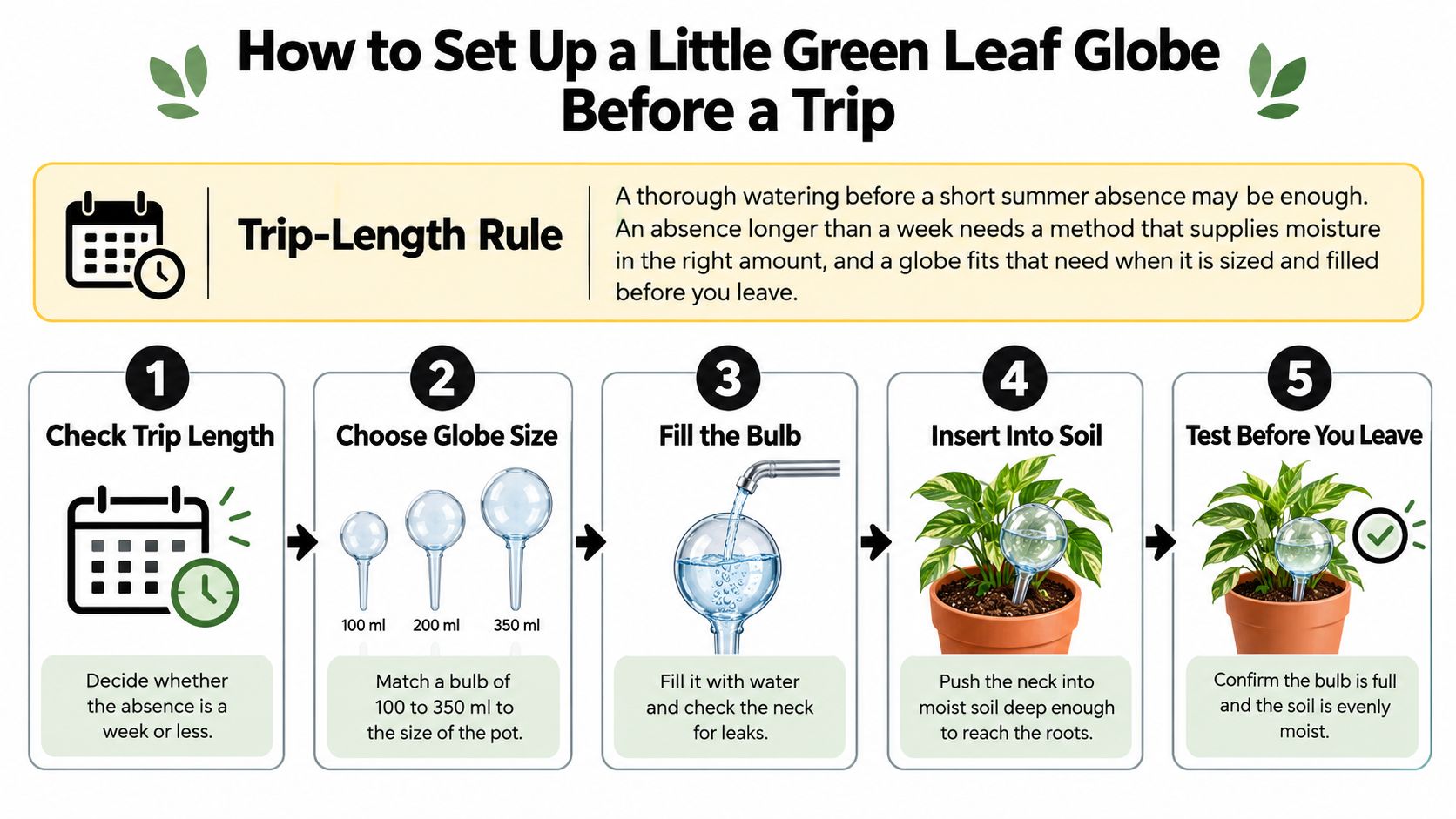
Setup has three steps overall. Fill the globe with water, insert it into the soil, then enjoy healthier plants. Before a trip, two extra checks turn that simple sequence into a reliable one.
Five Steps Before Departure
- Water thoroughly first. The plant gets a full watering and the pot drains until dripping stops, so the root zone starts full but not soggy.
- Make a pilot hole in dense soil. A pencil pressed into the insertion point opens a path, so the stem slides in without bending or snapping.
- Fill the globe. Owners choose the 100 ml, 200 ml or 350 ml size that fits the pot and fill it completely.
- Insert at a slight angle. The stem goes into already moist soil with its tip reaching the root zone, not resting near the surface.
- Check after two days. Soil gets probed about 2 inches down, the reservoir level gets read, and the leaves get a look for early stress signs.
The whole setup should be tested before departure, not installed the night before a flight. Duration depends on the plant, pot, temperature and moisture loss, and a home test reveals the actual interval. Owners planning longer absences can compare options in the guide to keeping plants watered while on vacation.
A two week absence sits at the edge of what a 350 ml globe can cover in favourable conditions. For longer trips, a trusted person can top up the globe mid absence, or a second globe can go into a larger pot. Owners who test early know which plan each plant needs, instead of hoping one fill stretches further than it should.
Stopping Clogs and Cleaning a Globe Safely
A blocked stem usually has one of two causes. Soil particles enter the stem from below, or residue and algae build inside the bulb when water stands too long. Both slow the release, and both are preventable.
Prevention Comes First
Clean water cuts residue from the start. Seat the stem in firm soil rather than loose mix near the surface, because loose particles wash into the opening more easily. Where clogging is likely, optional tip covers help prevent clogs by keeping larger particles out of the stem while water still flows freely.
A globe that drains slower than its first fill deserves a stem check before the plant gets blamed. A partial blockage looks like reduced thirst. Dry soil beside a full bulb points to the stem, not the roots, and a finger pushed into the soil settles the question in seconds.
Cleaning Routine
- Empty and rinse. Empty the bulb and rinse it with warm water to clear loose residue.
- Clear the stem. A thin brush or pipe cleaner works from the bulb end, pushing debris out rather than packing it deeper.
- Soak stubborn residue. A brief soak in a mild vinegar solution loosens mineral buildup, followed by a thorough rinse with clean water.
- Dry fully before refilling. A dry interior discourages new growth and makes it easy to spot any particles still trapped in the glass.
Cleaning frequency depends on the water in the area and how often the globe runs. Homes with hard water will clean sooner than homes with soft water, so the refill is the right moment to look. Inspect the stem at each refill, and a ten-second check catches early buildup before it hardens into a blockage that needs a soak.
Watering Globe Questions Answered
How Long Does a Watering Globe Last
A fill can last up to two weeks, but treat that figure as a ceiling rather than a promise. Plant type, climate, pot size and the insertion angle all pull the number down. Run one test fill and count the days until the bulb empties. That count is the only duration that applies to your pot.
Are Watering Globes Good for Succulents and Cacti
Skip the globe for these plants. It releases water as soon as the soil dries, so the extended dry period succulents and cacti depend on never arrives. The same applies to pots too small to take the stem without crowding the roots.
Can a Watering Globe Cover a Two Week Vacation
Two weeks sits at the far end of what a fill can deliver. If your test fill emptied sooner, arrange a top up or set a second globe in a large pot. Never leave for a long trip on an untested setup.
How Can Clogging Be Stopped
Most clogs trace back to fine soil particles working into the narrow stem tip. The sleeve, the stem check and the cleaning routine in the section above handle the rest.
What Are the Signs of Overwatering
Yellow leaves and wet soil mean what they always mean. The part specific to globes: a globe cannot push water into soil that stays wet, so persistent sogginess points to poor drainage or a pot that never fully dries.
Little Green Leaf sells hand blown glass watering globes in 100 ml, 200 ml and 350 ml sizes, plus a mixed size option for households with different pots, currently on sale at $12.45 USD at Little Green Leaf. Match the globe to the pot, test a fill before you rely on it, and keep succulents and cacti on a drier routine. That is the honest ceiling of the tool.