

Best Self Watering Devices Compared for Easy Plant Care
A filled watering globe can keep a suitable houseplant hydrated for up to about two weeks, but never promise a fixed number of days. The actual duration depends on the globe's capacity, pot size, soil, plant demand, temperature, and airflow, so a watering globe helps most when it matches the plant rather than replacing plant checks.
Table of Contents
- Introduction
- Understanding Self Watering Devices
- Detailed Comparison of Device Types
- Selecting Devices for Plant Types and Travel Durations
- Setup Guide for Little Green Leaf Globes
- Recommendations for Busy Plant Owners
- FAQ
Introduction
Forgetting to water is only half the problem. Busy plant owners also water too often, leave the surface wet while the root zone dries unevenly, or return from travel to find a wilted plant. Houseplants need watering based on actual moisture needs, not a fixed calendar, because plant type, pot size, container type, temperature, humidity, and growth rate all change how quickly the growing medium dries, as Washington State University Extension explains.
The best self watering devices solve that problem in different ways. Glass globes release water gradually, spikes meter water through a porous tip, reservoir planters hold water beneath the growing medium, and wicking systems move moisture upward through a wick or mat. None is universally right.
For most busy owners with ordinary moisture-loving houseplants, a glass watering globe is the simplest starting point. It requires no timer, battery, app, or permanent installation. The key is choosing the right capacity and accepting its limits, especially for succulents, cacti, plants that need a dry period, and very large pots.
Understanding Self Watering Devices
A self-watering device controls the route water takes into the root zone. Instead of pouring a large amount over the surface and hoping the plant uses it, the device creates a slower supply through gravity, capillary action, or a reservoir.
A glass globe uses gravity first. The bulb is filled, the stem enters the soil, and water moves downward through the opening. As the surrounding soil dries, it draws more water from the stem. When the soil is already moist, air exchange and reduced demand slow the release. That makes a globe a gradual-delivery tool, not a fixed timer.
A spike follows a similar principle, but its porous or controlled outlet meters water through a narrower contact point. It can suit a plant that needs a slower stream, though the outlet can become obstructed and the setup usually takes more adjustment.
A reservoir planter stores water below the growing medium. A wick, capillary mat, or soil column carries moisture upward toward the roots. University of Maryland Extension describes self-watering containers as a water- and nutrient-conservation tool that can leave plants unattended for several days while keeping the growing medium evenly moist in suitable conditions, as explained in its guidance on self-watering containers.
A wicking system separates the water source from the pot and relies almost entirely on capillary movement. The wick has to touch the growing medium properly, and the medium must allow water to travel through it. That system can maintain steady moisture across several plants, but it usually demands more setup than a globe.
The practical difference between slow and responsive
A device that releases water slowly isn't automatically watering only when the plant needs it. A passive globe responds indirectly to the moisture around its stem. A sensor-controlled system actively measures moisture and triggers irrigation, which is a different level of control.
That distinction matters. A blocked stem, empty reservoir, shifted wick, or sudden change in room conditions can interrupt delivery without an alert. Owners still need to inspect the soil and plant.
Research supports judging these devices by water-use efficiency rather than reservoir size alone. A USDA-supported trial found that an on-demand irrigation system used 16% less water than conventional irrigation, showing why moisture-responsive delivery can outperform a fixed schedule when demand changes, as reported in the USDA trial summary.
Detailed Comparison of Device Types
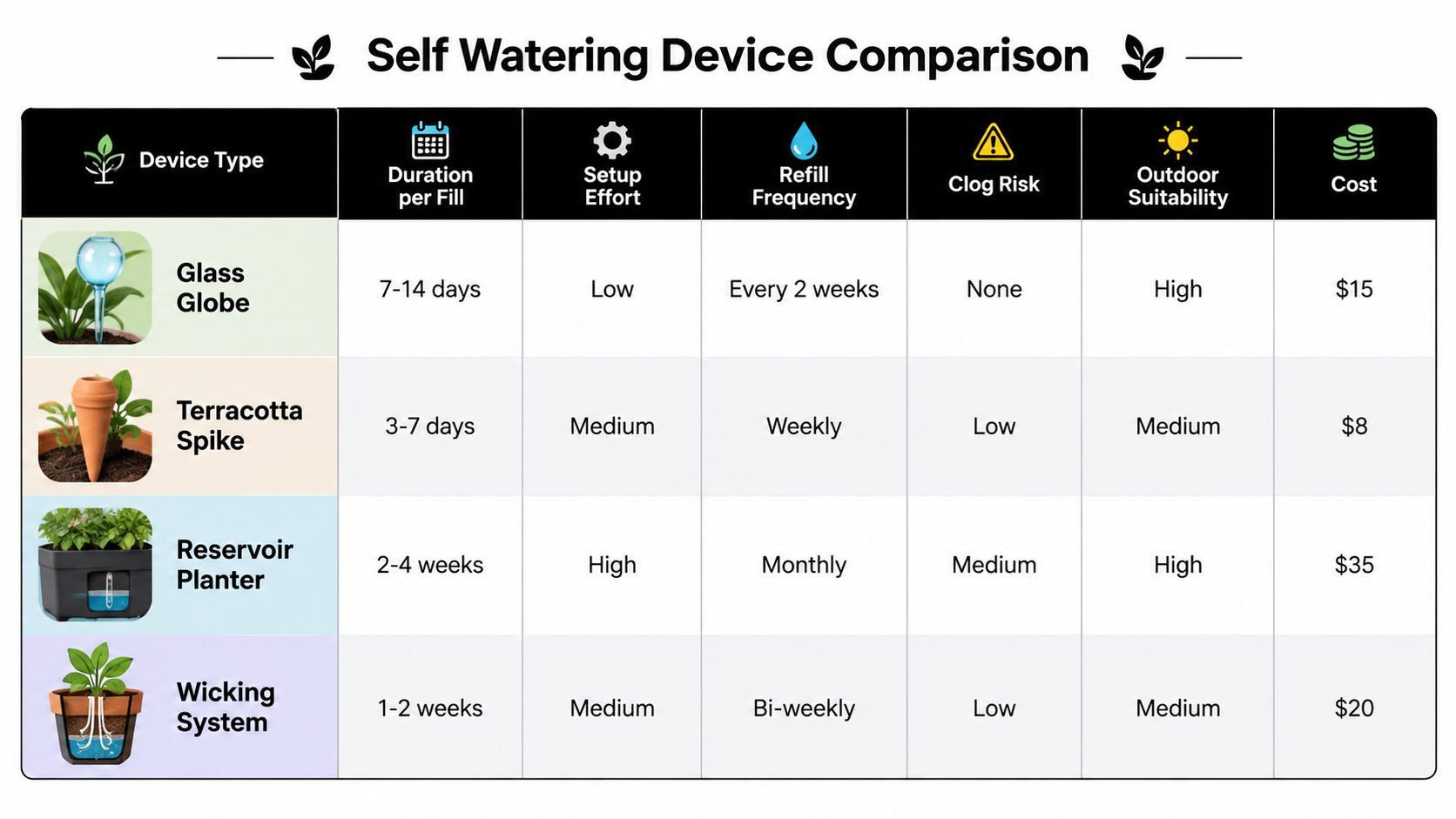
The right choice depends less on marketing labels and more on the plant owner's tolerance for setup and maintenance. A globe is fast and portable. A reservoir planter is more substantial. A wicking system can serve several containers but needs correct contact. A spike can work well when the outlet and soil match.
| Device type | Duration per fill | Setup effort | Refill frequency | Clog risk | Outdoor suitability | Cost per plant | Maintenance |
|---|---|---|---|---|---|---|---|
| Glass globe | Up to about two weeks, depending on conditions | Low | Based on soil dryness | Low, with an open stem and optional sleeve | High | Product-dependent | Check stem, soil, and glass |
| Spike | Varies with outlet and plant demand | Medium | Based on flow and drying rate | Moderate | Medium to high | Product-dependent | Inspect outlet and flow |
| Reservoir planter | Several days or longer, depending on reservoir and plant | High | Based on reservoir level | Moderate | Medium to high | Product-dependent | Clean reservoir and inspect moisture |
| Wicking system | Varies with reservoir and wick performance | Medium to high | Based on reservoir level | Low to moderate | Medium | Product-dependent | Keep wick in contact and clean components |
Glass globes
Glass globes win on simplicity. The owner waters the plant, fills the bulb, creates a pilot hole, and inserts the stem. Little Green Leaf offers hand-blown glass bulbs in 100 ml, 200 ml, and 350 ml capacities, with long stems and pack options of one, two, four, or six. The product family includes multicolor and clear rainbow designs, with optional plastic anti-clog sleeves for the stem.
The practical duration is up to about two weeks per fill, not a guaranteed interval. A small globe in a small pot can empty sooner when the room is warm or the plant drinks heavily. The larger 350 ml globe gives more reserve, but a single small globe isn't a sensible solution for a very large pot.
Globes also have clear weaknesses. Glass breaks if dropped, stems can clog in dense or compacted media, and passive delivery can't warn the owner when the bulb is empty. The owner must still check for persistently wet soil.
Spikes
Spikes are useful when controlled delivery matters more than decoration. Their outlet can meter water gradually, but the result depends on the spike, the soil contact, and how firmly the device sits in the pot.
The setup takes more trial and adjustment than a globe. A spike can release too slowly if the outlet is obstructed or too quickly if the soil channel is loose. The option can work for a plant owner who wants a utilitarian device, but it has less visual appeal and still needs inspection.
Readers considering this category can review how plant watering spikes work, but spikes aren't automatically safer than globes. They still need a plant with compatible moisture needs and a container that drains properly.
Reservoir planters
Reservoir planters suit owners who want a built-in water source rather than a removable accessory. Water sits below the growing medium and moves upward through a wick or capillary zone. The design can maintain a steady moisture supply, but it changes the container itself and usually costs more than adding a globe to an existing pot.
The main risk is assuming that a full reservoir means the plant is healthy. Persistently wet growing media can reduce oxygen around roots. Nebraska Extension warns that overly wet soil can lack the oxygen roots need and contribute to root rot. A reservoir system still needs monitoring, suitable drainage, and a plant that tolerates consistent moisture.
Wicking systems
Wicking systems are effective when the wick has broad, reliable contact with the growing medium. They can maintain moisture without placing a water-filled bulb inside the pot, which makes them useful for grouped containers or longer unattended periods.
The trade-off is setup. The owner has to position the water source, secure the wick, and confirm that moisture is moving rather than pooling at one point. Wicking also depends on the growing medium's pore structure and contact area. If the wick shifts or dries out, delivery can stop.
Comparative subirrigation research reported an average 70% reduction in water consumption with tested capillary-mat systems, but plant dry weight also declined in that experiment, so lower water use alone isn't a complete performance test, as recorded in the FAO AGRIS study record. The useful benchmark is moderate moisture with healthy roots, not maximum water delivery.
Selecting Devices for Plant Types and Travel Durations
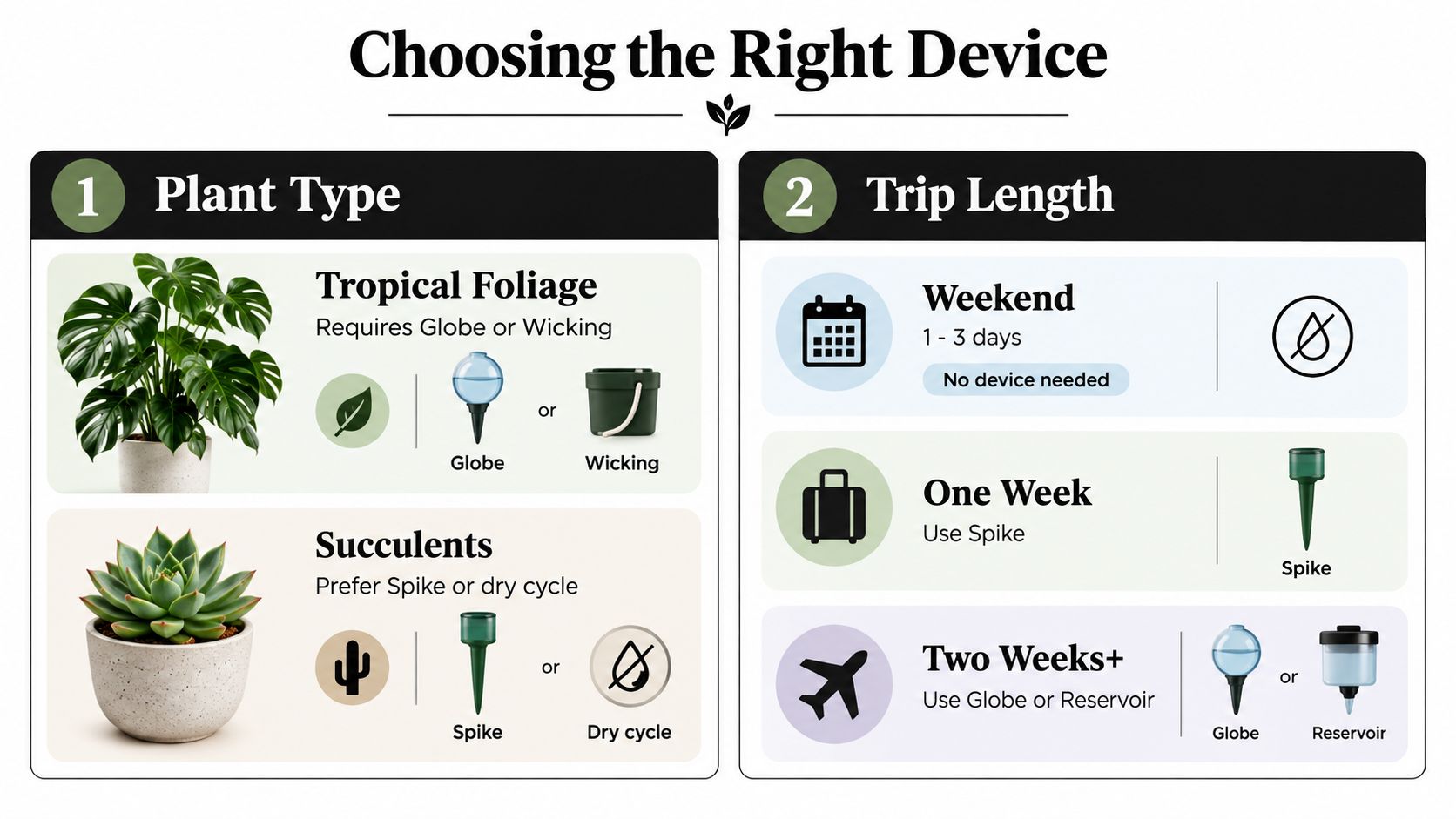
Plant type comes first. Travel length comes second. A device that works for a thirsty tropical foliage plant can harm a cactus because the two plants need different wetting patterns.
Succulents and cacti need a deliberate wet-dry cycle. Iowa State University Extension recommends soaking the root ball, allowing excess water to drain, and letting the growing medium dry completely before watering again. A globe that continues supplying moisture as the soil dries can interrupt that cycle, so succulent watering guidance supports leaving globes out of cactus and succulent collections.
A decision matrix for plant owners
| Plant and situation | Weekend away | Away for one week | Away for two weeks or longer |
|---|---|---|---|
| Moisture-demanding tropical foliage | No device may be needed if soil is appropriately moist | Globe or wicking system | Larger globe, reservoir, or human check |
| Ordinary houseplant in a small pot | Soil check before leaving | Globe sized to the pot | Globe with a refill check if conditions are warm |
| Outdoor container | Check before leaving and protect against rapid drying | Globe or another secured delivery method | Multiple compatible devices or a person checking the container |
| Hanging basket | Thorough pre-trip watering and inspection | Secured globe if the basket can support it | Larger capacity or human assistance |
| Succulent or cactus | Water according to its dry cycle | No continuous-moisture globe | No globe unless the plant's normal care specifically allows it |
A one-week absence is where a globe becomes especially practical for suitable houseplants. It reduces the chance of a missed watering without forcing the owner to install a permanent system. For a longer absence, the 350 ml option gives more reserve, but capacity doesn't overcome a plant's moisture intolerance or a pot that drains poorly.
Container size changes the decision sharply. Oklahoma State University Extension reports that small pots may need water every two to three days, while large pots may need water every seven to fourteen days, with season, temperature, humidity, plant species, and growing medium also affecting frequency, as detailed in its houseplant care guidance. A small globe can empty quickly in a fast-drying pot, while one globe may be inadequate for a large planter.
Travelers should test the setup before departure. A plant owner can fill the globe, check the soil after two days, observe whether the bulb is draining too quickly, and reposition the stem if needed. A device should never be used for the first time on the morning of a long trip.
For a broader travel-focused approach, see this vacation plant watering system guide.
Setup Guide for Little Green Leaf Globes
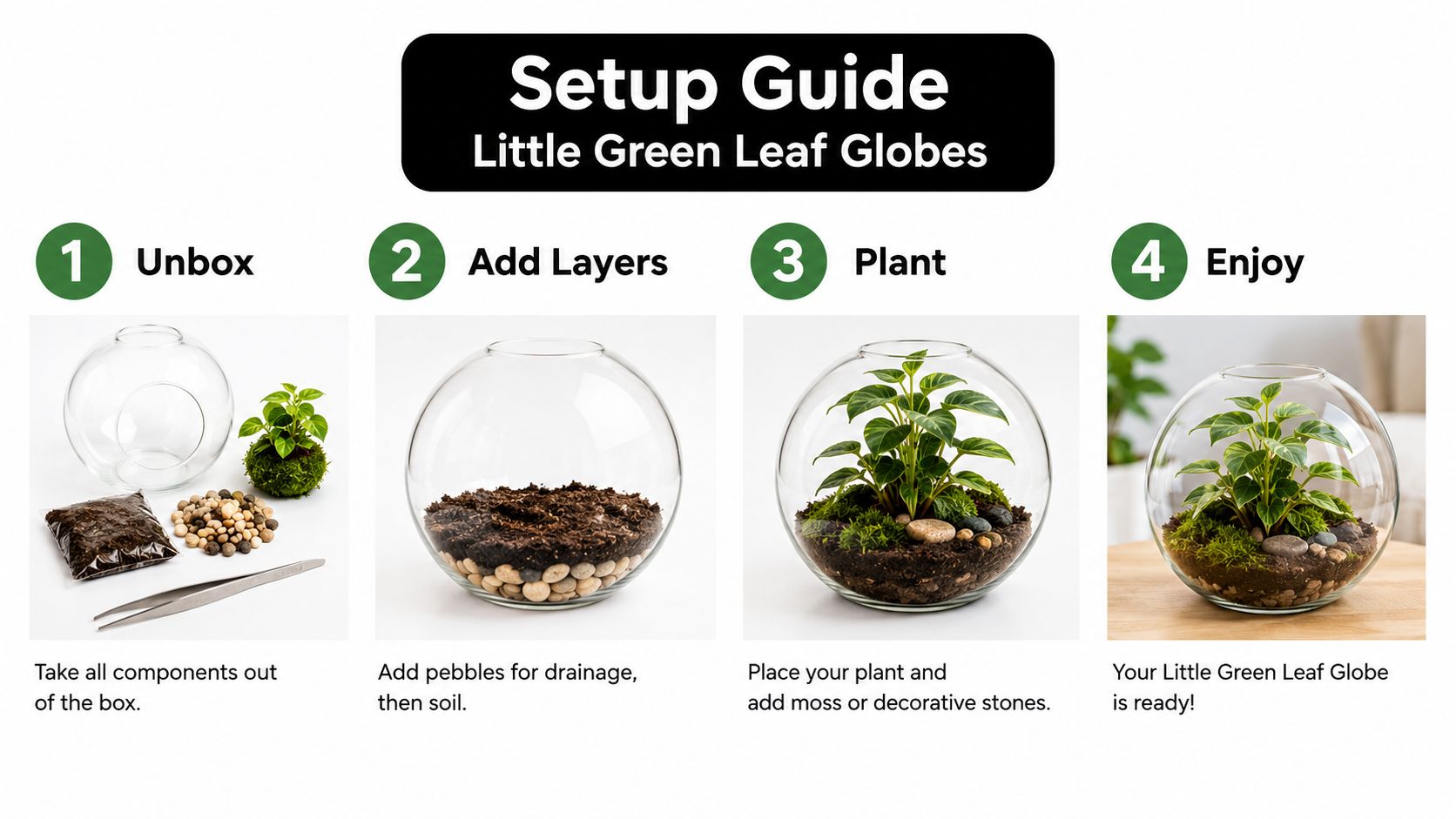
A Little Green Leaf globe works best when the plant starts with a proper watering and the stem enters the soil without crushing or sealing around the opening.
- Water the plant first. Moisten the growing medium thoroughly, then allow excess water to drain. The globe is for gradual maintenance, not for correcting a severely dry root ball.
- Make a pilot hole. Use a narrow stick or similar tool to create a pathway for the stem. Dense soil can bend, block, or stress the glass if the stem is pushed in directly.
- Fill the globe. Add water to the 100 ml, 200 ml, or 350 ml bulb. Choose capacity according to pot size and expected drying speed, not the longest possible absence.
- Insert the stem at an angle. Place it firmly in the pilot hole, avoiding a position where the stem can be knocked. An anti-clog sleeve can help keep the opening clear.
- Check after two days. Look at the soil and the water level. If the pot remains saturated, remove or reposition the globe. If the bulb empties quickly, the plant may need a larger globe or a different watering plan.
The full guide to using watering globes provides the product-specific setup details.
Recommendations for Busy Plant Owners
For a weekend away, most healthy houseplants don't need a complicated device. A thorough moisture check before leaving may be enough, provided the plant isn't already drying rapidly. A globe becomes more useful when the owner regularly forgets watering or when the container dries unevenly.
For a one-week trip, a Little Green Leaf globe is the practical first choice for a compatible houseplant. It adds water gradually, fits an existing pot, and doesn't require a powered setup. The 100 ml size suits smaller containers, while 200 ml and 350 ml capacities provide more reserve for medium planters or thirstier conditions. None should be treated as a guaranteed travel timer.
For two weeks or longer, the recommendation changes from “install one globe and forget the plant” to “use the largest suitable capacity and arrange a check.” A large pot may hold moisture longer than a small one, but a thirsty plant in a warm environment can empty a globe sooner than expected. Outdoor containers and hanging baskets deserve extra caution because airflow and heat can accelerate drying.
Practical rule: Match the globe to the plant's drying rate, then test the setup before travel. Capacity helps, but it can't compensate for a plant that needs dry soil or a pot that stays saturated.
Office managers and apartment owners generally benefit from a removable accessory rather than a permanent watering installation. The glass design also makes a globe suitable as a plant-lover gift, particularly for someone who wants a practical item that still looks decorative.
People managing several household responsibilities may also find a household management services guide useful for organizing recurring tasks, including plant checks before travel. The guide doesn't replace a watering device, but a reliable household routine makes it easier to inspect soil, refill globes, and notice problems early.
FAQ
How do you stop a watering globe stem from clogging?
Make a pilot hole before inserting the stem, especially in dense soil. Keep the opening clear, avoid pushing the stem against compacted material, and use an optional anti-clog sleeve when available.
What size watering globe is best for a medium planter?
A 200 ml or 350 ml globe is the sensible starting point for a medium planter, but the plant's drying speed matters more than the label “medium.” Test the setup before relying on it during travel.
Can a watering globe cause overwatering?
Yes. A globe can contribute to overwatering when the pot lacks drainage, the soil stays saturated, or the plant needs a dry period. Yellowing, leaf drop, and persistently wet media are reasons to remove or reposition it, not add more water.
How do you clean a glass watering globe?
Empty the globe, rinse it thoroughly, and clear the stem opening before it dries. Let the parts dry fully before storage, and inspect the glass for cracks because dropped or damaged glass shouldn't return to a plant pot.
Are watering globes good for succulents?
Usually, no. Succulents and cacti need the soil to dry completely between waterings, while a globe supplies moisture as the surrounding soil dries, so the device can interfere with their normal cycle.
Little Green Leaf offers hand-blown glass watering globes in 100 ml, 200 ml, and 350 ml sizes, with multicolor and clear rainbow designs for compatible indoor and outdoor containers. Visit Little Green Leaf to choose a globe, test it before the next trip, and make routine plant watering easier.