

Best Vacation Plant Watering System for Stress-Free Travel
The best vacation plant watering system depends on trip length, plant type, and how much setup a traveler will tolerate before walking out the door. For most indoor houseplants on short trips, self-watering globes are the simplest winner. For longer trips, larger collections, or sun-baked outdoor containers, a globe stops being the safest answer.
The usual mistake happens the night before a flight. Someone sees a shelf of pothos, a fern, a peace lily, and one plant that already looks annoyed, then tries to solve all of them with one gadget. That's how people come home to soggy soil in one pot and bone-dry mix in another.
Table of Contents
- What Every Traveler Needs Before Leaving Plants Behind
- The Five Vacation Watering Systems Compared Side by Side
- How Self-Watering Globes Actually Keep Soil Moist
- Matching the Right System to Your Trip Length
- Which Plants Respond Best to Passive Watering
- Setting Up a Globe So It Does Not Clog or Run Dry
- The Best Pick for Each Common Travel Situation
- Vacation Watering Questions Travelers Ask Before Packing
What Every Traveler Needs Before Leaving Plants Behind
The better move is a fast check of three things before buying anything. Trip length comes first. Plant category comes second. Setup tolerance comes third. If those three don't line up, the system won't either.
Trip length decides the category
A weekend away is different from a full week. A full week is different from two weeks. Beyond that, passive watering starts running into its limits, especially if the plants are thirsty or the home runs warm.
A useful reality check comes from broad houseplant watering data. A 2026 analysis of 8,357 catalogued houseplant species found that 67.4% need water every 7 days or less often, the median watering interval is exactly 7 days, and only 8.4% need watering more than every 3 to 4 days. That matters because most indoor plants aren't built for constant daily watering. They usually do better with steady moisture that bridges a normal week away.
Practical rule: most houseplants need a system that prevents extremes, not one that dumps water every day.
Plant type changes the answer fast
A pothos and a fern can both appreciate steady moisture. A cactus usually won't. A balcony planter in summer can dry out so fast that any passive device becomes a gamble.
A quick pre-trip filter works well:
- Leafy tropicals: usually good candidates for passive watering.
- Ferns and moisture lovers: need consistency and closer monitoring.
- Succulents and cacti: poor candidates for moisture-holding devices.
- Outdoor containers and hanging baskets: often need more than a passive globe can provide.
Setup tolerance matters more than people admit
Some travelers want a five-minute fix. Others don't mind tubing, reservoirs, or asking a neighbor to stop by. That matters because the best vacation plant watering system isn't the one with the biggest promise. It's the one that will be set up correctly before departure.
For indoor plant owners who want low effort, a globe is the obvious starting point. For readers weighing more automated options, Little Green Leaf also has a guide to a beginner-friendly irrigation system setup.
The Five Vacation Watering Systems Compared Side by Side
You leave Friday, get home Sunday night, and one plant in the room is the one that always dries out first. That plant should decide your system.
Most roundups flatten these options into one generic category. That is a mistake. A watering globe, a wick, a drip timer, and a plant sitter solve different problems, and they break down in different ways.
Vacation Plant Watering Systems Compared
| System | Typical Duration | Setup Effort | Refill During Trip | Best For |
|---|---|---|---|---|
| Self-watering globe | Often a few days to about 1 to 2 weeks, depending on conditions | Low | Usually no for short trips, maybe yes on longer trips | Indoor houseplants, short trips, travelers who want the simplest setup |
| Wick or capillary mat | Variable, depends heavily on wick size and reservoir | Medium | Sometimes | Grouped pots that can share a water source |
| Spike or flag reservoir | Variable | Medium | Sometimes | Medium-length indoor trips where a simple reservoir feed suits the pot |
| Automatic drip timer with emitters | Better for longer coverage if water supply and layout are reliable | High | Usually no if fully supplied | Larger plant collections, longer trips, outdoor containers |
| Plant sitter | As long as the sitter follows directions | Medium upfront, low during trip | Yes, by the sitter | Delicate plants, very long trips, mixed collections with different needs |
What actually separates these systems
Self-watering globes are the best fit for short, simple indoor trips. They are fast to set up, easy to test, and hard to overcomplicate. If you want the closest thing to fill-it-and-go for a pothos, philodendron, or peace lily, start here.
Wicks and capillary mats work best for grouped plants, not scattered ones. Wick flow changes sharply with material and diameter. Guidance on vacation wick setups notes that a 1/8-inch wick can deliver about 3 mL per hour, while a 1/4-inch braided nylon wick can deliver about 12 mL per hour. That spread is the whole story. Pick too small a wick and thirsty plants dry out. Pick too large a wick and smaller pots stay wet too long.
Spike reservoirs are a middle-ground option. They are more controlled than a globe and less involved than a full irrigation layout. I only recommend them when you have a few medium pots and enough time to test flow before the trip.
Automatic drip timers win for longer absences or bigger collections. They ask for the most setup, but they solve the biggest weakness of passive systems, which is limited stored water. If you are comparing passive devices with a more beginner-friendly irrigation system setup, the break point is simple: once you are watering many pots or planning a longer trip, a timer starts making more sense.
A plant sitter is still the right answer for fussy plants. Rare plants, large containers, mixed moisture needs, and anything already stressed should not be handed off to a one-size-fits-all device.
Choose for the hardest plant to keep alive, not the easiest one.
How Self-Watering Globes Actually Keep Soil Moist
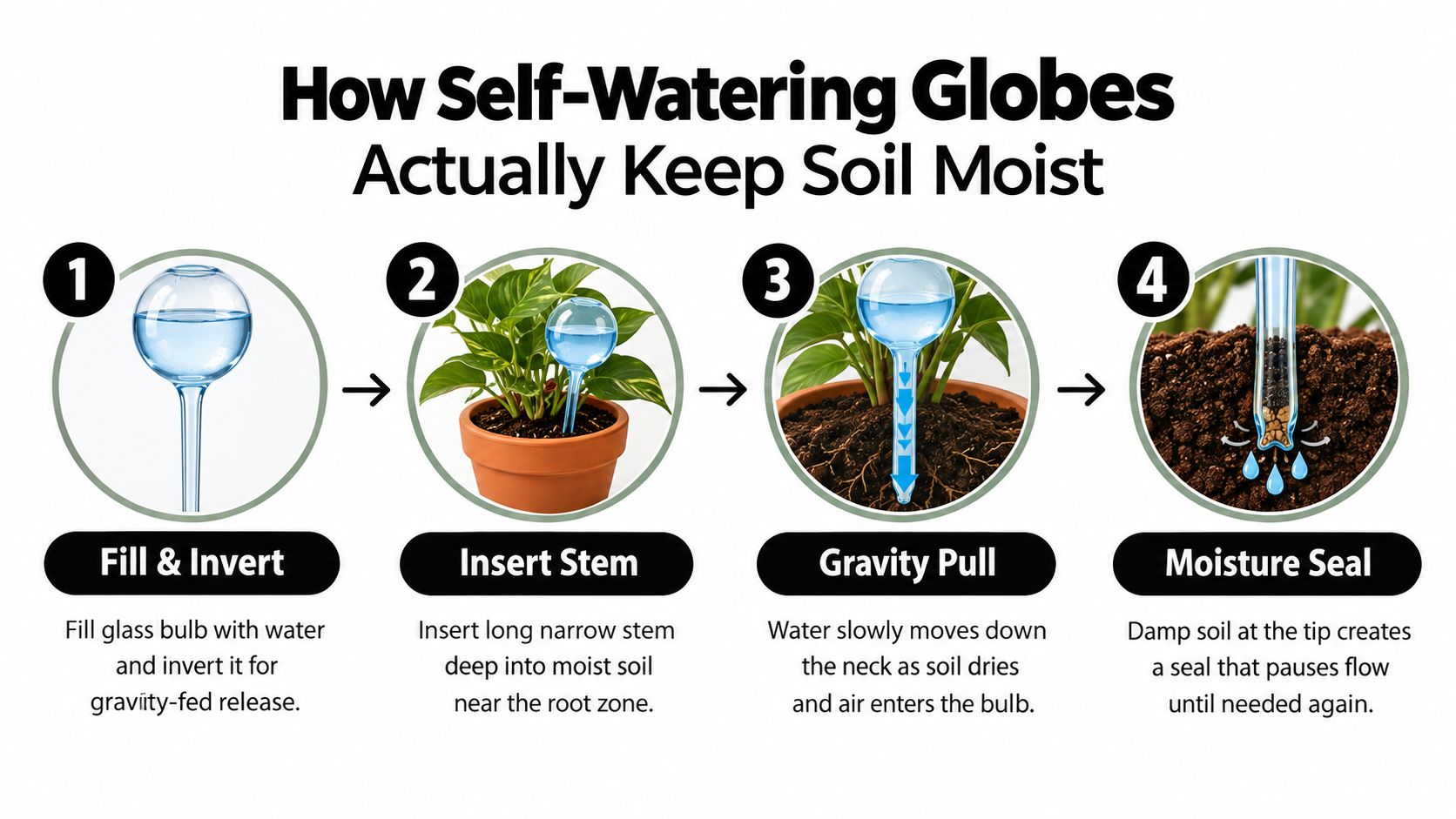
Self-watering globes work because the soil controls the release. That's why they're often the best vacation plant watering system for someone who wants hands-off watering without electricity, pumps, or timers.
How the release actually happens
A globe is filled with water and inserted into already moist soil. As the surrounding soil dries, it pulls moisture from the stem area. That change in moisture allows water to move out gradually rather than all at once.
Guidance on globe mechanics explains that self-watering globes work through capillary action and pressure differences. As the surrounding soil dries, it draws water from the globe, which is why the same globe can behave very differently in different rooms and pots.
How long one fill really lasts
This is the question buyers care about. The honest answer is up to about two weeks, but never on every plant and never in every room.
Practical benchmark data for globe runtime shows that globes under 150 mL often last 2 to 3 days, 150 to 300 mL often last 3 to 5 days, and globes over 300 mL often last 5 to 7 days. Separate guidance in that same research says many globes can keep soil moist for roughly 1 to 2 weeks in cooler, more humid, lower-demand conditions, but they may fall to 2 to 5 days in hotter or drier settings.
That's why Little Green Leaf's globe sizes matter in practical terms. The line includes 100 ml, 200 ml, and 350 ml glass globes. The 350 ml option gives the longest runway, but no single globe should be expected to carry a large thirsty plant through a hot, bright room without testing first.
For readers who want the full mechanics, Little Green Leaf explains more in its guide to how self-watering globes work.
Matching the Right System to Your Trip Length
Trip length is where most generic advice falls apart. A method that's excellent for a long weekend can be the wrong call for a ten-day trip.
Vacation Watering System Coverage by Trip Length
| Trip Length | Globe | Wick/Mat | Spike/Flag | Drip Timer | Plant Sitter |
|---|---|---|---|---|---|
| Weekend getaway | Strong choice | Good if already set up | Good choice | Usually overkill | Reliable but often unnecessary |
| About one week | Good for many indoor plants | Strong choice for grouped plants | Fair to good | Strong choice | Strong choice |
| About two weeks | Only if conditions are mild and tested first | Possible with the right reservoir | Risk rises | Better choice | Best choice |
| Longer than two weeks | Weak choice alone | Weak to moderate | Weak | Better than passive options | Best choice |
Weekend and one-week trips
For a short trip, passive systems make sense. Most indoor houseplants can often get through that window with a deep watering before departure and a steady moisture source if needed.
A useful gap in current advice is runtime reliability by trip length. One guide focused on that exact problem notes that many established houseplants can handle about a week with only pre-trip watering, some can stretch toward two weeks in cool conditions, and longer absences usually require a sitter or a more formal irrigation setup. That lines up with how passive systems behave in real homes. They're strongest in the one-week range, not the indefinite range.
Two weeks and beyond
Optimism causes plant losses. Reservoir size, room temperature, pot volume, and species differences become harder to fudge.
A wick system can still work if the reservoir is sized correctly and the soil is pre-moistened. A globe can still work for some easy indoor plants in cooler conditions. But once the trip reaches two weeks, reliability matters more than convenience. A drip timer or a person checking the plants becomes the safer answer.
For travelers unsure how long their plants can reasonably wait, Little Green Leaf has a practical read on how long plants can go without water.
If a traveler would be upset to lose the plant, two weeks is the point where “probably fine” stops being a plan.
Which Plants Respond Best to Passive Watering
The plant category matters as much as the watering device. Some plants appreciate steady moisture. Others resent it.
The best candidates
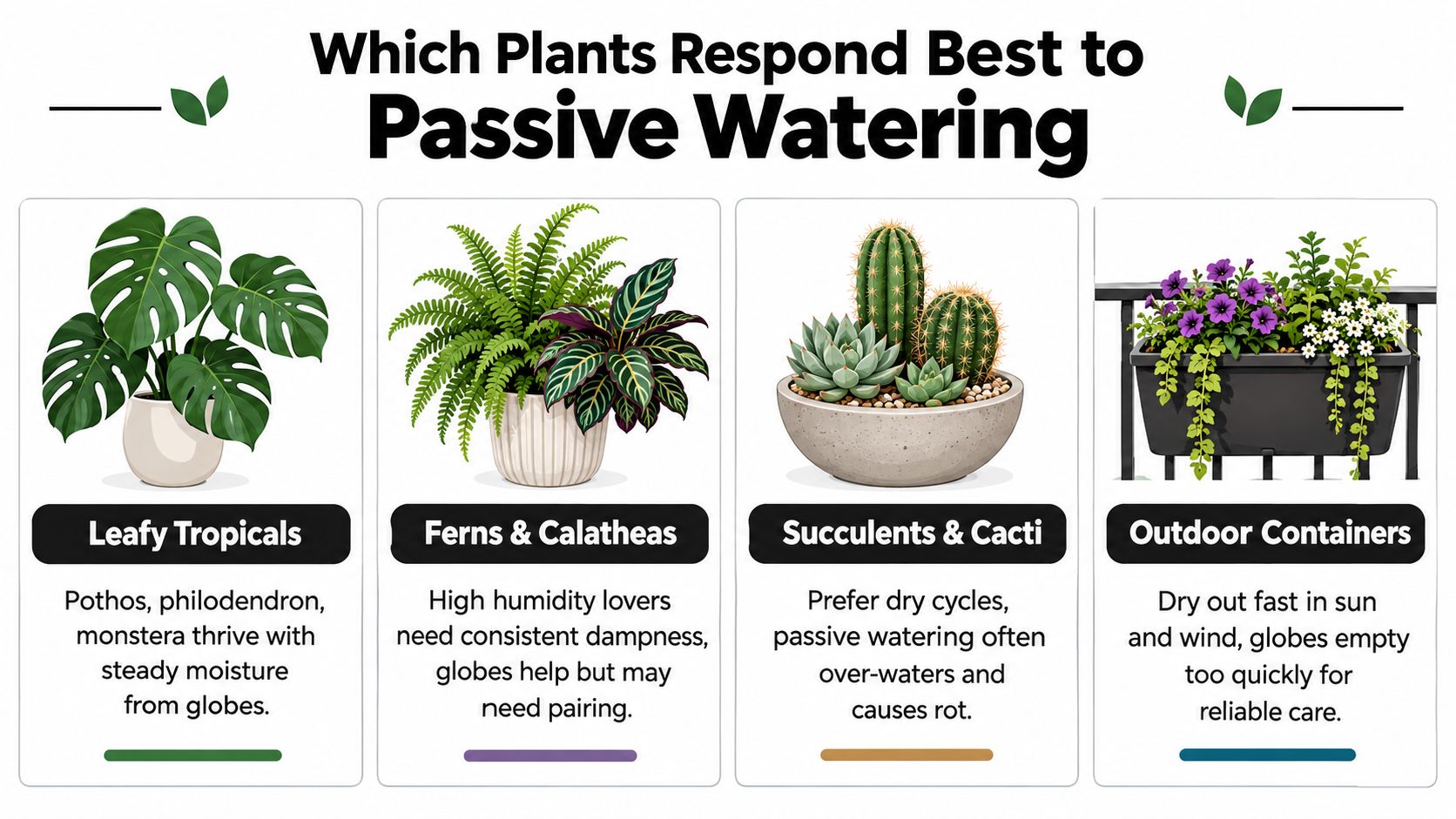
Leafy tropicals are the easiest match for globes and other passive systems. Pothos, philodendron, monstera, and similar plants usually prefer even moisture rather than sharp wet-dry swings.
Ferns and calathea-type plants also respond well to steady hydration, but they're less forgiving if the reservoir runs empty. For these, a wick or a more dependable long-duration setup can beat a single globe.
The mismatch group
Succulents and cacti are not good candidates for watering globes. They prefer drying cycles, and a device that keeps the root zone moist can push them in the wrong direction. If the trip is short, they're usually better left alone after appropriate pre-trip watering than attached to a moisture-feeding device.
Very large pots are another common mismatch. A single small globe in a big planter often creates false confidence. The device may be working perfectly, but the water volume still isn't enough for the pot.
Outdoor containers are their own category
Outdoor containers and hanging baskets dry out faster than most indoor pots, especially in warm, exposed conditions. That's where passive systems lose ground quickly.
A Royal Horticultural Society trial highlighted the tradeoff clearly. Reservoirs can reduce water wastage by delivering water to roots and storing it for later use, but compost can become too wet and the wicking system may degrade over time. The same source notes that container irrigation commonly occurs on 2 to 3 day cycles in control conditions and 3 to 5 day cycles under drought treatments, depending on species, growth stage, and climate. In plain terms, outdoor pots can burn through stored water fast.
That's why a globe is usually a good indoor travel tool and a weaker choice for a sunny hanging basket left unattended.
Setting Up a Globe So It Does Not Clog or Run Dry
A watering globe fails for predictable reasons. The soil is too dry, the stem opening gets packed with mix, or the globe is too small for the pot. Fix those three points and a globe becomes far more reliable.
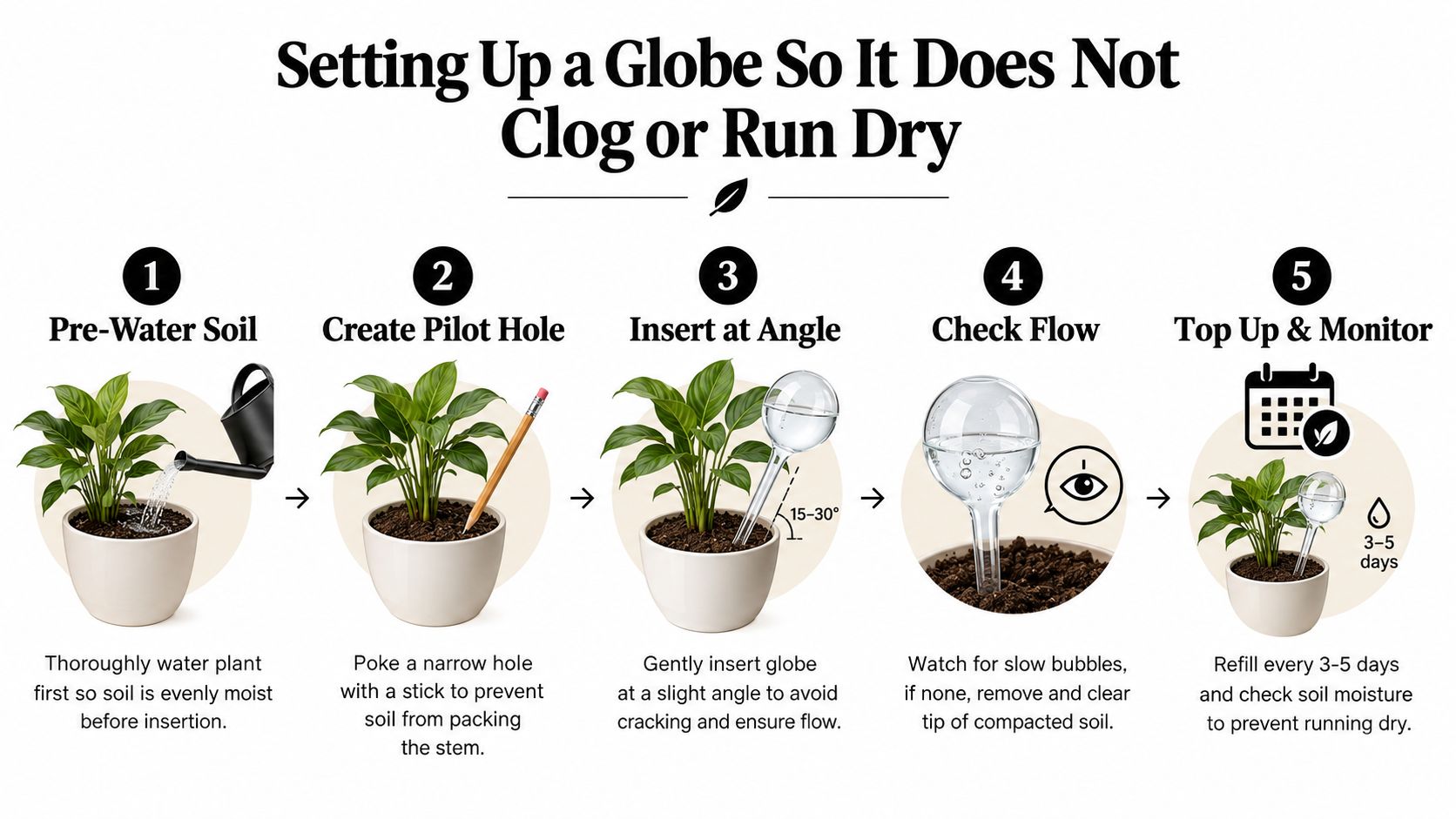
How to set up a Little Green Leaf globe for vacation watering
- Water the plant first. The root ball should be evenly moist, not bone dry with a wet top layer. If the mix has dried hard, water it thoroughly and let that moisture spread through the pot before inserting the globe.
- Make a pilot hole. Use a pencil, chopstick, or plant stake so the globe stem slides in cleanly instead of forcing soil into the opening.
- Fill the globe. Little Green Leaf globes come in 100 ml, 200 ml, and 350 ml sizes. Match the globe to the pot and the trip length, not just to what fits physically.
- Insert it at an angle. A slight angle lowers the chance of breakage and usually places the tip in a better spot near active roots.
- Test the flow before you travel. Check the water level after a day or two. No change usually means a clog or overly compact soil. A fast drop usually means the mix was too dry, too airy, or the globe is undersized for the plant.
Two details decide whether the setup works.
First, pre-moisten the soil. A globe is not a rescue tool for a thirsty plant. It works best when it is maintaining existing moisture, not trying to rehydrate a dry pot from scratch. If you leave for a week, set the plant up the day before and confirm the soil is evenly damp.
Second, keep the stem clear. Rinse the globe after each use, remove mineral film or algae from inside the neck, and avoid pushing it straight into a dense root mass. If your potting mix is heavy or fine-textured, a simple sleeve or filter over the tip can reduce clogging.
Do one test run at home. That single step matters more than any marketing claim.
For the product itself, the full range is available on the Little Green Leaf product page.
The Best Pick for Each Common Travel Situation
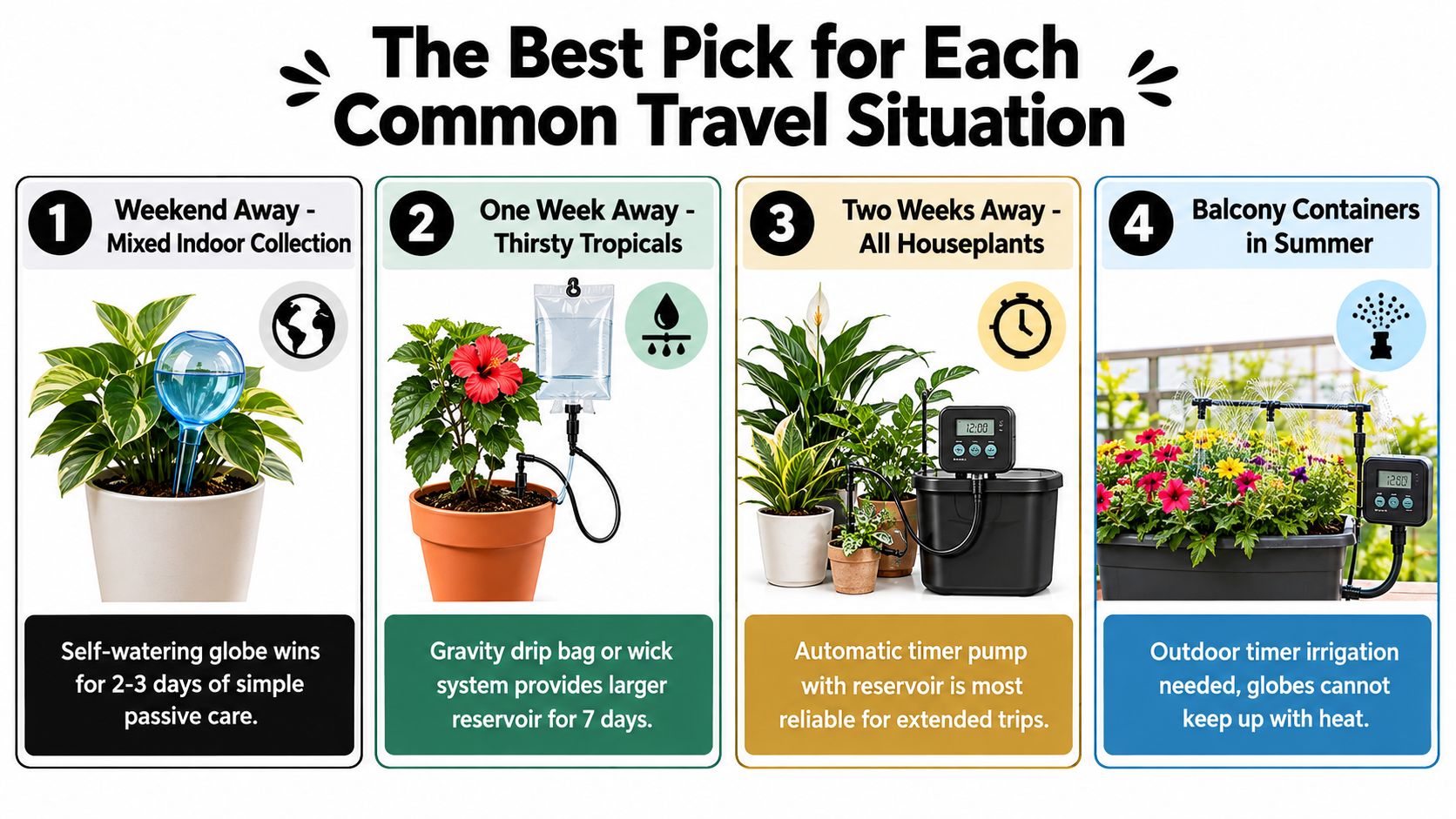
There isn't one best vacation plant watering system for every traveler. There is a best match for each travel situation.
Weekend away with a mixed indoor collection
Best pick: self-watering globe.
Backup: deep watering alone for tougher plants.
This is the globe's sweet spot. A traveler with common houseplants and a short absence usually needs simplicity more than engineering. A globe adds a buffer against forgetful pre-trip timing and helps smooth out moisture swings.
One-week trip with thirsty tropicals
Best pick: wick or globe-plus-prep strategy.
Backup: plant sitter for especially sensitive plants.
A single passive method can still work, but only if the traveler matches the setup to the plant. Larger thirsty plants may outpace a small globe, while grouped tropicals can do well on a tested wick system. For someone who wants almost no setup, a larger globe is the cleaner option, but it still needs a trial run.
Little Green Leaf's hand-blown glass globes fit this situation well because they offer 100 ml, 200 ml, and 350 ml capacities and release water gradually as soil dries. They're a practical option when the goal is low-effort backup moisture, not a full irrigation build.
Two-week absence with several large pots
Best pick: drip timer.
Backup: plant sitter.
Passive systems start getting asked to do too much. Large pots hold more soil, but they also support larger root systems and can need more total water than a globe or small reservoir can deliver reliably. A timer-based setup is less elegant, but it's the realistic answer.
Long trips or outdoor containers in summer
Best pick: plant sitter.
Backup: automated watering only if it has already been tested.
Outdoor containers in heat and wind are tough on every passive device. Globes can empty too quickly, and a missed refill isn't possible if no one is home. For extended travel, a human check-in is the safest answer because someone can respond if a plant dries faster than expected or a setup fails.
Vacation Watering Questions Travelers Ask Before Packing
How long do self-watering globes last?
They can last from a few days up to about two weeks, depending on globe size, pot size, soil, temperature, and how thirsty the plant is. Small globes run out much faster in warm, bright rooms, so a fixed number of days isn't honest.
What should be done the day before leaving?
Water plants thoroughly before departure, make sure the soil is already moist, and then install the globe or other passive system. Moving plants out of harsh direct sun can also reduce water demand while the home is empty.
Which houseplants do best with passive watering?
Leafy tropicals and many common foliage plants usually respond well because they prefer steadier moisture. Succulents, cacti, and plants that need to dry between waterings are poor candidates.
Are watering globes enough for a two-week vacation?
Sometimes, but only for the right plant in the right conditions and only after a test run. For larger plants, warmer rooms, or valuable collections, a drip setup or plant sitter is the safer plan.
Can a watering globe overwater a plant?
It can contribute to overly wet soil if used on a plant that wants to dry out, or if the potting setup already stays damp for too long. That's why globes are a bad fit for succulents and cacti and a much better fit for tropical houseplants.
Do watering globes work in dense soil?
Yes, but dense soil often needs a pilot hole first. If the stem is packed tightly with soil, the flow can slow too much or stop, which is why setup matters.
Little Green Leaf offers hand-blown glass plant watering globes in 100 ml, 200 ml, and 350 ml sizes for travelers who want a simple, decorative way to keep indoor plants evenly moist while away. For short trips, forgetful watering habits, and common houseplants that dislike drying out, they're a practical tool worth testing before departure. See the full range at Little Green Leaf.