

How Do Self Watering Globes Work? Your Guide to Happier Plants
Ever felt a little worried leaving your plants behind for a trip? Or maybe you're just looking for a simpler way to handle the "is it too wet, or too dry?" guessing game. If so, you're in the right place. Think of a self-watering globe as a simple, beautiful tool that lets your plant take the lead, sipping water exactly when it needs it.
Your Guide to Worry-Free Plant Watering
It's a common question for any plant parent: how do I know when my plant is thirsty? While they can't exactly send you a text, a self-watering globe is the next best thing. It’s an elegant, wonderfully simple solution to one of the biggest challenges in plant care—providing consistent, gentle moisture.
This hands-off approach takes the guesswork out of your routine, helping you build confidence. No more poking your finger in the soil every day, wondering if it's time. Instead, you can relax, knowing your green friends are getting the steady hydration they need to thrive.
The Benefits of Consistent Hydration
A steady supply of moisture is the secret to a happy, healthy plant. Self-watering globes create that perfect environment, supporting strong growth and lush, vibrant leaves. They're especially helpful for:
- Preventing Overwatering: The globe only releases water when the soil starts to dry, which means no more soggy conditions that can lead to root rot.
- Avoiding Underwatering: It’s a reliable reservoir, so your plants won’t go thirsty when you’re busy or away from home for a few days.
- Promoting Stronger Roots: Consistent moisture encourages roots to grow deeper and stronger, building a more resilient and robust plant overall.
A self-watering globe is more than a convenience—it's a tool that helps you create a stable, nurturing environment for your plants, letting them flourish with less stress for both of you.
These clever devices work on a simple principle of physics, using soil moisture to create a vacuum that delivers water precisely when needed. This method became a favorite as indoor gardening grew in popularity. It’s a straightforward way to avoid common issues like overwatering, which can affect many houseplants. You can see more on plant care trends over at datainsightsmarket.com.
By embracing this simple tool, you can move past common watering worries and enjoy a more relaxed, rewarding relationship with your plants. It's the first step to becoming a more intuitive and confident plant parent.
At-a-Glance Benefits of Self-Watering Globes
Here's a quick look at the key advantages self-watering globes bring to your plant care routine, helping you spend less time worrying and more time enjoying your indoor jungle.
| Benefit | How It Helps Your Plants Thrive |
|---|---|
| Consistent Moisture | Prevents the stress of wet/dry cycles, encouraging steady growth and healthier foliage. |
| Prevents Overwatering | Releases water only when the soil is dry, protecting against root rot and fungal issues. |
| Saves Time | Reduces how often you need to water, freeing you up from daily checks. |
| Vacation-Friendly | Keeps plants hydrated while you're away, so you can return home to happy greenery. |
| Ideal for All Plants | Works for a wide variety of plants, from thirsty tropicals to fussier specimens. |
| Promotes Root Health | Encourages deeper root growth as they seek out the consistent water source. |
In short, these globes act as a reliable partner in your plant care journey, ensuring your plants get the right amount of water right when they need it.
The Simple Science of Automatic Plant Hydration
Ever wondered how that little glass globe seems to know exactly when your plant is thirsty? It’s not high-tech magic, but a simple and elegant bit of science playing out right in your living room. Once you understand how it works, you’ll see why it’s such a reliable way to care for your plants. It all comes down to a quiet conversation between the soil and the water in the globe.
At its core, the system is a gentle balance of soil moisture and vacuum pressure. When you fill a globe with water and place it in the pot, the water doesn't just pour out. Instead, the damp soil creates a neat little plug at the end of the stem, which stops air from getting in. This creates a gentle vacuum inside that holds the water in place.
The Self-Regulating Watering Cycle
Think of the soil as a very patient gatekeeper. As your plant absorbs water and the soil around it starts to dry, tiny air pockets begin to form. Soon, a small bubble of air will find its way into the globe's stem, breaking the vacuum seal for just a second.
This little bubble travels up, and as it does, it releases a small amount of water, which trickles out into the soil. It’s a perfect on-demand delivery. The soil gets the drink it needs, which in turn recreates that natural plug, stopping the flow until the plant gets thirsty all over again.
This elegant, self-regulating cycle is the real beauty behind why self-watering globes are so effective. They respond directly to your plant's needs, making sure the soil is never a swamp or a desert. It’s the kind of stable, healthy environment roots love.
This process simply keeps repeating itself, offering a slow, steady supply of hydration without any batteries, timers, or fuss. It’s just the laws of physics keeping your plants happy.
The diagram below shows how this simple give-and-take leads to some major perks for your plant's health.
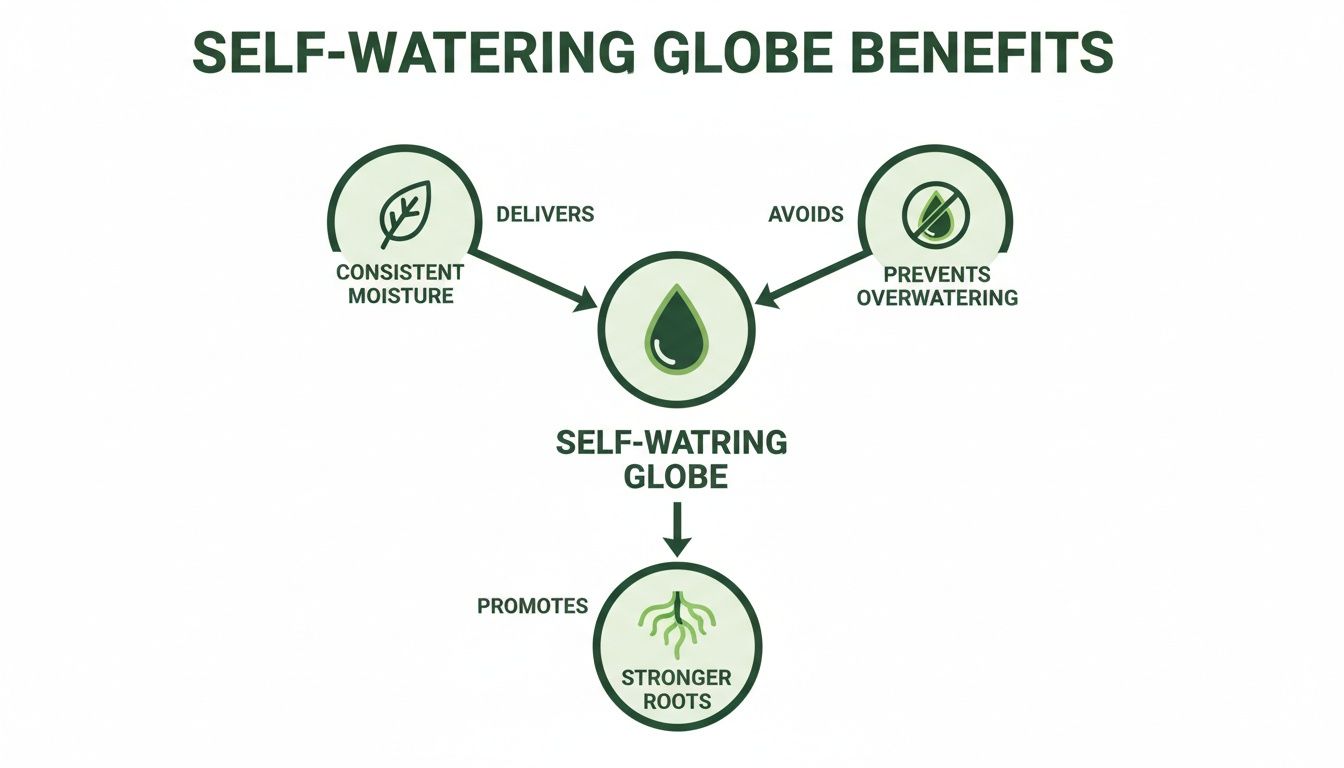
As you can see, the globe’s on-demand watering keeps moisture levels just right, which is the key to preventing root rot and building a much stronger, more resilient root system.
Why This Method Prevents Overwatering
Let's be honest, one of the easiest ways to harm a plant is with too much kindness—specifically, too much water. We've all been there. Drowning the roots in soggy soil is a surprisingly common mistake. Self-watering globes help eliminate that risk by taking the guesswork out of it.
The globe cannot release more water than the soil can handle. Once the soil is moist enough, it effectively seals the opening. No more air can get in, which means no more water can come out. It's a simple, foolproof system that makes it nearly impossible to overwater your plants.
- For thirsty plants: A leafy fern in a sunny spot will use water quickly. As its soil dries, it will pull more frequent sips from the globe.
- For low-maintenance plants: A snake plant that likes to stay on the drier side will sip water much more slowly. Its soil will stay damp longer, keeping the globe sealed and preserving the water inside.
This natural responsiveness is what makes the whole system work so well for all kinds of different houseplants.
Building Stronger, Healthier Roots
Consistent watering does more than just keep the leaves looking perky; it builds a powerhouse of a root system below the surface. When plants go through cycles of being very dry and then suddenly flooded, their roots can become stressed and damaged. This can lead to an unhappy plant.
A self-watering globe provides that gentle, steady moisture that encourages roots to grow deep and strong. Instead of staying near the surface waiting for their next drink, roots can spread out and explore the whole pot, grabbing more nutrients and creating a much more stable plant. For you, this means less worrying and more time just enjoying your thriving indoor garden. It’s a small change that creates a much healthier world for your plant, right from the ground up.
Setting Up Your Globe for Success
Getting your self-watering globe started is a simple, satisfying little ritual. Think of it as your one-minute investment for weeks of hands-off plant care. It’s less about following rigid instructions and more about understanding the "why" behind each step.
By walking through four quick steps, you’ll create the perfect environment for that gentle, self-regulating watering cycle we've been talking about. Let's get it set up together.
A Simple Four-Step Setup
This whole process takes less than a minute, but it's key to making sure your globe delivers consistent moisture right from the start. It's all about creating the right conditions for that vacuum seal to form properly.
- Water Your Plant First: Before you do anything else, give your plant a good, thorough watering. This is the most important step! Damp soil creates the initial "plug" that prevents all the water from rushing out of the globe at once.
- Create a Pilot Hole: Gently poke a small hole in the soil with a pencil or a chopstick where you plan to place the globe. This quick move keeps the globe's stem from getting clogged with soil on its way down.
- Fill the Globe Completely: Hold the globe under a running faucet and fill it all the way to the top. A completely full globe creates the strongest vacuum pressure, which helps it perform consistently.
- Insert at a Slight Angle: Carefully push the globe’s stem into the pilot hole you just made. Placing it at a slight angle—rather than straight up and down—often improves water flow and keeps the globe more stable in the pot.
And you're done! Your globe is now ready to take over, giving your plant a slow, steady drink whenever it needs one.
Why Each Step Matters
Once you see the logic behind these steps, you realize how simple the science really is. Every action has a purpose, helping you understand how do self watering globes work in a real, practical way.
It’s a team effort between you and the globe. Your initial setup gets the soil ready, and from that moment on, the globe takes care of the rest, responding perfectly to what your plant needs.
For example, skipping the pilot hole is a common reason for clogs, especially in soil that's a bit compacted. Taking that extra five seconds to clear a path helps ensure water can flow freely from day one.
This reliability is why beginners find so much success with these systems. Self-watering methods can help new plant owners feel more confident. To make things even more straightforward, simple add-ons like Little Green Leaf’s optional adapters can prevent most common clogs, helping ensure steady water flow no matter the soil type. It turns a handy tool into a truly dependable plant care partner.
Fine-Tuning for Different Soil Types
While the basic setup works for almost any houseplant, a tiny adjustment can make a difference depending on your potting mix.
- For Dense or Compacted Soil: If your soil is heavy, a tip cover or an adapter can be very helpful. These accessories create a barrier that stops dense soil from creating a blockage.
- For Airy or Loose Soil: With very light mixes, like those for orchids or aroids, just make sure the stem is inserted deep enough to make firm contact with the potting medium.
This isn’t about perfection—it’s about observing your plant. Once you’ve set up your first globe, you’ll quickly see how it settles in. For a deeper dive, you can also check out our complete guide on how to use watering globes. It's such an effortless step toward a healthier, happier plant.
Finding Your Globe's Refill Rhythm
Ever wonder why two identical self-watering globes, placed in two different plants, seem to have their own schedules? You might find one lasts for nearly two weeks, while the other is empty in just five days.
Don’t worry—this isn't a sign that something's wrong. Actually, it’s a sign that your globe is working perfectly. It's simply responding to the unique personality and needs of each plant.
Getting a feel for this natural rhythm is the key to becoming a more intuitive plant parent. It's not about fixing a problem, but learning to read the simple cues your plant and its environment are giving you. Let's look at the factors that create this unique watering schedule.
The Thirst of the Plant
The biggest reason for the difference is the plant itself. Just like people, some plants are simply thirstier than others. This often comes down to their native habitats.
A lush Boston fern, for example, comes from humid rainforests where moisture is always available. It will "sip" from its globe pretty frequently to keep its delicate fronds happy. A snake plant, on the other hand, evolved in drier regions and is built to withstand drought. These plants are much more conservative with water, meaning your globe will last significantly longer.
By watching how quickly your globe empties, you’re getting direct feedback from your plant about what it needs.
Pot and Plant Size
Scale matters. A large, established plant with an extensive root system and lots of leaves is going to use water much faster than a small, young one. It’s supporting more growth and activity.
The pot size plays a huge role, too. A large pot holds more soil, which acts like a bigger reservoir for moisture. This means it will take longer for the soil to dry out and ask the globe for more water. A tiny pot has less soil, dries out much faster, and will trigger the globe to empty more quickly to keep things consistent.
The Makeup of the Soil
Think of your potting mix as a sponge. Some sponges soak up and hold water for a long time, while others let it drain right through. The same goes for soil.
- Dense, moisture-retentive soils: Mixes with a lot of peat moss or coco coir are designed to hold onto water. In this kind of soil, your globe will release water more slowly because the soil surface stays damp for longer.
- Airy, well-draining soils: Potting blends with lots of perlite, orchid bark, or sand allow water to pass through easily, giving roots plenty of air. This soil dries out much faster, signaling the globe to release water more often.
The type of soil you use directly impacts how a self watering globe works by setting the pace for the entire drying cycle.
The beauty of the globe is that it doesn’t follow a schedule; it follows the soil. It patiently waits for the soil to say, "I'm ready," before releasing another gentle drink, perfectly matching the pace of your plant's environment.
Your Home Environment
Finally, the conditions inside your home have a direct effect on your plant’s water use. Just as we feel thirstier on a hot day, your plants respond to their surroundings.
Factors like sunlight, temperature, and humidity all determine how quickly water evaporates from the soil and transpires (or "breathes") from the plant's leaves.
- Sunlight and Heat: A plant in a bright, sunny window will use water much faster than one in a dimly lit corner. The warmth from the sun speeds up evaporation from the soil's surface.
- Humidity: In a dry room—especially common in winter when the heat is on—moisture is pulled from the plant's leaves and the soil more rapidly. A globe in a humid bathroom, however, will last much longer.
Estimating Your Globe's Watering Duration
To help you get a better feel for your specific setup, here’s a quick guide to the factors that influence your globe’s refill schedule.
| Influencing Factor | Causes Faster Water Use (Shorter Duration) | Causes Slower Water Use (Longer Duration) |
|---|---|---|
| Plant Type | Thirsty tropicals (ferns, calatheas) | Drought-tolerant (succulents, ZZ plants) |
| Pot Size | Small pots with less soil volume | Large pots with more soil volume |
| Plant Size | Large, mature plants with lots of leaves | Small, young plants |
| Soil Mix | Fast-draining (sandy, perlite-heavy) | Moisture-retentive (peat or coir-heavy) |
| Light | Bright, direct sunlight | Low or indirect light |
| Temperature | Warm rooms, near heaters or vents | Cool rooms |
| Humidity | Low humidity, dry air (winter heating) | High humidity (bathrooms, humidifiers) |
Remember, these are just guidelines! The best way to learn is to observe. You'll quickly get a feel for how your globe is responding to its own little ecosystem.
By paying attention to these simple elements, you start to see the whole picture. Your globe isn't just watering a plant; it's responding to a living, breathing environment right in your home. This is how you move from just owning plants to truly connecting with them.
Choosing the Right Globe for Your Plant and Style
A self-watering globe is more than a watering can substitute; it’s a little piece of functional decor that brings an extra bit of life to your space. Finding the right one is all about balancing your plant’s practical needs with a style that makes you happy. Think of it as finding a partner for your plant that’s both beautiful and incredibly helpful.
It’s a thoughtful gift for your plant, but also for you. A well-chosen globe keeps your plant consistently hydrated and adds a touch of personality to your indoor jungle. Let's explore how to find that perfect match.
Matching Globe Size to Your Plant
First things first: picking a globe that holds the right amount of water for your pot is the most important decision. The whole point is to have a reliable water reservoir that lasts for days, not hours. A globe that's too small for a big, thirsty plant will run dry in no time, which defeats the purpose.
Here’s a simple way to break it down:
- Small Globes (around 100 ml): These are perfect for your smaller companions—think succulents in 4-inch pots or a new pothos cutting. They offer gentle hydration without overwhelming a small root system.
- Medium Globes (200-350 ml): This is the sweet spot for most common houseplants. Snake plants, monsteras, you name it. If it's in a 6 to 8-inch pot, a medium globe will likely hold enough water to last one to two weeks, depending on the plant.
- Large Globes or Multiple Globes: For those big floor plants or extra-thirsty ferns, you have options. You can go with one very large globe or, even better, place two medium-sized ones on opposite sides of the pot to make sure the moisture is spread around evenly.
The right size gives you peace of mind. It’s the difference between a tool that needs constant attention and a set-it-and-forget-it solution that lets you simply enjoy your plants.
Finding a Style That Speaks to You
Once you’ve figured out the size, the fun part begins. Self-watering globes have become functional art. The classic clear glass globes have been joined by designs that can complement any home aesthetic, whether you're a minimalist or love a more vibrant look.
For many of us, especially city-dwellers with busy lives, combining function with beauty is a great bonus. When many urban plant owners say 'forgetting to water' is their number one plant-care headache, you can see why decorative and effective solutions are so popular. A globe's design can turn a chore into a delightful accent piece.
This is where Little Green Leaf’s hand-blown glass designs come into their own. From elegant multicolor swirls to playful mushroom shapes, they provide that reliable 7-14 day hydration while adding a beautiful, personal touch to your plant collection. You can browse our frontpage collection to see which one feels right for your home. When you find a globe you love looking at, plant care starts to feel less like a task and more like an act of creative expression.
Answering Your Top Self-Watering Globe Questions
Even with a tool as simple and elegant as a self-watering globe, it’s natural to have a few questions. The goal is to feel completely confident in your plant care routine, and getting clear answers is the best way to get there.
Let's walk through some of the most common questions from plant owners. We'll cover everything from the fear of overwatering to knowing which plants are the best fit, helping you put your globes to work with total peace of mind.
Will a Self-Watering Globe Overwater My Plant?
Absolutely not, and that’s the real beauty of its design. A self-watering globe is a reactive tool, not a proactive one—it only gives water when it's needed. This is the core of how do self watering globes work.
It only releases water when the soil has dried out enough to let a tiny air bubble into the stem. When the soil is perfectly moist, it forms a natural, temporary seal that stops the water flow completely. This self-regulating system makes waterlogged soil and the risk of root rot a thing of the past.
Instead of guesswork, you get consistent, gentle hydration that helps your plants thrive. The globe simply waits for the plant to signal it's thirsty before offering a drink.
This simple, physics-based process is what makes it such a reliable partner in your plant care journey.
How Often Will I Need to Refill My Globe?
The refill schedule is unique to each of your plants, and that’s a good thing! It’s a direct sign that your globe is responding to a specific plant in its specific environment. The timeline really depends on a few key factors working together.
- Your Plant's Needs: The size of your plant and how thirsty it is naturally play the biggest role. A large, leafy Calathea will sip water much faster than a snake plant that's just relaxing.
- The Pot and Soil: A small pot with airy, fast-draining soil will dry out quicker, meaning the globe will empty faster than it would in a huge pot with dense, moisture-retentive soil.
- Your Home's Environment: The amount of light, heat, and humidity in the room directly impacts how fast your plant uses water and how quickly moisture evaporates from the soil.
A globe hydrating a thirsty fern in a warm, sunny window might last 3-5 days. That exact same globe in a ZZ plant tucked away in a cool, low-light corner could easily last for over two weeks. The best approach is simply to watch the globe for its first cycle or two. This is how you’ll learn your plant’s personal rhythm, no stress involved.
Can I Use Self-Watering Globes for All My Plants?
Self-watering globes are a fantastic solution for the vast majority of common houseplants that prefer their soil to stay consistently moist. They are lifesavers for plants that tend to get a bit dramatic the second they dry out.
They are perfect for plants like:
- Ferns
- Prayer Plants (Maranta and Calathea)
- Pothos
- Philodendrons
- Peace Lilies
That said, they aren't the right fit for every single plant. For your desert dwellers like most succulents and cacti, it's best to stick with your watering can. These unique plants have adapted to thrive in dry conditions and need their soil to dry out completely between waterings. Using a globe could keep the soil too moist for their liking. For more tips on specific plant needs, our Little Green Leaf blog has plenty of articles to explore different plant care routines. Respecting those dry-out periods is key to keeping them happy.
What Should I Do If My Globe Gets Clogged with Soil?
A soil clog can happen, but don't worry—it’s a quick and simple fix. It usually happens if the soil is very dense or if you forget to poke a pilot hole before inserting the globe. The good news is that it’s easy to prevent.
If you notice your globe’s water level hasn’t changed in a long time, here’s what to do:
- Gently Remove the Globe: Carefully wiggle the globe out of the soil.
- Clear the Stem: Use a thin bottle brush, a pipe cleaner, or even a rolled-up paper towel to clear the soil from the stem. A quick rinse under the tap usually does the trick.
- Re-insert Correctly: Before putting it back, make sure to create a clear pilot hole with a pencil or a chopstick. This simple prep step is the most effective way to prevent future clogs and ensure a smooth, consistent flow every time.
Taking just a few seconds to prepare the soil makes all the difference and helps your globe do its job without any hiccups. It’s an easy habit that leads to long-term success.
Ready to bring this simple, beautiful solution to your own indoor jungle? The Little Green Leaf self-watering globes are designed to make plant care easier and more joyful, so you can spend less time worrying and more time watching your plants thrive.
Discover the perfect globe for your home at littlegreenleaf.co
Powered by the Outrank app