

Hand Blown Glass Watering Bulbs: What They Are and Do
You just unwrapped a hand blown glass watering bulb, and the key question is simple, will it keep your plant evenly moist without tipping it into overwatering? The short answer is yes, if the bulb size, soil moisture, and pot size match the way the vacuum-and-air-exchange cycle works, and no if the plant wants to dry out between waterings.
Hand blown glass watering bulbs are passive watering aids, not timers, and they're meant to slow water delivery as the soil dries. That makes them useful for travel, forgetful routines, and plants that like steadier moisture, but they're not a fit for succulents, cacti, or any plant that needs to dry between drinks.
Table of Contents
- What Hand Blown Glass Watering Bulbs Are
- How the Vacuum and Air Exchange Cycle Works
- Why Glassblowing and a 1958 Patent Meet in One Product
- Matching Bulb Size to Pot, Plant, and Room
- Hand Blown Glass Bulbs Compared to Spikes, Drip, and Self Watering Pots
- Setting Up and Caring for a Little Green Leaf Bulb
- Plants and Situations Where Bulbs Are Not the Answer
- Vacation Use, Breakage Risk, and Other Common Questions
What Hand Blown Glass Watering Bulbs Are
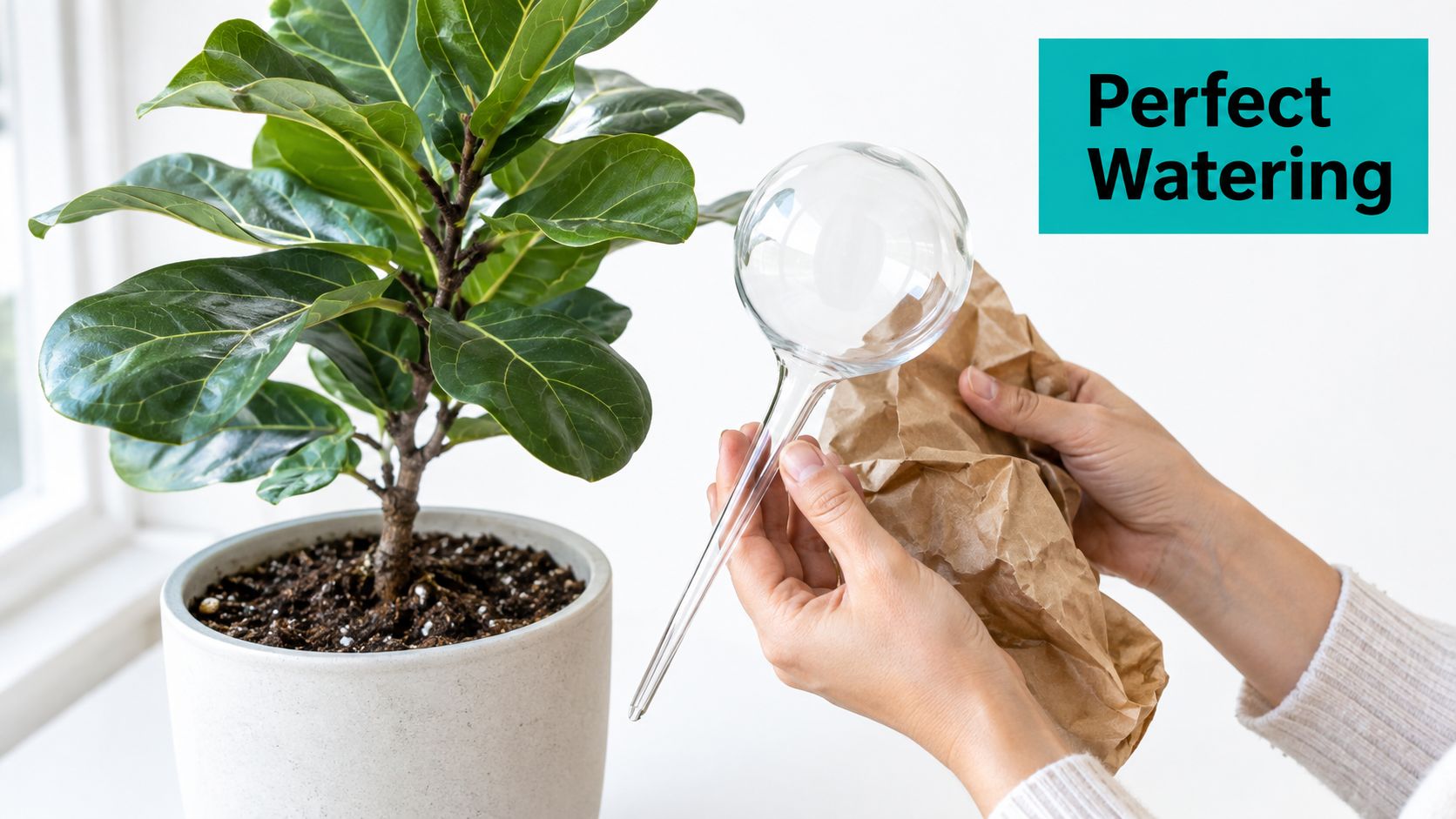
A hand blown glass watering bulb combines a visible water reservoir with a narrow glass stem. The reservoir holds the supply, while the stem forms the connection between that supply and the potting mix. Its value comes from how those parts work together, not from the bowl alone.
The stem sets the pace
The tapered stem must sit in direct contact with damp potting mix. That contact throttles the flow, much like placing a finger over part of a straw changes how quickly liquid moves. If the stem is loose, surrounded by large air gaps, or pushed into unsuitable soil, the bulb may release water unevenly.
The result differs from hand watering. A watering can delivers water in one session, whereas a bulb keeps a small reserve beside the root zone and lets the soil regulate access to it.
Practical rule: the bulb does not choose a watering schedule. Its size provides the reserve, but the soil and stem interface influence how quickly that reserve is used.
The clear glass also makes the remaining water easy to check, while hand blown shaping gives each piece a decorative character. Function still depends on setup: a beautiful bulb cannot compensate for a poor fit between its stem, the potting mix, and the plant's moisture needs.
How the Vacuum and Air Exchange Cycle Works
The easiest way to think about the mechanism is like a straw held under water. Once the bulb is inverted into the soil, water wants to move out, but the stem and surrounding moisture create a weak seal that slows that movement until air can get back in.
Why wet soil changes the flow
When the stem goes into pre-moistened soil, the wet particles cling around the glass and reduce open air gaps. That's the control point, because a bulb inserted into already damp, aerated soil releases in a steadier way than one pushed into dry, compacted mix how plant water bulbs work.
As the soil dries, it pulls away from the stem just enough to admit a small bubble of air. That bubble lets a measured amount of water escape, then the seal partly reforms, so the process repeats in pulses rather than one continuous pour.
Why angle and pilot holes matter
A pilot hole matters because dense soil can press so hard on the stem that it cracks the glass or blocks the air path. A slight angle also helps the neck avoid sealing against one tight patch of dry media, which can make the bulb dump too fast or stop releasing altogether.
That's why duration varies from pot to pot. Soil moisture, container size, and room conditions all change how often air can enter and how quickly water can leave, which is why watering globes are described as a passive system that responds to plant demand rather than a fixed timer self-watering globes.
Useful shortcut: if the plant's soil is already saturated, the bulb has less reason to release. If the soil is evenly damp, the flow usually becomes more predictable.
For a fuller visual guide to the setup logic, the internal walkthrough on how self-watering globes work is a helpful companion.
Why Glassblowing and a 1958 Patent Meet in One Product
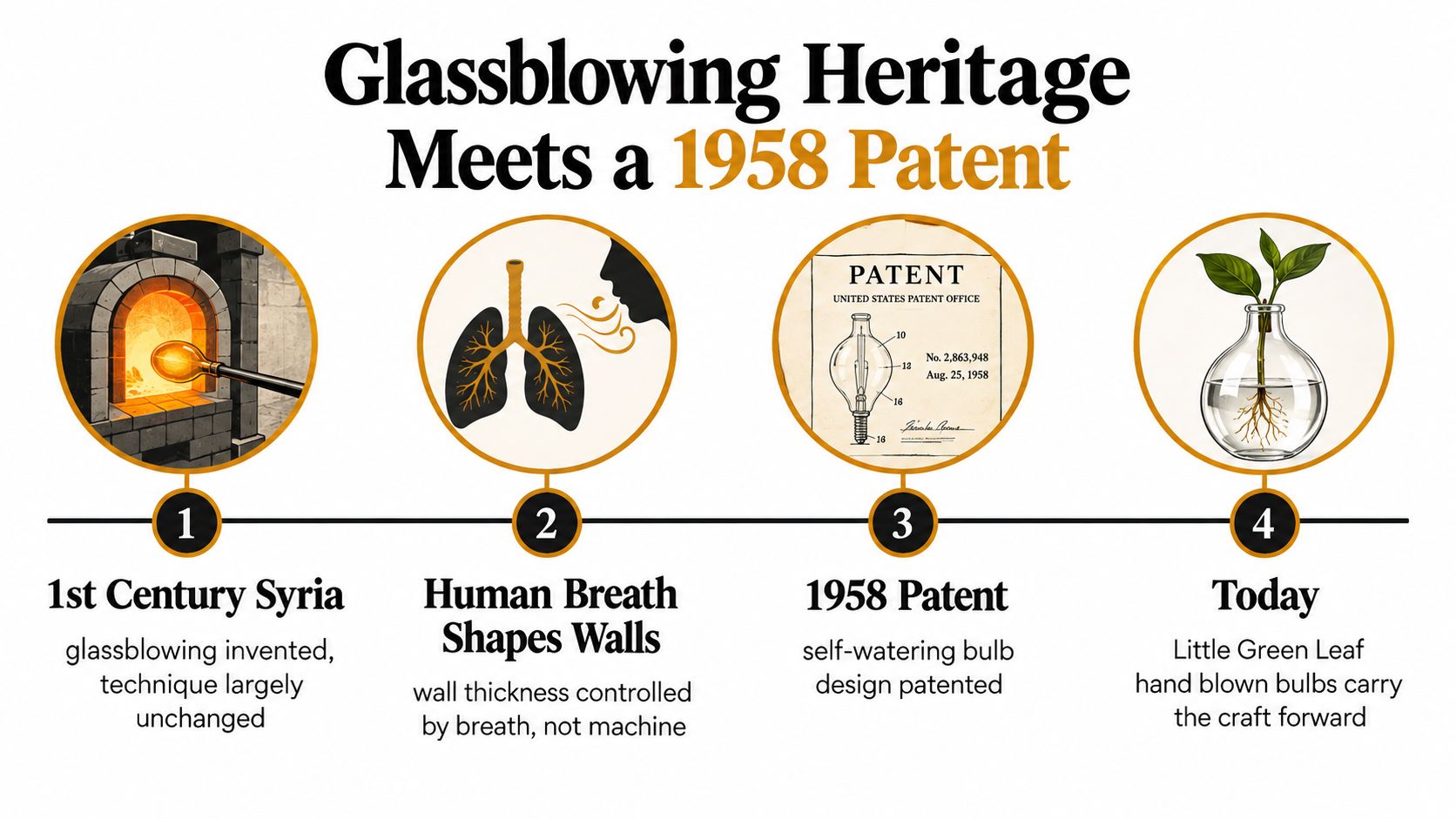
A hand blown glass watering bulb brings together an old craft and a practical plant-care mechanism. Glassblowing dates to the 1st century B.C.E., when the technique spread and made glass more common. Decades later, a U.S. plant-watering patent was filed in 1954 and issued on June 10, 1958. It described a watering bulb made from transparent plastic or glass US2837869A.
Craft and mechanism ended up solving the same problem
Hand-formed glass gives each bulb small differences in wall thickness and shape. Those variations make the piece feel more like a crafted object than a uniform container. The result is decorative, but its appearance still serves a practical purpose: the reservoir remains visible, so you can check its water level.
The patent matters because it specified the narrow stem and inverted reservoir that create the vacuum-and-air-exchange cycle explained above. The stem sits in the soil while the reservoir holds water. As the plant and soil draw moisture, air enters through the stem, allowing more water to leave. The design turns a simple container into a repeatable passive watering aid.
That combination explains the product's lasting appeal. It is both a piece of glass craft and a tool for supplying water gradually. Buyers can therefore value the bulb's appearance while judging it by the mechanism that determines how it performs.
Matching Bulb Size to Pot, Plant, and Room
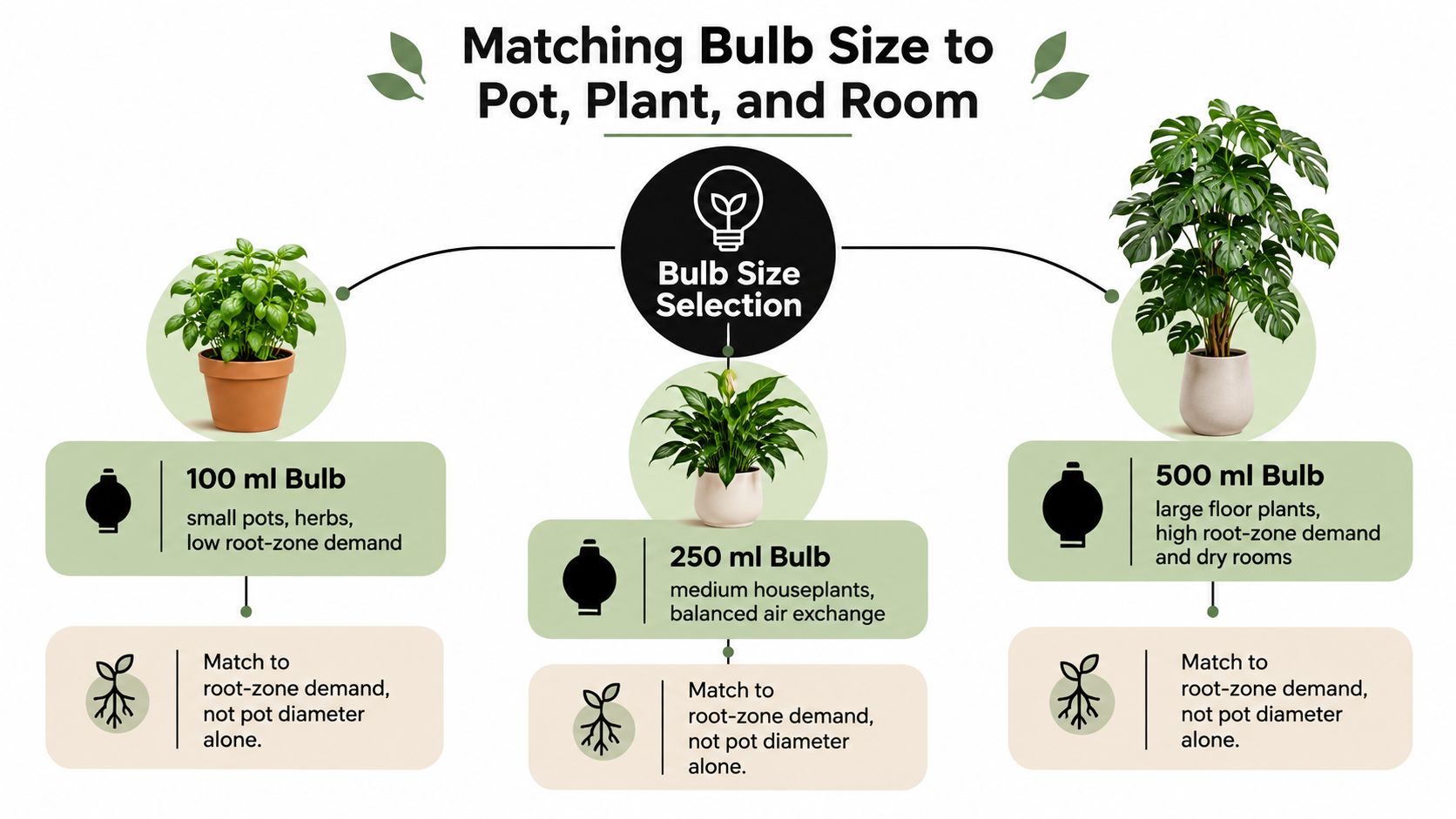
The three Little Green Leaf sizes, 100 ml, 200 ml, and 350 ml, should be matched to the plant's thirst and the room's drying speed, not just the pot label. A small bulb in a hot, bright room can empty much faster than the same bulb in a cool, shaded apartment.
A simple size rule that follows the physics
A 100 ml bulb makes the most sense for small pots and plants that only need a light, steady supply. A 200 ml bulb fits the middle ground for common houseplants, while 350 ml is the better option when the root zone is larger, the room is warmer, or the plant dries faster.
For outdoor containers or hanging baskets, heat and direct sun speed up evaporation, so even a bigger bulb won't behave like it does indoors. Dense root balls also pull water faster than loose, airy pots because the bulb keeps encountering dry zones that invite more flow.
Decision rule: pick the size for the pot first, then move one step larger if the room is bright, warm, or dry.
The same logic is why people sometimes overbuy size. The glass reservoir isn't just a bigger bottle, it's a bigger water supply feeding a system that responds to the plant's moisture demand.
For a more detailed sizing reference, the internal guide on globe bulb sizes pairs well with this approach.
Hand Blown Glass Bulbs Compared to Spikes, Drip, and Self Watering Pots
The right tool depends on how much control you want, how much setup you'll tolerate, and whether the plant needs gentle, gradual moisture or something more precise. Hand blown glass bulbs are usually the easiest to place and the nicest to look at, but they aren't the longest-lasting option.
| Criterion | Hand Blown Glass Bulb | Terracotta Spike | Drip System | Self Watering Planter |
|---|---|---|---|---|
| Duration per fill | Up to about two weeks, depending on pot, soil, and temperature | Varies by bottle size and soil demand | Can run much longer with a water source | Depends on reservoir volume |
| Setup effort | Low, fill and insert | Low to moderate, bottle plus spike | Higher, tubing and timer setup | Higher, requires the right pot design |
| Refill effort | Simple, periodic refills | Simple, but bottle handling can be fiddly | Lower day to day, more system upkeep | Refill reservoir as needed |
| Clogging risk | Moderate if the stem is blocked by dense soil | Moderate around the spike opening | Moderate at emitters | Lower at the reservoir, higher if parts are poorly fitted |
| Works outdoors | Limited in wind and strong heat | Can be used in some containers | Can work well if installed properly | Depends on the planter and exposure |
| Cost per plant over a year | Generally modest for a single plant | Often low | Usually higher because of system parts | Higher upfront because the pot does the job |
The honest tradeoff
Bulbs win when the goal is easy, attractive, hands-off watering for a small number of indoor plants. They lose when the plant needs exact delivery, when the container is very large, or when outdoor heat and wind make passive release less predictable.
A drip setup can be more consistent for a larger collection, but it asks for more parts and more planning. Self-watering planters hold more water, but they only make sense when the pot itself is built around that reservoir design.
Setting Up and Caring for a Little Green Leaf Bulb
Before inserting the bulb, water the plant normally. Moist soil gives the vacuum cycle a stable starting point. Fill the bulb underwater, turn it upside down to release trapped air, and cover the stem opening with a finger while carrying it to the pot.
- Make a pilot hole. Use a pencil or dibber to open a path through compacted soil, rather than forcing the stem and disturbing the seal.
- Set the angle. Insert the stem at a slight tilt. This keeps the air path open and helps water leave in controlled pulses.
- Seat it firmly. Press soil around the stem to close loose gaps. A gap can let water escape too quickly before the vacuum cycle settles.
- Check the first hour. A slow, steady drip is normal. If the bulb empties quickly, the hole may be too loose, or the plant may have started too dry.
Rinse at each refill and brush the stem interior monthly; mineral narrowing reduces the air-exchange gap and makes the pulse cycle less predictable. In heavier soils, the optional plastic anti-clog sleeve can help keep the channel open and make insertion easier.
If you want the product details in one place, visit Little Green Leaf's glass plant watering globes.
Plants and Situations Where Bulbs Are Not the Answer
Succulents and cacti are the clearest mismatch because they need the soil to dry out between waterings, and a bulb keeps adding moisture while the root ball is still damp. That same problem shows up with any plant that prefers a dry rest, because the bulb is built to even out moisture, not create a wet-dry cycle on demand.
Other poor fits are about the container, not just the plant
A pot with no drainage is a bad match for any passive watering tool. The bulb can't correct a container that traps water, and houseplant guidance on overwatering makes the same point, roots need air pockets, and soil that stays too wet can lead to root rot root rot guidance.
Very windy outdoor spots also reduce reliability because they speed evaporation and can break the seal at the stem. Cold, shaded rooms can slow uptake so much that the bulb appears underused, while very fine mixes can either wick water too fast or clog the neck.
Bulbs are for plants that want steady moisture, not for plants that want a dry-down rhythm.
For a broader look at where passive watering helps most, the internal article on the best vacation plant watering system covers the travel use case from a practical angle.
Vacation Use, Breakage Risk, and Other Common Questions
Can hand blown glass watering bulbs be used for vacation?
Yes, they can work well for short trips when the plant likes even moisture and the setup is correct. A larger 350 ml bulb in a cooler room is a better choice than a small bulb in a bright, warm spot, because the soil will draw water more gradually.
Do hand blown glass watering bulbs break easily?
Glass can chip or break if it's dropped, so they need careful handling on tile, stone, and hard shelves. Filling them over a sink and setting them on a mat reduces the risk, and keeping them away from pet traffic and crowded edges makes sense for any glass item.
How often do you refill a watering bulb?
The refill rhythm depends on plant demand, temperature, and the bulb size, so there isn't a fixed schedule that fits every pot. For many houseplants, the practical range is often about one to two weeks, but thirsty plants and warm rooms shorten that window.
What plants are watering bulbs best for?
They're a good fit for moisture-loving tropicals and other potted plants that do better with gradual moisture than with drying out completely. They're not the right tool for succulents, cacti, or anything that needs a dry rest between waterings.
Do hand blown glass watering bulbs clog?
They can, especially if the stem is forced into compacted soil or if minerals build up inside the neck. A pilot hole, a slight angle, and regular rinsing keep the stem open and make the release more reliable.
For most buyers, the next decision is simple, match the bulb size to the pot, then match the pot to a plant that wants steady moisture.
Little Green Leaf makes hand blown glass watering globes that turn that routine into a calmer, more predictable habit for indoor and outdoor containers. If steady watering, simple setup, and a decorative glass look matter to your plants and your space, visit Little Green Leaf and choose the bulb size that fits your pots.