

Globe Bulb Sizes for Plants: How to Pick the Right One
Watering globes come in three practical capacities, 100 ml, 200 ml, and 350 ml. The right pick depends on pot size, plant thirst, and how long the owner wants between refills.
Someone preparing for a week away, staring at a dry-looking houseplant, usually doesn't need a complicated watering system. They need a globe that fits the pot, reaches the root zone, and holds enough water without keeping unsuitable plants constantly wet. A Little Green Leaf globe releases water gradually as the surrounding soil dries, with a full fill lasting up to about two weeks, depending on pot size, soil, plant needs, and temperature.
Table of Contents
- What Globe Bulb Sizes Actually Mean for Plant Watering
- How a Watering Globe Releases Water
- Comparing 100 ml, 200 ml, and 350 ml Watering Globes
- Matching Globe Size to Pot Size and Plant Type
- Setting Up a Little Green Leaf Globe for the Right Size
- When a Watering Globe Is the Wrong Choice
- Choosing Your Globe Size and Common Questions
What Globe Bulb Sizes Actually Mean for Plant Watering
Search results often use “globe bulb sizes” to describe decorative light bulbs. In that context, a letter and number identify the bulb shape and diameter. Globe light bulbs use the letter G plus a number representing diameter in eighths of an inch, so a G25 measures 25/8 inches, or 3.125 inches, across, while a G30 measures 3.75 inches and a G50 measures 6.25 inches (McMaster's globe bulb reference).
For plant watering, the useful measurement is different. A watering globe is a glass reservoir attached to a long stem, and its size label refers to water capacity in millilitres. Little Green Leaf offers 100 ml, 200 ml, and 350 ml options, so buyers can choose capacity rather than trying to interpret a lighting code.
Capacity affects three practical decisions:
- Refill interval: A larger reservoir can support watering for longer, although flow still depends on the plant and conditions.
- Physical fit: The globe must sit securely in the pot without tipping or crowding the root ball.
- Moisture level: A globe that holds too much water for a small or drought-tolerant plant can keep the growing medium wetter than the plant prefers.
The reliable starting point is pot size, not the apparent size of the leaves. A large plant in a cramped pot may need a smaller globe than a modest plant in a deep container. Stem length matters too. One technical product specification recommends a 7 × 20 cm globe for pots 11–18 cm tall, showing why the reservoir and stem must both suit the container.
How a Watering Globe Releases Water
A watering globe doesn't operate on a timer. After the filled bulb is inverted and its stem is placed in moist soil, water moves out gradually as the soil around the stem dries. Drier soil pulls water from the reservoir, while air enters the globe to replace the water that has left. This combination of capillary action and air-pressure differences creates a passive release system (how self-watering globes work).
The result is demand-driven rather than scheduled. Moist soil at the stem can slow or temporarily stop the flow because a weak vacuum forms at the opening. As that area dries again, water movement resumes.
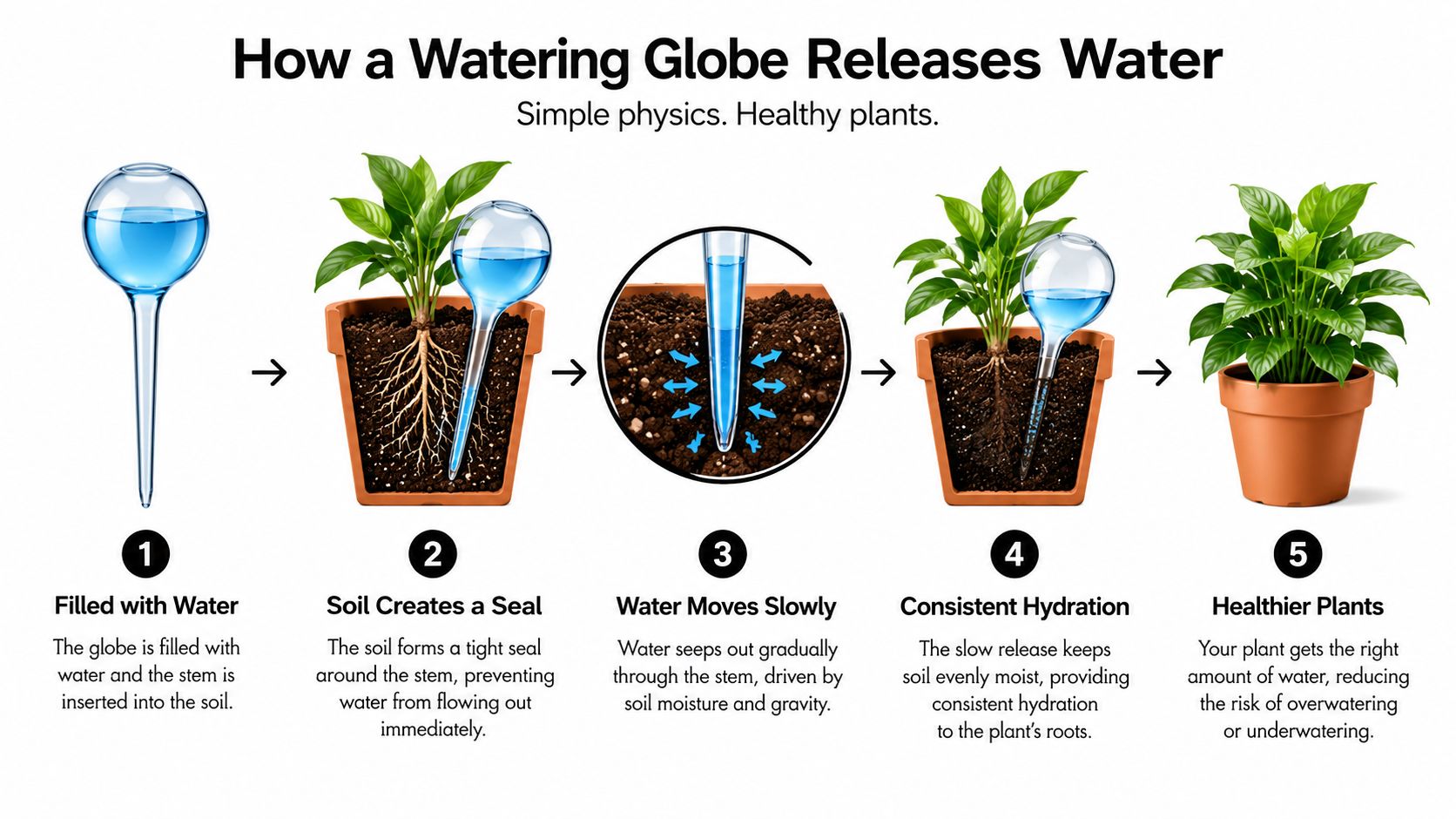
Several conditions change how quickly the reservoir empties:
- Soil texture: Fast-draining media can draw water differently from dense media.
- Stem opening: A wider or partially blocked opening changes the flow.
- Insertion depth: The stem needs contact with the active root zone, not just the surface.
- Temperature: Warm rooms, hot outdoor containers, and direct heat can increase demand.
A larger bulb holds more water, but it doesn't automatically release that water faster. Its main advantage is greater capacity. If two globes release water at a similar rate in comparable pots, the 350 ml option provides a longer reserve than the 100 ml option.
Comparing 100 ml, 200 ml, and 350 ml Watering Globes
The three Little Green Leaf capacities suit different watering problems. A 100 ml globe is the compact choice for a smaller container or a plant that doesn't need a large reserve. A 200 ml globe provides a middle ground for many everyday houseplants. A 350 ml globe makes more sense when the pot is larger, the plant drinks readily, or the owner wants a longer interval before checking the reservoir.
A neutral market guide places small watering globes around 100–200 ml, medium globes around 300–500 ml, and large globes around 600–1000 ml, with estimated durations from 1–2 days for small units to 7–10 days for large ones. The same guide gives examples such as a 250 ml globe measuring about 10 inches high and a 14 oz globe lasting 1–2 weeks, depending on soil and pot size. These ranges are useful context, but they aren't promises for every home.
| Globe Size | Best Pot Diameter | Typical Run-Time | Best For |
|---|---|---|---|
| 100 ml | Small pots and compact containers | About 1–2 days in suitable small setups | Small foliage plants, seedlings, and shorter refill intervals |
| 200 ml | Medium everyday houseplant pots | Several days, depending on demand | General houseplants and owners who need a moderate reserve |
| 350 ml | Larger medium pots and thirstier plants | Up to about two weeks in favorable conditions | Longer absences, larger containers, and plants that use water steadily |
The 100 ml size is easier to balance in a small pot, but it may need frequent refilling in a warm room or with a thirsty plant. The 200 ml size offers more breathing room without placing a large reservoir in every container. The 350 ml size supports longer unattended periods, although a heavier bulb needs stable placement and a stem that reaches the root zone.
Practical rule: Choose the smallest capacity that can cover the intended absence while keeping the plant's preferred moisture pattern intact.
For more buyer-focused context, the Little Green Leaf watering globe reviews can help shoppers compare the available sizes and pack formats.
Matching Globe Size to Pot Size and Plant Type
Pot diameter gives a faster answer than plant height. A tall plant in a small container still has a limited reservoir of soil, while a shorter plant in a broad pot may need a globe with more capacity. The stem should sit firmly in the root zone without forcing deep into compact soil.
| Globe Size | Pot Diameter | Best Plant Types | Refill Interval |
|---|---|---|---|
| 100 ml | Small containers, especially under about 6 inches | Small seedlings, compact foliage plants, and kitchen-window herbs | Short interval, often 1–2 days in small setups |
| 200 ml | Medium containers, roughly 6–8 inches | Leafy tropicals and ordinary houseplants | Several days, depending on soil, temperature, and plant demand |
| 350 ml | Larger medium containers, roughly 8–10 inches | Thirstier leafy plants and plants being left for a week or longer | Longer interval, potentially up to about two weeks in suitable conditions |
Succulents and cacti sit outside this recommendation because they tolerate long dry periods. A houseplant-care source notes that these plants can go several weeks without water, and advises checking whether the top inch of soil is dry before watering, making constant moisture from a globe unsuitable for them (watering guidance for houseplants during travel).
For leafy tropicals such as pothos or philodendrons, a 200 ml globe is often the sensible starting point in a medium pot. Flowering plants and herbs need closer observation because their water use can vary with temperature and container size. Small seedlings generally suit a smaller reservoir, provided the stem doesn't disturb their limited root area.
One common mistake is choosing by leaf size instead of pot diameter. A globe that's too short may leave water above the active roots, while a stem that's too long can penetrate too far or destabilize the container. For broader guidance on maintaining plants in a regional home environment, plant care for Northwest Indiana offers useful context alongside this size-based watering decision.
When a pot sits between two sizes, start with the smaller globe and move up only if the soil dries too quickly or the reservoir empties before the required check-in.
Setting Up a Little Green Leaf Globe for the Right Size
Correct setup determines whether the selected capacity performs as intended. A globe should supplement a properly watered plant, not compensate for dry soil or a poorly placed stem.
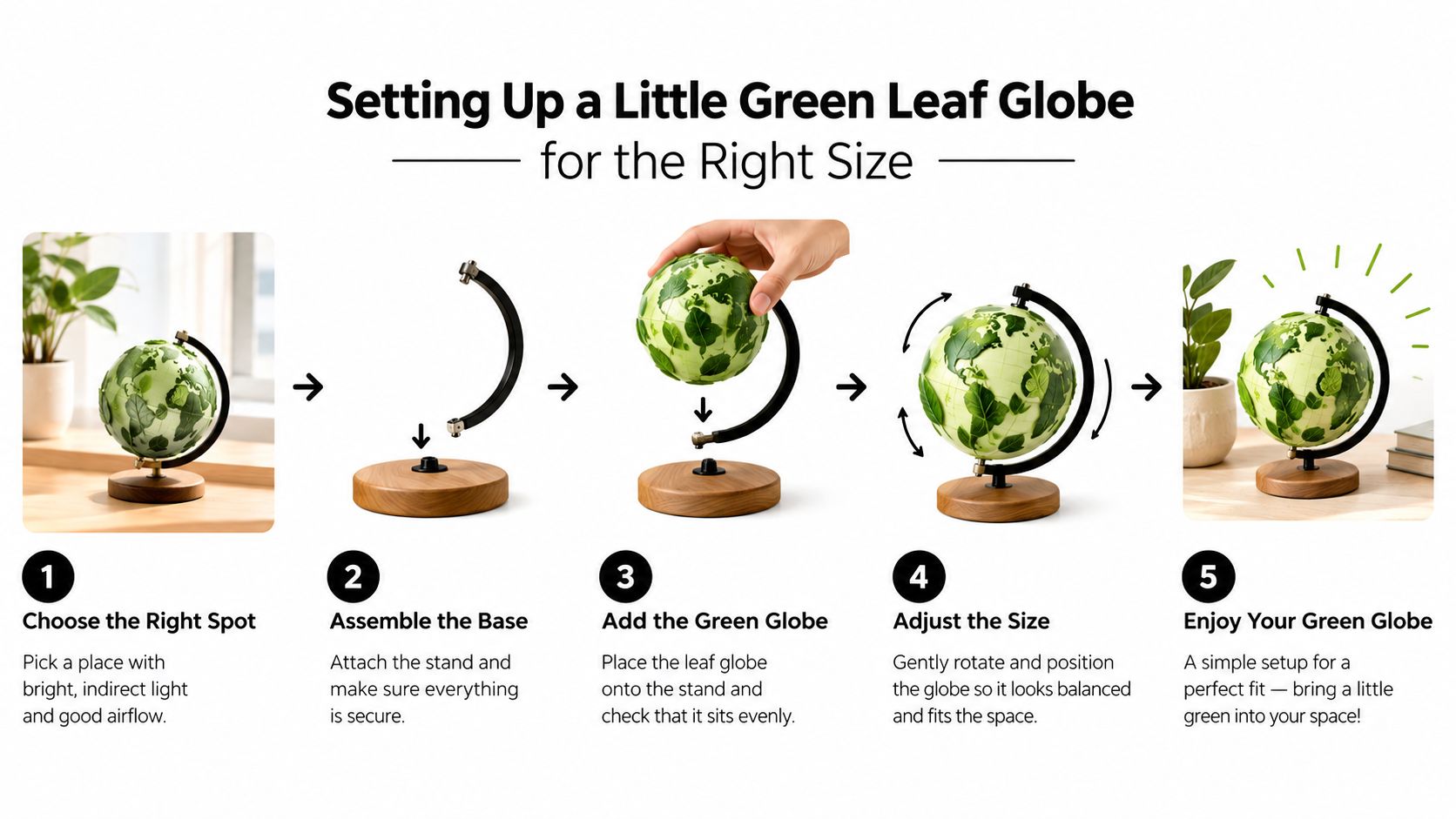
- Water the plant first. Moisten the soil thoroughly so the root zone starts evenly damp. Inserting a globe into dry soil can create an unreliable air channel around the stem.
- Make a pilot hole. Use a pencil, finger, or similarly narrow tool to open the path before inserting the glass stem. Dense soil can resist the stem, and forcing it can damage the globe.
- Fill the reservoir carefully. Hold the globe at a slight angle while filling so air can escape and the body fills properly. Little Green Leaf globes are available in 100 ml, 200 ml, and 350 ml capacities.
- Insert and check. Push the stem into the prepared hole at a slight angle, then make sure the globe is stable. Check the soil after two days, and add manual water if the medium has become completely dry.
An optional plastic anti-clog sleeve can help protect the stem opening. Glass also needs ordinary care because it can break if dropped, so filling and insertion should happen over a stable surface.
The Little Green Leaf plant watering globes are available in multicolor and clear rainbow designs, with pack options suited to single plants or groups of containers.
When a Watering Globe Is the Wrong Choice
A globe isn't a universal answer to every watering problem. The wrong capacity can leave a plant too wet, fail to reach enough of the root zone, or create more maintenance than it removes.
Large pots are a particular limitation. A single small globe won't meaningfully supply a very large container, and even a larger reservoir may not distribute moisture evenly through a deep root ball. Adding more capacity isn't always the answer, especially when the stem reaches only one part of the pot.
Very small pots can be difficult too. If the container can't support the bulb or the stem crowds the root area, the globe may tip, loosen the plant, or sit at the wrong depth. A pilot hole helps, but it can't solve a container that has no practical space for the globe.
Plants that prefer dry intervals should not receive constant slow watering. That includes succulents, cacti, and other plants that need the soil to dry between drinks. Plants recovering from root problems also need careful moisture management rather than an automatic reservoir.
A globe may also be a poor fit for extremely thirsty arrangements, hot outdoor containers, or hanging baskets that dry rapidly. In those cases, the reservoir can empty quickly and still require frequent checks. A comparison of broader container-watering approaches appears in plant pots and self-watering options, but the same rule applies: the method must match the plant's moisture preference and the container's size.
Choosing Your Globe Size and Common Questions
The simplest decision rule is to choose the smallest globe that physically fits the pot, then move up only when the plant empties it too quickly or a longer refill window is needed.
- For pots under about 6 inches, start with 100 ml.
- For pots around 6–10 inches, consider 200 ml first, then move to 350 ml for thirstier plants or longer absences.
- For pots over about 10 inches, don't assume one globe will be enough. Assess the root-zone depth, the plant's water use, and whether a single reservoir can reach the container properly.
A full globe can last from about 5 to 14 days depending on conditions. Standard glass globes around 100 ml may last about 5 days in small pots, while some hand-blown globes may reach two weeks in cooler conditions. Little Green Leaf describes its globes as lasting up to about two weeks per fill, but pot size, soil, temperature, and plant thirst still control the result.
How long does a full watering globe last?
It varies rather than following a fixed schedule. Small globes and thirsty plants can need attention sooner, while a 350 ml globe in a suitable container may provide a longer reserve.
Can watering globes stay inserted while refilling?
They can remain inserted if the globe is stable and the stem isn't being forced or disturbed. Removing and reinserting a glass globe repeatedly can widen the hole or damage the stem, so careful refilling is preferable.
Do globes from different brands with the same ml capacity last the same time?
Not necessarily. Capacity describes how much water the reservoir holds, but stem opening, stem length, insertion depth, soil, temperature, and plant demand also influence release.
Are watering globes good for plants that need dry soil?
No. Succulents, cacti, and plants that require dry intervals generally aren't suitable because a globe keeps delivering moisture as the surrounding soil dries.
What size watering globe is best for a small pot?
A 100 ml globe is the practical starting point for a small container, provided the stem reaches the root zone without crowding the plant. A 200 ml globe may be excessive if the pot is small or the plant uses water slowly.
For direct sizing help and hand-blown glass options in 100 ml, 200 ml, and 350 ml, visit Little Green Leaf. The available multicolor and clear rainbow globes can be selected in pack sizes that suit one plant, several containers, travel preparation, or a gift for a plant lover.