

Plant Watering Globes Reviews Tested for Real Results
How long will one plant watering globe keep a plant hydrated, and why can the same size appear to last only a few days in one pot but much longer in another? A Little Green Leaf globe can provide up to about two weeks per fill, but thirsty plants, large pots, warm rooms, outdoor exposure, and smaller globes shorten that period.
That range is more useful than a fixed promise. Independent reviews report that a 95 mL globe may last 3 to 7 days, while a 380 mL globe can last up to 14 days in the same pot, with sharply shorter runtime in porous soil, sun, or breeze. This guide treats plant watering globes reviews as a question of flow, soil contact, and plant demand, not just bulb size.
Table of Contents
- Introduction That Answers How Long Globes Really Last
- How Self Watering Globes Work and Why Soil Controls Flow
- How We Tested Watering Globes for This Comparison
- Head to Head Comparison of Capacity Runtime and Build Quality
- Best Use Scenarios and When to Choose a Different Aid
- How to Set Up a Little Green Leaf Globe Without Clogging
- Our Recommendation and Final Verdict for Different Buyers
Introduction That Answers How Long Globes Really Last
Most product reviews compress a condition-dependent device into one duration claim. That makes shopping easier, but it leaves the buyer with the practical question unanswered: will the plant still have water when the trip ends?
A better interpretation is conditional. A small globe may empty quickly in a thirsty plant or a warm container, while a larger globe can support a longer interval in a moderate indoor setup. A separate product-neutral assessment describes watering globes as maintaining moisture for about one to two weeks for moisture-loving indoor plants, while also noting that plant demand and the growing environment determine the exact runtime (watering globes and plant suitability).
Little Green Leaf's hand-blown glass family includes 100 mL, 200 mL, and 350 mL bulbs, sold in 1, 2, 4, and 6 packs, with multicolor and clear rainbow designs. The range gives buyers a way to match capacity and visual preference to the plant collection, but capacity alone can't compensate for a dry pot, a highly porous mix, or intense outdoor evaporation.
The review verdict in brief
A globe is a sensible watering aid for moisture-loving houseplants, office plants, outdoor containers, and hanging baskets that need steadier hydration while an owner is busy or away. It isn't a universal replacement for a thorough watering routine, and it isn't appropriate for plants that need the growing medium to dry between watering.
The market comparison also has a clear cost distinction. A simple glass watering globe typically costs under $15, while smarter irrigation systems can cost around $50, according to a 2025 independent review. That price gap explains why buyers often accept a little setup and monitoring in exchange for a decorative, low-tech solution.
Practical rule: Treat “two weeks” as an upper planning limit, not a guarantee. Test the exact globe and pot combination before relying on it during travel.
A detailed explanation of whether these devices suit a particular watering problem appears in this guide to whether watering globes work. The useful takeaway is simple: a watering globe is most valuable when it reduces swings between bone-dry soil and rushed overwatering.
How Self Watering Globes Work and Why Soil Controls Flow
Why can one watering globe empty in three days while another lasts fourteen? The reservoir size matters, but the surrounding soil usually determines how quickly water leaves it.
A self watering globe is a sealed reservoir with a narrow stem. After filling, the stem enters moist soil, and the soil regulates the rate of water release. The process depends on air exchange. Moist soil restricts air entering the stem, which slows the flow. As the root zone dries, air reaches the globe and allows a small amount of water to move into the soil. That cycle continues until the reservoir is empty (how plant water bulbs work).
The globe therefore works more like a pressure-sensitive valve than an open bottle. A loose, dry channel around the stem can create a fast initial discharge. Firm contact with moist soil provides resistance and supports gradual delivery. Pot size, soil porosity, root density, temperature, and exposure then determine how long that restricted flow remains useful.
Why insertion changes the result
The insertion path changes the hydraulic resistance around the neck. Independent reviews identify low-angle insertion, pre-moistened soil, and close soil contact at the neck as conditions that slow release. A steeper angle can increase flow. Adding cloth or sponge around the tip may reduce flow further, though it creates another possible blockage point.
Dense or compacted soil requires a pilot hole. Forcing a glass stem into it can push particles into the opening or place stress on the stem. A narrow hole made first gives the stem a cleaner route, while packing soil gently around the neck helps maintain contact without sealing the outlet completely.
This also sets the plant-selection limit. Succulents, cacti, and other plants that require a dry interval are poor matches because the globe maintains moisture rather than scheduling a dry period. Excess water can conflict with their normal watering pattern.
For a technical explanation of water movement through growing media, see this article on capillary action in soil. The practical conclusion is straightforward: the globe and pot form one system. A runtime claim detached from soil condition can make the same product appear inconsistent when the changing variable is the root zone.
How We Tested Watering Globes for This Comparison
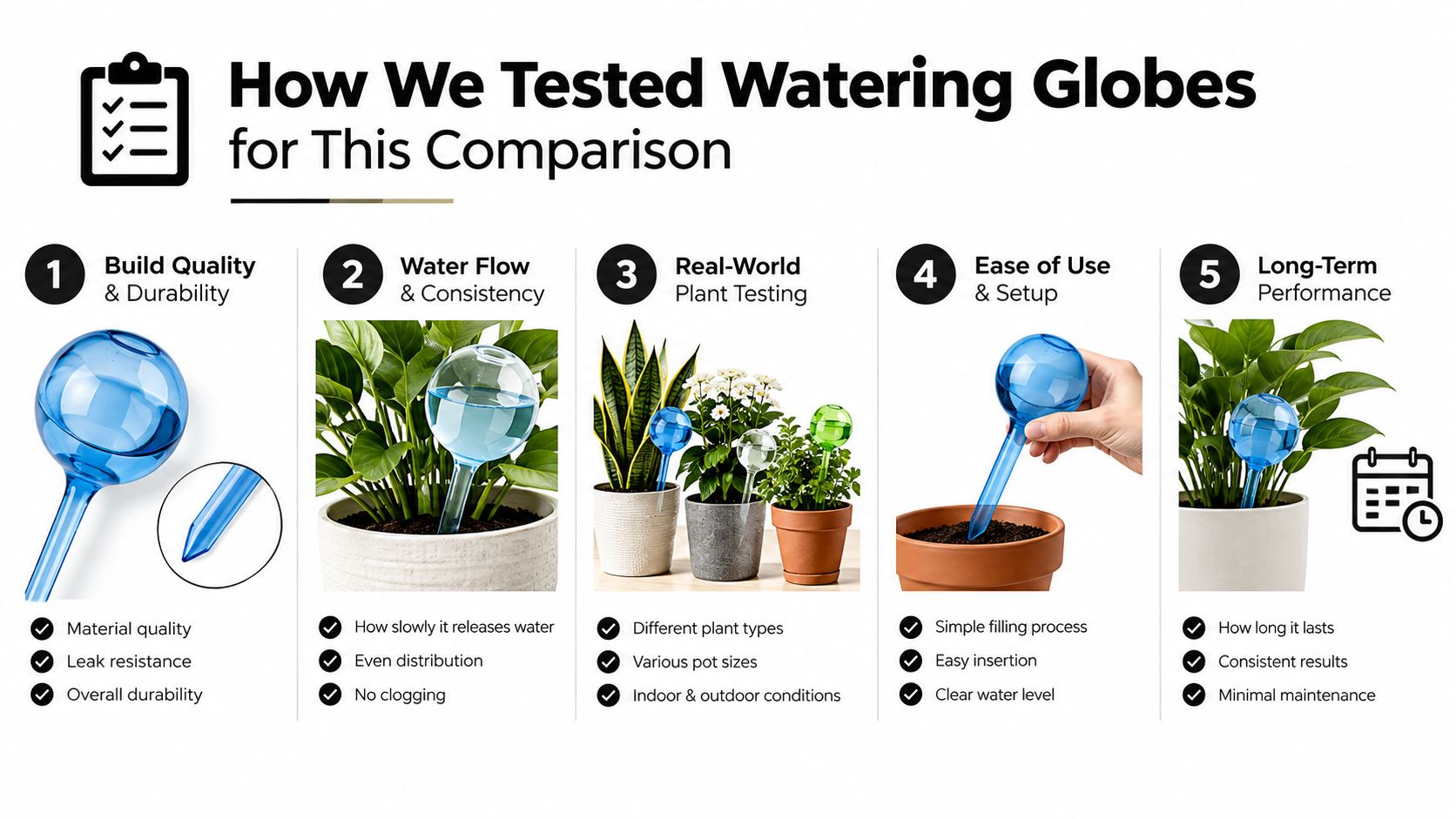
How long should a watering globe last in a real pot? We treated that as a condition-dependent measurement, not a label claim. The test tracked release stability, blocked stems, and whether the plant received suitable moisture for its root zone.
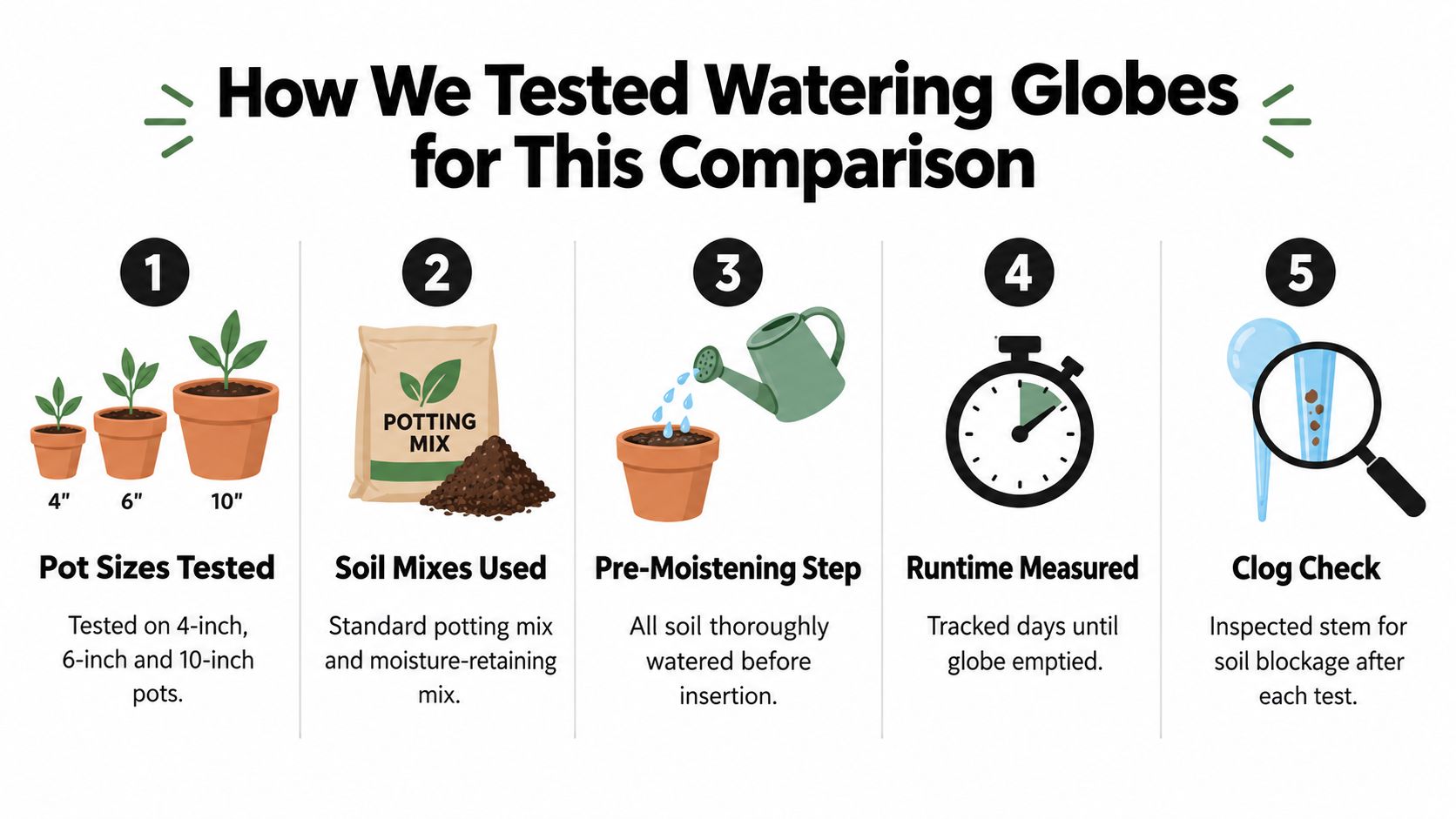
Each setup followed the same sequence:
- Pot scale: Small, medium, and large containers were assessed separately. Reservoir size alone cannot explain runtime because the surrounding root zone changes with pot volume.
- Soil condition: Standard potting media and moisture-retaining media were compared for release speed. Porous mixes were treated as higher-flow conditions.
- Pre-moistening: Each plant was watered thoroughly before insertion. This created the moist-soil airlock instead of testing the globe against dry media.
- Pilot hole and angle: A narrow opening was made where needed, then the stem was inserted gently at a slight angle. This separated hydraulic behavior from avoidable clogging.
- Runtime and consistency: We recorded when the globe emptied and checked whether flow stayed reasonably even rather than rushing out at the start.
The useful comparison is the relationship between capacity, pot size, plant demand, soil porosity, temperature, and exposure. Independent findings report that identical globes can deliver roughly three times more water in peat-based soil than in gritty succulent mixes, while failure rates rise markedly beyond about 16 days of continuous use (soil hydraulics and watering globe performance). That difference explains why one setup may run for 3 days while another lasts 14. The changing variable is often the soil's resistance to flow, not the reservoir itself.
What the measurements reveal
Faster flow is not automatically better. In loam, expert assessments describe a moderately stable output of about 12 mL per hour. The same output in clay can overwater the root zone and reduce available oxygen. In sandy media, a reservoir may empty in 2 to 3 days and then stop supplying water.
A check after two days can expose a poor setup sooner than a fixed-duration promise. If the bulb level has barely changed while the soil remains saturated, resistance may be too high. If the globe is nearly empty or the surface is already dry, the pot may need a slower insertion angle, closer neck contact, or a different capacity.
Customer ratings can therefore diverge without either side being misleading. Some reviewers value transparent, decorative bulbs, while others report disappointing capacity or breakage. We recorded appearance and construction, but judged runtime in the buyer's own pot, where soil hydraulics and plant demand determine the result.
Head to Head Comparison of Capacity Runtime and Build Quality
Capacity is the easiest feature to compare, but it isn't the strongest predictor on its own. The same pot can consume a small globe quickly in a warm, porous setup and use a larger globe more slowly when the soil remains evenly moist.
Little Green Leaf offers 100 mL, 200 mL, and 350 mL sizes. The 100 mL option suits smaller containers or shorter absences. The 200 mL size gives a middle position for ordinary indoor pots, while the 350 mL reservoir is the logical choice when the pot is larger, the plant is thirstier, or the owner wants more reserve.
| Globe capacity | Typical runtime | Best pot size | Key variables |
|---|---|---|---|
| 100 mL | Several days, with shorter runtime in fast-draining or warm conditions | Small pots and modest plant demand | Soil porosity, plant thirst, insertion angle |
| 200 mL | Several days to longer intervals in stable indoor conditions | Small to medium pots | Moisture at insertion, room temperature, neck contact |
| 350 mL | Up to about two weeks in suitable conditions, with shorter runtime when demand is high | Medium pots and longer absences | Pot volume, heat, breeze, soil hydraulics |
The table is a planning framework, not a promise. Independent benchmarking found that a 95 mL globe lasts 3 to 7 days and a 380 mL globe lasts up to 14 days in the same pot, which provides a useful capacity comparison close to the Little Green Leaf range.
Flow control and clog resistance
Angle is a simple control. A lower angle and a well-moistened pot generally slow release, while a steeper position can allow water to move more freely. Soil touching the neck helps preserve the airlock, but loose gaps can cause an unexpectedly rapid drain.
The optional plastic anti-clog sleeves add a practical layer around the stem. They don't remove the need for a pilot hole or careful insertion, and they can't correct a pot that is already too dry. Their value is greatest where loose particles are likely to enter the opening during placement.
The real differentiator isn't the largest reservoir. It's predictable contact between the stem and the soil.
Glass design and refill effort
Hand-blown glass gives the globe a decorative role as well as a watering function. Transparency lets the owner see the remaining water, a feature customers commonly appreciate, but glass also breaks if dropped. Handling should happen over a stable surface, with the bulb filled and moved carefully.
Refill effort is low because the reservoir is filled manually and inserted without batteries, timers, or an app. That simplicity is useful for apartment owners, offices, and gift buyers, but it also means the owner must select the capacity and position correctly. A globe won't sense plant stress or adjust for an unexpected heat spell.
Best Use Scenarios and When to Choose a Different Aid
A watering globe makes the most sense when a plant needs steady moisture and the owner wants a visible, low-maintenance reservoir. It serves a different purpose from a system designed to manage many plants automatically, so the right choice depends on scale and supervision.
For a one-week absence, a properly prepared globe can be a practical buffer for a moisture-loving indoor plant. For a planned two-week absence, the 350 mL option offers more reserve than the smaller sizes, but the plant, pot, and room still determine whether that reserve lasts. Longer absences need a trial run and may require more than one globe or another watering arrangement.
Scenario-based choices
- Small apartment pots: A 100 mL globe can suit a compact pot with moderate demand. The owner should check the water level and soil after two days before relying on it.
- Medium indoor planters: The 200 mL size offers a balanced capacity for routine care, especially when the plant shouldn't dry sharply between watering.
- Travel and larger demand: The 350 mL size gives more reserve, but a large pot shouldn't depend on one small globe.
- Outdoor containers: Sun and breeze can increase water loss, so outdoor use deserves a shorter expected runtime than a stable indoor setup. Hanging baskets need particular caution because they can dry quickly.
- Office greenery: A visible globe makes the remaining water easy to inspect during routine office checks, without asking staff to remember daily watering.
- Gifts: Multicolor and clear rainbow designs make the glass bulb suitable for plant lovers who value an accessory that remains visible after installation.
The comparison below uses generic aid categories rather than ranking brands. It highlights trade-offs that product listings often hide.
| Watering aid | How long it lasts | Setup | Refill effort | Clogging | Works outdoors | Cost per plant |
|---|---|---|---|---|---|---|
| Globe | Several days to about two weeks, depending on conditions | Fill and insert into moist soil | Manual refill | Stem can clog without a clean pilot hole | Yes, with closer monitoring | Low for one plant |
| Spike | Depends on attached reservoir and release path | Fit reservoir and insert | Reservoir must be refilled | Outlet can block | Possible, but exposure changes flow | Low to moderate |
| Drip system | Can support longer unattended care when correctly configured | More involved installation | Central reservoir or supply needs attention | Emitters and lines can block | Yes, when protected and monitored | Varies with system size |
| Self-watering pot | Designed for ongoing reservoir-based care | Requires the right container and initial setup | Refill the built-in reservoir | Wicking path needs maintenance | Depends on pot design and exposure | Higher initial cost per plant |
When a globe isn't the answer
Succulents and cacti shouldn't be treated like moisture-loving foliage. Plants that need the soil to dry out also don't match a device intended to maintain moisture. A very large pot may need multiple watering points, and a single small globe can't distribute water evenly through a broad root zone.
The same applies to owners who need completely unattended care for a collection during a long trip. A globe reduces watering frequency, but it doesn't eliminate the need to test conditions first. A fixed duration claim is especially risky outdoors, where heat and breeze can accelerate drying.
How to Set Up a Little Green Leaf Globe Without Clogging
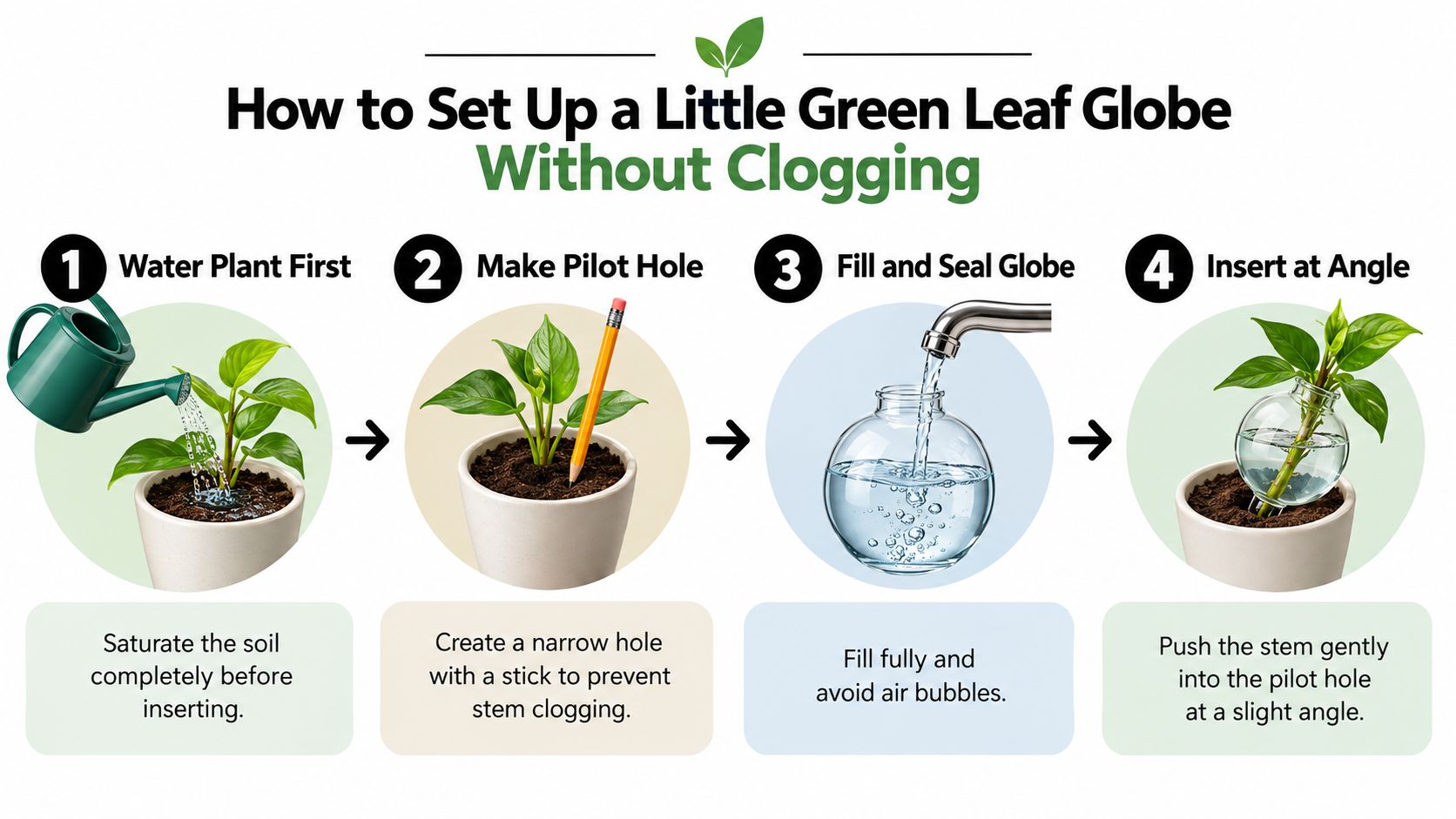
How can a globe release water steadily instead of emptying quickly or blocking at the stem? Start by preparing the soil and matching the insertion to the pot's structure. The objective is a moist, compact contact zone that controls flow.
- Water the plant first. Soak the soil thoroughly, then let excess water drain. Dry soil can pull water through a newly opened channel around the stem, producing faster release than the surrounding root zone needs.
- Make a pilot hole. Use a pencil, stick, or similarly narrow tool in dense soil. Make the opening just wide enough for the stem. A broad gap allows water to bypass the soil and escape too quickly.
- Fill the globe. Add water to the bulb and handle the hand-blown glass carefully. Do not drop it, since impact can break the reservoir or stem.
- Insert at a slight angle. Guide the stem gently into the pilot hole and maintain firm soil contact around the neck. A lower angle generally restricts release, while a steeper position can increase flow.
- Check after two days. Compare the remaining water with the soil's moisture. A nearly empty bulb indicates rapid release. Minimal water movement alongside persistently wet soil indicates restricted flow or poor contact.
Cleaning and maintenance
If the stem clogs, remove the globe carefully and rinse it with clean water. A soft, narrow cleaning tool can loosen residue, but forcing an object through the opening may damage the stem. The optional plastic anti-clog sleeve helps keep loose particles away during insertion.
Refill only after you understand the release pattern. Changing the angle, moving the globe to another pot, or placing it outdoors can alter water movement because soil texture, root density, heat, and airflow change demand. The Little Green Leaf setup guide for using plant watering globes offers further instructions for routine care.
Little Green Leaf globes are sold in 100 mL, 200 mL, and 350 mL sizes, with packs ranging from one to six and designs including multicolor and clear rainbow options. Capacity changes the available reserve, not the actual runtime by itself. A porous mix or high-demand plant may empty the same globe far sooner than compact, already-moist soil.
Our Recommendation and Final Verdict for Different Buyers
Which watering globe fits the buyer depends more on plant demand and soil behavior than on capacity alone. For a busy beginner with one or two moisture-loving houseplants, the 200 mL globe is a practical starting point. It provides more reserve than the smallest option without taking up excessive space. Run the setup for two days before leaving, then inspect both the water level and soil moisture.
Frequent travelers can consider the 350 mL size in suitable medium containers, but should test the actual pot before relying on it for an absence approaching two weeks. A larger reservoir extends the available supply. It does not overcome heat, porous soil, high plant demand, or weak contact around the stem. Runtime is therefore a capacity and conditions question, not a fixed schedule.
Apartment and office owners may value the visible water level and straightforward refill process. Outdoor containers require closer observation because sun and breeze can increase water loss. Gift buyers can select multicolor or clear rainbow designs according to the recipient's collection and number of pots. A globe is a poor match for plants that need a dry interval between waterings.
The final verdict from these plant watering globes reviews is conditional. Globes work best when the plant prefers steady moisture, the soil accepts water at a controlled rate, and the reservoir is matched to demand. The same globe may empty in a few days in loose, dry mix and last much longer in compact, already-moist soil. That difference reflects soil hydraulics and plant demand, not a reliable product-day rating. Succulents, cacti, dry-cycle plants, and very large pots served by one small bulb remain unsuitable cases. Glass also requires careful handling.
Frequently asked questions
How long do plant watering globes last?
A globe can last up to about two weeks per fill, though thirsty plants, warm rooms, outdoor exposure, porous soil, and smaller capacities can shorten the runtime. Published testing gives a broad range, from 3 to 7 days for a 95 mL globe to as long as 14 days for a 380 mL globe in the same pot, as reflected in these watering globe duration benchmarks. Treat those figures as test conditions, not a guarantee for every pot.
Do watering globes work for two weeks?
They can support about two weeks when the reservoir suits the container, the plant prefers consistent moisture, and the soil limits rapid release. Soil texture, stem contact, temperature, airflow, and plant demand can shorten that period.
Are watering globes good for succulents?
Generally, no. Succulents and cacti usually need the soil to dry, while a globe supplies continuing moisture. The watering pattern does not match their needs.
Why is my watering globe empty so fast?
Dry soil, a steep insertion angle, loose contact around the neck, porous media, warmth, sun, or breeze can accelerate drainage. Re-water the plant, make a narrow pilot hole, insert the stem at a lower angle, and inspect the setup after two days.
How do you stop a watering globe from clogging?
Water the plant first and create a narrow pilot hole before inserting the stem. Rinse the stem when residue appears. An anti-clog sleeve can help where loose particles repeatedly enter the opening.
What size watering globe should be used?
The 100 mL size fits smaller pots, 200 mL suits many small to medium indoor containers, and 350 mL offers more reserve for larger suitable pots or longer absences. Pot size, soil condition, and plant demand still determine performance. One small globe cannot supply every large container.
Little Green Leaf offers hand-blown glass watering globes in 100 mL, 200 mL, and 350 mL sizes, with single and multipack options for everyday plant care, travel, office use, and gifting. Choose the capacity and design according to the plant's moisture requirements and the number of pots.