

Watering Plants While on Vacation: Proven Methods
The suitcase is open, departure is approaching, and watering plants while on vacation suddenly needs a plan: for a one-to-two-week absence, moisture-loving plants may need a tested globe, wick, or watering helper, while others need only ordinary care. A watering globe can supply water for up to about two weeks per fill, depending on the plant, pot, soil, and temperature, but that's a conditional limit, not a guaranteed refill interval.
Table of Contents
- Planning Plant Care Before You Pack
- Comparing Vacation Watering Methods
- Setting Up a Watering Globe Step by Step
- How Long One Globe Lasts in Practice
- Sorting Plants by Thirst Before You Leave
- Testing Your Setup Before the Trip
- Pre-Departure Plan and Common Questions
Planning Plant Care Before You Pack
The most tempting departure-day routine is also the least discriminating: water every pot heavily and leave. That gives an already-wet plant more water while doing little to establish whether a thirsty plant has enough reserve for the trip.
A better starting point is the plant's normal dry-down interval, compared with the actual absence. University of Illinois Extension's vacation-preparation guidance offers a roughly weekly baseline for many potted plants, while emphasizing that environmental conditions change watering needs. That baseline is a planning aid, not permission to water every pot on the same day.
Match the care plan to the absence
Before choosing equipment, the plant owner needs a departure date, return date, and realistic allowance for delays. Then each pot needs a condition check rather than an automatic drink.
- Needs water before departure: Water normally, allow drainage, and assess whether supplemental care is necessary.
- Still comfortably moist: Leave the watering can alone and observe how the pot dries.
- Usually dries before the trip ends: Assign a tested reservoir method or a helper.
- Needs a dry period: Keep it separate from plants receiving continuous moisture.
A simple label on each pot makes the plan easier to follow. “Check soil before watering” is more useful to a neighbor than “water regularly,” especially when similar-looking containers behave differently.
Practical rule: Vacation preparation should extend normal care, not replace it with an unusually large dose of water.
The useful question isn't how much extra water can fit into a pot. It's whether that plant will need another watering before someone returns to check it.
Comparing Vacation Watering Methods
A neighbor, a wick, a globe, and reduced water demand solve different problems. Only the first involves someone who can inspect the plant and change course during the trip.
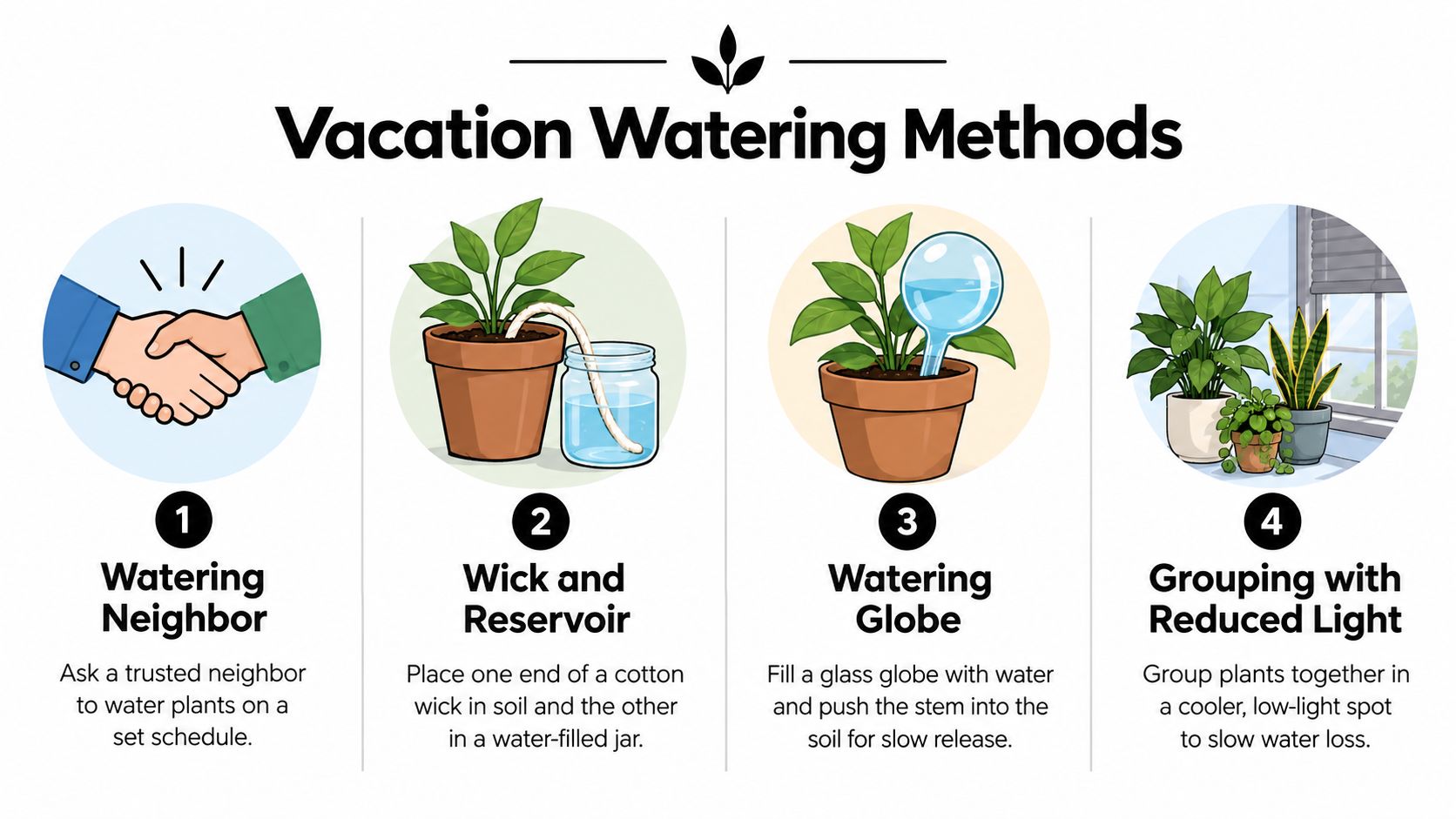
Vacation Watering Methods at a Glance
| Method | Typical Coverage | Refill Effort | Best For | Watch Out For |
|---|---|---|---|---|
| Watering neighbor | As long as agreed visits continue | Helper checks and waters when needed | Longer trips and mixed collections | Calendar watering without checking soil; payment depends on the arrangement |
| Wick and reservoir | Limited by reservoir capacity and tested delivery | Reservoir needs replenishment when depleted | Moisture-loving plants grouped together | Wick contact, reservoir placement, and excessive delivery; material costs vary |
| Watering globe | Limited by bulb capacity and the pot's demand | Remove, refill, and reinsert | Individual pots needing supplemental moisture | Blocked stems, breakable glass, and insufficient capacity; cost depends on size and pack |
| Grouping with reduced light | Extends existing moisture rather than adding water | No reservoir to refill | Plants that can already tolerate the absence | Not a substitute for irrigation in a fast-drying pot; no watering-device purchase |
A wick takes more arranging than a globe, but the reservoir can be chosen around the collection. Extension guidance on vacation care describes pre-wetted cotton wicks running from a raised reservoir into the growing medium, with performance dependent on the complete setup. That's a reason to test it, not assume every cord-and-jar arrangement behaves alike.
A globe offers a compact reserve at an individual pot. It's a practical option when only part of the collection needs help, but a single small bulb isn't a credible answer for a very large, thirsty container.
Outdoors, none of the passive options should receive an indoor-duration assumption. A helper offers more flexibility when conditions change, while grouping is a supporting measure rather than a water supply.
For a broader look at these trade-offs, the guide to choosing self-watering devices can help match the method to the collection. Compare usable capacity and refill access, not just the convenience of installation.
Setting Up a Watering Globe Step by Step
A globe belongs in a pot that genuinely needs supplemental water, which is already a triage decision. Plants that dry slowly or shrug off a short dry spell can be left alone, so installation effort goes only where the container would run out before you return. In the chosen pot, the stem should sit in contact with moist growing medium without being forced past roots or compacted soil.
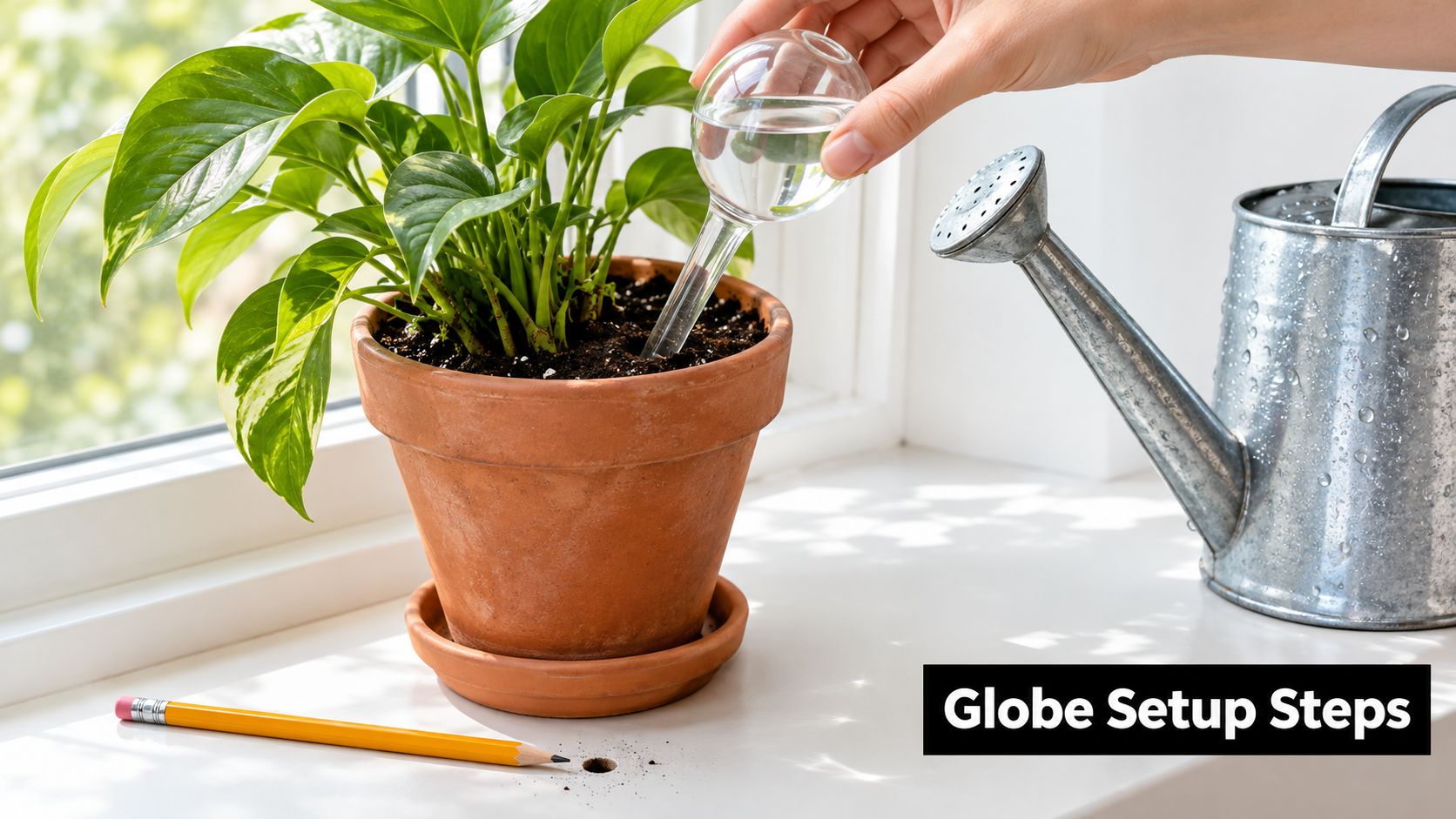
The setup routine
- Assess, then water if needed. A dry plant needs its normal thorough watering before installation. An already-saturated pot doesn't need another soak because a globe is being added; the indoor-watering guidance on moisture extremes supports avoiding both drought stress and oxygen-poor, overwatered roots.
- Make a pilot hole. A pencil can open a narrow path in dense or peat-heavy medium. The aim is to avoid packing a plug of soil into the open stem, not to make a broad cavity around it.
- Fill the bulb. Keep a firm grip while filling and handling the glass, since wet glass is slippery. Where a stem tends to collect soil, an optional plastic anti-clog sleeve provides another barrier against blockage.
- Insert at a slight angle. Guide the stem into the prepared hole without twisting or forcing the glass. The bulb needs a supported position with the opening in contact with the medium, and firm soil contact around the stem matters more than the exact tilt. A loose seal lets air in, and I've watched reservoirs drain far faster than the soil was drying for exactly that reason.
- Check after two days. Treat this as an early inspection point, not a promised operating duration. Compare the water level with the soil condition and confirm the pot is moist rather than soggy. A bulb that has barely dropped may have a blocked stem, while one that emptied early may have a soil-seal problem.
The useful evidence arrives after installation. A globe that looks tidy on departure day hasn't yet demonstrated that water can move through its stem or that the pot can accept the supply without staying wet.
A filled bulb proves that water is available. Only a pot-level check shows whether the setup is delivering it appropriately.
This routine suits hand-blown glass globes with narrow stems; optional anti-clog sleeves can help with clogging, but they don't eliminate the need for a trial run in the actual pot.
How Long One Globe Lasts in Practice
Capacity is only half the calculation. The other half is how quickly the particular plant and container use the water. A larger bulb offers a larger reserve, but it doesn't turn an unsuitable plant into a suitable candidate.
Glass globes commonly come in capacities such as 100 ml, 200 ml, and 350 ml, and under otherwise comparable conditions the largest size provides the most reserve. What no bulb volume gives you is a dependable number of days. I've had a mid-size globe hold a pothos for over a week in a cool room, then watched the same size empty in a few days next to a sunny window. No capacity-to-pot-diameter chart survives contact with a real apartment.
Read duration from the pot outward
Four groups of variables deserve attention:
- Plant demand: A thirsty, actively growing plant can exhaust a reserve sooner than a plant using little water.
- Container and medium: Pot volume, container material, and moisture retention affect how quickly the root zone dries.
- Room conditions: Heat, humidity, and window exposure change the conditions under which the globe operates.
- Globe capacity and delivery: A larger reserve helps only if the stem remains functional and the soil doesn't stay excessively wet.
Extension guidance on drought stress in indoor plants identifies the growing medium, container material, humidity, temperature, and growth stage as relevant variables. That's why a duration measured in one apartment shouldn't be transferred untested to another.
For context, the published discussion of container-watering intervals gives a range of every 2–3 days for small pots and every 7–14 days for large pots. Those are watering intervals, not globe-runtime guarantees.
The apparent contradiction matters: a large container may retain ordinary watering longer, yet a large plant in that container can still overwhelm a small globe's reserve. Pot diameter alone cannot settle the choice.
Skip the invented runtime. Record whether the tested bulb still contains water when the plant would normally need attention, and let that observation set the schedule. A refill plan should follow observed performance, with a helper arranged when the trip exceeds it.
Sorting Plants by Thirst Before You Leave
Not every plant needs a vacation watering device. Adding one to a plant that prefers a dry-down can create the very problem the owner hoped to prevent.
The collection needs sorting by watering preference, root-zone condition, and observed demand, not by appearance. A shallow-rooted, actively growing plant deserves a different assessment from a drought-adapted plant in moisture-retentive medium.
Three useful care groups
- Supplemental-water candidates: Plants whose established routine favors evenly moist medium and whose pots will dry before the owner returns.
- Ordinary-care candidates: Plants whose normal watering interval already covers the absence, particularly after a modest reduction in direct exposure.
- Dry-down candidates: Succulents, cacti, and other plants that need a drying period. These shouldn't receive a globe intended to maintain moisture.
Names alone aren't enough. Pothos, philodendron, and peace lily may appear together in a mixed collection, but they shouldn't automatically receive identical globe setups. The actual plant's response to its usual watering routine remains the better guide.
A drooping plant also shouldn't automatically move into the thirsty group. University of Minnesota Extension's houseplant-watering guidance notes that wilting in moist soil can indicate root loss associated with persistently wet conditions.
Triage checkpoint: Wilted foliage plus wet soil calls for investigation, not an automatic refill.
This distinction matters after the trip as much as before it. In USDA research on root-rot infection and irrigation, reducing irrigation after infection began didn't lessen disease, underscoring the importance of prevention rather than relying on a later correction.
The guide to how long plants can go without water can support the initial sorting. The final decision still belongs at the pot: supplemental watering is useful only when that plant needs it.
Testing Your Setup Before the Trip
A useful rehearsal happens under the conditions planned for the absence. Testing beside a sunny window and then moving the plant elsewhere at departure leaves the owner with evidence from the wrong location.
Consider a trial in which the globe remains full and the leaves begin to droop. That combination doesn't establish whether the plant needs more water: the soil may already be wet, or the stem may be blocked. The next action depends on the root-zone check, not the bulb alone.
Read the soil and the reserve together
Houseplant-care guidance on checking below the surface gives a practical moisture check at approximately 2 inches into the medium. The useful observation is whether moisture is reaching the growing medium without leaving it persistently saturated.
- Full bulb and wet soil: Don't force additional release. Check drainage and reconsider whether the plant needs supplemental water.
- Full bulb and dry soil: Remove and inspect the stem for a soil plug, rinse it clear, and reinstall through a pilot hole.
- Empty bulb and wet soil: Reassess the setup before assuming a larger reservoir is needed.
- Water in the saucer: Empty it and establish why drainage water remained trapped.
For owners comparing assessment methods, Barefoot Organics lawn care advice offers related reading on measuring soil moisture, though lawn guidance shouldn't substitute for a container-specific decision. The guide to understanding moisture-meter readings provides additional context if an existing meter is part of the routine.
Finally, place the globe where a curtain, passing hand, or pet won't knock it over. Glass breaks if dropped, and an unstable shelf position isn't a watering problem that capacity can solve.
A successful rehearsal doesn't mean the setup is infallible. It means the owner has replaced an assumption with observable evidence.
Pre-Departure Plan and Common Questions
The bags are packed, the boarding pass is on the phone, and a row of pots on the windowsill is the last unresolved job. By this point each plant should have an assigned approach: a tested reserve for the ones that dry out quickly, a deliberate dry-down for the ones that prefer neglect, and a named helper for anything in between. The checklist below condenses that plan, though condition-based watering still takes priority over blanket advice to water everything.
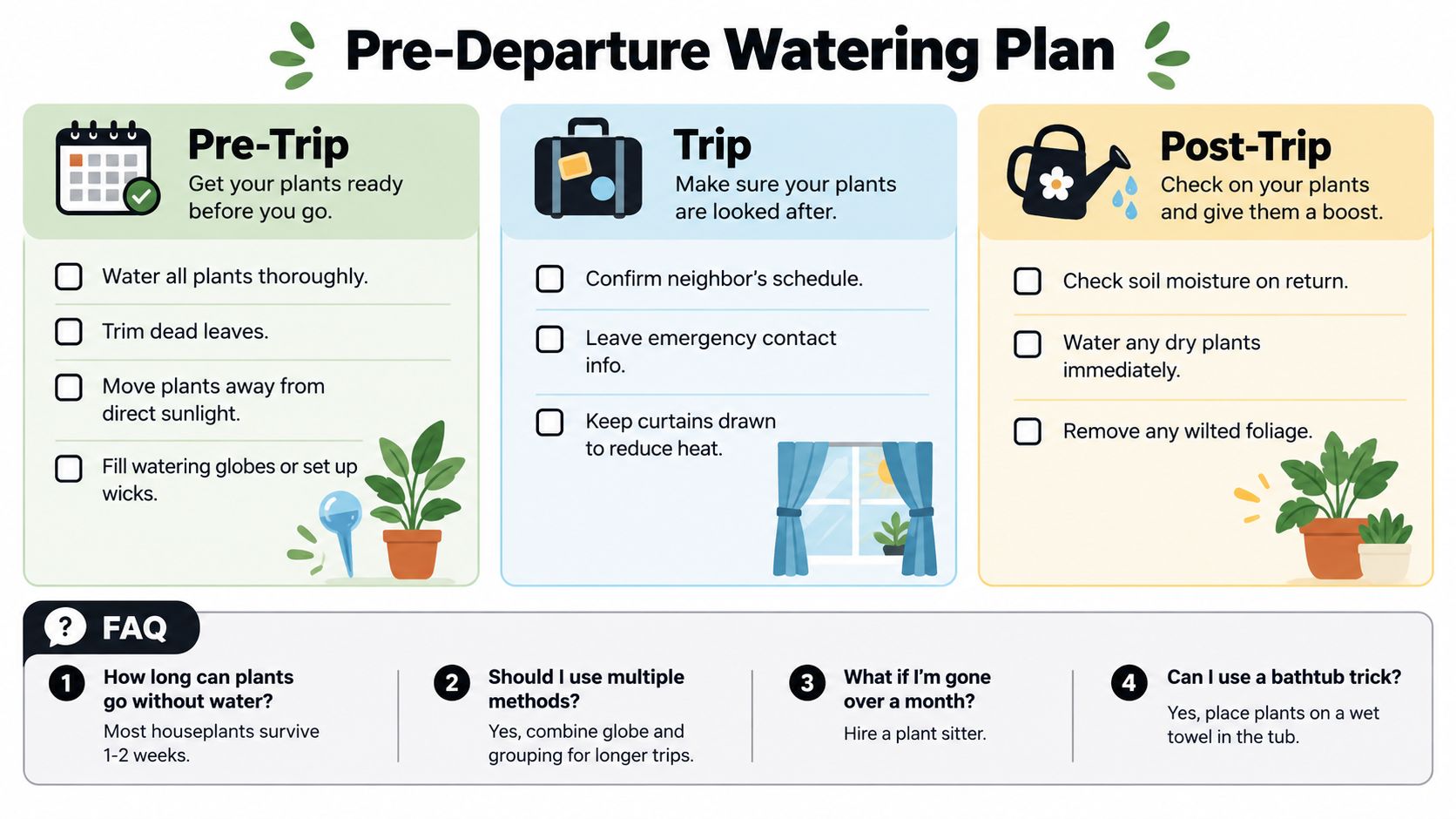
- Before departure: Confirm drainage, fill tested reserves, and leave written instructions specific to each plant.
- During the absence: Give any helper clear refill responsibilities and a way to reach you.
- After returning: Inspect soil and equipment before resuming the normal routine.
A short checklist works because the decisions already happened during sorting and testing.
How long can houseplants go without water?
There isn't a universal survival interval. Species, pot size, light exposure, and season all shift the answer, so a plant's ordinary dry-down rhythm is a better planning guide than discovering its stress limit mid-trip.
Can watering globes keep plants alive for two weeks?
They can support suitable plants when the reserve and delivery match the pot's demand. A thirsty plant in a small terracotta pot can empty a globe far sooner than a modest drinker in a large plastic one. Only a trial in the actual pot establishes whether the setup covers the absence; the advertised upper duration isn't a guarantee.
How do outdoor pots and hanging baskets get watered on vacation?
Outdoor containers need testing in the spot where they'll sit, since wind and direct sun dry them faster than the same plant indoors. When a passive reserve doesn't demonstrate enough coverage, a helper is the safer fallback.
Should wilted plants get watered after vacation?
Only after checking the growing medium. Dry soil and wet soil require different responses, even when the foliage looks similar. A wilted plant sitting in saturated mix needs airflow around its roots before it needs more water.
Can plants sit in water while their owner is away?
Standing water shouldn't replace a calibrated watering plan. Pots need drainage, and a wet towel or bathtub arrangement treats a mixed collection as if every plant wanted constant moisture. A few moisture-loving plants tolerate it for a short stretch; the drought-tolerant ones come back to rot.
Little Green Leaf offers hand-blown glass watering globes in multicolor and clear rainbow, with optional anti-clog sleeves for the stems. Visit the Little Green Leaf shop to choose a reserve for the plants that need supplemental moisture, then allow time to test it in the actual pot before departure.