

Watering Outdoor Potted Plants: How Often and How Much
There's no single watering interval for an outdoor pot. A small container in hot, dry, windy weather can need water up to three times a day, a large container in cool weather may need it once or twice a week, and several cool, wet days may need none at all. Whatever the interval turns out to be, the amount doesn't change: water until it runs from the drainage holes, then stop.
Watch one balcony over a single July day and the reason becomes obvious. A terracotta pot in full afternoon sun is light by lunchtime. The glazed pot two steps away, tucked against a wall, is still heavy at dinner. Same street, same weather, different water bill. Watering outdoor potted plants is a decision about the pot in front of you today, not a chore you can slot into a weekly routine and forget.
The useful question is therefore not "how often do I water" but "how do I tell, right now, whether this pot needs it". Once you can answer that in ten seconds, the schedule takes care of itself.
Table of Contents
- How Often Outdoor Pots Need Water
- How to Water a Pot Until It Drains
- Adjusting Watering for Heat, Wind and Pot Type
- Watering Globes Versus Other Outdoor Aids
- How to Set Up a Little Green Leaf Globe in an Outdoor Pot
- Watering Plants While Away From Home
- Questions Before You Trust a Globe Outside
How Often Outdoor Pots Need Water
Start with the pot, not the calendar. Water should keep flowing until it exits the drainage holes, because that's the point where the full volume of mix has been wetted rather than just the top inch. Iowa State University Extension sets that drainage rule and pairs it with a frequency range that runs from once or twice daily for a small container in hot, windy weather to once or twice weekly for a large container in cool conditions (Iowa State University Extension). Two pots on the same patio routinely sit at opposite ends of that range.
Find the row that matches your container and weather, then confirm it with a finger before you pour.
| Situation | Check interval | How much to apply | What shortens the interval |
|---|---|---|---|
| Small container, hot dry wind | Up to 3 times a day | Until water flows from the drainage holes | Limited soil, wind, and full sun |
| Hanging basket or small pot in summer heat | 1-2 times a day | Slow watering until drainage | Dark pots, exposed balconies, thirsty plants |
| Medium patio pot, warm fair weather | Often daily | Soil only, early in the day, until drainage | Larger plant and tighter spacing |
| Large container, cool conditions | Once or twice a week | Until water flows out, then stop | A sudden hot or windy day |
| Several cool wet days | Skip if the root zone is moist | None until 2 to 3 inches down is dry | A dry surface can hide moist roots |
Why a fixed day on the calendar fails
Five things change how fast a pot empties: sun, wind, humidity, the size of the plant, and how much mix the pot holds. A breezy afternoon on a hot balcony can pull moisture out of a small pot several times faster than the same pot in still air against a north wall. Follow a Tuesday-and-Friday habit and you'll overwater during a cloudy cool spell and underwater during the first real heat wave, usually in the same month.
Where a glass globe fits, and where it doesn't
A glass watering globe is a buffer, not a schedule. Filled and pushed into moist soil, it releases water gradually as the mix dries, which stretches the gap between your checks. One fill lasts up to about two weeks, and the honest word is "up to": a thirsty plant, a large pot, a hot spell, or the smallest globe will empty it far sooner, while a 350 ml globe in a sheltered pot in mild weather sits nearer that upper end. Refill it when the bulb is empty rather than on a chosen day of the week.
What a globe won't do: it won't suit succulents or cacti, it won't carry a very large planter on one small bulb, and glass breaks if a hanging basket swings it against a railing.
Read your row, test the mix, and let the pot answer the question. That habit is worth more than any interval someone hands you.
How to Water a Pot Until It Drains
The drainage hole is the only honest signal a container gives you. Everything below works the same whether you're watering a shrub in a half-barrel or a trailing plant in a hanging basket, and the sequence matters more than the tool.
Here is the full routine, step by step.
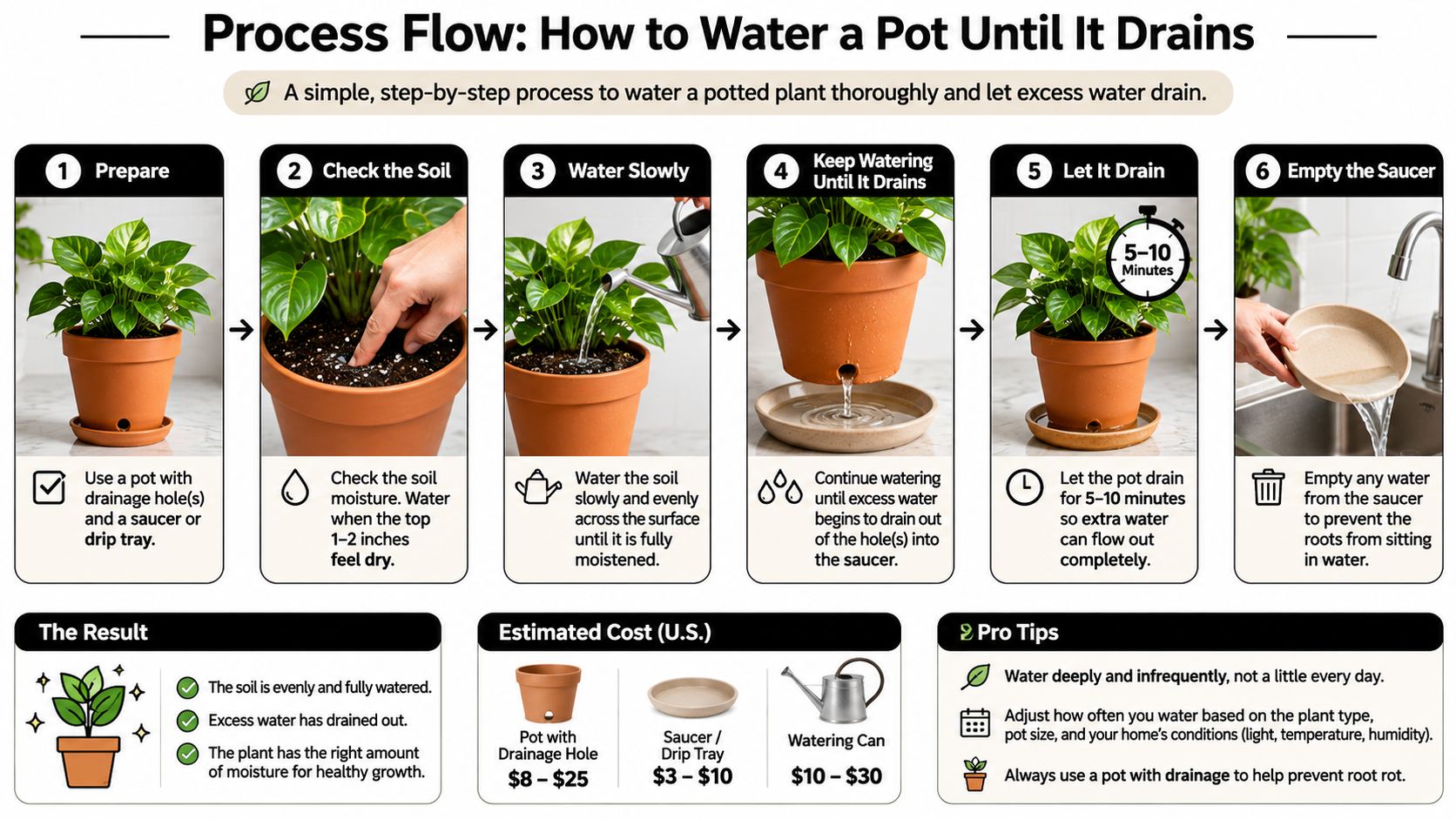
- Look at the pot daily in summer, not at yesterday's interval. Demand climbs with sun and wind, so a pot that lasted two days last week may need water twice today. Two pots a metre apart can need different amounts.
- Push a finger 2 to 3 inches into the mix. Water only if that zone is dry. A dry crust doesn't prove the roots are dry, and a damp surface can hide a dry core.
- Weigh the pot if you want a number you can trust. Virginia Cooperative Extension describes the method: irrigate thoroughly, let the pot drain for about an hour, weigh it, then weigh it again after 24 hours (Virginia Cooperative Extension). One fluid ounce of water weighs roughly one ounce, so a container that comes back 12 ounces lighter has lost about 12 fluid ounces and needs roughly that much to return to its previous moisture level. The loss reflects evapotranspiration, water leaving through the mix surface and through the leaves, which is why the figure shifts with weather instead of holding steady.
- Pour slowly onto the soil, not the leaves, preferably early in the day. If the mix was very dry, pause after the first pass and make a second one. A single fast flood races down cracks and out the holes while the core stays dry.
- Stop when water runs from the bottom, then feel the top 1 to 2 inches again. If those inches are still dry, the mix is hydrophobic or crusted. Break the crust, open a few shallow holes with a chopstick, and water again.
- If the lower mix is still moist, don't add water. A pot that's already wet doesn't need company, and persistently saturated mix starves roots of oxygen.
Reading the plant's signals
Underwatering shows as wilt that recovers within a few hours of a full soak. Overwatering shows as yellowing leaves and mix that stays wet for days with no drainage. The two look similar from a distance, so check the soil before you decide which one you're looking at.
Now the step almost everyone skips. If the pot itself is decorative, check what it's sitting in. An outer cachepot can trap water against the base of the inner pot long after the drainage hole stopped running, and if you're choosing one, this guide to how to style aged brass cachepots covers liners and finishes that keep metal out of standing water.
Finish with a full soak, then let the pot drain. That wet-through, drained starting point is what a globe needs before it goes in; inserted into dry mix, it has nothing to work with. A globe evens moisture out by releasing water slowly as the mix dries, which keeps a pot away from both extremes rather than holding it saturated.
Adjusting Watering for Heat, Wind and Pot Type
The most common false alarm on a hot afternoon is a plant with drooping leaves and damp soil. Heat alone can make leaves wilt at midday even when the root zone is fine, so the finger test decides, not the leaf. Push 2 to 3 inches into the mix. If that zone is dry, water now rather than waiting for a cooler, more convenient moment, because a plant that's actively dehydrated doesn't benefit from patience.
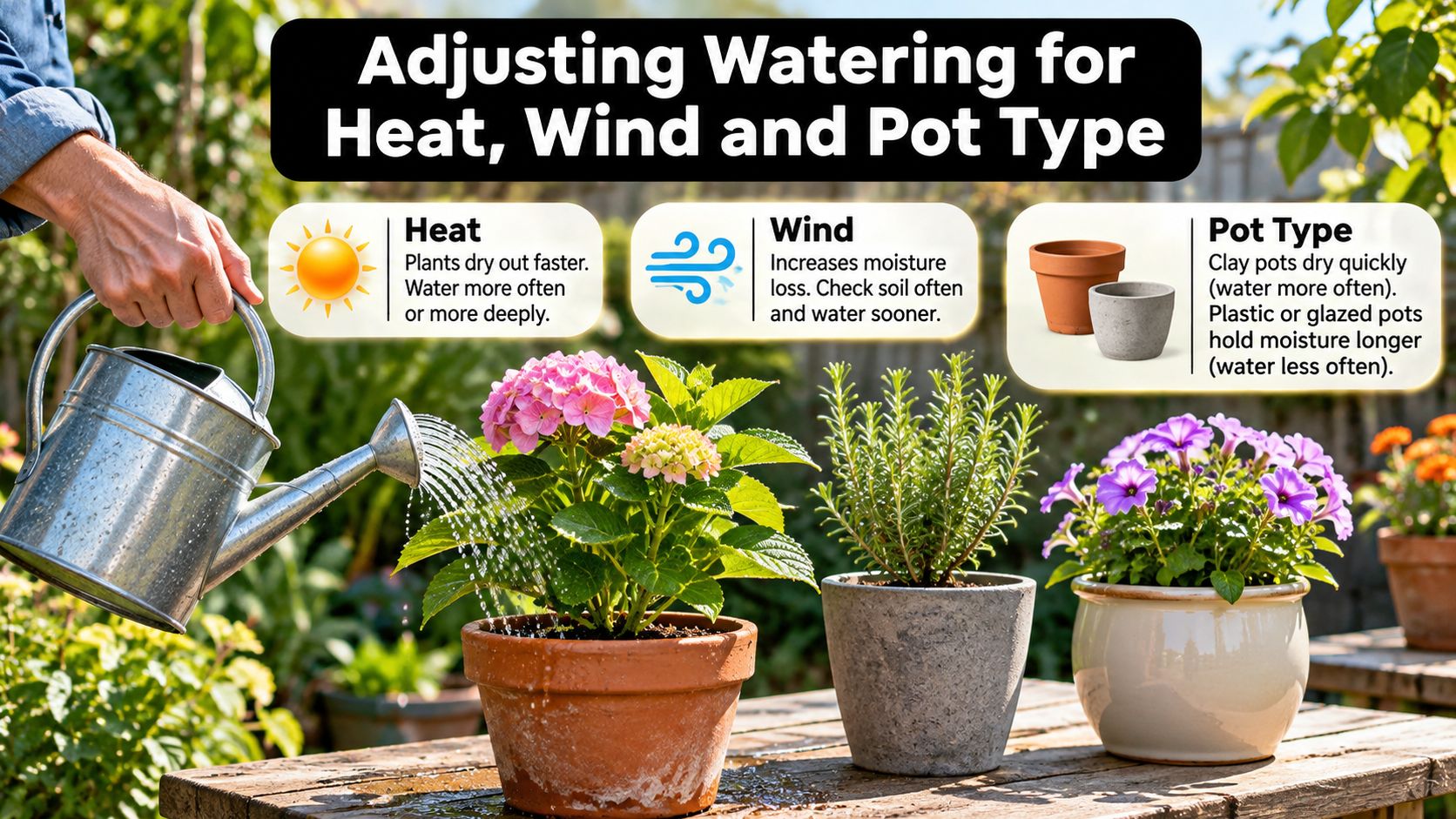
The drying speed of each pot is written into its situation. Extension guidance notes that during heat waves containers can dry fast enough to need watering daily or even twice a day, with small pots, hanging baskets, dark containers, and exposed balconies most at risk (West Virginia University Extension). A black pot on sun-baked concrete is a different proposition from a pale pot in sheltered morning shade, and a large soil volume buys you more time than a small one.
- Water at the soil, not across the foliage. Roots get the water and wet leaves don't invite disease.
- Soak until it runs from the holes. Repeated small splashes leave dry pockets inside compacted mix.
- Check the drainage holes are open before a hot spell. A blocked hole turns a heat wave into a root-rot problem.
- Move what you can. Morning sun and afternoon shade, pots grouped together, and a shielded side cut demand considerably.
Where relocation isn't possible, shade structure does more than any gadget. Comparing cedar shade structure options before summer is a practical step, since blocking the worst of the afternoon sun lowers water demand at the source. The guide to watering plants in hot weather takes the timing question further.
After a heat spike, check the bulb. A globe that lasted ten mild days may empty in three during a windy 35°C stretch, so look at it after the weather turns rather than trusting a mild-weather timeline.
Watering Globes Versus Other Outdoor Aids
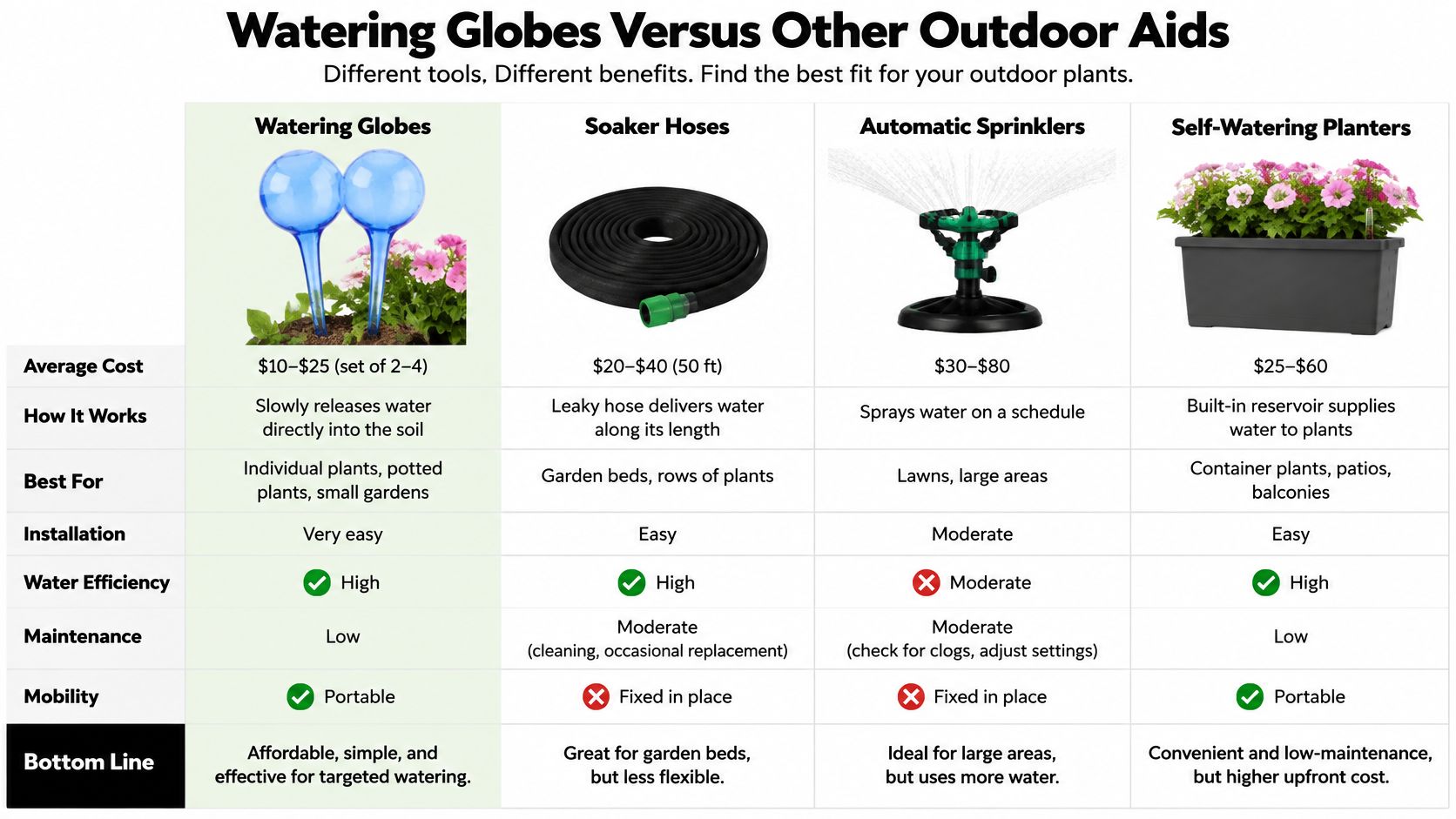
A glass watering globe earns its place when the pots already exist, the plant likes steady moisture, and nobody is home at two in the afternoon to water a hanging basket. It's the wrong tool for succulents, cacti, and anything that must dry out between waterings, and one small globe cannot carry a very large planter. Those limits are the verdict, so start there.
Four common options decide it on the same criteria.
| Aid | How long a cycle lasts | Setup and refill | Clogging and outdoor fit | Best used when |
|---|---|---|---|---|
| Glass watering globe, 100 to 350 ml | Up to about two weeks when the pot is generous, the weather is mild, and the plant drinks slowly; shorter in heat or a small pot | Fill, pilot hole, insert in moist soil; refill when empty | Stem can clog; an optional tip cover helps; suits pots and baskets if it cannot fall | Steady-moisture plants and missed waterings |
| Terracotta spike with a bottle | Set by the bottle; a small bottle ends the cycle sooner than a globe in the same pot | Spike plus inverted bottle; swap the bottle | Pores clog; bottles tip in wind | A cheap reservoir where a bottle sits safely |
| Drip emitter or line | Only while the timer or flow is on | Tubing, emitter, and a water source | Emitters clog; strong for many pots | A row of containers with a hose or reservoir |
| Self-watering planter | Until the built-in reservoir empties, so bigger reservoirs buy more days | Built-in reservoir; fill the gauge or inlet | Wicks and inlets clog; works outdoors if overflow can leave | One plant when replacing the pot is acceptable |
How the globe actually releases water
A hand-blown glass globe fills with water and sits with its stem in moist mix. As the soil dries, oxygen travels up the stem and gently displaces water into the root zone. When moisture returns, airflow slows and release tapers off on its own. The globe works like a buffer rather than a tap, holding water in reserve until the soil asks for it, which is why a single fill can stretch to two weeks only when pot size, heat, and plant thirst leave room for it. Nothing to program, nothing to plug in.
The three costs nobody mentions
Clogging is the main one. Fine mix and mineral deposits block the stem, and an optional tip cover plus a rinse keeps flow honest. Breakage is the second: a globe knocked off a railing by a gust or a swinging basket is gone. Scale is the third, because a single small globe cannot serve a half-barrel planter.
The Missouri Botanical Garden notes that small containers may need watering up to three times per day during hot, dry, windy weather, which is precisely the gap a gradual-release globe bridges for someone who can't be home at noon. A globe should be filled and set into soil that's already moist, because its job is to extend the interval, not to replace the first thorough watering.
Practical rule: if a small pot runs dry between morning and evening, a globe will help. If the plant wants to dry out completely between drinks, no globe will help.
A drip line with a timer remains the better answer for a long row of pots with a tap nearby, and a self-watering planter suits a single specimen when you're replacing the pot anyway. If you're weighing a plumbed setup against bulbs, this piece on an outdoor automatic watering system for plants sets out the trade-offs.
How to Set Up a Little Green Leaf Globe in an Outdoor Pot
A good setup takes about two minutes, and most of what decides success happens before the globe ever touches water: the pilot hole, the angle of the stem, and where the globe sits relative to a gust of wind.
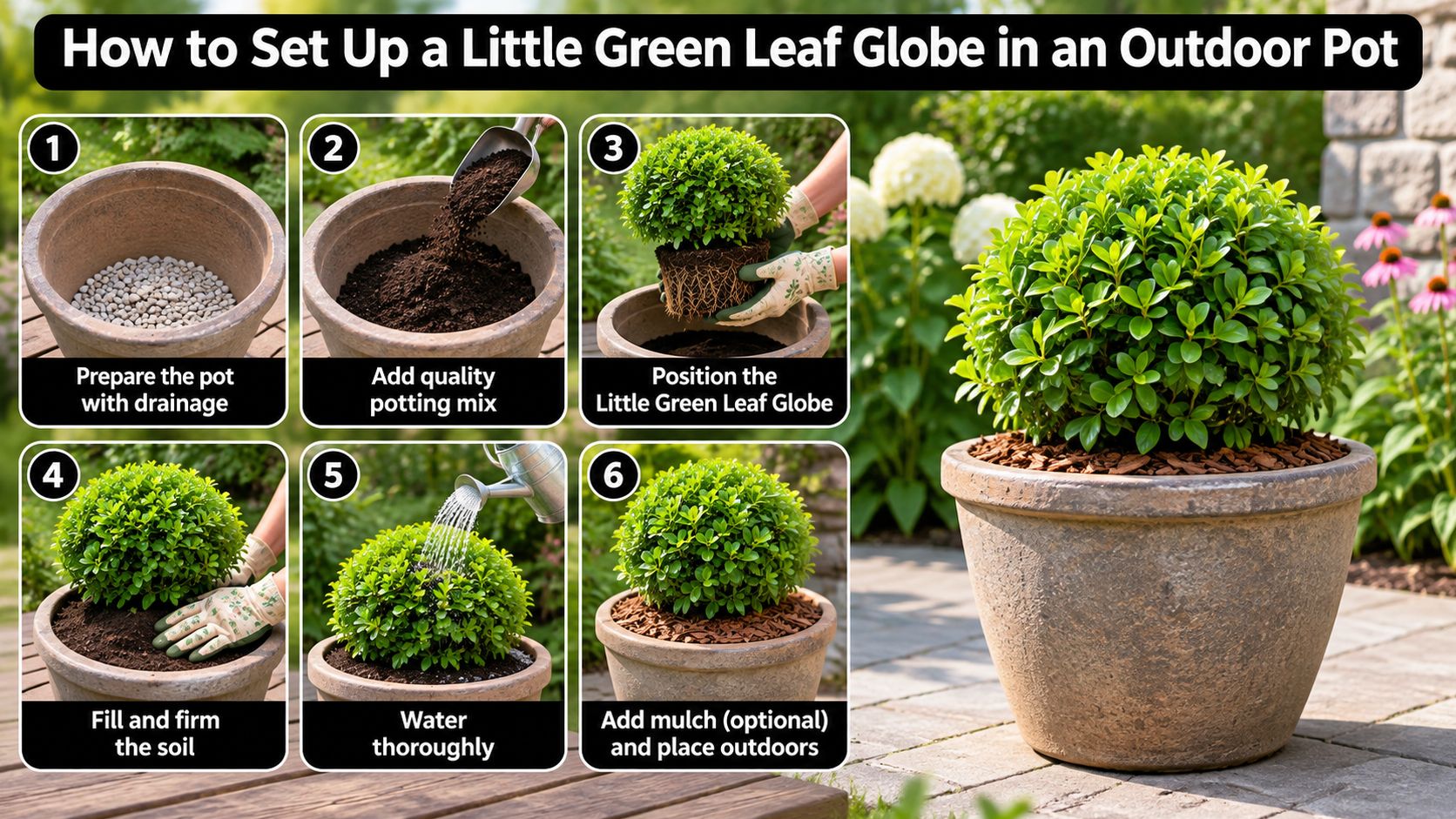
- Water the pot first, until water drains from the holes. Let the excess leave so the stem goes into moist mix rather than dust-dry or soggy soil. The system works because drying soil pulls air through the stem and displaces water, so a globe pushed into bone-dry mix has nothing to buffer.
- Make a pilot hole with a pencil or chopstick. Dense potting mix resists glass, and forcing a stem is how bulbs break. Widen the hole slightly so the stem slides in without pressure, and clear any roots at the bottom that could press against the tip.
- Fill the globe and set it into the soil. Globes come in 100 ml, 200 ml, and 350 ml, and a larger globe holds a longer reserve. Milliliters describe capacity, while weather, pot size, and plant thirst decide how many days that capacity buys.
- Angle the stem rather than pushing it straight down. Seated closer to 45 degrees, air moves through the stem easily and water releases faster. Closer to 90 degrees, air escapes harder and the drip slows. As the mix dries, oxygen enters through the stem and gently displaces water into the root zone, then the release eases off on its own once moisture returns. Position the globe where a swinging basket or a balcony gust cannot knock it loose, because hand-blown glass does not survive a fall.
- Check after two days, then again after any hot or windy spell. Refill when the bulb is empty. If the bulb still holds water but the mix stays dry, the stem is likely clogged: pull it out, rinse it, and fit the optional tip cover before reinserting. An adapter can help the stem seat cleanly in stony or stubborn mixes.
Skip this setup entirely for succulents, cacti, and any plant that should dry out between waterings. For everything else, one fill can last up to about two weeks, though a small globe in a large pot or a stretch of hot, windy weather will shorten that considerably. Treat the globe as a buffer between waterings, and let the weather, not the calendar, tell you when it needs a refill.
Watering Plants While Away From Home
A globe widens the gap between checks, but it can't promise a fixed number of days away. One fill lasts up to about two weeks, and less for a thirsty plant, a large pot, the smallest globe, or a hot spell in the forecast. It works like a spare bottle of water left beside the pot: it stretches what the soil already holds, and the weather decides how fast it goes.
Set the globe up the way the section above describes, with the pot watered first and the bulb matched to the container. The trip itself adds three jobs:
- Watch the bulb for a day or two before you leave. A water level that barely moves can mean a clogged stem, and a bulb that empties overnight tells you the pot will outdrink one fill. Better to learn that on a Tuesday than from the airport.
- Ask someone to look at the bulb if you'll be gone longer than one fill. A neighbour doesn't need a watering schedule, only a glance at whether the bulb is empty and whether the basket is still secure.
- On return, test the soil before adding water. Rain may have done the work for you, and a pot that looks dry on top can be wet an inch down.
For a week away, plan on a thoroughly watered pot plus a filled globe doing its job, with the weather holding the final say. Longer trips need a second pair of eyes, and a single small bulb can't carry a large planter through a long absence. The guide to watering outdoor potted plants while away goes through the longer-trip options.
Questions Before You Trust a Globe Outside
How often should I water outdoor potted plants?
Check the soil rather than relying on a fixed interval. Feel a few inches below the surface, or lift the pot and compare its weight after watering. Heat and wind can dry a container quickly, so check again when conditions change.
How long does a watering globe last outside?
A globe can hold enough water for up to two weeks, depending on the plant, climate, pot size, and insertion angle. Hot, windy weather or a thirsty plant can use that reserve sooner.
Can I use a watering globe in a hanging basket?
Yes, if the globe is secure and the basket can support it. Because baskets are exposed to air on more sides, check their soil and the globe more often than you would in a sheltered spot.
Will a globe overwater patio plants?
The globe releases water gradually as soil dries, and its flow slows as moisture returns. It does not fix poor drainage, though. If water cannot drain from the pot, wet soil may remain around the roots.
What if the globe still holds water but the soil seems dry?
Check the soil near the stem, not just the surface or the pot's edge. The globe releases water into the root zone, so moisture may be concentrated there. If that area is also dry, check that the stem is inserted into the soil and adjust its angle: at 45 degrees, water releases more readily; at 90 degrees, it drips more slowly.
Do watering globes need special care outdoors?
They are hand-blown glass, so place the globe where it is unlikely to be knocked or blown over. Rain can also change how much water a pot needs. Check the soil before adding more water rather than treating the globe's reservoir as a watering schedule.
For outdoor pots, Little Green Leaf Plant Watering Globes are hand-blown glass globes that release water slowly as soil dries. They come in 100 ml, 200 ml, and 350 ml sizes, plus a mixed size option, and are suitable for indoor and outdoor plants.
A globe is a moisture buffer, not a substitute for checking the pot. Little Green Leaf's globes use airflow through the stem to release water into the root zone as soil dries; as moisture returns, airflow slows and water release reduces on its own. One fill can last up to two weeks, depending on plant type, climate, pot size, and insertion angle.