

Watering Globes for Outdoor Plants: What Really Works
A 350 ml globe can keep an outdoor container hydrated for several days up to about two weeks, depending on pot size, weather, and plant thirst, while heat, wind, and full sun can shorten smaller globes' coverage to just a few days. Watering globes for outdoor plants work best as tested moisture supplements, not guaranteed vacation coverage.
The familiar problem is a patio pot that looks comfortable before breakfast and thirsty by evening, just as its owner is packing for a trip. A glass reservoir can help, but buying one without testing the container is a gamble. The useful question isn't what the packaging promises; it's whether that reservoir can keep pace with that particular plant outside.
Table of Contents
- What Outdoor Watering Globes Actually Do
- How a Watering Globe Releases Water
- The Five Outdoor Variables That Decide Performance
- How to Set Up a Globe for Outdoor Containers
- Plants and Conditions Where a Globe Is the Wrong Tool
- Real Outdoor Results From Real Conditions
- Maintenance, Sizing, and Common Outdoor Questions
What Outdoor Watering Globes Actually Do
An outdoor watering globe holds a reserve of water beside a plant's roots and releases it gradually through a narrow stem. Its job is to reduce gaps between manual waterings, not to turn every container into an unattended watering system.
That distinction matters on balconies and patios. A container under an awning and another beside an exposed railing can need very different watering routines, even when both contain similar plants. A globe doesn't remove that difference.
A Reservoir, Not a Countdown
Penn State Extension describes glass globes as potentially supplying moisture for one to two weeks, but limits their suitability to plants whose soil should remain consistently moist. It also warns that loosely packed soil can allow the water to drain out immediately, an important qualification often missing from duration claims (Penn State Extension's assessment of plant-watering equipment).
The sensible buying decision starts with the container rather than the advertised maximum:
- Container volume: A small reservoir isn't a sensible sole supply for a very large pot.
- Outdoor exposure: Sheltered conditions are a better starting point than an exposed balcony.
- Plant preference: Plants that appreciate steady moisture are better candidates than those requiring dry intervals.
Buying rule: Choose a globe to support an existing watering routine, then extend the interval only after the container proves it can manage.
What Counts as Success?
A useful result is more even root-zone moisture with fewer urgent watering sessions. An empty globe doesn't automatically indicate failure, and a full globe doesn't prove the plant has enough water. Both observations need a soil check.
The strongest recommendation is therefore selective: globes suit manageable outdoor containers with suitable plants and reliable drainage. For thirsty specimens in exposed positions, they're supplementary reserves, not a reason to stop checking the pot.
How a Watering Globe Releases Water
A glass globe operates through water leaving its stem while air enters the reservoir. The surrounding soil affects that exchange, which is why installation matters as much as capacity.
A simple comparison is a drinking straw held with a finger over its upper end. Water doesn't pour freely until air can replace it. A watering globe uses a related pressure balance, although soil around the outlet makes the actual process less tidy than the straw demonstration.
Soil Contact Controls the Exchange
Damp soil around the stem helps restrict easy air entry. As conditions around the outlet change, air can enter and more water can leave. This isn't a precise sensor, and it shouldn't be described as measuring exactly what the plant needs.
Once water reaches the potting medium, capillary forces redistribute moisture through its smaller pores. Larger pores drain and hold air, while smaller pores retain water. Maintaining that balance is essential: continuously saturated media restrict oxygen movement and can contribute to root decline and rot (Oregon State University's container-media guidance).
A globe therefore differs from a timed drip outlet, which follows a programmed supply, and from a wick, which moves water along a connecting material. Its narrow outlet and surrounding soil form the critical connection.
Globe Size vs Outdoor Pot Size
The capacities below describe the available glass watering-globe range. They aren't verified pot-diameter ratings, and assigning fixed outdoor lifespans to them would be misleading.
| Globe size | Best pot size | Sun exposure | Realistic outdoor duration |
|---|---|---|---|
| 100 ml | Smaller containers with modest demand | Sheltered exposure is the more sensible starting point | Shorter reserve; establish coverage through a trial |
| 200 ml | Small to medium containers, subject to demand | Partial exposure requires observation | Variable; neither capacity nor pot size establishes a schedule |
| 350 ml | Medium containers needing a larger reserve | Exposed positions still require close checks | Greatest capacity in this range, not guaranteed holiday coverage |
All sizes require filling, careful insertion, and accessible placement for refills. All can encounter stem blockage. Cost per plant can't be compared responsibly without current pricing and a tested number of globes per container.
The Five Outdoor Variables That Decide Performance
Outdoor irrigation deserves careful attention beyond convenience. The EPA reports that outdoor water use averages more than 30% of household consumption, reaching 60% in arid regions, and estimates that as much as 50% of outdoor water can be lost through inefficient irrigation (EPA WaterSense statistics and facts).
Those figures don't measure globe performance or prove a particular saving. They do support a practical principle: water should reach the intended roots without unnecessary runoff or repeated guesswork.
Container Size and Sun Exposure
Pot size changes the margin for error. A compact railing planter has less stored moisture to draw on, while a much larger container may contain more roots and require more water than a modest reservoir can provide. Neither “small pot” nor “large pot” automatically means easy watering.
For example, a small flowering container beside a patio door may need frequent attention despite its compact appearance. A larger, lightly planted container under shelter may be easier to manage.
Sun exposure changes the test conditions. A pot beside a sun-warmed wall shouldn't inherit the watering schedule of a similar container beneath an awning. Its owner should judge the actual location rather than the appearance of the globe.
Wind Can Outrun the Reservoir
Container water loss depends on temperature, sunlight, humidity, wind, plant size, container size, and spacing. In a California Agriculture study, estimated daily water loss increased from about 135 ml per container under normal wind to 280 ml under strong Santa Ana winds (container-grown plant irrigation research).
Those measurements aren't a prediction for every balcony. They show why a breezy week can invalidate a previously comfortable watering interval.
A successful trial in mild weather isn't permission to ignore the same pot during a hot, windy spell.
Plant Thirst and Soil Texture
- Plant demand: A leafy, moisture-loving annual and a sparse plant with low demand shouldn't receive identical treatment just because their pots match.
- Soil texture: An airy mix can behave differently around the outlet from dense, compacted material. Water movement and stem contact both matter.
A sheltered fern container and an exposed flowering basket present different matching problems. Understanding capillary action in soil helps explain why reservoir depletion alone cannot describe moisture throughout either pot.
The practical verdict is straightforward: size, sun, wind, plant demand, and soil must be assessed together. Changing only the globe won't correct every mismatch.
How to Set Up a Globe for Outdoor Containers
A careful installation starts with a watered plant, not an empty reservoir pushed into dry soil. The globe should maintain suitable moisture after the initial watering, rather than attempt to rescue an already dry root ball.
An Outdoor Setup That Can Be Checked
- Water thoroughly first. Wet the root ball evenly, then allow excess water to drain. Confirm that drainage holes are open before adding a continuing water source.
- Make a pilot hole. Use a suitable narrow tool to prepare a path in the damp medium, especially where it's dense. The hole should guide the stem without requiring force or leaving a large empty channel around it.
- Fill the globe before insertion. Use ordinary room-temperature water and handle the glass over a stable surface. An optional plastic anti-clog sleeve can protect the outlet, but it shouldn't prevent water from leaving.
- Insert at a slight angle. Position the outlet within the active root zone, away from direct contact with the main stem. The bulb should sit securely without levering against the pot rim or requiring pressure on the glass.
- Observe and adjust. Mark the starting reservoir level and compare depletion with moisture below the surface. A rapidly emptying globe and a persistently wet root zone require different corrections.
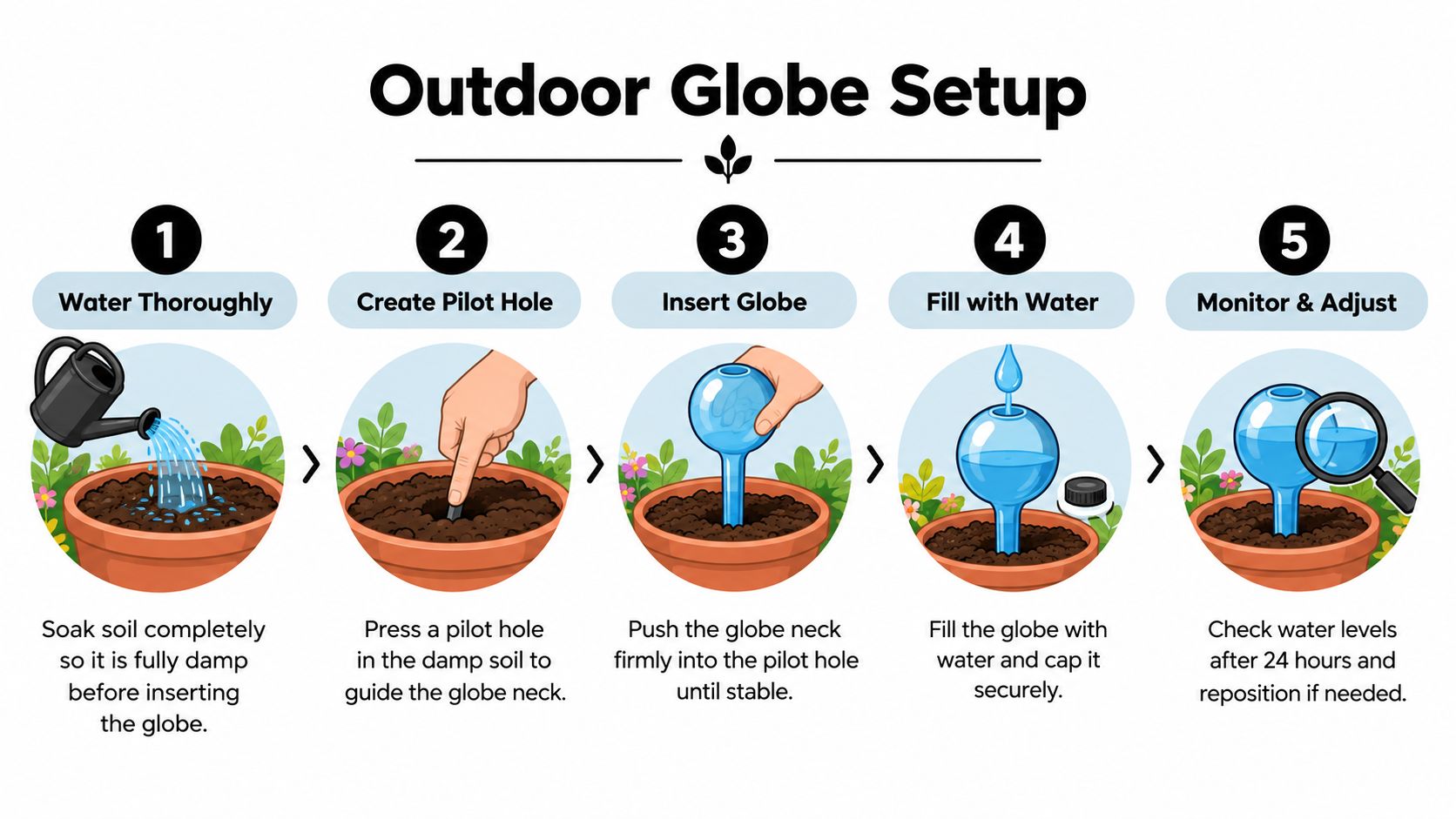
For a conventional open-stem glass globe, filling comes before insertion. A protective sleeve isn't a watertight cap, and the outlet must remain functional.
Check the Plant, Not Just the Bulb
The initial trial should compare both water movement and the condition of the potting medium. Surface dryness alone isn't enough to justify another refill, particularly when deeper material still feels wet.
If the bulb stays full while the root zone dries, inspect the outlet for blockage and reconsider its contact with the soil. If the bulb empties while the pot becomes saturated, remove it rather than immediately refilling it.
Installation safeguard: Glass breaks if dropped or forced. A pilot hole is cheaper than a broken globe and safer than pushing harder.
The broader routine in caring for outdoor potted plants remains relevant: globes supplement attentive container watering rather than replace it.
Plants and Conditions Where a Globe Is the Wrong Tool
A slow water supply isn't automatically a safe water supply. A plant that requires a drying interval can be poorly matched to a device intended to maintain moisture.
Succulents and cacti are the clearest exclusions. Mediterranean herbs such as rosemary, lavender, and thyme also shouldn't receive a continuous reserve merely because they live outdoors. Plants requiring a dry dormant period need a watering routine that respects that pause.
Moisture Preference Comes First
The moisture-loving-only recommendation in the earlier extension guidance should be treated as a selection rule, not a minor warning. A decorative bulb doesn't change a plant's requirements.
The same applies to container problems:
- Unreliable drainage: A pot without functioning drainage holes is a poor place for an ongoing water supply.
- Oversized planting: A single small globe shouldn't be treated as complete coverage for a very large root system.
- Crowded roots: A tightly occupied pot may leave no safe insertion path without disturbing roots.
- Difficult geometry: A tall, narrow container shouldn't be assumed to wet uniformly around a single outlet.
Where installation requires forcing glass through resistance, stopping is the sensible choice. Adding a globe should simplify watering, not create another avoidable problem.
Don't Mistake Wet Roots for Thirst
A drooping plant doesn't automatically need more water. The owner should inspect the root-zone medium before topping up a reservoir, particularly when the pot stays heavy or the deeper material remains wet.
The mechanism section's oxygen warning matters here. Repeatedly adding water to persistently saturated media can worsen the conditions around roots rather than correct the visible problem.
Warning observations worth investigating include:
- Persistent wetness: The medium remains saturated instead of returning toward the plant's preferred condition.
- Poor drainage: Water remains trapped rather than escaping through the container.
- Decline despite moisture: The plant looks stressed even though the root zone isn't dry.
These observations call for assessment, not an automatic diagnosis. Removing the globe is the correct first move when it's maintaining unsuitable moisture, followed by checking drainage and the plant's actual watering needs.
Skipping the device in these situations isn't a compromise. It's better plant care.
Real Outdoor Results From Real Conditions
A sheltered patio and an exposed balcony make useful contrasting examples, but neither should be presented as a measured customer trial without records. The following situations illustrate buying decisions, not guaranteed outcomes.
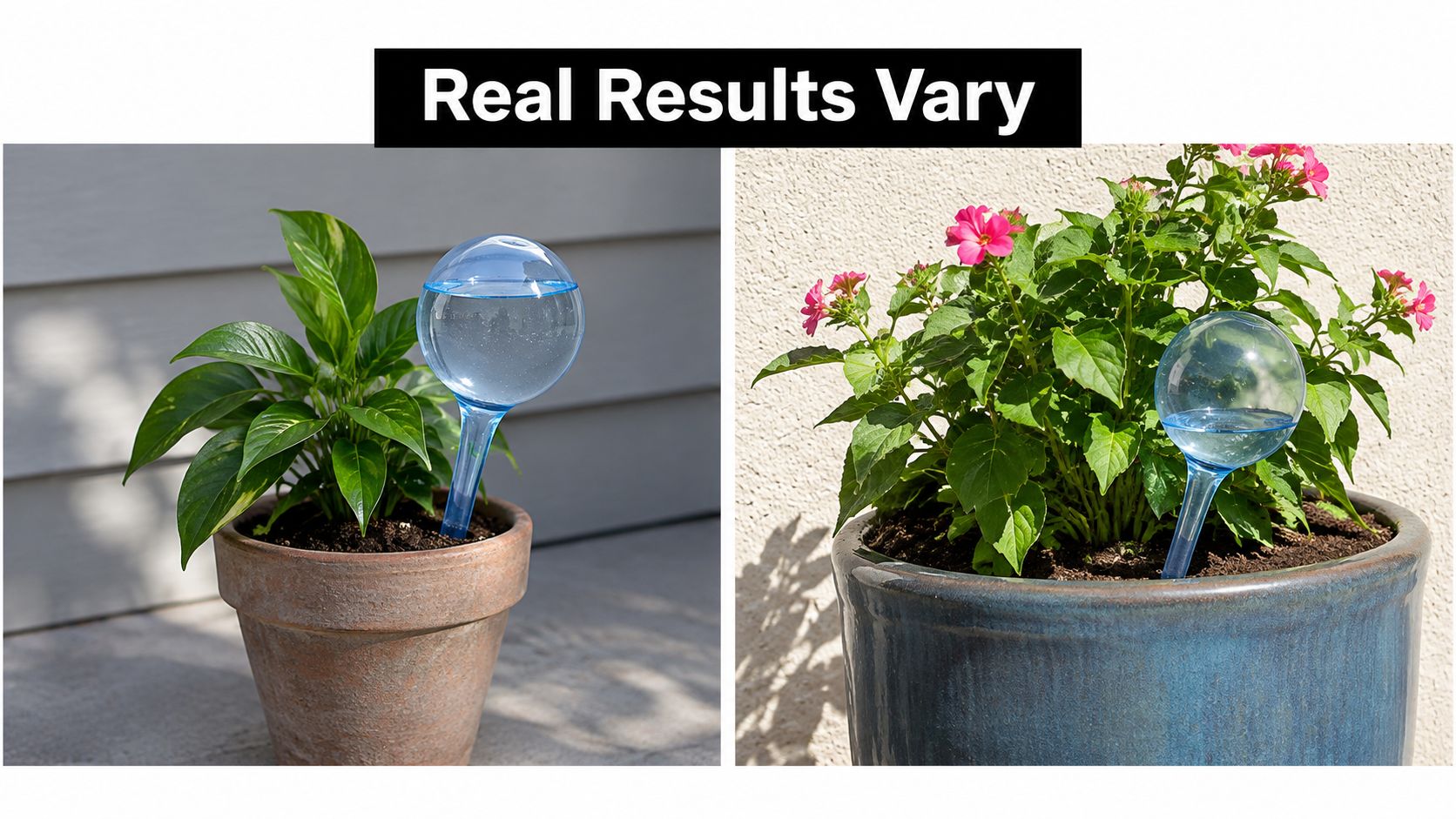
A Sheltered Patio With Modest Demand
Consider a moisture-loving plant beneath an awning during mild weather. Its owner starts with an evenly watered container, installs a larger reservoir, and observes the root zone as the water level falls.
If the medium remains appropriately moist without staying saturated, the combination is useful. The owner can record the observed refill interval and repeat the test before relying on it during an absence.
That's a credible success: a suitable plant, manageable demand, and an installation checked against actual conditions. No dramatic before-and-after claim is necessary.
An Exposed Balcony With a Small Reserve
Now consider a small reservoir in an exposed container during windy weather. The owner finds that it empties quickly and that the surrounding root zone still needs supplemental watering.
The response shouldn't be to declare every globe ineffective. The owner should reassess capacity, exposure, and plant compatibility. If the plant prefers drying cycles, however, a bigger globe would be the wrong correction.
An empty reservoir is an observation. Whether the plant remained suitably watered determines the result.
For anyone reading plant-watering globe reviews, the most useful details are the container, plant, exposure, and soil condition. A bare duration claim leaves out the information needed to judge whether the same setup belongs on another patio.
Maintenance, Sizing, and Common Outdoor Questions
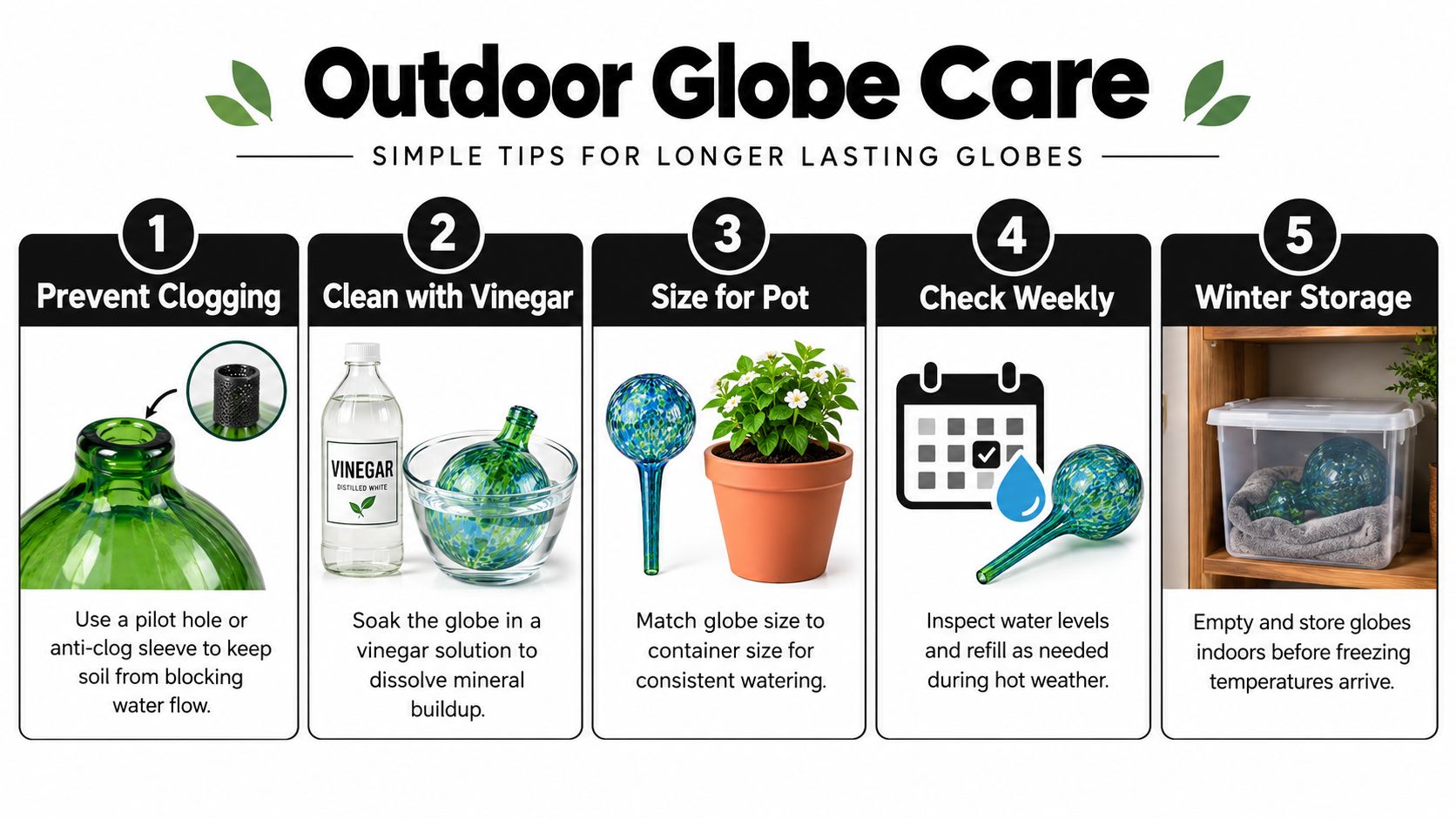
A clogged stem turns a good globe into decoration. Keep maintenance simple: make a pilot hole before inserting so soil doesn't pack into the stem, and use a sleeve if the potting mix is loose enough to collapse around the opening.
Mineral buildup responds to a vinegar-and-water soak followed by a thorough rinse. Check the narrow stem before every refill. A blocked globe delivers nothing, no matter how full the reservoir looks.
Simple Care Between Refills
- Handle by the bulb: Carry the globe by its reservoir, never by the stem.
- Inspect the glass: Cracked or chipped globes come out of service immediately.
- Store before freezing: Empty the reservoir and bring it indoors. Trapped water expands and breaks glass.
- Reassess the fit: The sizing table gives a starting point. The container trial gives the answer.
Do Watering Globes Work in Full Sun?
They can, but only if you test the container in that spot. A refill interval measured on a shaded patio means nothing once the pot moves into afternoon sun. Exposure changes demand more than any globe specification does.
Can Watering Globes Be Used in Hanging Baskets?
Yes, for moisture-loving basket plants, provided the globe sits securely and the basket can carry the added weight. A basket that dries fast still needs hands-on watering if the reservoir can't keep pace, so watch the soil rather than the glass.
Will Watering Globes Keep Outdoor Plants Watered While on Vacation?
A successful trial is the only thing that proves the setup covers your absence. If the trial is inconclusive, ask a neighbor to check the pots. That's a safer plan than betting a plant on an advertised duration, which rarely survives contact with a hot, windy week.
Does Wind Make Watering Globes Empty Faster?
Wind raises the container's water demand, so a reserve that lasted days in calm weather can drain far sooner. When conditions shift, check the soil again instead of trusting the old schedule.
Little Green Leaf sells hand-blown glass watering globes in multicolor and clear rainbow designs, with individual and multipack options for suitable outdoor containers. Plant owners can choose a capacity at Little Green Leaf, then test it on a moist, freely draining pot before relying on it while away.