

Terracotta Watering Spikes: Do They Actually Work?
Terracotta watering spikes can keep a potted plant hydrated for roughly three to ten days, depending on heat, soil moisture, pot size, and reservoir capacity. They don't release water on a fixed timer. Their porous clay responds to the moisture gradient around the roots, so dry soil draws more water while already-wet soil slows the flow.
Table of Contents
- Why Your Plants Need Help When You Are Away
- How Terracotta Spikes Work
- The Pros and Cons of Terracotta Spikes
- When Spikes Succeed and When They Fail
- Terracotta Spikes vs Other Watering Aids
- How to Set Up Your Spike for Success
- Is a Terracotta Spike Right for You?
-
Frequently Asked Questions
- How long do terracotta watering spikes last?
- Do terracotta watering spikes really work?
- How do you stop a terracotta watering spike from clogging?
- Can terracotta watering spikes be used for succulents?
- Are terracotta watering spikes good for vacations?
- Do terracotta watering spikes work in outdoor pots?
Why Your Plants Need Help When You Are Away
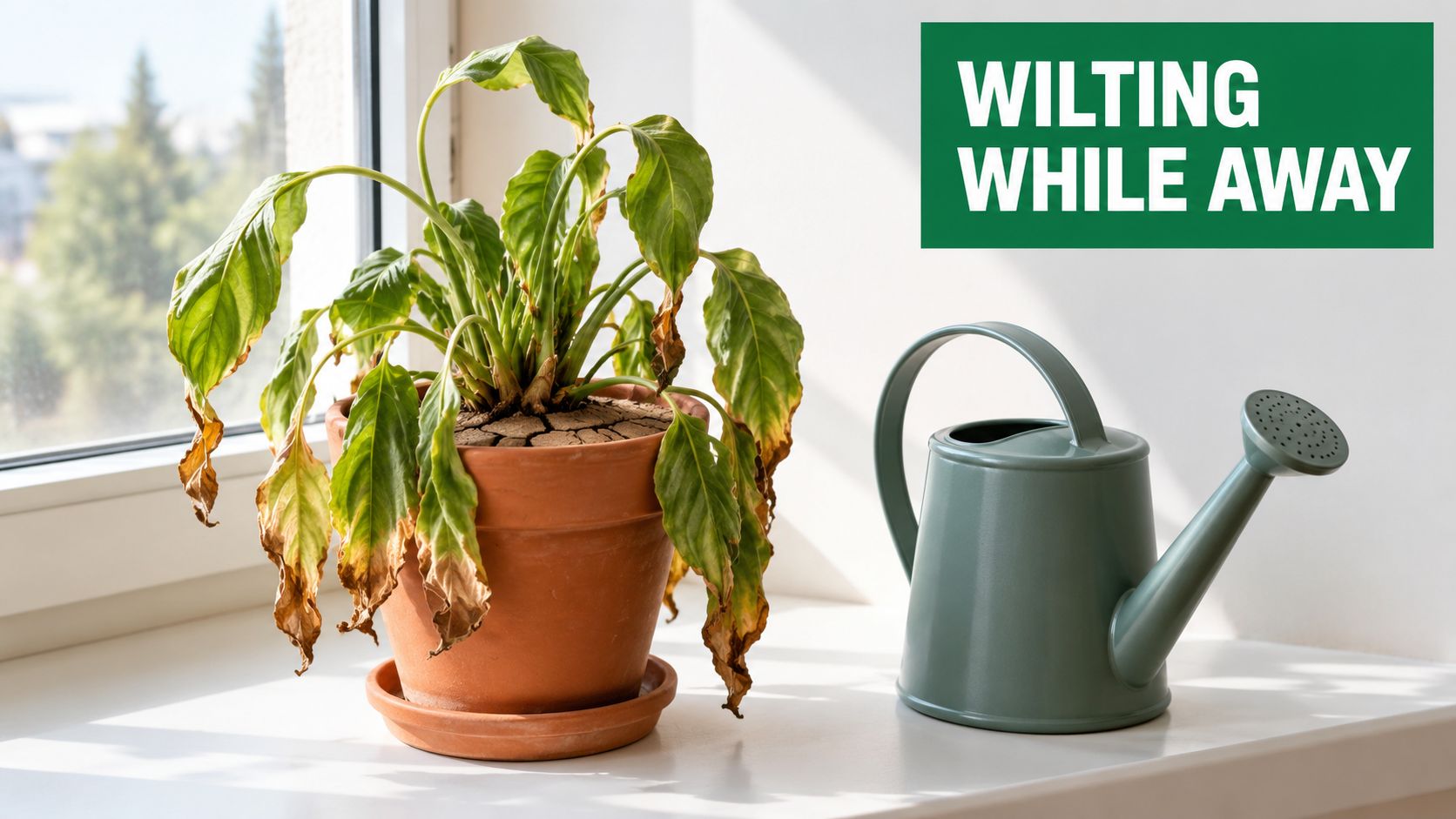
A plant rarely suffers because its owner doesn't care. More often, watering gets squeezed between packing, commuting, family plans, and an ordinary busy week. A houseplant can look healthy on Monday, then wilt by the time its owner returns from a short trip because the pot dried unevenly.
Terracotta watering spikes offer a passive way to reduce that risk. A water-filled bottle sits in or on the clay spike, while the unglazed terracotta releases moisture gradually into the surrounding soil. There are no batteries, timers, or electrical parts to manage.
The idea is old, even though the modern product is small enough for an indoor pot. Gardening sources often connect terracotta irrigation with the ancient Olla method, which some date to more than 4,000 years ago, including use in hot regions such as ancient China and North Africa, as described in this history of terracotta watering spikes. The modern spike is a compact version of that water-saving principle.
What the spike can and cannot solve
A spike can help a moderately thirsty plant through a short absence, especially when the pot is already moist and the reservoir is stable. It won't turn a small spike into a long-term watering system for a large container, and it won't suit plants that need the soil to dry between waterings.
Outdoor containers create a harder test. Sun, wind, and warm conditions can empty a reservoir more quickly than a cool indoor room. For that reason, a spike should be treated as a way to smooth out watering, not as a guarantee that every plant will be safe for a fixed number of days.
How Terracotta Spikes Work
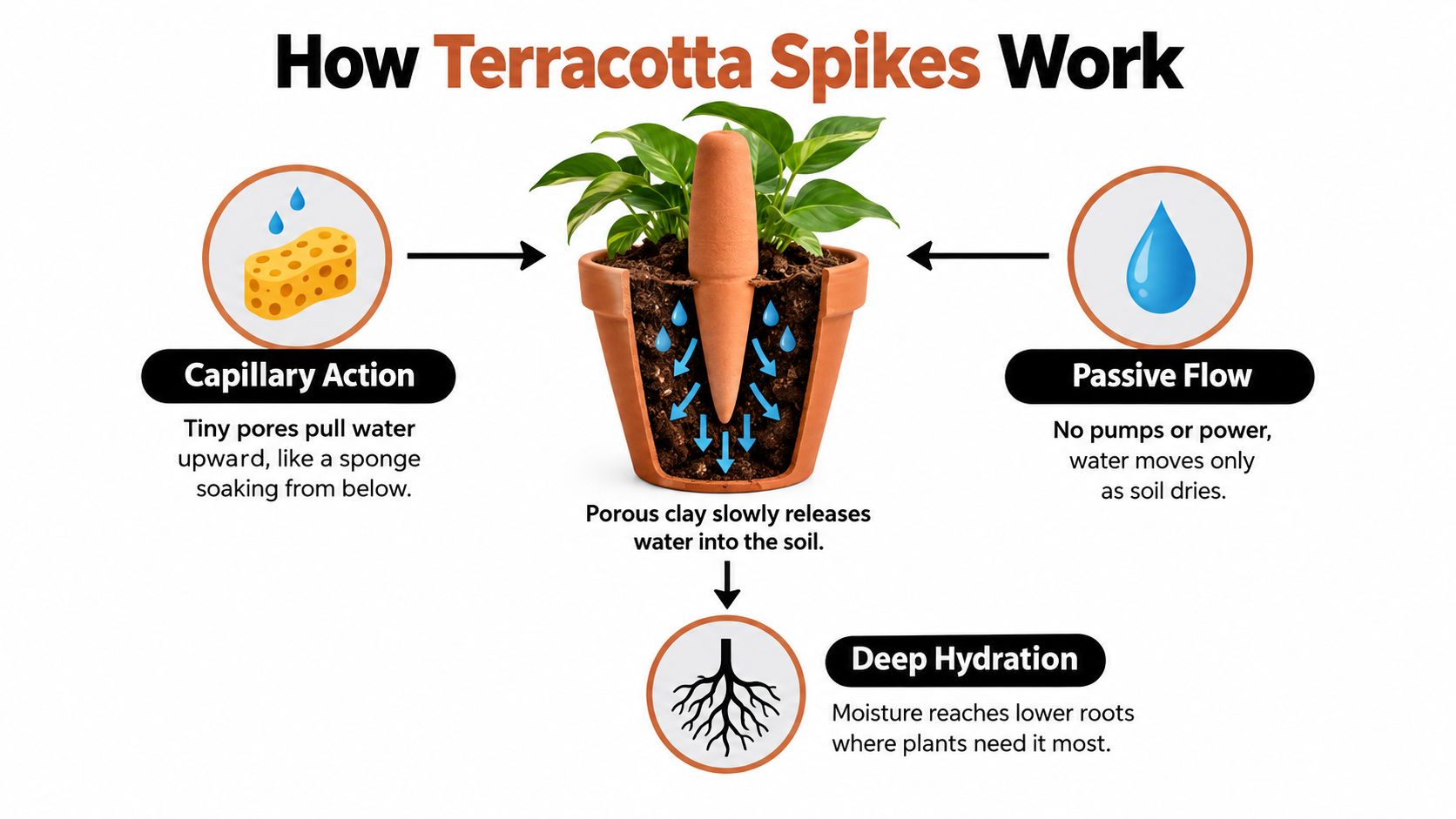
Unglazed terracotta behaves a little like a sponge with very small channels. Water moves through those channels by capillary action, but the surrounding soil determines how strongly it is pulled.
When soil dries, its moisture tension increases. That tension draws water through the clay wall toward the drier root zone. When the soil is already wet, the pull becomes weaker and the flow can nearly stop. This is why a terracotta spike responds to soil conditions instead of dispensing the same amount all day.
The science in simple terms
An industrial explanation states that clay fired between 900°C and 1050°C develops interconnected pores roughly 0.5 to 5 microns wide. Those pores let water move slowly through the unglazed material, rather than pouring out through a large opening, as explained in this technical overview of terracotta self-watering spikes.
That same source reports testing in standard 6-inch pots, where unglazed terracotta spikes kept soil moisture within an optimal 45% to 65% volumetric water content range for 3 to 7 days. Plastic alternatives in that testing varied by about ±30% daily, linked to temperature-sensitive valve drift. These figures don't predict every home, but they show why porous clay can provide a steadier form of passive hydration.
Readers who want a closer look at the principle can explore how capillary action works in soil. The useful idea is simple: the spike doesn't decide that a plant needs a certain amount every hour. The soil's dryness creates the demand.
Practical rule: A spike works best when its clay is pre-soaked, its soil contact is firm, and its reservoir stays stable.
The Pros and Cons of Terracotta Spikes
Why can a simple clay spike outperform a fixed drip outlet in some pots, yet fail in others? Its advantage comes from a moisture gradient. Water moves through the porous terracotta toward the drier soil around the roots, so delivery responds to local conditions instead of following a rigid timer. Releasing water below the soil line can also reduce surface evaporation. Under suitable conditions, a bottle-and-spike setup may last 7 to 10 days, according to this review of terracotta watering spike performance.
That responsive movement has limits. The clay must be soaked first, the soil should already be moist, and the spike needs gentle insertion. Hard, dry soil can create air gaps or force the spike against resistance, increasing the risk of cracks. Mineral deposits may gradually narrow the pores, particularly when the water contains many dissolved minerals.
Strengths worth keeping in mind
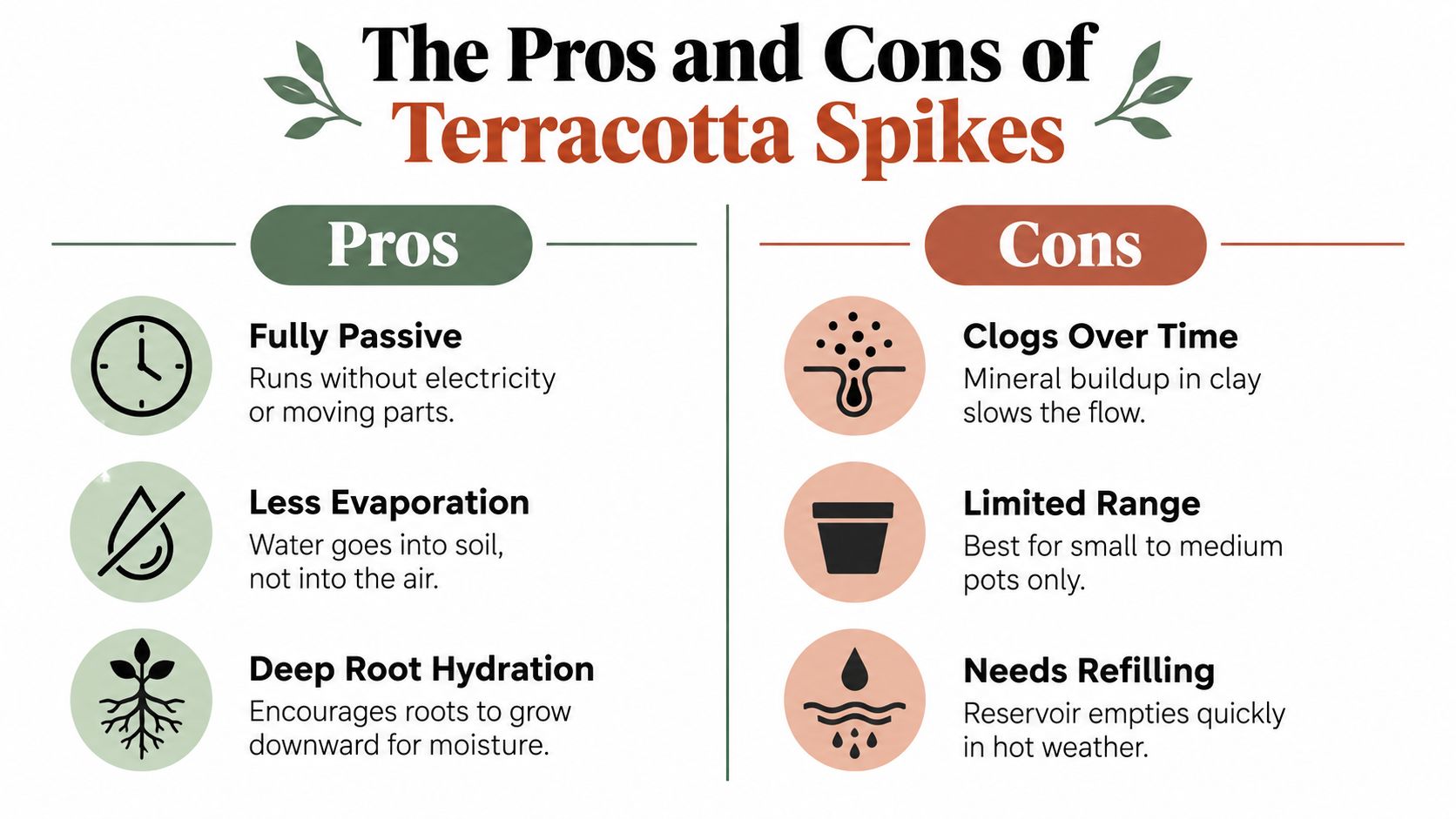
- Passive operation: The spike needs no electricity, batteries, pump, or moving parts.
- Deeper delivery: Water reaches the root zone rather than wetting only the surface.
- Lower evaporation: Clay and surrounding soil shield moisture better than exposed surface water.
- Reusable design: A maintained terracotta spike can serve the same pot repeatedly.
Limits that change the recommendation
- Dry-cycle plants: Succulents, cacti, and plants that need dry soil may remain wet for too long.
- Large containers: One small spike cannot distribute water evenly through a very large pot or satisfy a highly thirsty plant.
- Hot weather: Heat can increase water loss outdoors or in a warm room. A runtime guide for terracotta watering systems reports ranges from about three days in hot weather to 7 to 14 days, depending on conditions.
- Maintenance: Clogged pores, loose soil contact, or a poorly fitted bottle can interrupt delivery.
A spike suits growers who want quiet, gradual watering and can test the setup first. It is less suitable for plants that require a reliable dry cycle or for anyone expecting a fixed schedule.
When Spikes Succeed and When They Fail
The best match is usually a moderately thirsty plant in a standard indoor pot, with soil that holds contact around the spike without becoming a hard, airless mass. The spike should sit securely, and the reservoir should remain upright enough for water to reach the clay consistently.
Failure often begins before the spike enters the pot. If the soil is bone dry, it can pull water rapidly at first, making the bottle appear to empty too quickly. If the clay is dry, it absorbs water before normal release begins. If a user pushes the spike straight into compacted soil, the clay can break or leave a channel that bypasses the surrounding root zone.
A quick diagnosis
| Situation | Likely result | Better response |
|---|---|---|
| Pre-soaked spike and moist soil | Gradual, responsive delivery | Monitor the soil rather than assuming a fixed schedule |
| Dry, compacted soil | Fast initial draw or weak contact | Water first and make a pilot hole |
| Small indoor pot | Often suitable for short absences | Use a stable reservoir and check the first setup |
| Hot outdoor container | Faster reservoir loss | Test the system before relying on it during travel |
| Succulent or cactus | Soil may stay wetter than preferred | Choose a watering method that allows a dry cycle |
User guidance consistently recommends moistening the soil, soaking the spike, inserting it securely, and keeping the top above the soil line so soil doesn't enter the opening, as explained in this terracotta spike setup guidance. These small details matter more than just owning the device.
Terracotta Spikes vs Other Watering Aids
A terracotta spike is one option within a larger group of watering aids. The right choice depends on whether the priority is soil-responsive delivery, decorative appearance, long unattended periods, or simple installation.
| Watering aid | How long it lasts | Setup | Refill effort | Clogging risk | Works outdoors | Cost per plant |
|---|---|---|---|---|---|---|
| Terracotta spike | Roughly 3 to 10 days in reported examples, depending on conditions | Soak clay, moisten soil, make a hole, attach a reservoir | Moderate, based on reservoir size and weather | Clay pores can clog | Yes, but hot conditions shorten runtime | Usually one device per pot |
| Glass watering globe | Up to about two weeks per fill, depending on pot, plant, and temperature | Fill bulb and insert stem into moist soil | Low to moderate | Stem can clog without careful insertion | Suitable for containers, with weather affecting demand | One globe per suitable pot |
| Drip system | Set by the system and reservoir | More involved installation and adjustment | Depends on reservoir and controls | Outlet or tubing can clog | Possible when protected and tested | May serve several plants |
| Self-watering pot | Depends on its reservoir and plant demand | Plant is grown in a built-in reservoir system | Periodic reservoir refill | Wicking path can need cleaning | Depends on container design | Higher initial cost per plant |
Glass globes can be a useful alternative when a plant owner wants a visible, decorative reservoir for medium-term care. Little Green Leaf glass globes are hand-blown bulbs available in 100 ml, 200 ml, and 350 ml sizes, with stems designed for insertion into moist soil. They come in single and multipack formats, including multicolor and clear rainbow designs, and optional anti-clog sleeves can help protect the stem.
A globe isn't automatically better. Glass can break if dropped, and a single small globe won't meet the demand of a very large pot. A drip system may suit a collection that needs coordinated watering, while a self-watering pot makes more sense when the container itself is being selected or replaced.
For travel planning, this guide to vacation plant watering systems can help compare the practical trade-offs. The decision should begin with the plant's watering pattern, not with the most elaborate device.
How to Set Up Your Spike for Success
A careful first setup reveals whether the spike fits the pot and plant. Testing it before a trip is safer than inserting it for the first time on the way out the door.
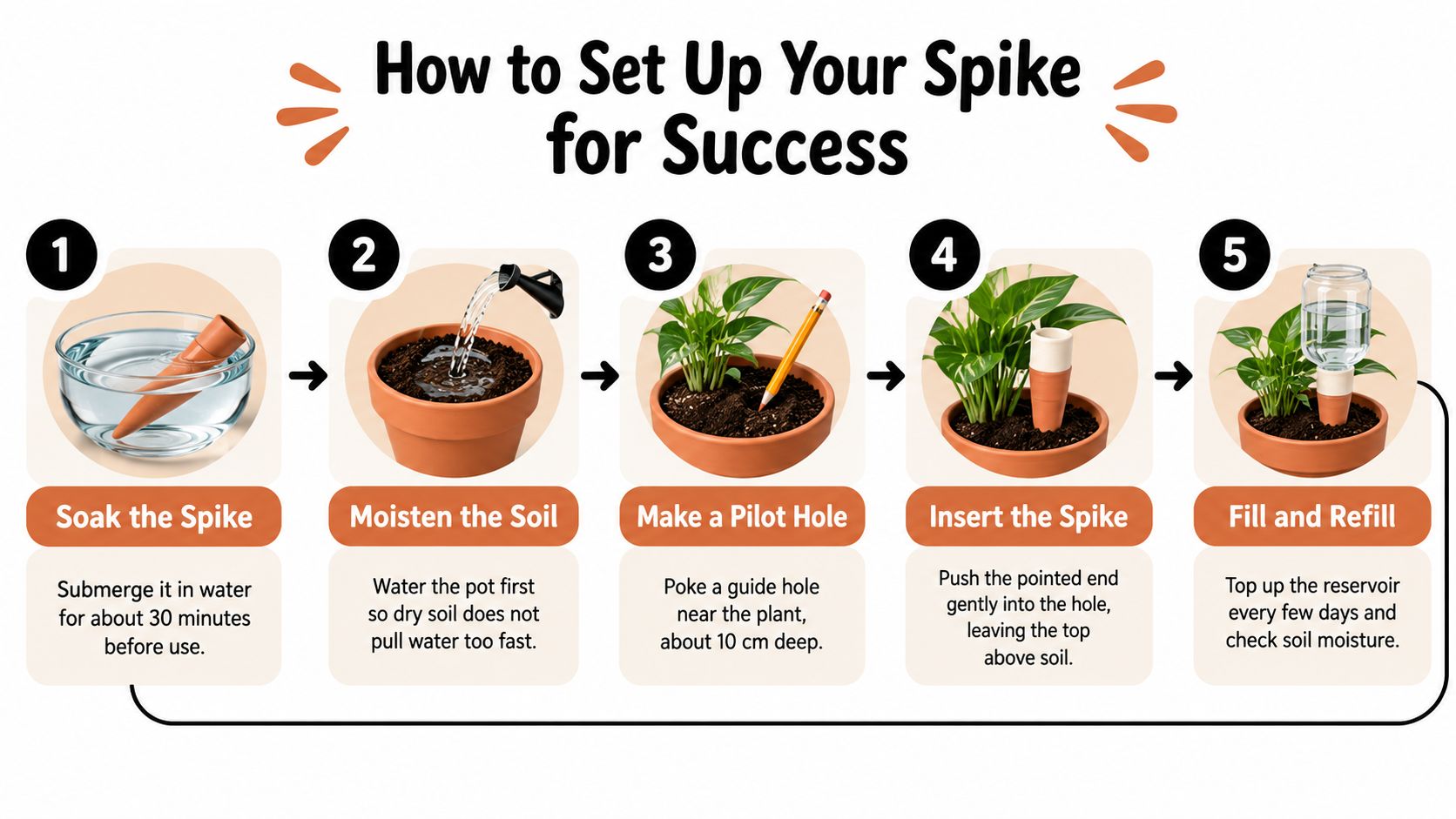
- Soak the spike first. Submerge the unglazed clay in water before use so the material starts hydrated. A dry spike can delay normal delivery or draw water too aggressively during startup.
- Water the plant and soil. The surrounding soil should be moist, not powder-dry. This gives the moisture gradient a stable starting point.
- Make a pilot hole. Use a pencil or similar blunt guide to open a path in dense soil. A guide hole reduces pressure on the clay and helps prevent cracks.
- Insert gently at an angle. Place the spike near the root zone without forcing it. Keep the upper opening above the soil line, then attach the filled bottle or reservoir securely.
- Check the setup after two days. Look for a stable reservoir, firm soil contact, and moisture that is spreading rather than running down a gap. Make adjustments before depending on the spike during travel.
A useful companion resource is this guide to controlling soil moisture. The central lesson is that installation affects performance as much as the clay itself.
Is a Terracotta Spike Right for You?
Terracotta watering spikes suit plant owners who want a low-tech way to soften the gap between waterings. They make particular sense for moderately thirsty houseplants, office pots, apartment greenery, and selected outdoor containers where a passive reservoir can stay upright and protected.
They aren't a universal vacation guarantee. A small spike may run out quickly beside a thirsty plant, a large pot may need more than one watering point, and a hot outdoor setting can change the result substantially. Plants that require dry periods, including cacti and succulents, are also poor matches because the system is designed to keep moisture available.
A practical decision
Choose a terracotta spike when the following description sounds familiar:
- The plant prefers fairly consistent moisture.
- The pot is small or medium rather than very large.
- The owner wants a battery-free solution.
- The soil can be moistened and prepared before installation.
- The setup can be tested before a holiday or busy period.
Choose a glass globe or another watering aid when appearance, a larger visible reservoir, or medium-term indoor care matters more. A globe can also be easier to monitor at a glance, although its glass stem still needs careful insertion and the device isn't suitable for plants that need dry soil.
The safest approach is to match the device to the watering problem. A spike can reduce forgotten-water stress, but it shouldn't replace a quick check of the pot, plant condition, and reservoir before departure.
Frequently Asked Questions
How long do terracotta watering spikes last?
A bottle-and-spike arrangement may supply water for about 7 to 10 days, while a spike used alone may last about 4 days, according to this overview of terracotta watering spike duration. Treat those figures as starting points, not promises. Heat, dry soil, a thirsty plant, or a large pot can change the result.
Do terracotta watering spikes really work?
Yes, if the clay is porous, pre-soaked, and pressed against moist soil. The spike responds to a moisture gradient, the difference between wetter soil and drier clay. Water moves gradually through the terracotta, rather than leaving at one fixed rate. It works more like a doorway that opens wider when the surrounding soil dries.
How do you stop a terracotta watering spike from clogging?
Keep its opening above the soil. Make a pilot hole before installation so dry soil does not force its way inside or crumble the spike. If mineral residue builds up and the flow slows, clean the clay before using it again.
Can terracotta watering spikes be used for succulents?
Usually, no. Succulents, cacti, and other plants that need the soil to dry between waterings can suffer when moisture remains available. The spike suits plants that prefer steadier moisture.
Are terracotta watering spikes good for vacations?
They can support a short trip when the reservoir, pot, temperature, and plant demand match. Test the setup first. A spike has no fixed schedule, so the same arrangement may last longer in a cool room and less time beside a sunny window.
Do terracotta watering spikes work in outdoor pots?
They can, but sun, wind, and heat pull moisture from soil faster. Outdoor pots therefore need closer checking than similar indoor arrangements.
Little Green Leaf offers decorative hand-blown glass watering globes in several capacities and designs, with optional stem protection for everyday use. Visit Little Green Leaf for a hands-off watering aid for indoor plants, travel days, outdoor containers, or a plant-lover's gift.