

Protective Plant Covers: Match Weight to Weather
A lightweight protective plant cover adds about 2°F of frost protection and still passes 90-95% of available light, while a heavyweight cover can add as much as 8°F but transmits only 30-50% of light. Water follows the same rule: a filled glass watering globe lasts up to about two weeks, and noticeably less when the plant is thirsty, the pot is large, the room is warm or the bulb is small.
The standard advice is to buy the thickest cover in the shop and to water every Sunday. Both habits set a number before anyone has looked at the plant, the pot, the room or the forecast. University of Maryland Extension sorts covers into three weights, starting at roughly 0.45 ounce per square yard for the lightest fabric, moving through medium fabric that transmits about 70-85% of light and adds 4-6°F, and ending with heavyweight fabric for the coldest nights.
Above the soil, a cover trades light for warmth. Below it, a water reservoir trades a dry spell for a wet one. Get either match wrong and the plant pays, whether the bill arrives as a frozen leaf or a rotted root. This is a guide to making that match twice, once for the fabric over the leaves and once for the water at the roots.
Table of Contents
- How Long Does One Watering Globe Fill Last?
- Are Watering Globes Better Than Spikes, Drip or Self-Watering Pots?
- Which Globe Size Fits Your Pot?
- Can a Watering Globe Fix Overwatering or Underwatering?
- How to Set Up a Little Green Leaf Globe Before You Leave
- What Watering Globes Cannot Do and How to Stop Clogs
- Watering Globe Questions Answered
How Long Does One Watering Globe Fill Last?
One fill of a Little Green Leaf watering globe lasts up to about two weeks, and the honest working number is often shorter. A thirsty plant in a big pot in a warm room pulls the bulb down well before that.
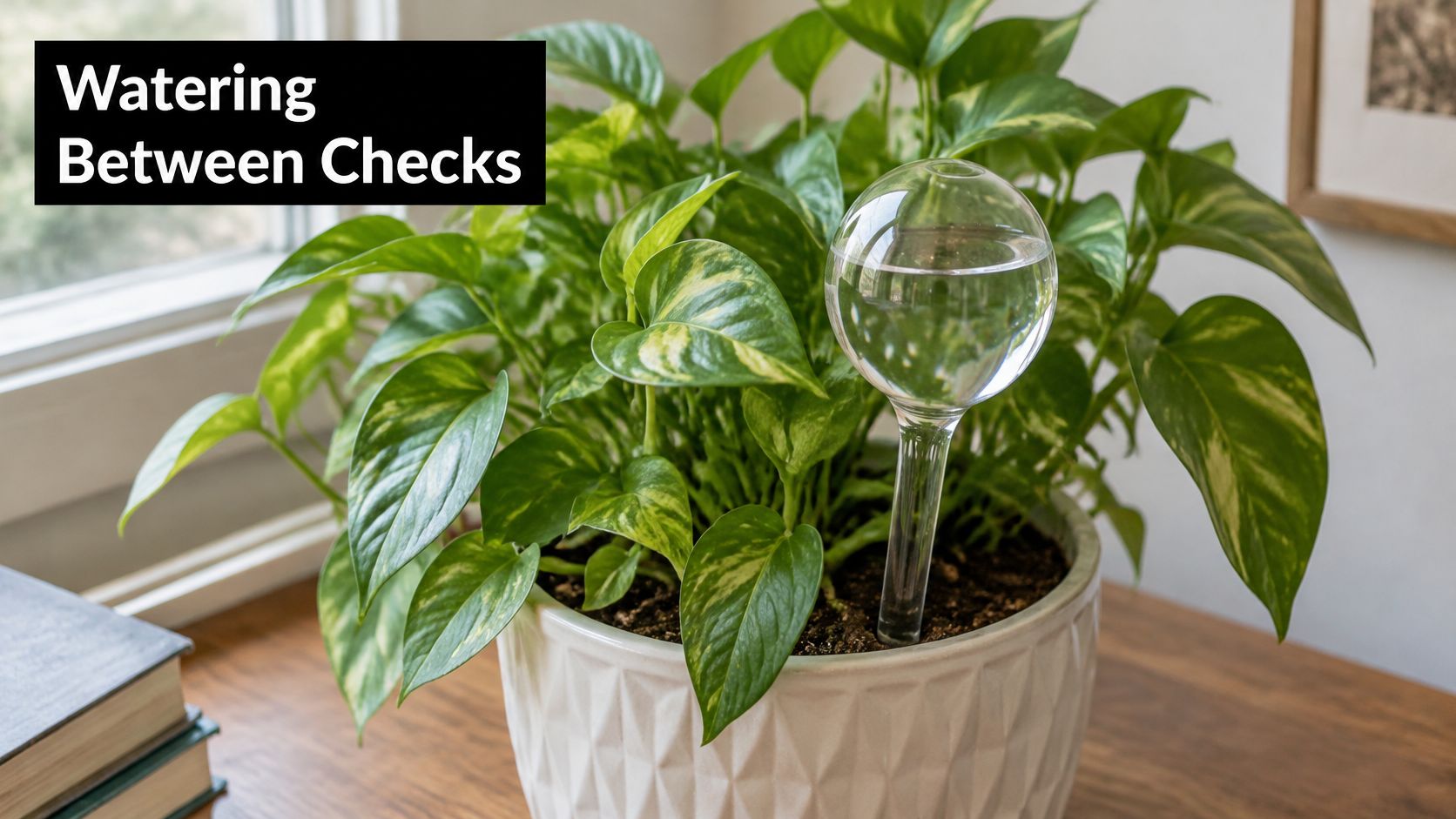
The range starts with the bulb. Little Green Leaf makes three sizes, 100 ml, 200 ml and 350 ml, sold in packs of one, two, four and six and as a mixed-size set. The 350 ml holds the most water and runs longest, which makes it the size for a large planter or a plant that wilts between waterings. The 100 ml empties first, and in a warm room it can be dry in days rather than a fortnight.
Little Green Leaf describes the water as lasting up to two weeks depending on plant type, climate, pot size and the angle the globe is inserted. Read that list as four dials on the same machine.
What changes the countdown
- Bulb size: a 350 ml reservoir holds three and a half times what a 100 ml does, so the same plant in the same pot gets a much longer run from the larger bulb.
- Pot volume: more soil around the roots stores more water between fills, but it also holds more roots drawing on it. A large planter with a mature root ball can empty a small globe in days.
- Warm, dry air: winter heating and summer air conditioning both raise how much water a plant moves through its leaves, and warm soil loses moisture faster than cool soil.
- Plant appetite: a fast-growing vine in active growth drinks more than a slow grower in the same pot, and a plant just repotted into fresh moist mix needs less added water at first.
- Insertion angle: a stem set at a tilt, with more of its length in the soil, releases differently from one pushed straight down. That's one reason two identical pots can finish a fill on different days.
Practical habit: write the fill date on a strip of tape stuck to the pot, then glance at the bulb on day three and day seven. Two fills teach you more about that plant than any chart, because the number you need is the one for your room, not an average.
Planning a trip by its length
A weekend away isn't the problem. Most houseplants tolerate a few days of absence, and a filled globe is ample for a Friday-to-Sunday trip.
A week changes the calculus very little. The Royal Horticultural Society's holiday care guidance sets the threshold at longer than one week, which is where plants left alone start to need a system for supplying moisture. A globe inserted the night before departure covers that week in an average pot, and the 350 ml covers it comfortably.
Two weeks is the top of the range, so treat it as a target rather than a promise. Water the plant thoroughly first, fit the globe, and ask someone to look at the bulb at the halfway point and top it up if the reservoir has emptied.
Beyond two weeks, one globe per pot is a tool inside a larger plan, not the plan itself. Pair it with a deep watering before departure and a check-in from a neighbour who can refill, or move the pot out of direct sun for the duration.
Are Watering Globes Better Than Spikes, Drip or Self-Watering Pots?
For a single houseplant, a windowsill of pots or a hanging basket that dries out by Thursday, a globe is the simplest thing that works. For thirty containers on a strict schedule it isn't, and pretending otherwise wastes money.
| Aid | How long it lasts | Setup | Refill effort | Clogging |
|---|---|---|---|---|
| Little Green Leaf globe | Up to about two weeks per fill, less in a big pot or a warm room | Fill the bulb, push the stem into moist soil | Lift, refill, replace; one bulb per pot | Stem can clog in dense soil; an optional plastic sleeve keeps it open |
| Terracotta spike | As long as the bottle standing on it; the spike stores no water of its own | Soak the spike, push it into the soil, seat a bottle on the spout | Lift the bottle and refill; the spike stays put | The narrow channel silts up in hard water and needs scrubbing |
| Drip system | Set by reservoir size and timer, so a large reservoir runs for days or weeks | Tubing, emitters, a pump or gravity reservoir, and a timer | Refill or reconnect the reservoir; clean the emitters | Emitters, filters and fittings scale up and block |
| Self-watering pot | One reservoir's worth, set by the pot's capacity | Buy the pot; the wick and water gauge come with it | Top up through the fill tube | Wicks and fill tubes collect algae and fine roots |
Read the table down the columns rather than across the rows. The column that decides most purchases is refill effort, because that's the job you'll repeat.
Where a globe wins, and where it doesn't
A globe needs no tubing, no timer and no electricity. Push it in and it works. The trade is that every bulb is refilled by hand, one pot at a time, and a stem pushed into dense or chalky soil can silt up and stop releasing.
The places a globe is the wrong answer are just as clear. Succulents and cacti dislike soil that stays moist. Plants that want to dry out fully between waterings don't want a reservoir at all. And a very large pot on a single small bulb will be dry long before the trip is over.
Drip systems and self-watering pots earn their cost when one person looks after many containers and wants a schedule rather than a series of one-off jobs. The guide to drip irrigation for indoor plants walks through how tubing and emitters are laid out if that's the direction you're heading.
The verdict: buy globes for a few plants that dry out fast, for a hanging basket in summer, or for the pots you'd otherwise forget. Choose a drip line or self-watering containers once the collection is big enough that hand-refilling every bulb becomes the chore you were trying to avoid.
Which Globe Size Fits Your Pot?
Match the globe to the pot, because one fill level doesn't suit every container. Oklahoma State University Extension's houseplant care fact sheet puts the difference in plain terms: small houseplant pots may need watering every 2-3 days, while large pots may need water only every 7-14 days.
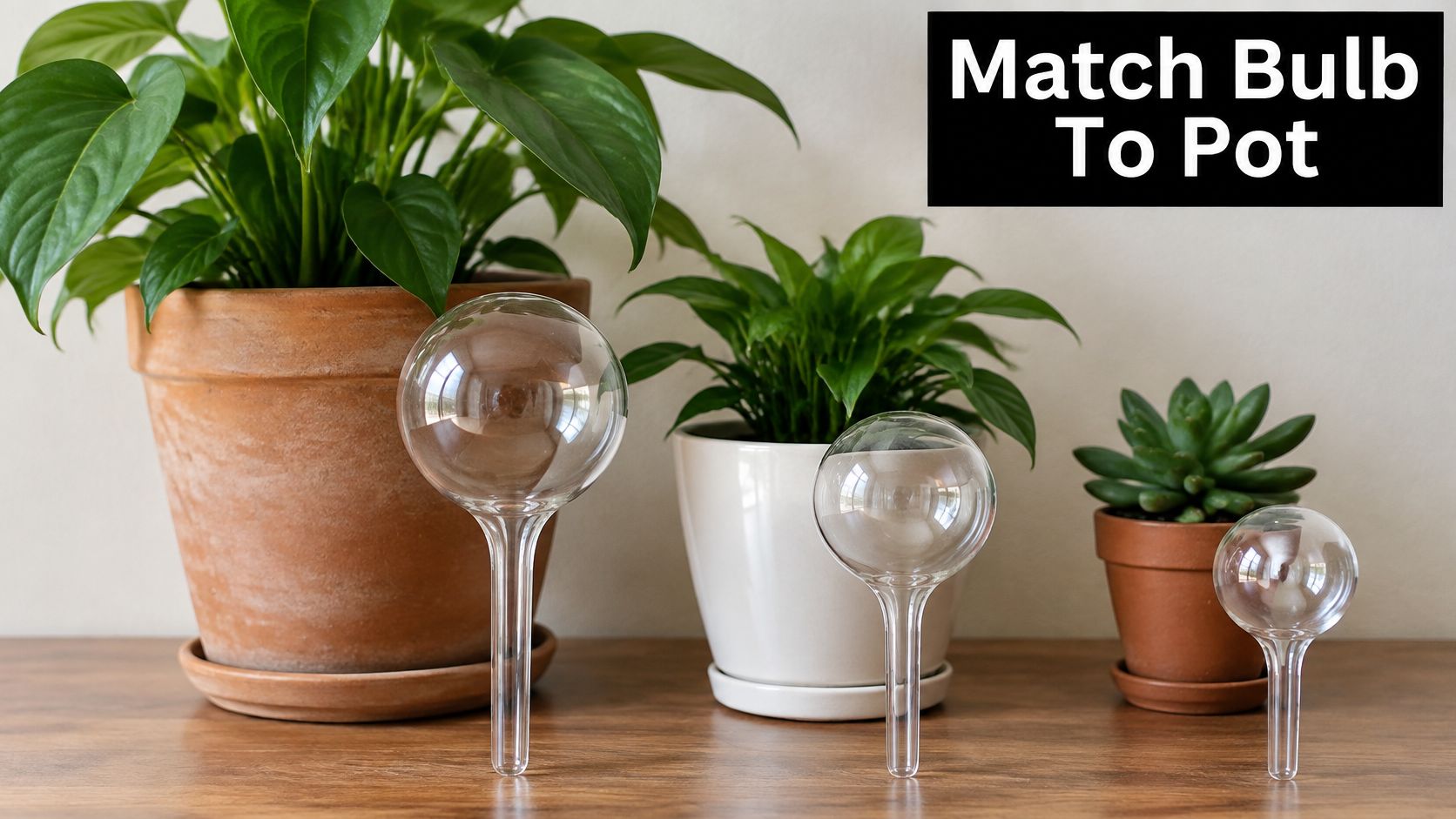
The same source attributes the frequency to growing medium, season, light, temperature, humidity, plant species and pot size, and notes that small pots dry faster and distribute water less uniformly. That last point matters for globes, because uneven moisture is exactly what a slow release is meant to smooth out.
| Pot size | Typical watering interval | Globe size to consider |
|---|---|---|
| Small houseplant pot | Every 2-3 days | 100 ml, expect shorter fills |
| Medium pot | Every 4-6 days | 200 ml |
| Large pot | Every 7-14 days | 200 ml or 350 ml |
A medium pot falls between the two reported intervals, which lands it at roughly every four to six days. That's the container the 200 ml bulb was sized for, and it's the size most windowsill plants take.
The limit worth stating plainly
A single small globe cannot carry a big pot for weeks. Fit a 100 ml bulb into a half-barrel planter and it will be empty while the soil two inches down is still dry. The reverse is also true: a 350 ml bulb in a tiny pot can hold more water than a small root ball can use, keeping the mix wetter than the plant likes.
There's a simple test that settles it for your own plant. Fill the globe, note the date, and check both the bulb and the soil after one week. If the bulb is still half full and the soil at two inches is damp, drop down a size or accept a longer interval. The plant pot size guide covers how container volume changes watering in more depth.
A globe that empties in two days isn't broken. It's telling you the pot is small, the room is warm or the plant is drinking hard, and that the next size up will buy you more time.
Can a Watering Globe Fix Overwatering or Underwatering?
A globe doesn't fix overwatering or underwatering on its own. What it does is flatten the swings between your checks, so soil that would have gone bone dry on Tuesday is still damp when you look on Thursday.
Diagnosis comes first. University of Maryland Extension lists wilting and gray-green foliage as signs a plant is too dry, and leaf drop or yellowing as signs it's too wet. The same source recommends skipping the weekly schedule entirely and testing the medium instead: push a finger about 2 inches into the soil and water only when it feels dry at that depth.
How a globe evens moisture out
A globe releases water as the soil around its stem dries, so it works in the gap between your checks rather than replacing them. A plant that dries out every three days gets a slow trickle for those three days instead of one drench and a long, thirsty wait.
That helps most with the two common failures. Repeated dry-outs stall growth and scorch leaf edges. Repeated soaking leaves roots without air. Neither is fixed by a reservoir that ignores the soil, which is why the finger test still comes first.
Why drainage still decides everything
Slower water doesn't replace drainage. Run water through the pot until it drains freely from the hole, empty the saucer, and never let a houseplant stand in water, because roots left in the wet rot. The Royal Horticultural Society's houseplant growing guide is blunt on the point: containers need drainage holes, excess water should be allowed to drain away, and filled saucers should be emptied.
A globe should never go into soil that's already saturated. Its job is to bridge intervals, not to keep a waterlogged pot wetter for longer. If the soil is wet at two inches, leave the bulb out and check again in a few days.
Water movement is a property of the soil, not the gadget. Gardeners whose containers sit on dense, slow-draining ground recognise the same behaviour outdoors, and this guide to watering trees in Georgia clay soil explains why heavy ground holds moisture long after the surface looks dry.
The rule: test the soil with a finger, then decide whether a globe belongs in the pot. A fixed schedule is never the reason to use one, and it's the reason many plants fail in the first place. More detail on spotting the wet side early sits in the guide to the signs of overwatering plants.
How to Set Up a Little Green Leaf Globe Before You Leave
Setup takes about a minute per pot, and the order matters more than the speed. Running the steps out of sequence is how stems snap and how bulbs empty in a day.
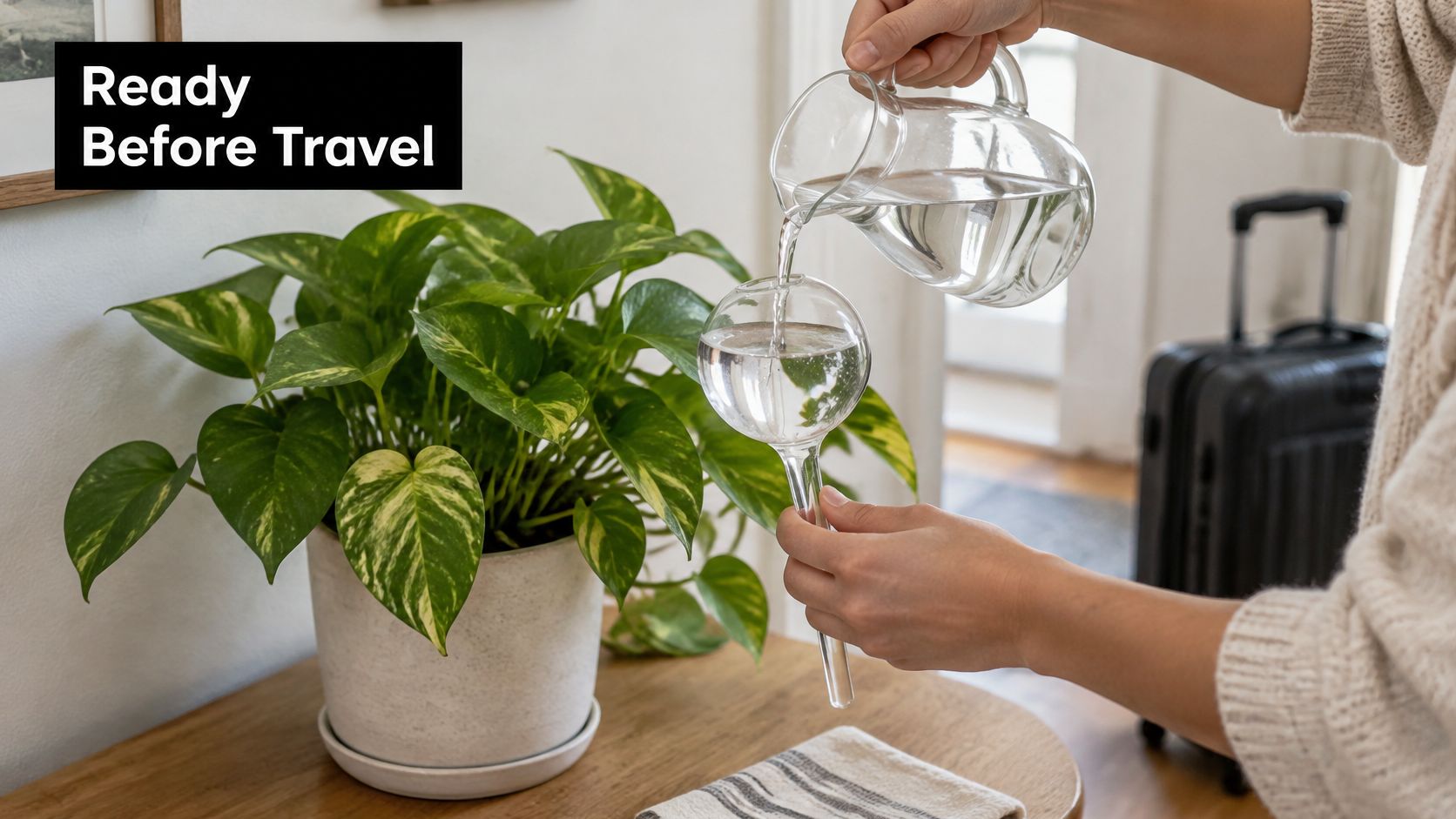
- Water the plant first, until it drains. Run water through the pot until it comes out of the drainage hole, then empty the saucer. A globe pushed into dry soil dumps its contents fast and finishes early; a plant watered first has a full profile for the globe to maintain rather than a dry one to rescue.
- Make a pilot hole in dense soil. Push a pencil or a thin stick in to the depth the stem will reach, then wiggle it out. Fresh potting mix compacts around a root ball, and forcing a glass stem into it risks a snapped tip or a cracked bulb.
- Fill the bulb and pick the size for the pot. Use 100 ml for a small pot, 200 ml for a medium one, 350 ml for a large planter or a heavy drinker. Hold the bulb upright, fill to the shoulder, and keep a thumb near the stem on the way to the plant.
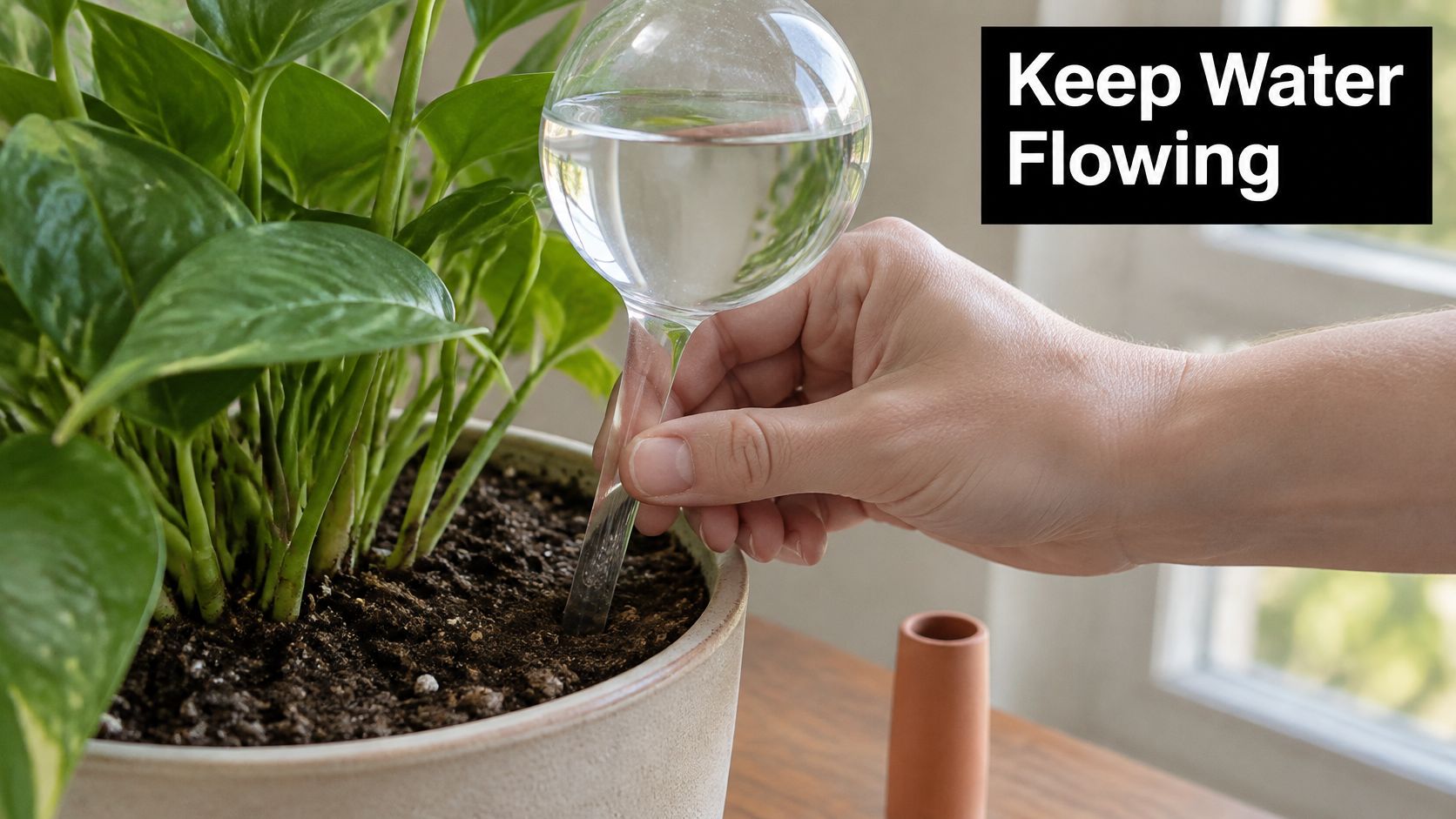
- Insert at an angle with the stem buried and the bulb above the soil line. A slight tilt keeps the tip away from the base of the pot where the mix stays wettest, and it keeps the water level visible so you can see what's left.
- Check after two days, then again at the midpoint of the trip. Look at the level in the bulb and feel the soil at two inches. A bulb that hasn't dropped at all usually means a blocked stem or a pot that was already soaked.
If the level hasn't moved after two days, lift the bulb, rinse the stem under a tap and reinsert it in a fresh spot a few inches away. Dense or gritty mixes can pack around the opening, and the optional plastic anti-clog sleeves for the stem are the simplest fix for soils that keep doing it.
The full range, including the Little Green Leaf watering globes in 100 ml, 200 ml and 350 ml, sits alongside the anti-clog sleeves and mixed-size packs on the Little Green Leaf site.
What Watering Globes Cannot Do and How to Stop Clogs
More water is not safer. A globe that keeps soil permanently damp does as much damage as a dry week, and the plants most often harmed by one are the ones their owners were trying hardest to save.
Here's where a globe is the wrong tool, stated without hedging:
- Succulents and cacti. These plants want soil that dries between waterings, and a globe keeps the root zone moist, which is the opposite of what they need.
- Plants that must dry out. Anything that sulks in constant moisture, from some flowering houseplants to established tropicals in a cool room over winter, does better with a drench and a dry-down.
- A very large pot on one small bulb. A 100 ml globe in a big planter runs dry while the lower soil is still parched, which gives a false sense of security for the whole trip.
- Glass near a doorway or a pet. The bulbs are hand-blown glass and they break if dropped or knocked from a shelf, so place them where a sleeve or a tail won't catch one.
Every protective layer has a failure mode, and covers above the soil have theirs too. Colorado State University Extension warns that a plastic cover touching foliage can transfer cold and injure the leaves it was meant to save, and that a cover has to come off once the air underneath warms. Protection applied without a plan causes harm.
Keeping the stem open
Clogging is the most common reason a globe "stops working", and it's almost always mechanical. Dense soil, gritty mix and hard water all leave deposits in a narrow stem. A pilot hole before insertion is the first defence, because it stops soil packing into the opening from the tip upward.
The plastic anti-clog sleeves that fit over the stem are the second, and they're the sensible add-on for anyone using the same bulb in a gritty cactus mix or a heavy, compost-rich potting soil.
A cleaning routine that takes two minutes
Empty the bulb at the end of a season, rinse it with clean water, then flush the stem by drawing clean water through it until it runs clear. Stand both parts upright to dry fully before storage, so nothing grows in the residue. Between fills, a quick rinse is enough.
If a plant falls into any of the excluded groups above, choose a different aid. A recommendation that names its limits is worth more than one that promises everything.
Watering Globe Questions Answered
How long does a watering globe last? Up to about two weeks per fill, and often less. Thirsty plants, large pots, warm rooms and the 100 ml bulb all shorten the run, while the 350 ml lasts longest.
Can I use a watering globe for a two week vacation? For most houseplants that aren't succulents, yes, provided the bulb is sized to the pot. Water the plant first, fit the globe, and have someone check the bulb at the midpoint.
Do watering globes work for succulents and cacti? No. Globes keep the soil moist, and these plants prefer to dry out between waterings, so a globe can do more harm than a week without water.
How do I stop a watering globe stem from clogging? Make a pilot hole in dense soil before inserting, fit an optional anti-clog sleeve, and rinse the stem under a tap whenever the flow slows or the level stops dropping.
What size watering globe do I need for a large pot? A 200 ml or 350 ml bulb, since large containers are usually paired with the bigger sizes. For a half-barrel or a mature root ball, two bulbs set apart often serve better than one large one.
Little Green Leaf also publishes further reading on the first signs of overwatering, on choosing a pot size that suits a globe, and on drip irrigation for indoor plants if a collection grows past a handful of pots.
Little Green Leaf makes hand-blown glass watering globes in 100 ml, 200 ml and 350 ml, sold in single bulbs, packs and mixed-size sets, with optional anti-clog sleeves for gritty or dense soil. They suit the plants that dry out fast and the trips that come around more often than anyone plans for, and they're trusted by more than 250,000 plant lovers. Visit Little Green Leaf to match a bulb to your pot before the next time you pack a bag.