

Long Spout Watering Can: Water Deep Without Overwatering
A long spout watering can suits a crowded shelf of plants that need careful, hands-on watering; a watering globe suits suitable plants left behind during travel or missed watering rounds. The important difference is what happens inside the pot: the can delivers water during a controlled session, while a globe releases it gradually, for up to about two weeks under suitable conditions, not a guaranteed fortnight.
Table of Contents
- Long Spout Cans Compared With Watering Globes
- Which Plants Suit a Globe and How Long One Fill Lasts
- Pour Through a Long Spout and Check the Root Ball
- How to Set Up a Globe and Keep the Stem Clear
- Keeping Plants Watered While You Are Away
- Pick Your Watering Aid and Start This Week
- Frequently Asked Questions
Long Spout Cans Compared With Watering Globes
A long spout gives reach; it does not limit how much water enters the pot. The spout threads beneath dense foliage so the reservoir never has to pass over the plant, and the pour lands on soil rather than leaves. Pour speed, coverage, and the stopping point all sit with the person holding it, so a can waters exactly as carefully as its user.
A globe works on a different schedule. The hand-blown glass reservoir stays in the pot, and as the soil dries, oxygen flows through the stem and gently displaces water into the root zone. Once moisture returns, the release slows on its own. That suits plants that tolerate maintained moisture, provided the container drains freely.
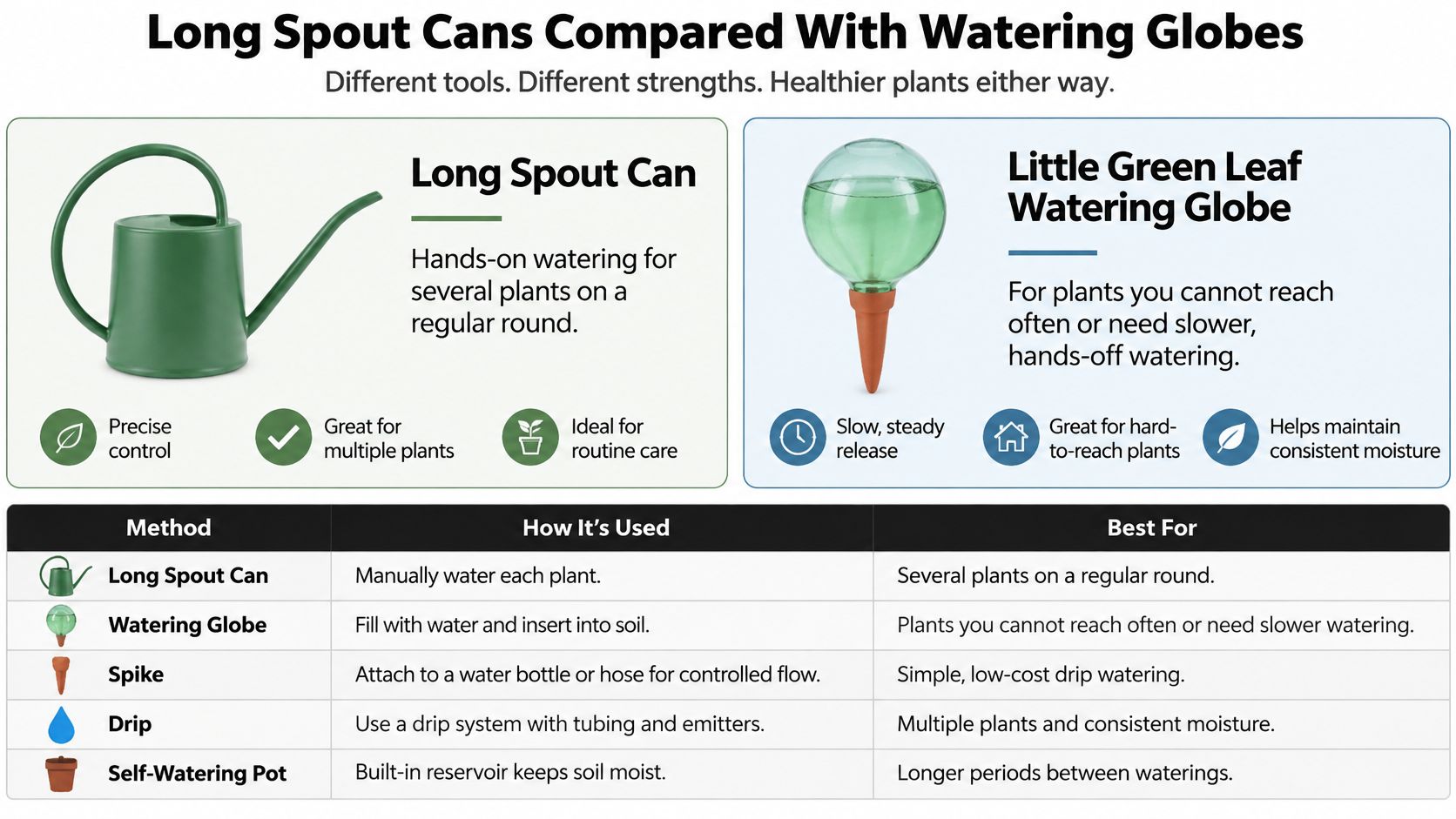
Watering aids compared on the criteria that matter
| Aid | Capacity or reach | Refill effort | Clog risk | Works outdoors |
|---|---|---|---|---|
| Long spout watering can | Choose reservoir size and spout reach to match the collection | Refill each watering session | Low; grit can block the rose | Yes |
| Watering globe | 100, 200 or 350 ml | Fill once; lasts up to about two weeks under suitable conditions | Soil can block the stem; anti-clog sleeves help | Yes, indoors and outdoors |
| Terracotta spike | Reservoir-fed designs draw from an attached water supply | Refill the attached reservoir | Inspect the porous outlet for deposits and soil blockage | Yes, with a suitable reservoir |
| Drip system | Tubing carries water to individual containers | Refill a reservoir or maintain a connected supply | Small outlets need clean water and inspection | Yes, with outdoor-rated components |
Inside the pot is where the comparison gets decided. A fast pour into dry, shrunken soil can run straight down the gap between root ball and pot wall and out the drainage hole, leaving the center dry even though water clearly flowed. A globe's slow release rewets the soil evenly instead, though that same sustained moisture works against plants that need a full dry-down between waterings.
Setup cost follows the same logic as coverage. A single can serves a whole collection, globes occupy individual pots, spikes may need separate reservoirs, and drip arrangements need tubing and outlets, so compare complete setups per plant rather than component prices.
A self-watering plant pot is a related category worth understanding before changing an existing setup.
Practical rule: Whichever aid you use, confirm the water reached the root ball. A wet surface means little; drainage from the base of a freely draining pot is the check that counts.
Which Plants Suit a Globe and How Long One Fill Lasts
One globe fill can last up to about two weeks, with shorter service for thirsty plants, large pots, warm rooms, and smaller bulbs. The 350 ml size holds more reserve than the 100 ml size, but capacity alone doesn't establish a refill date.
Washington State University Extension identifies plant and pot size, container type, temperature, humidity, and growth rate as factors affecting watering frequency. Its central recommendation is to inspect moisture rather than follow a fixed calendar, while remembering that roots need air as well as water.
Watering method by plant group
| Plant group | Soil target | When to water | Globe fit |
|---|---|---|---|
| Succulents and cacti | Dry fully between waterings | After complete drying; every two to three weeks is only a starting interval | Poor; sustained moisture interrupts drying |
| Typical houseplants | Surface zone dries without the root ball remaining soggy | When a below-surface check reaches the plant's appropriate dryness | Good for forgetful owners when the plant tolerates maintained moisture |
| Plants that prefer evenly moist soil | Steadily moist, never waterlogged | Before the root ball dries completely | Good if the pot drains freely |
| Outdoor containers and hanging baskets | Moist but draining | Check as the container dries, especially in hot weather | Useful when bulb capacity matches demand |
For succulents, Iowa State University Extension recommends thoroughly wetting the root ball, allowing drainage, and letting the soil dry completely; every two to three weeks is a starting interval, not a schedule. Yellow leaves or soft stems can indicate excessively wet conditions.
That distinction matters more than whether a plant is described as a houseplant. A globe is appropriate for a plant that benefits from steadier moisture, not automatically for everything grown indoors.
Match the reserve to the container
A very large pot on a single small globe can exhaust the available water early. Conversely, adding reservoirs to an already wet container doesn't correct poor drainage. The useful measure is moisture across the root zone, not whether water remains visible in the bulb.
Outdoor baskets deserve a trial under their actual conditions. A globe that performs adequately in a cool room may empty sooner in a warm, exposed container.
Glass also needs careful handling: it breaks if dropped, and a stem shouldn't be forced into dense soil. A pilot hole provides a safer insertion path.
If the plant needs a complete drying period between waterings, a can is the better choice.
Pour Through a Long Spout and Check the Root Ball
The long spout lets water reach beneath foliage without lifting the can over the plant. That improves access, but successful watering still requires slow infiltration, an open drainage route, and a check beneath the surface.
University of Illinois Extension recommends checking approximately 1–2 inches below the surface and watering according to moisture, rather than a fixed routine. That depth is a useful starting check for many houseplants, adjusted for the plant and container.
A controlled watering sequence
- Probe before pouring. Check below the surface and water only when that zone has reached the appropriate dryness for the plant.
- Position the spout beneath the foliage, close enough to direct water onto the mix rather than splash the leaves.
- Pour slowly across the surface. Move the stream around the root ball, easing the tilt whenever water begins pooling.
- Continue until drainage begins, then verify that the moisture reached the root ball rather than escaping through a shortcut.
- Let the container drain completely and empty the saucer. Roots shouldn't remain standing in the runoff.
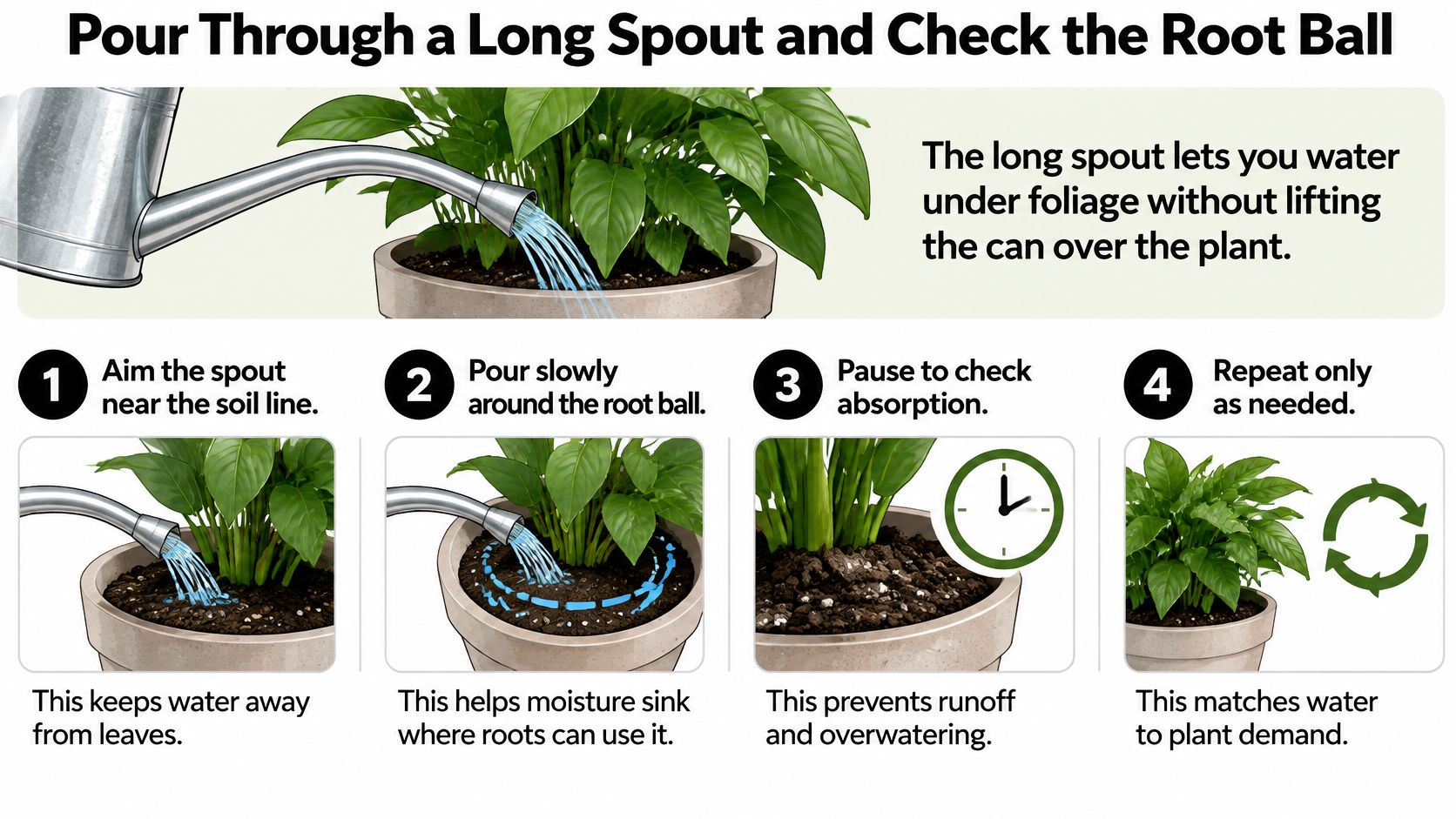
When drainage gives a false impression
Side-channeling occurs when dry, shrunken mix pulls away from the pot wall. Water runs down the gap and exits underneath while much of the root ball stays dry. Immediate runoff therefore isn't proof of successful saturation.
Several smaller pours with short pauses give the mix a chance to absorb moisture. A deeper check distinguishes genuine wetting from water that merely passed through. Little Green Leaf's explanation of how to tell if soil is dry helps separate a dry-looking surface from a dry root zone.
The University of Minnesota Extension watering guidance supports checking roughly 1–3 inches deep, adjusted to container size, and confirming that no standing water remains after approximately 30–60 minutes. For dry, water-repellent mix, it describes bottom watering in approximately 2–3 inches of water for 15–30 minutes, followed by complete drainage.
The inspection itself is quick: check that drainage flows freely and that moisture feels reasonably even at accessible depths. The waiting period belongs to drainage, not continuous handling of the plant.
Symptoms, causes and fixes after watering
| Symptom | Likely cause | Fix |
|---|---|---|
| Water runs down the wall, soil stays dry | Side-channeling in shrunken mix | Apply small pours with pauses, then recheck deeper |
| Surface wet, lower roots dry | Pour stopped too soon | Continue gradual watering until drainage and root-zone checks confirm wetting |
| Water remains in the saucer after draining | Retained runoff or restricted drainage | Empty the saucer and let the pot finish draining |
| Yellow leaves, soft stems | Excess moisture is a possibility | Pause watering and check root-zone moisture before adding more |
| Wilting in dry soil | Underwatering | Bottom water the dry root ball, then drain fully |
| Slow or no flow from the can | Grit blocking the rose | Remove the rose, soak it in warm water, and rinse |
A narrow stream cannot repair a blocked drainage hole or compensate for repeated watering of wet soil. The can is a delivery tool, not a calendar-based dose.
How to Set Up a Globe and Keep the Stem Clear
A globe works best as a moisture-maintenance aid, not an emergency treatment for a completely dry root ball. Starting with evenly moistened soil also makes the initial trial easier to interpret.
Setup for a container between watering rounds
- Water the plant thoroughly first. Let excess water escape before installing the globe, so the reservoir isn't being used to rescue an unevenly dry pot.
- Make a pilot hole with a pencil in dense soil. This creates a route for the stem without forcing glass against compacted mix or roots.
- Fill the bulb with water. Handle it over a stable surface, with enough clearance to avoid striking a tap or sink edge.
- Insert the stem gently at a slight angle. Keep the bulb supported and avoid using it as a lever to enlarge the hole.
- Check the pot after two days. Note both soil moisture and the remaining water, rather than judging performance from the bulb alone.
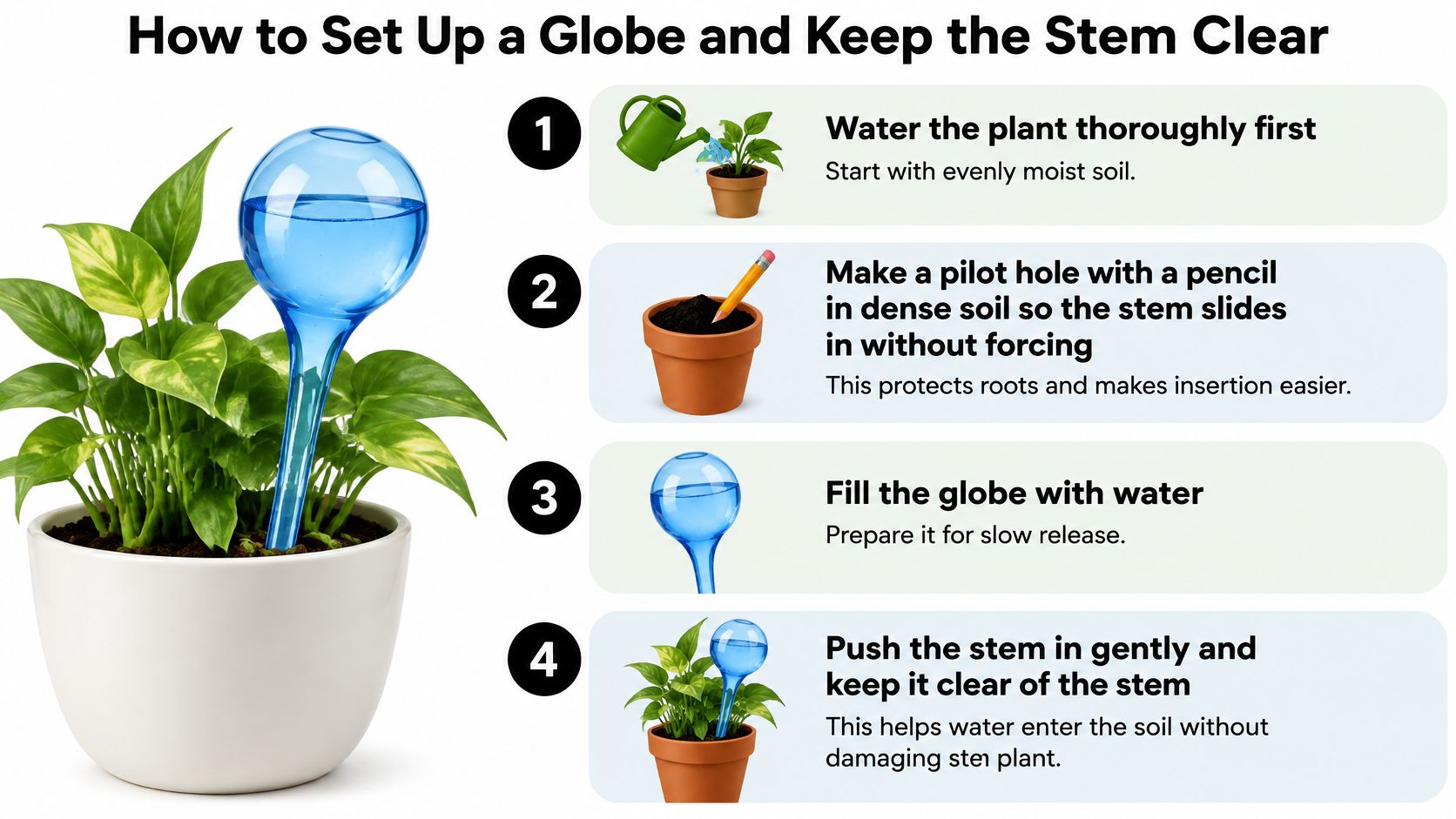
Keep the water path open
Fit the optional plastic anti-clog sleeve before insertion. Keep loose grit off the opening, and rinse the bulb and stem with warm water during refills.
As soil dries, air enters through the stem and displaces water into the root zone. A blocked opening can interrupt that exchange, leaving a full bulb above dry soil. An unchanged water level therefore needs a soil check, not an assumption that everything is working.
Successful setup leaves the root zone appropriately moist, the reservoir emptying gradually, and no persistent pooling on the surface. If the soil becomes saturated, remove the globe and let the container drain before reconsidering capacity or placement.
Keeping Plants Watered While You Are Away
Start with the travel plan, then match the reserve to it. Use the setup and two-day moisture check from the previous section as the baseline; departure changes only the margin you leave in the bulb.
Plan around the tested refill window
- A weekend away: A suitable plant can usually ride on normal care if the trial showed the root ball evenly moist and the reservoir falling steadily.
- Three to five days: Leave only pots that drained well after watering and kept moisture through the middle, not just a damp surface over a dry core.
- About a week: The home trial should still show water in the globe after the early days. If the bulb empties fast, treat the plant as a hands-on watering job.
- Up to two weeks: This is the upper end reported for some plant, climate, pot-size and insertion-angle combinations. Use the largest size that suited the container in testing and arrange a check near the end of the window.
- More than two weeks: Book a refill visit. A second globe adds reserve, yet a person still needs to confirm that water reached the root zone rather than tracking down the side of the pot.
Little Green Leaf's guide to keeping plants watered while on vacation follows the same order: set the reserve, protect the water path, and give someone access to the pot.
A globe is a reservoir with a fixed reserve. Disease, a blocked drainage hole, stale mix and an empty stem still need eyes on the plant.
Plants that need a dry interval stay on their normal wet-dry routine. After the trip, a long spout watering can earns its place again when you want to inspect each container, pour slowly at the soil line and watch for a stream that runs down the edge while the center of the root ball stays dry.
Pick Your Watering Aid and Start This Week
A watering aid earns its place by what happens inside the pot after the water goes in. A fern that sags three days after a thorough soak wants steady top-ups. A jade plant that needs a dry root ball between waterings wants the can.
Choose for refill rhythm and upkeep
- Refill frequency: A can rests between sessions and asks for the tap only on watering day. A globe works daily, so pick a bulb size whose emptying pace you can keep up with.
- Maintenance: A can wants an occasional rinse of the spout. A globe wants a stem kept clear of grit.
- Handling and storage: A larger can cuts refill trips but adds carrying weight, and an extra-long spout needs clearance around shelves. A gentle, predictable stream beats maximum reach indoors.
Take a pothos in a freely draining pot. Watered by can, its root zone stays moist for several days, then dries enough to water again. With a globe set near 45 degrees, the angled stem releases water more readily and the plant stays evenly moist while the bulb empties; set nearer upright, the drip slows. Matching that release pattern to the plant is the selection step.
Little Green Leaf's hand-blown glass Plant Watering Globes come in 100 ml, 200 ml and 350 ml sizes, plus a mixed-size option. Packs of 2, 4 and 6 span multicolor, clear rainbow and mushroom designs, with optional plastic tip covers. They suit indoor and outdoor containers that drain.
Start with a trial pot
The smallest suitable bulb is a sensible start, but the pot's measured behaviour settles the choice. If the root zone dries while the bulb still holds water, check the insertion angle and the soil contact around the stem before buying more capacity.
This week, water one suitable plant with the controlled sequence, let it drain, and note the day its root zone next wants water. Then run the same pot on a globe and compare the two readings.
Frequently Asked Questions
How long does one watering globe fill last?
Up to two weeks, depending on plant type, climate, pot size, and insertion angle. The angle is the part you control day to day: a globe seated at 90 degrees drips more slowly, while 45 degrees lets water release more easily.
Can I use a watering globe on succulents?
Skip it. Succulents and cacti need the root ball to dry fully between waterings, and a globe keeps soil steadily moist. Water with the can, let the pot drain completely, then leave the plant until the mix is dry.
Do I need a pilot hole for a watering globe stem?
In dense soil, yes. Push a pencil into the pot first so the stem slides into loosened material instead of compacted soil. That protects the hand-blown glass and leaves a clear channel around the opening.
Is a long spout watering can better than a watering globe?
They behave differently inside the pot. A can delivers one soak that you watch drain through. A globe releases water only as the soil dries: oxygen moves down the stem, displaces water into the root zone, and the flow slows on its own once moisture returns. Choose by what the root zone needs after watering.
How do I stop a watering globe stem from clogging?
Fit the optional anti-clog sleeve, keep grit away from the opening, and rinse the bulb and stem with warm water when refilling. If release stops, check the soil and opening before assuming the plant doesn't need water.
Little Green Leaf offers glass watering globes for suitable plants that need gradual hydration between hands-on watering rounds. Visit Little Green Leaf to choose a bulb size, then test it in a freely draining pot before relying on it during a trip.