

Hanging Basket Watering System: How Long One Fill Lasts
A hanging basket can drip all over the patio and still be dry where it matters. Water poured across the surface darkens the compost for an hour, runs down the inside of the liner and leaves the lower half of the root ball untouched, while the roots that feed the flowers sit pressed against a wall of coir or wire that loses moisture to moving air on every side.
So the useful question isn't how often to water a hanging basket. It's how many days of demand a hanging basket watering system can cover before the compost crosses from moist to dusty, and whether you'll be there when it does. A globe, a spike, a drip line and a reservoir basket each answer that differently, and one of them will fit your basket better than the rest.
The numbers below come from measured trials and extension guidance rather than watering-can folklore. They set out how much a basket really drinks, how long a fill lasts at that rate, when a different system earns its place, and how to keep whichever you choose running through a heatwave.
Table of Contents
- Which Watering System Fits a Hanging Basket
- Why Hanging Baskets Dry Out Faster Than Pots
- How Long One Fill Lasts in a Hanging Basket
- How to Set Up a Little Green Leaf Globe in a Hanging Basket
- Spotting Overwatering and Underwatering Before Plants Suffer
- Stopping Clogs and Keeping Globes Working All Summer
-
Hanging Basket Watering Questions People Ask
- How often should I water a hanging basket
- Do watering globes work in hanging baskets
- How long does a 350 ml watering globe last in a hanging basket
- Can I leave hanging baskets for two weeks with a watering globe
- Why is my hanging basket wilting when the compost is wet
- How do I unclog a watering globe stem
Which Watering System Fits a Hanging Basket
The arithmetic settles most of this argument. A basket in summer drinks water in the hundreds of millilitres a day, so a globe filled with 100, 200 or 350 ml buys days, not fortnights. At the top of the measured range even a 350 ml globe is a one-day buffer.
A globe is still the right tool for a specific job: holding moisture steady between the checks you already make and spanning the three or four days when life gets in the way. Where a basket has to survive a full holiday with nobody home, a reservoir basket or a drip line carries the bulk of the water, and a globe works alongside as insurance. One arranged mid-trip refill turns even a modest globe into a week of cover.
Hanging basket watering options compared
| Option | How long one fill lasts | Setup | Refill effort | Clogging | Works outdoors |
|---|---|---|---|---|---|
| Little Green Leaf globe (100, 200 or 350 ml) | About 1 day (100 ml) to about 4 days (350 ml) at 80 ml a day, shorter at 160 to 380 ml a day | Water the basket first, make a pilot hole, fill, insert at an angle | Refill when empty, recheck after two days | Grit in the stem, anti-clog sleeve helps | Yes |
| Ceramic or plastic spike | Hours to a short day, very small reservoir | Push into moist compost | Refill often | Low | Poor fit on a hanging basket |
| Drip line with emitters | Runs while the timer is on, not one fill | Tubing, emitters and a timer | Check emitters on a schedule | Emitters clog with fine grit | Yes |
| Self-watering basket with reservoir | Longer than a 350 ml globe, still not a fixed fortnight | Built-in reservoir | Top up the reservoir on a schedule | Low | Yes |
The evidence favours steady delivery over sheer volume. In a nine-week Royal Horticultural Society trial at RHS Garden Wisley, where the run included a day at 36.7°C and every basket used under 25 litres in total, an average of roughly 142 to 380 ml a day, self-watering baskets produced a similar number of flowers to hand-watered baskets while using about one-third less water, and doubling the manual volume raised flowering by only 8% to 15% (RHS hanging basket watering trial).
Practical rule: choose the system that bridges the days between your checks, not the days you imagine you'll be away.
Globes suit moisture-loving flowers and foliage. Succulents and cacti want to dry out between drinks, and one small globe cannot carry a large, sun-baked basket for two weeks. No device of any kind rescues a basket that has been allowed to bake bone dry, because peat-based compost becomes hard to rewet once it shrinks away from the liner.
Run three questions against the basket in front of you before you buy anything.
- How big is it? A packed 30 cm petunia basket holds more compost and drinks more than a small fern basket, and it can carry two globes where the small one takes a single stem.
- How often can you check it? Daily checks mean a 100 ml or 200 ml globe is plenty. Weekly checks mean a reservoir or a drip line, whatever the packaging promises.
- Where does it hang? A shaded porch basket behaves almost like a houseplant, while a wall bracket in full afternoon sun pushes demand toward the top of the range and shortens every fill.
Plant choice sets demand as much as hardware does, and seasonal planting advice for small plots is worth a look before you pack a liner with vigorous trailers that will drink a small reservoir dry by August.
Why Hanging Baskets Dry Out Faster Than Pots
Hang a petunia basket on a wall bracket and stand an identical pot two feet below it, and by late July the two plants will be on different schedules. The basket dries first, and not because it holds less compost. Four things work against it at once.
- Air on every face. A basket's sides are liner, not glazed ceramic, so wind pulls moisture through the walls as well as off the surface.
- Rising heat. Warm air gathers around a hanging container in full sun, and a basket in a hot corner can go from saturated to wilting inside a day.
- Crowded roots. Petunias and busy lizzies sharing one liner fill it with roots and then drink a small volume of compost very fast.
- A thin buffer. There's no reserve beneath the root ball. Every dry hour cuts straight into the plant.
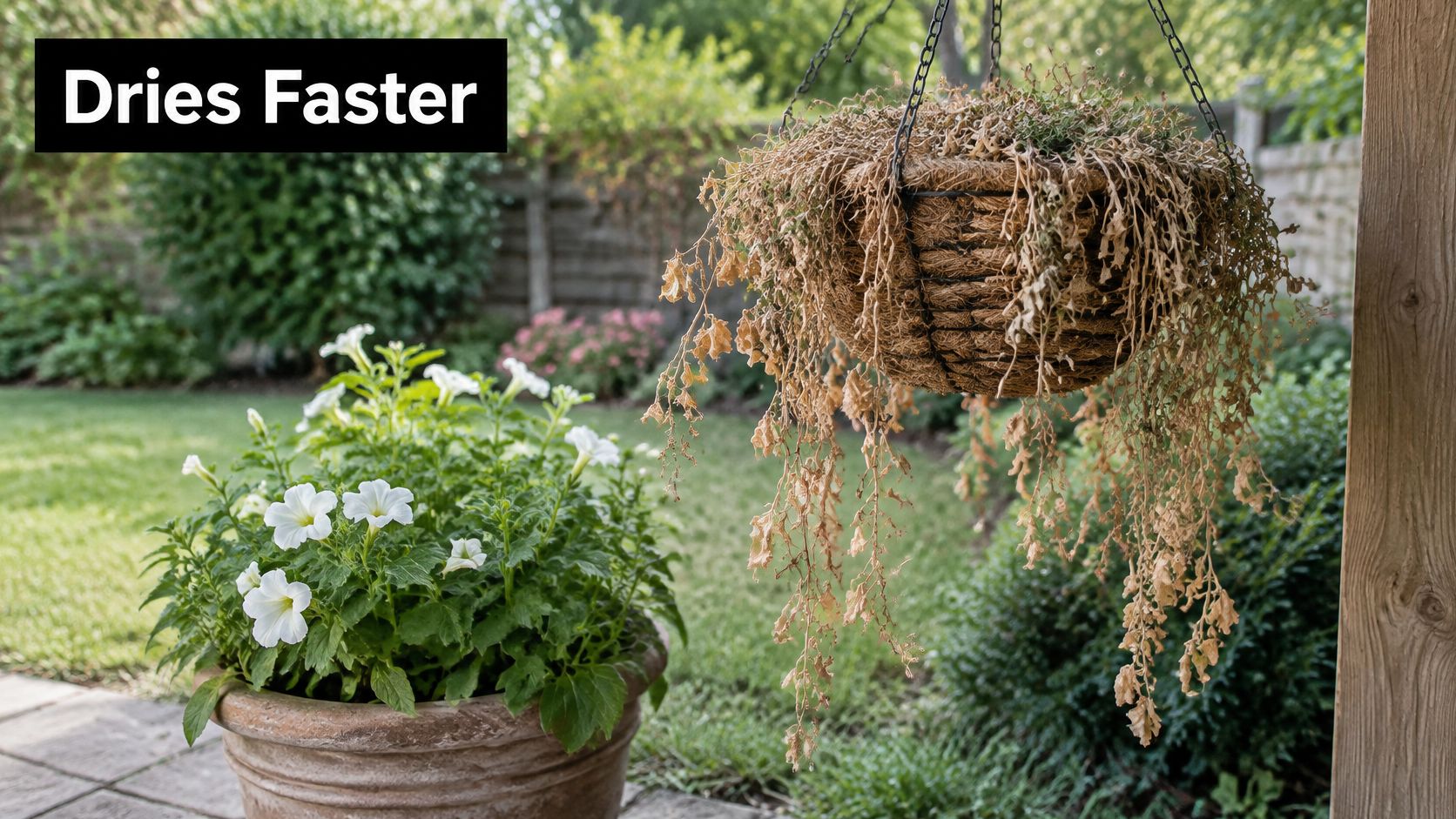
That variability is why calendars fail. Extension sources describe baskets needing water every one to two days, daily, or even two or three times a day, depending on container size, sunlight, temperature, wind, plant density and humidity (Oregon State University Extension guide to hanging baskets). Container size alone shifts the interval by days. Oklahoma State University Extension notes that small pots may need water every two to three days, while large pots may wait seven to fourteen (Oklahoma State University Extension on houseplant care). A hanging basket sits at the fast end of that range and often beyond it.
Check below the surface, not on it. Push a finger or a wooden skewer a couple of inches into the compost near the centre and again near the base, and water only when that zone feels dry. A fuller schedule for different basket types sits in this guide to how often to water hanging plants.
Recalibrate three times: after the plants fill out and root growth takes off, after the basket moves into more sun or a windier spot, and at the start of a heatwave. A globe covers the gap between those checks. It doesn't replace them.
How Long One Fill Lasts in a Hanging Basket
A petunia or busy lizzie basket does not drink at one speed. Measured demand runs from roughly 80 ml a day in mild, still weather up to about 380 ml a day once heat, wind and a full root ball stack up. Put those rates against globe capacity and one fill lasts anywhere from a few hours to about four days.
Globe size against daily basket use
| Globe size | Mild day (about 80 ml) | Hot, windy day (about 380 ml) | When to use it |
|---|---|---|---|
| 100 ml | About 1 day | A few hours | Small basket checked daily |
| 200 ml | About 2 to 3 days | About half a day | Typical basket in mild weather |
| 350 ml | About 4 days | Just under 1 day | Larger basket or the longest passive run |
| Two weeks away in summer | Not covered by one fill | Not covered by one fill | Plan a mid-trip refill or a second globe |
The globes come in 100 ml, 200 ml and 350 ml sizes plus a mixed option, so a wide liner can carry two stems instead of one. Two 200 ml globes in a large basket hold more than a single 350 ml and deliver water at two points in the root zone, which matters when one side of the basket dries faster than the other.
A fixed daily dose is the wrong mental model anyway. A system should respond to drying conditions rather than deliver a set volume, with delivery adjusted for basket size, plant density, sunlight, wind and temperature, and a periodic thorough water that reaches the lower root zone (Nebraska Extension guidance on hanging baskets). That is roughly how the globe itself behaves: as the soil dries, oxygen moves down the stem and displaces water into the root zone, and when moisture returns the airflow slows and the release drops off on its own. The thing to watch is placement. If the bottom of the basket stays dry while the top stays damp, the stem is not delivering where the roots are.
Insertion angle changes the run. Little Green Leaf notes that a globe pushed in at 90 degrees makes it harder for air to escape and slows the drip, while a 45 degree angle lets water out more easily. On a sun-baked basket, the shallower angle buys hours.
Two weeks is a houseplant upper bound, not a summer basket promise. Little Green Leaf rates the water in its globes at up to two weeks depending on plant type, climate, pot size and insertion angle, and a thirsty basket in July is the least favourable version of every one of those variables.
Time the first fill over an ordinary day rather than a cool one, and expect hot sun, wind and crowded roots to shorten the run while shade and cloud stretch it. For a fortnight away in summer, one fill will not cover it however the numbers fall, so plan a mid-trip refill or fit a second globe.
How to Set Up a Little Green Leaf Globe in a Hanging Basket
Setup is simple, and nearly every failure comes from skipping the first step or forcing the stem. Work through these five in order, preferably before the basket goes up on its hook.
- Water the basket first, until the compost is evenly moist. A globe releases into damp soil. Pushed into dry mix it stalls, and the compost around the stem stays dusty while the reservoir sits full.
- Make a pilot hole with a pencil. Dense liner compost packs hard, and a glass stem forced into it can snap or plug itself with grit. The hole should run as deep as the stem is long.
- Fill the bulb with clean water and fit the anti-clog sleeve if the mix is gritty. Tap water is fine. Water scooped from a saucer of old runoff carries algae and particles straight into the bore.
- Push the stem in at an angle so the outlet sits in the root zone, then hang the basket. A 45 degree insertion lets air in and water out more freely than a vertical push. Insert before hanging, because glass breaks when it's dropped and wrestling a full globe into an overhead basket is how drops happen.
- Check after two days, at the stem and near the base. If the lower compost is still dry, add a second globe or water by hand. If it's soggy, pull the globe out and let the basket drain before refilling.
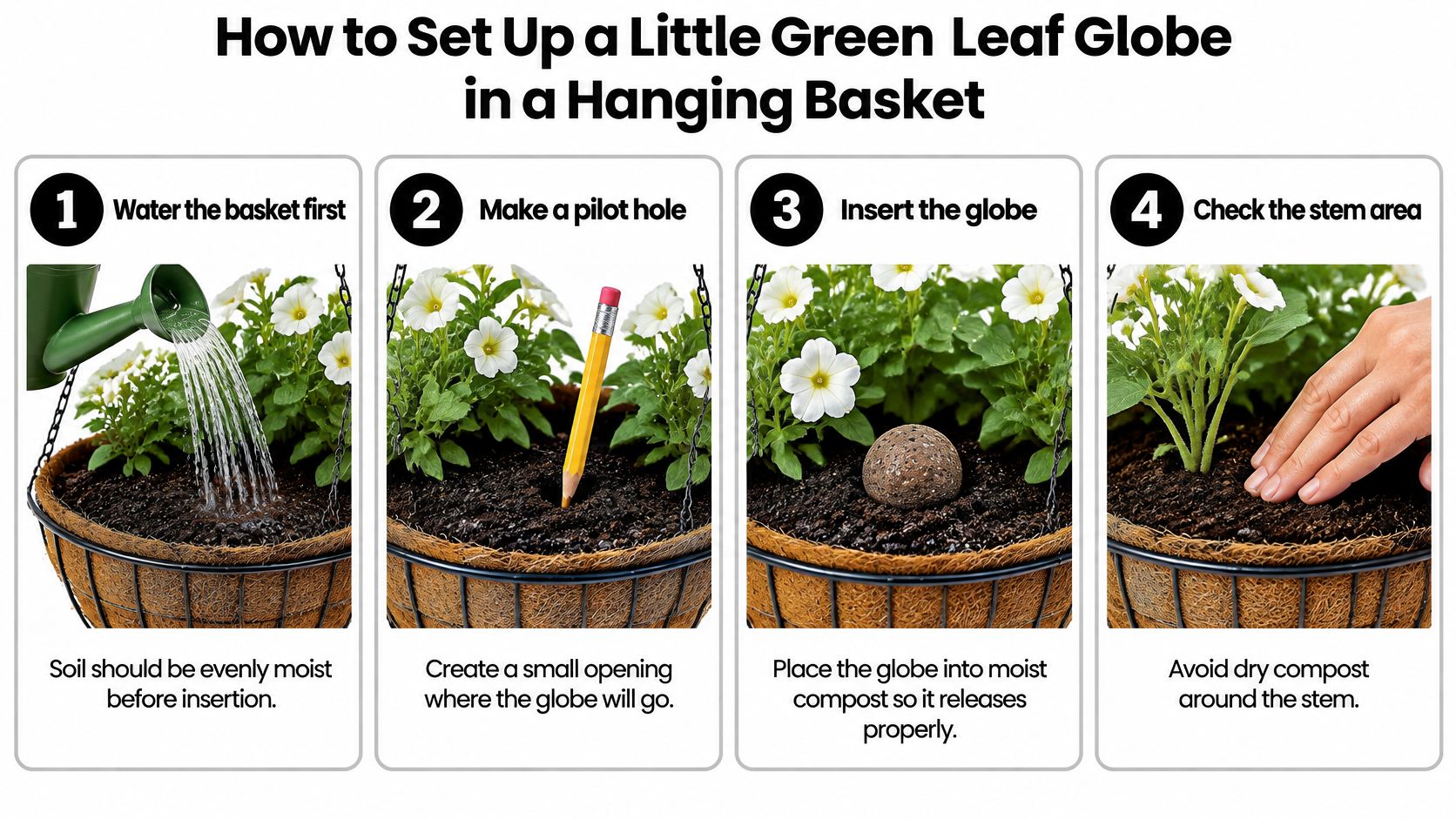
The short version is three moves: fill the globe, insert it into moist soil, then leave it to work. What the longer version buys you is a basket that stays evenly moist instead of alternately flooded and parched, which is what keeps petunias flowering rather than sulking. The whole Little Green Leaf globe range is built around that slow release, with sizes for small baskets up to thirsty ones.
One fill never replaces two or three waterings on a hot day. A globe smooths the curve. It doesn't rewrite the weather.
Spotting Overwatering and Underwatering Before Plants Suffer
A basket can look dark and wet on top and be bone dry two inches down, which makes the surface the least useful thing to touch. The Royal Horticultural Society and the University of Reading tested subsurface irrigation delivered about 5 cm below the compost surface, and the top layer stayed visibly dry while plant quality improved (RHS water use in gardens). Root-zone moisture is the measure that matters. The same work found that watering didn't need to produce drainage from the basket to keep plants healthy.
That finding explains most basket failures. Water that darkens the surface and pours straight out of the liner can leave the lower root zone untouched, so the plant wilts while the gardener insists it was watered this morning.
The check that beats the calendar
Feel the compost before you judge it by eye. University of Maryland Extension recommends testing the growing medium with a finger to a depth of about 2 inches and watering when it feels dry at that depth (University of Maryland Extension on watering indoor plants). It separates the two extremes clearly: plants that are too dry wilt and turn grey-green, while plants that are too wet drop leaves or yellow. A globe helps between checks, but the checks still matter.
On an exposed wall in summer heat, a basket pulls hundreds of millilitres a day, so the finger test matters most exactly when the globe is draining fastest.
Why wet compost can still wilt a plant
Saturated compost displaces the oxygen roots need, and the roots deteriorate instead of drinking. University of Connecticut Extension explains that oxygen-starved roots lose their ability to take up water, so the plant wilts even though the mix is soaked (UConn Extension on watering houseplants). Its practical sequence is to check about an inch down, water thoroughly when that layer is dry, and empty any saucer or cachepot within roughly an hour.
Lifting the basket works as a second opinion. A basket that feels light and reads dry at fingertip depth needs water, while one that stays heavy and wet needs time to drain.
Hanging basket symptoms, causes and fixes
| Symptom | Likely cause | Fix |
|---|---|---|
| Wilting while the surface looks dry | Root zone is dry and the surface is misleading | Water until drainage exits the base, and check the globe is flowing |
| Wilting while the compost stays wet | Waterlogged roots short of oxygen | Stop refilling, let the root zone drain and dry |
| Yellowing leaves and soggy compost | Overwatering from a globe stuck open in dense mix | Empty the globe, drain the basket, wait for the top to dry |
| Dry compost and an empty globe | Reservoir empty or the stem blocked | Clear the stem, refill, check again after two days |
A basket that wilts with wet compost is drowning. More water is the wrong fix and the fastest way to lose the plant.
A globe releases in proportion to dryness and tapers off once moisture returns, the same airflow mechanism described in the setup steps. What it can't do is rescue a basket that's already waterlogged. If a basket wilts while the compost stays wet, stop refilling, let the root zone drain, and check the base for standing water before you do anything else. More detail on the early warning signs sits in this guide to the signs of overwatering plants.
Stopping Clogs and Keeping Globes Working All Summer
Clogs come from three places: fine compost drawn up into the stem, mineral film from hard water, and algae when the same water sits in the bulb for weeks. All three are preventable, and none of them requires a new globe.
Prevention first. Always open a pilot hole rather than forcing the stem, and fit the anti-clog sleeve when the basket mix is gritty or contains coir dust. Fill with clean water, not the murky runoff from a saucer. If flow stops, lift the globe out instead of leaving it jammed in wet compost, where it does nothing but keep the root zone saturated.
Cleaning takes ten minutes at the end of the season. Empty the bulb, rinse it with warm water, then soak the stem in a mild vinegar solution to lift mineral film. Clear the bore with a thin brush, rinse everything, and dry it fully before storing indoors. Frost cracks glass that has been left outside with water in it.
Output changes with conditions, so check it rather than trusting a calendar. A review of container irrigation research in HortTechnology describes systems that trigger watering at a defined container weight and stop once a higher target is restored, one of them irrigating at 94% of its setpoint and stopping at 98% (HortTechnology review of container irrigation). The principle applies to a passive globe: delivery follows the moisture gradient between reservoir and compost, so angle, compaction, a partly blocked stem and evaporation all change the rate. Treat the globe as a low-flow buffer, not a guaranteed fixed dose.
The 24-hour test: mark the water line on the glass, leave the globe in the basket for a day in its normal sun and wind, and note how much disappeared. Repeat once right after you water the basket and once as the surface starts to dry.
Release should be faster when the compost is dry and slower when it's already wet, because that moisture difference is what drives flow. If almost nothing leaves a dry basket, clear the stem and reset the angle before you buy a larger globe. What owners report after a season of use, both the wins and the annoyances, is collected in these plant watering globe reviews.
Hanging Basket Watering Questions People Ask
How often should I water a hanging basket
In hot sun, two or three times a day is normal for a full basket, and in cool cloudy weather it may stretch to every two or three days. Judge by the moisture check described earlier rather than the calendar, since the interval swings with wind, exposure and how crowded the roots are.
Do watering globes work in hanging baskets
Yes, for moisture-loving flowers and foliage, provided the compost starts moist and you accept a fill measured in days rather than weeks. They don't suit succulents or cacti, and one small globe won't carry a large basket through a heatwave on its own.
How long does a 350 ml watering globe last in a hanging basket
About four days where the basket uses around 80 ml a day, about two days at 160 ml, and less in wind or full sun. Time the first fill under real conditions rather than on a mild day, and you'll have a working figure for your own basket.
Can I leave hanging baskets for two weeks with a watering globe
One summer fill won't stretch that far. Use the timed figure from your own basket, plan a mid-trip refill, or fit a second globe and move the basket into shade to cut demand. Two weeks is a houseplant figure, and a summer basket will not match it.
Why is my hanging basket wilting when the compost is wet
That is the waterlogged-roots problem covered in the overwatering section: stop refilling, let the basket drain, and check the base for standing water before adding anything else.
How do I unclog a watering globe stem
Empty the bulb, rinse it, soak the stem in a mild vinegar solution, then clear the bore with a thin brush and rinse again. A tip cover keeps grit out of the stem on the next insertion.
Little Green Leaf makes hand-blown glass watering globes in 100 ml, 200 ml and 350 ml sizes, with a mixed size option and optional tip covers and adapters for gritty basket compost. For a hanging basket that dries out between visits, a globe seated in the root zone is the simplest way to stop the compost swinging from soaked to dusty. Match the size to the basket with the Little Green Leaf range before your next trip and let the basket water itself for the days you can't.