

Hand Blown Glass Gifts: How to Choose One That Lasts
Hand blown glass gifts are individually shaped pieces, so no two are exactly alike, and the most appreciated choices pair that artistry with everyday usefulness. For a plant lover who forgets to water or worries about plants while traveling, a decorative watering globe can offer both.
The familiar gift-shopping puzzle is finding something personal that won't become another object in a cupboard. A colorful glass bulb nestled among leaves feels considered, but its usefulness depends on the recipient's plants, watering habits, and willingness to handle glass gently.
Table of Contents
- Why Hand Blown Glass Gifts Make Such Memorable Presents
- How Hand Blown Glass Is Made and Where the Craft Began
- What to Check Before Buying Hand Blown Glass Gifts
- How to Match Hand Blown Glass Gifts to the Person and Occasion
- A Hand Blown Glass Gift That Waters the Plants Too
- How to Care for Hand Blown Glass So It Lasts
- Choosing Your Hand Blown Glass Gift With Confidence
- Hand Blown Glass Gifts FAQ
Why Hand Blown Glass Gifts Make Such Memorable Presents
A friend loves deep green. You know that much. What you may not know is whether a gift will earn a place in her home or disappear into a cupboard within a month. That gap between "pretty" and "kept" is where most gift choices go wrong.
Before you pick a color, check how the recipient waters: a forgotten watering routine needs a different gift than a shelf decoration. Someone who enjoys checking every pot each morning will look at the glass itself. Someone who travels for work may value the steady drip far more than the swirl of color.
Character without perfection
Hand-shaped glass works like handwriting. Two pieces from the same maker can share a form and still differ, the way two signatures from one hand never match exactly. A curve may lean slightly. A color pattern may settle differently. Those small variations are the signature of the process.
Some irregularities are harmless, and others call for a refund. Hand production creates character, but damage such as chips, cracks, or leaking joints is a different matter. Clear material descriptions and honest photos from the seller help you tell one from the other before you buy.
A maker's signature adds character. Buyers should still be able to confirm that the piece is sound before filling it.
A thoughtful choice weighs a few things together:
- A real purpose. The recipient has a compatible plant and a watering problem the globe can reasonably help with.
- An appealing appearance. The glass suits the recipient's taste without requiring a room rearrangement.
- Manageable care. Gentle washing and careful handling fit the recipient's habits.
- Clear expectations. The gift comes with practical instructions, so the recipient knows what it can and cannot do.
Useful doesn't mean maintenance-free
A watering globe lends a hand with the routine. The owner still does the watching. It needs refilling, occasional cleaning, and a glance now and then to confirm water is moving into the soil.
That distinction matters when choosing hand blown glass gifts. A useful object earns its place without exaggerated promises or hidden chores. The personal touch comes from matching the gift to a real need, then making it easy to enjoy.
How Hand Blown Glass Is Made and Where the Craft Began
Every hand-blown piece carries two kinds of history. One is the centuries of craft behind it. The other is the few heated minutes in which it took shape, and both are worth knowing before you buy.
The older history runs deep. In 1291, Venice moved its glass furnaces to the island of Murano, concentrating skilled workers and closely held techniques in one place. Renaissance makers there went on to develop the remarkably clear cristallo glass and delicate filigree work that still shape what people expect from fine glassware.
That background helps explain why glass can carry meaning beyond its practical function. A finished piece is the record of choices made while the material was hot and moving.
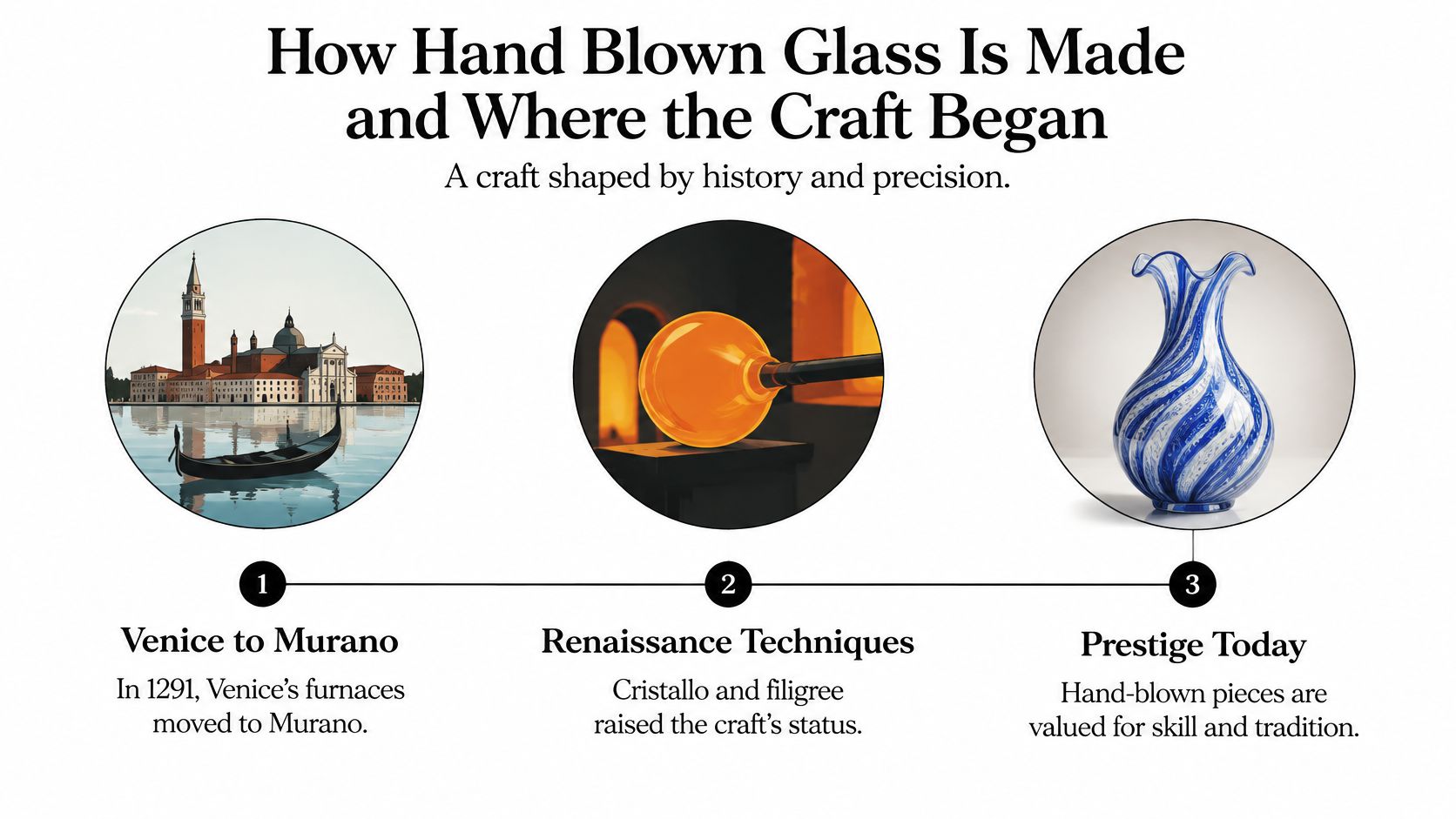
From large furnaces to individual studios
A major turning point for modern studio glass came in 1962, when Harvey K. Littleton and Dominick Labino ran experimental workshops at the Toledo Museum of Art. Their small-furnace approach and lower-temperature glass formula showed that artists could melt and shape glass outside large industrial plants.
The important distinction is access. Individual artists gained a practical way to work the material in studio settings, which created the conditions for artist-led, small-batch objects alongside factory production.
Individually made glass predates 1962, but the Toledo workshops made studio work practical for individual artists.
What happens at the blowpipe
The basic process is easier to follow than a finished piece suggests:
- Gather. The maker collects molten glass on a blowpipe.
- Inflate. Breath expands the hot material into a hollow form.
- Shape. Turning, gravity, and tools guide the outline while the glass remains workable.
- Anneal. The finished piece moves into a temperature-controlled kiln, where it cools slowly and evenly so internal stress can release instead of locking into the glass.
Picture a soap bubble that a glassmaker can hold in shape, but the glass stays hot and workable only under skilled control.
Annealing deserves a closer look because surface beauty reveals nothing about what is happening inside. A piece that cools too fast can carry hidden tension, and that tension is what later turns a small knock or a temperature change into a crack. Two pieces that look identical on a shelf can behave very differently in a kitchen.
For a gift the recipient will use, that invisible cooling stage matters as much as the colors you can see.
What to Check Before Buying Hand Blown Glass Gifts
A listing can say "hand-blown" and still leave the buyer guessing. That phrase tells you how the glass was shaped. On its own, it says nothing about the material, the cooling process, or whether the piece can handle everyday use.
A product photograph shows color beautifully while revealing little about a narrow stem or the join between bulb and neck. Clear descriptions and honest close-up photographs tell you more than elaborate craftsmanship language.
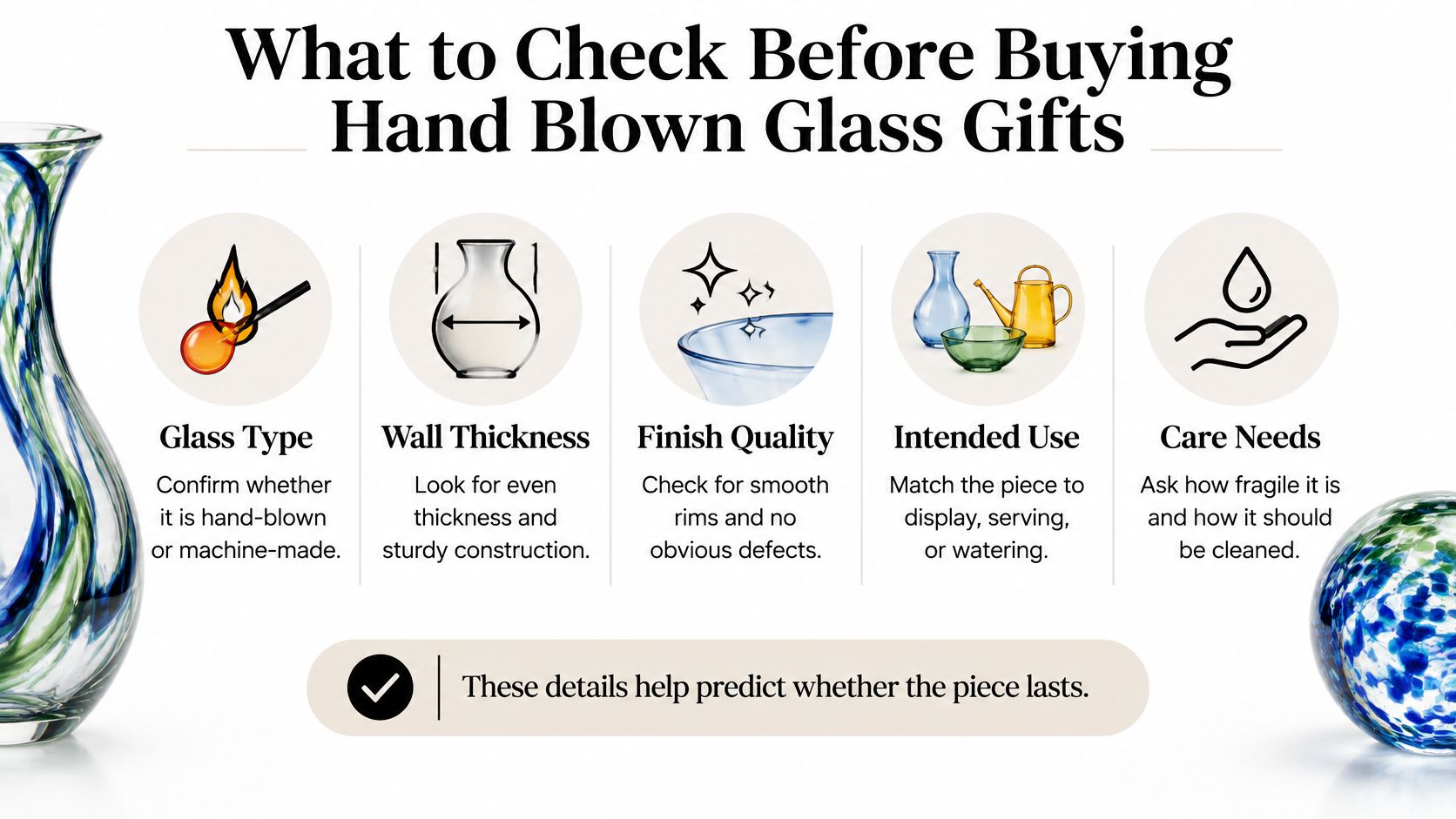
Ask about material and manufacturing
Two glasses that look identical on a shelf can behave very differently in a warm kitchen. Borosilicate glass expands less when heated than soda-lime glass, so it takes temperature swings more calmly. Soda-lime glass turns up more often in decorative work and asks for gentler treatment around heat. Either can make a fine gift, provided the glass was cooled slowly and evenly after shaping, the annealing step that relieves stress locked in during forming.
Useful questions for the seller include:
- Glass formulation. Does the seller identify borosilicate, soda-lime, or another composition?
- Annealing and inspection. Can the seller explain controlled cooling and the checks performed before dispatch?
- Material safety. Is there a clear lead-free statement where relevant, rather than an assumption based on appearance?
- Vulnerable areas. Are the stem, neck, and decorative transitions free of cracks, sharp edges, or conspicuously thin sections?
- Damage support. Are reporting procedures and replacement expectations available before purchase?
A seller who cannot answer these questions has not proven poor quality, but the buyer should ask again before paying.
Separate character from damage
Slight asymmetry, tool marks, or small enclosed bubbles often come with hand production. Whether they matter depends on location, severity, and whether they affect function.
A sharp chip, spreading crack, or leaking joint is damage. Handmade charm is no excuse for a flaw that will worsen with use.
Function deserves the same scrutiny as appearance. A globe, vase, or tumbler the recipient will reach for every day needs a comfortable weight, a stable base, and openings wide enough for easy filling and cleaning. Those details rarely appear in a product title, so they are worth a direct question or a careful look at the photographs.
For a watering gift, plant watering globe reviews offer a place to weigh practical questions alongside appearance. The useful questions concern setup, filling, handling, and suitability, as well as whether the color looks attractive.
Presentation deserves separate thought. Jolitee's personalized jar gifts for party hosts can serve as a related resource for presentation ideas, while construction checks remain the priority for any functional glass purchase.
How to Match Hand Blown Glass Gifts to the Person and Occasion
A color can catch the eye in a photo. A better clue is the moment the plant gets thirsty: dry soil on Monday, a packed calendar by Wednesday, and good intentions doing the watering.
That gap between intention and routine is where the match happens. A hand-blown piece works like a well-chosen kitchen tool: lovely to look at, most valuable when it fits the hand that reaches for it.
Match the gift to a real watering problem
A busy plant owner who keeps finding one pot crisped between checks needs support for that specific pot, with clear reminders to keep observing moisture rather than handing the job to glass. A frequent traveler needs proof before the trip: water demand shifts with season, airflow, humidity, room temperature, and light, so a trial in the actual pot beats any general duration claim.
Other situations call for the same practical test. A new renter does best with a globe sized to an existing pot, not an imagined jungle. An office plant needs instructions that name one responsible person, since several helpful coworkers can all add water. A beginner needs the simplest setup and one thing to watch before refilling. Outdoor containers dry quickly in warm weather, so the gift works only if someone can still check it.
A gift for someone who habitually overwaters needs particular care. Adding another water source can feed the problem, so match that recipient to guidance first and glass second.
Make it personal without pretending it is magic
Personal does not have to mean engraved. Palette, usable size, packaging, and a note written for the recipient's circumstances can say more than initials. ROCKS Whiskey Chilling Stones' glassware personalization ideas offer a useful way to think about presentation; for a watering piece, ask the seller before changing anything that touches safety.
A short card can explain the choice plainly: for the office plant everyone assumes someone else watered. The collection of unique gifts for plant lovers gives more directions to explore, and the deciding question stays practical. Will this piece be used on an ordinary Tuesday?
A Hand Blown Glass Gift That Waters the Plants Too
A watering globe combines a hollow glass bulb with a long stem. Fill the bulb, flip it, and press the stem into moist soil. As the soil dries, it draws water from the stem a little at a time, the way a straw only pulls when you sip. The plant waters itself between visits.
How long does one fill last? Buyers report anywhere from several days to about two weeks, and the honest answer is that it depends. Thirsty plants, large pots, warm rooms, and smaller globes all shorten the interval. The range offers 100 ml, 200 ml, and 350 ml capacities, 1, 2, 4, and 6 packs, and multicolor and clear rainbow finishes, so a larger bulb does store more water. More stored water still doesn't guarantee a set number of days away.
Which Globe Size Suits Which Gift
The capacities below come from the product range. Pot matches are starting points for testing, not fixed sizing rules.
| Globe Size | Best For | Gift Pairing Idea |
|---|---|---|
| 100 ml | A small compatible pot with modest water demand | A compact desk-plant gift with a care note |
| 200 ml | A small-to-medium planter needing supplemental moisture | A housewarming gift matched to an existing plant |
| 350 ml | A medium planter or a situation needing more stored water | A travel-minded gift with instructions for a trial |
Every size still needs filling and periodic inspection. Clogging, refill effort, and outdoor performance depend on the actual setup rather than capacity alone.
Optional plastic anti-clog sleeves are available for the stem. They can help with soil blockage, but they don't remove the need to check that water is moving.
Where a globe isn't the answer
Succulents and cacti need their soil to dry out completely between waterings, so a slow, steady water source is a poor match for them. The same caution applies to any plant that prefers a thorough dry interval.
A single small globe is also an unrealistic promise for a very large pot. Glass breaks if dropped, and a stem should never be forced through dense soil.
Wilting can mislead, too. Both overwatering and underwatering produce drooping leaves, so check the moisture with a finger before assuming a plant is thirsty.
How to set up a globe for a gift recipient
- Water the plant first. Begin with moist soil that has drained, not a saturated pot or a bone-dry root ball.
- Make a pilot hole. Prepare an opening in dense soil so insertion doesn't require pressure on the glass.
- Fill and insert. Fill the bulb, then position the stem at a slight angle with the globe supported securely.
- Check after two days. Inspect the remaining water and soil moisture, and keep observing for a few days before relying on the globe during travel.
For a closer look at how these pieces work, see the guide to hand-blown glass watering bulbs. Once plant compatibility is established, the Little Green Leaf range of globe sizes and bundles is the practical next step.
How to Care for Hand Blown Glass So It Lasts
A hand-blown piece teaches its own care routine the moment it leaves the box. Before the first fill, hold the globe up to a window and turn it slowly, checking for chips, cracks, sharp edges, or damage where the stem meets the bulb. Light reveals flaws that a quick glance on a countertop can miss.
Once the piece looks sound, give it a gentle rinse. Its job should stay clear too: a decorative watering aid has limits, and food, hot liquids, or other household uses all need separate confirmation from the maker.
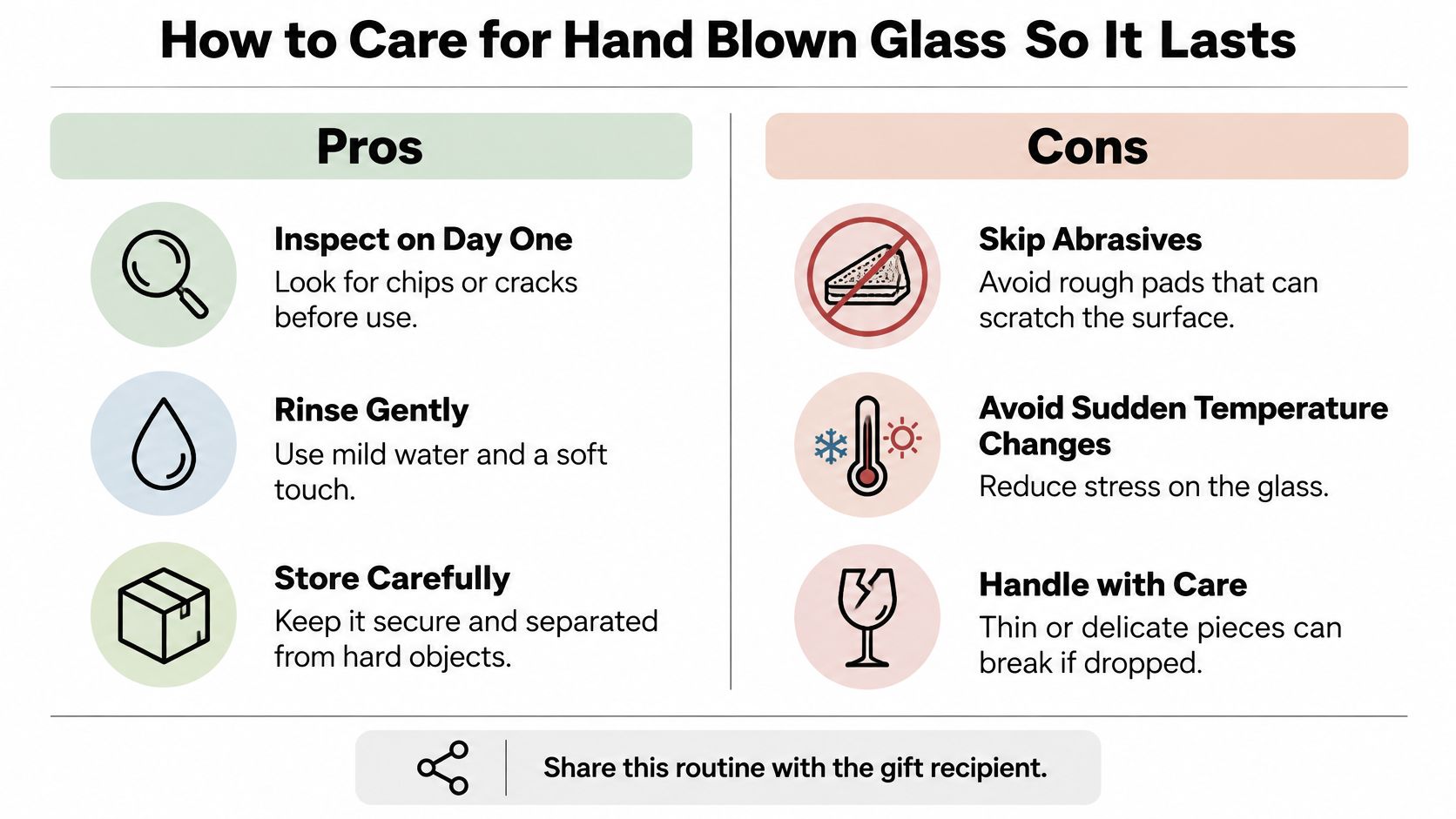
A simple way to tell variation from damage
Handmade glass often shows small quirks, and that confuses new owners. Here is an easy test. A shape that leans slightly is normal, but a line that catches a fingernail or shows light through the wall needs inspection before use.
Run a fingertip around the rim and along the stem while you're checking. Anything rough or raised deserves a photograph of the piece and its packaging, sent to the seller, and a damaged globe should stay unused until the seller advises on next steps. That small pause protects both the plant and the warranty conversation.
Everyday cleaning and temperature sense
Wash by hand with warm water and mild soap, using a soft cloth, unless the maker's instructions say otherwise. Skip abrasive powders and rough pads, wash pieces separately so delicate stems stay clear of hard sink edges, and treat the dishwasher as an option only when the product instructions allow it.
Temperature deserves its own attention. Boiling water poured into cool glass, or a chilled vessel set on a hot surface, can cause thermal shock and sudden cracking, so let glass adjust gradually between temperatures. Thermal-shock resistance and impact resistance are different properties, which means glass that handles heat swings well can still break from an ordinary knock.
Use handmade glass often and handle it gently, since a piece kept wrapped away gives no value.
Keep the water path clear
Rinse the bulb and stem between refills so loose soil can't settle in the passage, and follow mild soapy water with a thorough rinse before the globe returns to the pot. If the stem stops passing water, lift the globe out and inspect the opening. Clearing a blockage should never involve hammering, hard poking, or levering against the glass; persistent problems belong with the seller.
Choosing Your Hand Blown Glass Gift With Confidence
A friend once bought a swirled blue globe for a sister who travels three weeks out of four. The piece was lovely, and it solved nothing, because the plant it was meant to help had already been replaced twice.
That small story holds the whole lesson of this guide. A confident choice is a match. The earlier sections walked through the glass type, the annealing, and the difference between honest artisan variation and a real defect. Now the questions narrow to the recipient in front of you.
Two last checks deserve a pause before ordering:
- Plant compatibility. The intended plant benefits from supplemental moisture rather than a pronounced dry interval.
- Pot fit. Confirm the pot's drainage hole size before choosing a globe size, because a globe that sits wrong waters wrong.
Someone shopping mainly for a room-design present can follow a different path through this guide to decorative glass lighting for your home. A watering globe makes sense when plant care is part of the gift's purpose.
The pieces that earn their keep are the ones that join a real routine. A globe for a forgetful office plant earns its place when the recipient refills it on the same day each week.
Hand Blown Glass Gifts FAQ
Are hand-blown glass gifts environmentally friendly?
Glass is durable and recyclable, but its real impact depends on manufacturing energy, recycled content, transport, and how long the piece stays in use. A single artisan globe has no published footprint figure, so treat broad claims about glass sustainability as context rather than a calculation. Before recycling, check your local rules. Decorative glass is often processed differently from bottles and jars and may not be accepted in the same stream.
Do hand-blown glass gifts hold their value?
Handmade status does not set resale value; documented maker, condition, and provenance do. A watering globe earns its place through daily use rather than future appreciation. If collectibility matters to you, look for signed work and keep any paperwork the seller provides, since those details carry weight later.
How do you ship a hand-blown glass gift safely?
Wrap each piece separately, cushion it on all sides, and secure it so nothing shifts inside the box. Projecting stems and thin necks need extra padding, since they bear stress differently than the bulb itself. Ask the recipient to inspect the gift on arrival before first use, and check the carrier's fragile-item requirements before you send.
What should go with a hand-blown glass gift?
Include a card that says: refill when the bulb is empty and the soil feels dry two inches down; wash with warm water and mild soap only. Tuck in the seller's instructions and order details too, so the recipient has a direct way to ask questions later without tracking you down.
Little Green Leaf offers hand-blown glass watering globes in different capacities, finishes, and bundles for plant lovers who need supplemental watering support. As noted earlier, the right match between globe, plant, and routine matters more than the largest pack or the brightest finish.