

Gifts for Plant Moms: Which Watering Globe to Give
Her birthday is in nine days. She keeps fourteen plants across two windowsills and one hanging basket by the door, and she flies out on the twentieth for a week. The gift needs to be useful in an ordinary week, not another object that needs her attention.
A watering globe is the right present for a plant mom who forgets to water, travels, or tends to overwater, and the size to buy depends on her pot sizes and how long she'll be away. The plants a globe should never go near matter as much as the ones it suits.
Table of Contents
- Watering Gifts for Plant Moms at a Glance
- How Long One Watering Globe Fill Lasts
- Which Plants and Trips a Watering Globe Suits
- Watering Globes Compared With Spikes Drip and Self-Watering Pots
- How to Set Up a Watering Globe Before Gifting It
- Signs of Too Much or Too Little Water and What to Check
- Questions to Settle Before You Buy the Globe
Watering Gifts for Plant Moms at a Glance
Sizing the gift is the whole decision. A 350 ml globe covers the traveler gone one to two weeks, a 100 ml suits the owner whose plants live in small pots, and a mixed set works when you do not know her collection. Finish and styling come second to whether the bulb can hold enough water for her pots and her calendar.
The occasion matters less than it used to. A 2025 national houseplant purchasing study found consumers were more likely than in 2019 to consider houseplants suitable gifts for get-well wishes, thank-you gifts and personal enjoyment, and 96.6% of houseplant purchasers said plants made them feel happier to some extent (Floral Marketing Fund houseplant purchasing trends). For gifting, a small tool that keeps her plants watered tends to beat a second living thing she has to keep alive.
Globe size by recipient
| Recipient | Globe size to give | Why it fits |
|---|---|---|
| Frequent traveler | 350 ml | Longest single fill covers a one- to two-week trip |
| Busy owner with small pots | 100 ml | Smaller bulb suits a small root zone that dries quickly |
| Apartment or office plant owner | 200 ml | Middle size for shelf and desk plants |
| New plant parent with a mixed collection | Mixed size set | Covers several pot sizes in one gift |
| Gardener with hanging baskets | 350 ml or two globes | Fast-drying containers in summer |
Little Green Leaf sells its hand-blown glass globes in 100 ml, 200 ml and 350 ml, plus a mixed size option, and every size is the same slow-release tool. Getting the size mix right matters more than the color of the glass, because two small pots and one large pot need different bulbs. The mixed set is the safest pick for a beginner, and gifts for new plant lovers covers the rest of a starter box.
Skip these recipients entirely: succulents and cacti. A globe's whole job is holding moisture in the soil, and those plants want it dry.
Read the traveler row first if she is away more than a week, and the small-pot row if most of her plants sit in 4- to 6-inch nursery pots. The overwaterer row is the mixed set: a globe releases water slowly as the soil dries, so she can stop flooding a pot to compensate for a missed week. When a fill runs shorter than expected, pot size or room temperature is usually the cause; the bulb itself rarely is.
How Long One Watering Globe Fill Lasts
One fill lasts up to two weeks, depending on plant type, climate, pot size and the angle the globe sits in the soil. Treat two weeks as the maximum. The 350 ml bulb runs longest, the 100 ml runs out first, and two homes with the same globe can land most of a week apart.
Four things move the number. Pot size sets how much soil draws on the bulb. Soil mix and drainage decide how quickly water moves away from the stem. Room temperature and light drive how much the plant transpires. The plant itself matters, since a thirsty fern and a slow pothos draw on the same bulb at different rates.
None of this math applies to succulents and cacti. They want dry soil, so no globe size is right for them whatever the trip length.
What the extension guidance says about watering gaps
Oklahoma State University Extension is blunt that houseplants don't share one reliable schedule: frequency varies with growing medium, season, light, temperature, humidity, plant species and pot size. The concrete comparison is the part worth keeping: small pots may need water every two to three days, while large pots may need it only every seven to fourteen days (OSU Extension houseplant care). A globe covers the days between checks, and the checks still happen.
| Pot or plant situation | Typical watering gap | What one fill looks like |
|---|---|---|
| Small pots, fast-drying soil | Every 2-3 days | The shortest fills; in a warm room a small bulb can empty within days |
| Medium pots | Between the small and large ranges | Up to about two weeks in a cool room, less in heat |
| Large pots | Every 7-14 days | Up to about two weeks, less in heat |
| Hanging baskets and outdoor containers | Often more frequent in summer | Shorter in summer; check the bulb weekly |
Sizing rule: if the bulb empties in the first few days, the globe is undersized for that pot or the room runs warm. Move up one size before switching to a different kind of product.
Run a fill test before you wrap it
Fill the globe, write the date on the gift card, and note the day the bulb runs dry. One test in her pot, her soil and her room tells you more than any label on the box.
Match the result to the trip she takes. A long weekend barely tests a fill; a two-week trip uses most of it. If the bulb empties well before the trip it's meant to cover, size up or add a second globe. If it lasts past the window and the soil still feels wet, the bulb is supplying more than the pot can use, and the gift calls for a smaller size.
Which Plants and Trips a Watering Globe Suits
Most gifts for plant moms start with how the present looks on a table. That's the wrong first question, because a collection isn't one object with one watering need. Sort by trip length, then by plant, and the guessing mostly disappears.
Sort by trip length first
A weekend away needs almost nothing. University of Missouri Extension suggests arranging a reliable plant sitter, grouping plants together near water, moving indoor plants out of direct sunlight and setting pots on saucers before departure. One to two weeks is where a globe earns its place, holding moisture steady and slowing evaporation while she's gone, and it's the setup a best vacation plant watering system has to get right. Longer absences need the globe plus written instructions for whoever looks in, since no accessory replaces a human glance at a plant after three weeks.
Then sort the plants
Virginia Cooperative Extension draws the line cleanly: tropical houseplants may need watering once or twice a week, while succulents and cacti may need a thorough watering only once or twice a month. When soil is dry and roots can't absorb moisture, the plant sends a stress signal to its leaves and stops transpiring. That's the entire logic of the gift, compressed into two plant groups.
- Suitable: moisture-loving foliage plants, ferns, peace lilies, hanging baskets and any container that dries out fast in summer.
- Suitable with a caveat: a mixed collection, as long as the owner knows which pots get a globe and which get left alone.
- Not suitable: succulents, cacti and anything that wants to dry out completely between waterings.
- Not suitable: a very large pot relying on one small globe, which empties long before the soil is satisfied.
- Not suitable: a plant already sitting in soggy soil, where a globe just keeps it wet.
A globe keeps soil moist. That's the feature, and it's also the reason it fails with a cactus, which reads constant moisture as rot rather than care.
Match the globe to the pot and the trip. How the gift looks is the last decision, not the first.
Watering Globes Compared With Spikes Drip and Self-Watering Pots
Four watering aids get sold as gifts, and they aren't interchangeable. The table compares them on what a buyer can judge before spending money.
| Option | How long one fill lasts | Setup | Refill effort | Clogging and cleaning | Works outdoors |
|---|---|---|---|---|---|
| Watering globe | Up to about two weeks, less in heat or large pots | Fill, then insert the stem into moist soil | Lift, refill at a tap and reinsert | Stem can clog in dense soil; rinse and optional anti-clog sleeve | Yes, but check more often in heat |
| Terracotta spike | Set by the bottle you fit to it | Push the spike into soil and fill a bottle | Refill the bottle | Porous clay clogs with soil and algae; scrub it | Yes, in a single container |
| Drip system | Set by the reservoir size and timer | Tubing, emitters and a water source | Keep the reservoir or tap supplied | Emitters can clog | Yes, mostly for outdoor beds |
| Self-watering pot | Set by the reservoir size | Buy the pot, then fill the reservoir | Refill the reservoir | Wick or valve clogs with mineral build-up; rinse it | Mostly indoor or patio |
Duration. A glass globe is a hand-blown bulb in 100 ml, 200 ml or 350 ml. Fill it, push the stem into moist soil, and it releases as the soil dries, with the 350 ml holding longest and the 100 ml running out first.
Setup and refills. The globe takes a fill and an insertion, and a refill is a lift, a tap and a reinsertion at the same angle. A spike needs a bottle refilled. A drip system needs tubing, emitters and a water source, which suits an outdoor bed far better than a windowsill gift. A self-watering pot is a new planter with its own reservoir, so it suits a new plant rather than the plants she already owns.
- Clogging. The globe's stem can clog in dense soil, and a pencil pilot hole, the optional plastic anti-clog sleeve and a rinse between uses are the practical fixes. Emitters on a drip line clog too, and clearing them is a bigger job than rinsing a bulb.
- Outdoors. A globe works in an outdoor container or hanging basket as long as the bulb gets checked more often in summer heat. A self-watering pot is mostly an indoor or patio object.
- Cost per plant. That's the one criterion to work out at the till rather than from a table, since a single globe and a multi-pack price very differently per pot.
Moisture distribution is the technical reason gradual release makes sense as a gift. Experimental work on root growth and irrigation shows roots respond strongly to moisture gradients and concentrate where water is delivered, which is why even wetting beats alternating drought and flood. The same work is equally clear that response depends on soil texture, insertion depth, drainage, species, temperature, light and evaporation, so no globe can promise identical results in two different pots.
The verdict by situation: a globe for an existing indoor plant, a hanging basket or a trip of one to two weeks. A self-watering pot when the gift itself is a new plant. A terracotta spike for one cheap pot fix. A drip system only for larger outdoor setups, which are a different project.
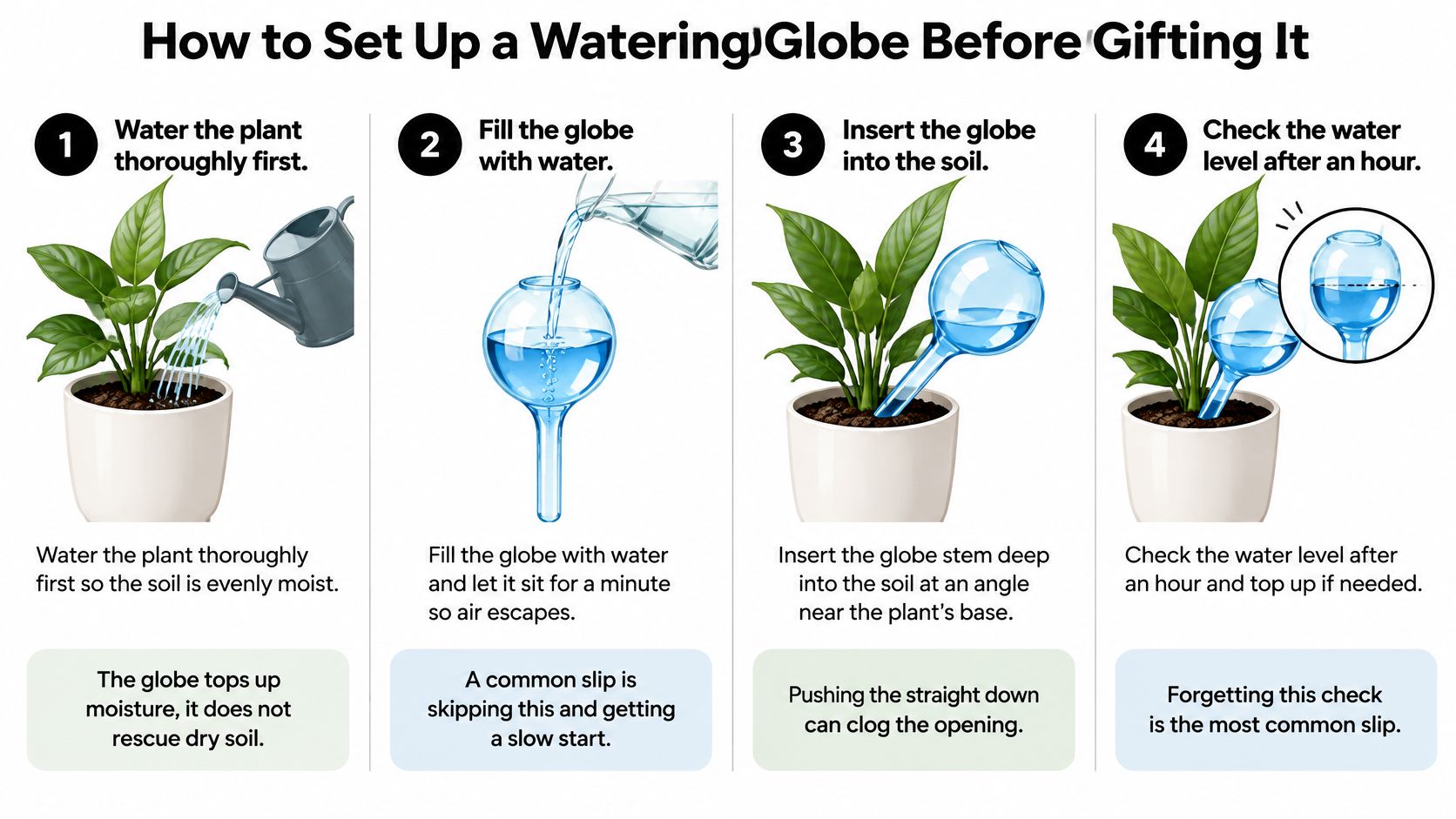
Run the globe once at home before wrapping it:
One limit is worth saying plainly, because buyers discover it too late: the stem is glass and it breaks if it's dropped.
How to Set Up a Watering Globe Before Gifting It
Setting up one globe before wrapping does two jobs. It proves the bulb holds water without a hairline crack, and it produces a real fill time to write on the card.
- Water the plant thoroughly first. The globe tops up moisture, it doesn't rescue dry soil, so the pot should be evenly moist before anything goes in. The common slip is skipping this and expecting the bulb to do the first soak, which leaves the plant stressed and the globe stalled.
- Make a pilot hole with a pencil. In dense or compacted mix, a pilot hole lets the stem slide in without snapping or compressing the root zone. Pushing straight into firm soil is how stems break and how the opening packs with grit.
- Fill the bulb and let it stand a minute. Air escapes while it sits, and a bulb with a trapped bubble starts slowly and unevenly. Fill to the top and check the seam and stem for drips before it goes near a shelf.
- Insert at a slight angle, near the base. An angled stem settles into the root zone and releases more predictably than one driven straight down into a drainage channel. Straight-down insertion often parks the tip in a pocket of air or grit.
- Check after two days. Soil near the stem should feel moist, not soggy, and the bulb should be emptying at a steady trickle. If the soil is sodden, lift the globe and leave the pot alone until the top two inches dry.
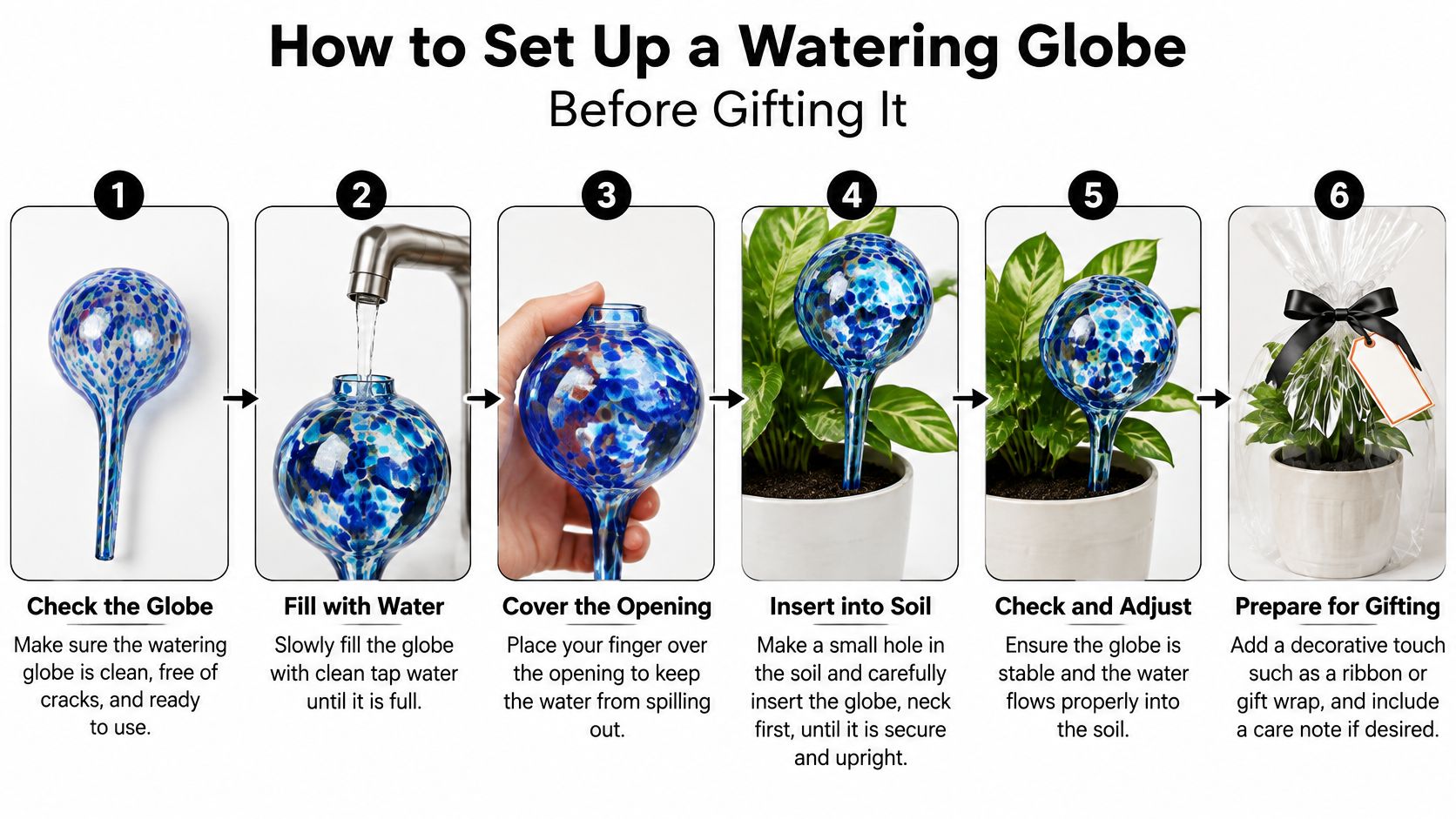
Card tip: write the setup date and the first check day on the gift card. A globe with a date beside it gets checked; one without it gets forgotten until something wilts.
The stem goes in gently and never gets knocked off a shelf edge. For dense potting mix, fit the optional plastic anti-clog sleeve before insertion, which is the difference between a steady release and a bulb that sits full while the plant dries underneath it.
Signs of Too Much or Too Little Water and What to Check
Read the plant, not the calendar. University of Maryland Extension recommends inserting a finger about two inches into the soil and watering when that depth feels dry, and it names the signals at both extremes: plants that are too dry may wilt and turn gray-green, while plants that are too wet may drop leaves or turn yellow.
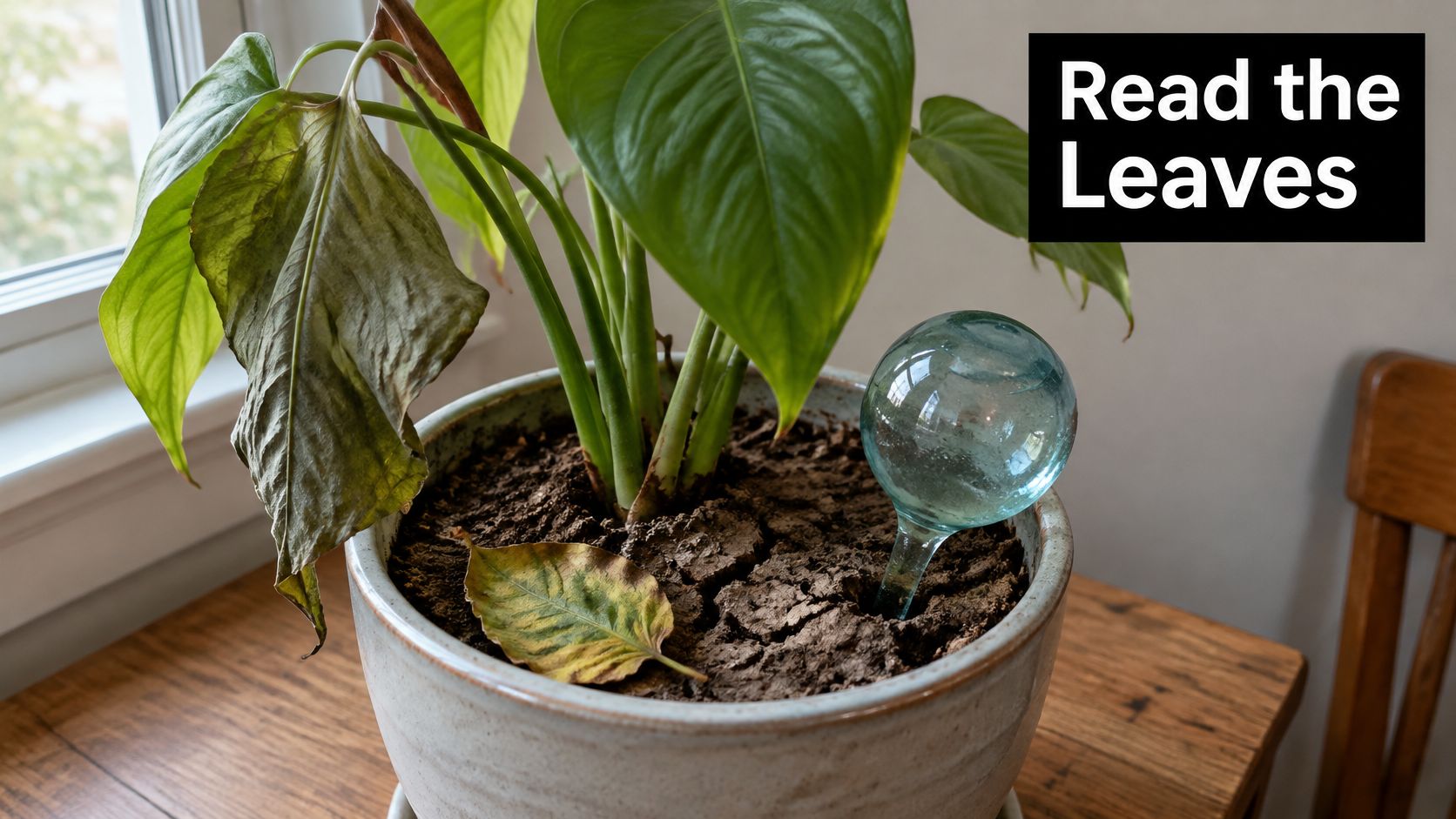
For a gifted globe, the useful step is turning each signal into one check.
- Drooping with crisp edges, bulb emptying fast. Large pot or a hot room. Add a second globe, or move the pot off a radiator or a sun-baked windowsill.
- Soil soggy and the bulb barely moving. The globe is over-supplying a pot that needs to dry. Lift it, let the top two inches dry, then reinsert.
- Yellow leaves and soft stems in wet soil. Too much water or poor drainage, and the globe is only part of the cause. Confirm the pot has working drainage holes before blaming the bulb.
- Soil dry while the bulb empties slowly. A clogged stem in dense soil. Pull it, rinse the stem, fit an anti-clog sleeve and reinsert through a pencil hole.
One habit worth keeping: two inches of finger in the soil before any refill. It takes five seconds and it catches every problem on this list early.
The same discipline applies to cut greenery around the house, which is why keeping balsam fir centerpieces fresh comes down to the same check-and-top-up routine that keeps a potted plant going through a dry week.
If a symptom continues after one correction, the globe is the wrong tool for that plant. A pot that stays wet for a week after the bulb comes out, or one that dries within a day, needs a different watering approach rather than more accessory. Signs of overwatering in plants covers that end of the problem in detail.
Questions to Settle Before You Buy the Globe
Little Green Leaf's plant watering globes come in 100 ml, 200 ml and 350 ml plus a mixed size option, so the buying decision comes down to her pots and her trips.
How many watering globes should I give a plant mom?
Count her thirsty plants, not her shelves. One globe covers one pot, so a single plant that keeps drying out needs a single globe. Two hanging baskets or a pair of ferns calls for two. For a mixed collection, the mixed size option puts more than one globe volume in the box, which matters because a 100 ml globe suits a small pot while a 350 ml globe belongs in a medium planter she leaves alone for longer stretches.
Should I buy multicolor or clear rainbow globes?
Water release works the same in every finish, so pick on visibility and taste. Multicolor reads as a decorative object on an open shelf. Clear rainbow makes the falling water level easy to read at a glance, which helps a beginner judge refill timing without lifting the globe. For a first-time globe owner, I'd pick the clearer finish.
How do I stop a watering globe stem clogging?
Start before the first fill. If her soil runs dense or peaty, include the optional tip cover or adapter in the gift so the stem seats cleanly and flows at a steady rate. Then one line on the card does the rest: rinse the stem whenever the flow slows.
Are glass watering globes safe around children and pets?
The globes are hand-blown glass, so treat one like a small glass vase rather than a plastic toy. The card should say to seat the globe deep in the pot and keep the plant back from table edges and out of reach of anyone who pulls at things. Sited properly, it waters in the background instead of asking a busy household to remember a schedule.
Order the size that matches her pots, skip succulents and cacti, and never promise a fixed number of days.
Little Green Leaf makes hand-blown glass plant watering globes in 100 ml, 200 ml and 350 ml, with a mixed size option so the gift can match her pots and her travel calendar rather than a guess. Each globe releases water as the soil dries, giving a plant a steady drink instead of a flood. Returnable items have a 30-day return window from delivery under the Refund Policy. Pick the size and finish at Little Green Leaf and wrap it with a card that names the fill date.