

Decorative Plant Waterer: What It Is and How It Works
Coming back from a trip to a drooping plant is a special kind of guilt, because the problem is usually simple: the soil dried out while no one was looking. A decorative plant waterer is a hand-blown glass bulb with a long stem that sits in the pot and releases water slowly as the soil dries, giving the roots a steadier supply between normal waterings.
One fill can last up to about two weeks, but that's a real-world range, not a promise. Pot size, temperature, soil, humidity, and the plant itself all change how fast the reservoir empties, so the globe should be treated as a moisture buffer, not a blind timer.
Table of Contents
- What a Decorative Plant Waterer Does
- The Simple Physics Behind Slow-Release Watering
- Glass Globes vs Spikes vs Drip Systems vs Self-Watering Pots
- How to Set Up a Little Green Leaf Globe
- What Really Changes How Long One Fill Lasts
- When a Decorative Plant Waterer Is the Wrong Tool
- A Travel-Ready Routine for One-Week and Two-Week Trips
- Care, Cleaning, and Common Questions
What a Decorative Plant Waterer Does
A fern can look fine on Monday and tired by Friday, especially when the potting mix dries faster than your routine can keep up. A decorative plant waterer sits in the soil and releases moisture little by little, so the root zone gets a steadier supply between regular waterings.
A slow feed, not a full replacement
The setup is simple. Fill the glass bulb, place the stem into moist, pre-watered soil, and let the surrounding mix pull water out as it dries. The globe does not replace normal watering, because plants still need occasional whole-pot irrigation to wet the full root ball and wash away built-up salts.
It works like a small reserve beside the plant. When the potting mix dries, the globe gives up more water. When the mix already holds enough moisture, the flow slows on its own, which is why one bulb can behave very differently from one home to another.
Practical rule: if the pot stays wet for too long, the globe is delivering too much water for that plant and pot.
That makes it useful for people who travel, forget a watering day, or want a steadier routine. It also suits small to medium houseplants, office pots, and containers that dry out faster than expected. The idea itself is old, even if the form is modern. Buried clay vessels once delivered water gradually beside crops, and a glass bulb follows the same basic logic in a cleaner, more decorative form.
The Simple Physics Behind Slow-Release Watering
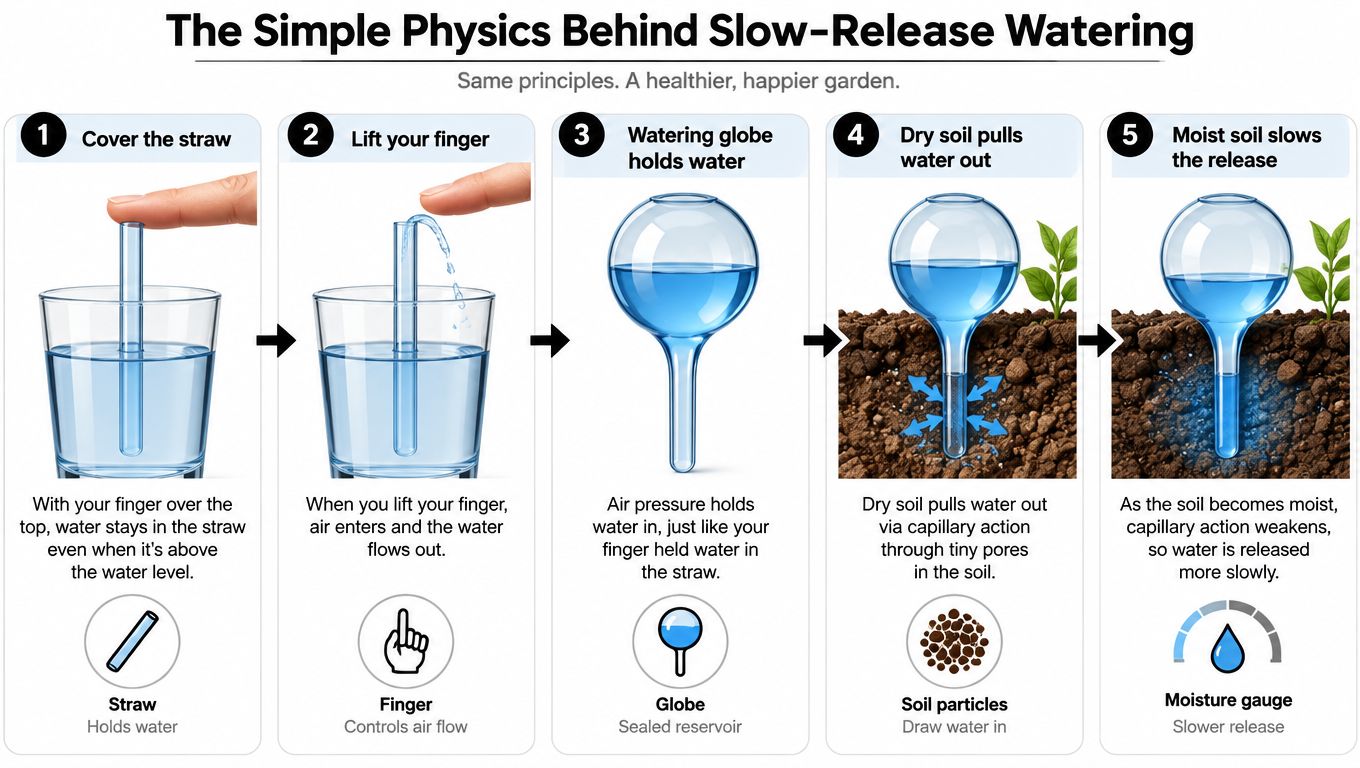
A good way to understand the globe is to picture a straw in a glass of water. Put your finger over the top of the straw and the water stays put. Lift your finger and the water moves because the pressure difference disappears, which is the same broad idea that helps the globe release water when the soil dries.
Why dry soil pulls water and wet soil slows it
Inside the pot, water moves through tiny gaps in the soil by capillary action. As the soil around the stem becomes drier, the moisture gradient gets stronger, so the globe releases more. As the soil gets wetter, that gradient weakens, so release slows naturally.
That self-regulating behavior is the point. The globe does not need batteries, pumps, or a timer, because the root zone itself tells it when to slow down. That same principle shows up in the long history of buried clay watering vessels, where porous containers delivered water gradually beside crops for centuries.
Modern glass bulbs use a different material and shape, but the logic is the same. Water moves from a reservoir into drying soil, then eases off as the soil recovers. For a deeper look at the soil-side mechanics, this capillary action explainer gives useful context.
Why that matters to a houseplant
The practical result is steadier moisture between ordinary waterings. A globe can help a plant avoid the swing from bone-dry to soaked, which is where many beginners run into trouble. It's still only one tool, though, and its usefulness depends on drainage, pot size, and the plant's actual water use.
That's why the right question isn't “How many days does it last?” The better question is “How does this pot use water?” Once that clicks, the globe stops feeling mysterious and starts acting like a quiet, passive helper.
Glass Globes vs Spikes vs Drip Systems vs Self-Watering Pots
A shopper usually wants the same outcome from every watering aid, but the tools solve different problems. A decorative glass globe wins when the goal is simple, attractive, low-effort moisture support for one pot, while other methods fit bigger or more technical jobs.
Watering Aids Compared
| Watering Aid | Typical Duration | Setup Effort | Clogging Risk | Works Outdoors | Cost Per Plant |
|---|---|---|---|---|---|
| Decorative glass globe | Up to about two weeks, depending on pot and plant | Low | Low to moderate, depending on soil | Yes, for contained pots and baskets | Moderate |
| Terracotta spike | Short absences, usually less flexible for long trips | Low | Moderate | Sometimes | Lower |
| Drip system with timer | Longer unattended stretches in managed setups | Higher | Moderate to higher | Yes | Higher |
| Self-watering pot | Ongoing moisture support after repotting | Medium | Low | Sometimes | Higher |
Where each option fits
Terracotta spikes suit people who want a budget-friendly helper for short gaps, but they're not as decorative or versatile. Drip systems make sense when a person needs control across several containers, especially outdoors or in more structured setups. Self-watering pots are a stronger choice when repotting is already on the table and a built-in reservoir fits the plant's routine.
Decorative globes sit in the middle. They're attractive, easy to place in many pots, and convenient for gifts or everyday use. They're not the answer for every container, though, especially very large planters or plants that need to dry out between waterings.
A globe is a moisture buffer, not a universal watering solution.
That honesty matters. Once the user knows the limit, the tool becomes more trustworthy, not less.
How to Set Up a Little Green Leaf Globe
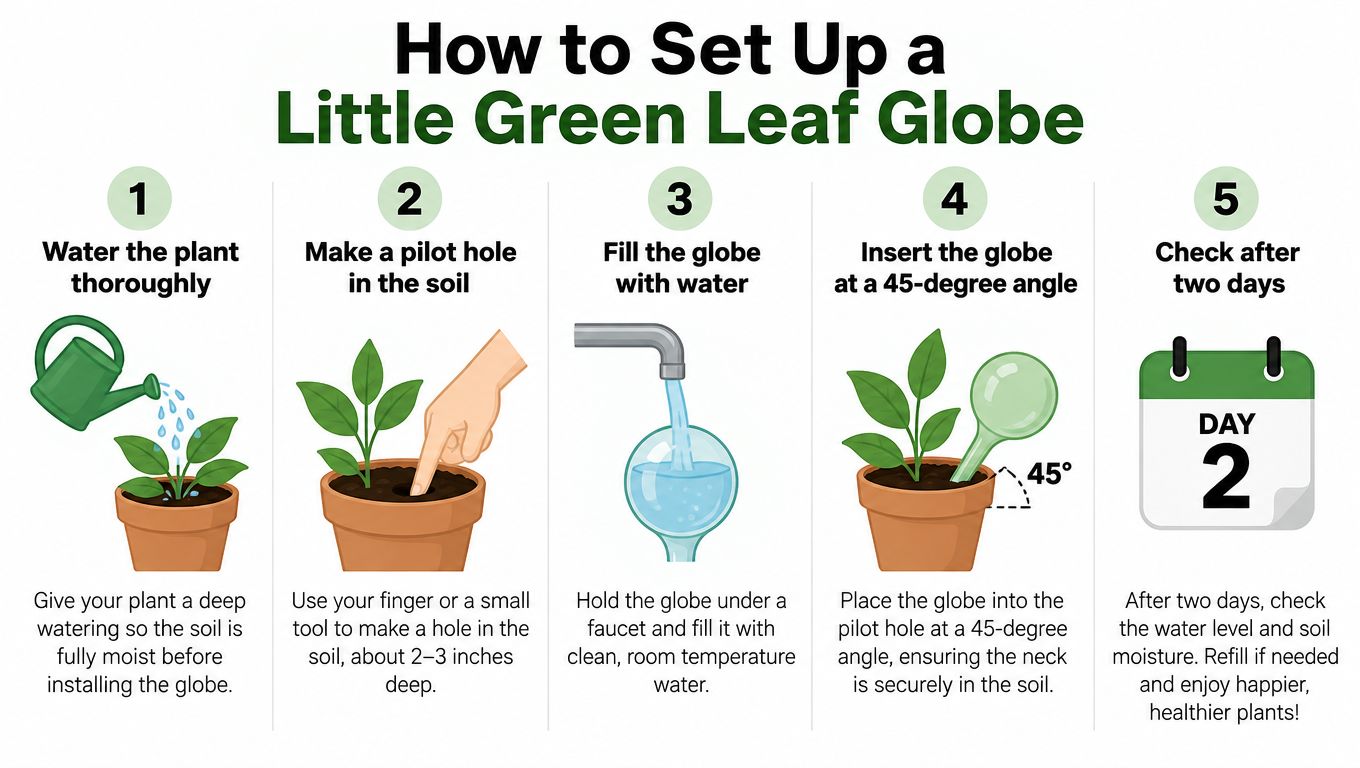
A globe works best when the pot is already holding some moisture. Dry mix can pull water away from the root ball in uneven paths, so the bulb should support an already watered plant, not do all the work at once.
Start with the soil, not the glass. If the pot is bone dry, the globe can empty fast while the deepest roots stay thirsty.
The setup routine
- Water the plant thoroughly first. The mix should feel evenly moist so the globe can act as a buffer around the roots.
- Make a pilot hole. Use a pencil or similar tool, especially in dense or gritty soil, so the stem enters without forcing the mix apart.
- Fill the bulb with room-temperature water. That keeps handling simple and avoids an abrupt temperature shift for the plant.
- Insert the stem at a slight angle. Aim for steady contact with the soil, not a straight plunge into the crown.
- Check the pot after two days. If the surface looks damp but deeper soil still feels dry, adjust the angle or choose a different bulb size next time.
Reading the pot matters more than trusting the glass alone. A compact reservoir can suit a small pot, while a larger planter may need closer observation or another watering method alongside the globe.
For a product-specific walkthrough, a step-by-step guide to inserting a watering globe is the clearest place to start.
What Really Changes How Long One Fill Lasts
One globe can empty slowly in a cool apartment and much faster in a warm, dry room. That is not a flaw in the glass. It is the normal result of how water, roots, and air behave inside a pot.
The variables that matter most
A 100 ml globe suits a small, low-transpiring plant. A 200 ml globe usually fits many medium pots, while a 350 ml globe gives extra buffer for a medium planter or a longer absence. Those sizes are useful reference points, but they do not promise a fixed number of days.
Pot size changes the pace too. Oklahoma State University Extension notes that small pots may need water every 2–3 days, while larger pots may go 7–14 days between waterings, depending on season, temperature, humidity, plant species, growing medium, and pot size. Washington State University Extension also ties watering frequency to plant size, pot size, temperature, humidity, and growth rate, which is why the same globe will not last equally long in every room.
| Factor | What it does |
|---|---|
| Reservoir size | Larger bulbs hold more buffer |
| Pot diameter | Bigger pots can dry more slowly or need more support, depending on the plant and mix |
| Temperature | Warm rooms speed drying |
| Humidity | Damp air slows drying |
| Plant type | Thirstier plants use water faster |
| Soil behavior | Some mixes move water quickly, others hold it longer |
A simple check before refilling
The most useful habit is still a finger check. In containers up to about 8 to 10 inches wide, check the top 1 inch of media. In smaller pots, check the top 1/2 inch. If that surface layer is still wet, or the pot feels heavy, wait before refilling.
That keeps the globe in the right role. It buffers moisture around the roots, while your eyes and fingertips read the pot itself.
When a Decorative Plant Waterer Is the Wrong Tool
A globe that keeps soil moist suits some plants and fights others. Succulents and cacti usually need the potting mix to dry between waterings, so steady dampness works against them.
Signs the globe is too much
The warning signs are easy to miss if you only watch the top of the pot. Yellowing leaves, a pot that still feels heavy, soil that looks dark and slimy, and a sour smell all point to excess moisture and poor oxygen around the roots. If the saucer never clears, the plant may be sitting too wet.
If the root zone stays saturated, roots can lose oxygen and struggle even though water is present.
University of Maryland Extension notes that overwatered plants can show yellowing foliage and other moisture stress signs, and that excess wetness can keep air from returning to the root zone. In that situation, the answer is not more water. Remove the globe and let the mix dry.
Very large pots are another poor match for a single small reservoir. One bulb can help the area around its stem, but it cannot buffer an oversized planter on its own. That calls for a different watering routine, more than one globe, or a different container setup.
The rule is simple. The globe should moderate moisture, not keep a pot permanently damp. If a plant already likes to dry out, the wrong watering aid only makes the problem worse.
A Travel-Ready Routine for One-Week and Two-Week Trips
The smartest travel setup starts before the suitcase is packed. A quick trial run reveals more than guessing ever will, because each pot reacts a little differently.
A calm pre-trip checklist
- Trial the globe a few days ahead. Set it up on one plant, then check the soil after 24 to 48 hours to see whether the root zone is getting moisture.
- Water every plant thoroughly first. The globe should maintain an already-moist pot, not rescue dry media.
- Group plants by water need. A thirsty fern and a slower-drying plant shouldn't be treated the same way.
- Move indoor pots out of direct sun. Less intense exposure slows drying while the owner is away.
- Use a bigger reservoir for longer gaps. A 350 ml globe makes more sense for a medium pot on a longer trip than a smaller bulb.
For people planning more than a brief trip, Little Green Leaf's vacation watering guide gives a helpful framework for comparing options. Pots without drainage holes still need extra caution, because excess water has nowhere reliable to go.
A globe can buy time, and that's valuable. It can't fix a plant that's already in the wrong container or a potting mix that stays wet far too long. For anything longer than about two weeks, a check-in from another person is still the safer plan.
Care, Cleaning, and Common Questions
A globe lasts longer when the stem stays clear. Rinse it during refills, and if dense soil keeps clogging the opening, use an anti-clog sleeve or similar adapter so the flow stays steady.
Quick maintenance habits
- Rinse on refill day. Clear water helps flush residue from the stem.
- Watch the insertion point. If the stem is packed too tightly into compact mix, flow can slow down more than expected.
- Keep it away from knocks. Hand-blown glass looks delicate because it is, and pets or tight shelves can turn a minor bump into a broken bulb.
FAQ
How long does a 350 ml plant watering globe last on a medium houseplant?
Up to about two weeks is a realistic upper range, but it can be shorter in warm rooms, bright light, or with a thirstier plant. A trial run matters more than the label alone.
Can succulents and cacti use a decorative plant waterer?
Usually not. Those plants prefer the soil to dry out between waterings, so a globe that keeps the root zone moist works against their needs.
What if the stem keeps clogging?
Rinse the stem at refill time and use an anti-clog sleeve if the soil is dense or particle-heavy. If the pot stays too wet, the problem may be the watering schedule rather than the stem alone.
Is it safe to leave a globe unattended for a week?
For many ordinary houseplants, yes, if the pot was watered first and the globe fits the pot size. The safer answer still depends on the plant, the room, and drainage, so a quick test before travel is worth it.
Do decorative plant waterers replace regular watering?
No. They help bridge the gap between waterings and keep moisture steadier, but the plant still needs periodic full watering and observation at root depth.
Little Green Leaf makes hand-blown glass watering globes in sizes that suit different pots, and the idea is straightforward, steady moisture without a timer or battery. If a plant needs a calmer watering routine, visit Little Green Leaf to see the globe sizes and styles that fit everyday houseplants, travel care, and thoughtful gifts.