

Best Plant Watering Devices: A 2026 Buyer's Guide
A flight leaves in three days, the calendar is packed, and the houseplants are already starting to look like another responsibility waiting to fail. The best plant watering devices can bridge that gap, but a globe isn't a promise of a fixed number of days. One fill lasts up to about two weeks, with less time for thirsty plants, larger pots, warm rooms, and smaller globes, and potentially more with the 350 ml size in suitable conditions.
The right choice depends on soil moisture fit, not just reservoir capacity. A gradual device that responds to drying soil can be safer than a timer for many foliage plants, while a globe is the wrong tool for cacti, succulents, and plants that need a complete dry period.
Table of Contents
- Why Watering Fails When You Leave Plants Unattended
- Watering Globes, Spikes, Reservoirs, Wicks, and Automation Compared
- How Passive and Active Watering Systems Actually Differ
- Matching a Watering Device to Your Situation and Plant Needs
- Real-World Scenarios Where the Best Device Saves Your Plants
- What to Look for in Design and Reliability, Not Just Marketing
- How to set up a Little Green Leaf globe for a vacation
- Frequently asked questions
Why Watering Fails When You Leave Plants Unattended
Three days before a trip, many plant owners soak every pot and hope the extra water will carry the collection through. That approach can leave one plant dry while another sits in saturated media. The same mismatch happens during a busy week. Missed watering causes limp foliage and dry soil, while a rushed correction can leave roots with too little air.
Plant care follows conditions, not calendars. Temperature, humidity, pot size, drainage, and current soil moisture determine how quickly a container dries. A pot beside a warm window may need attention sooner than one in a cool room, even if both were watered on the same day.
Practical rule: Use watering automation to support observation, not replace it.
Controlled delivery has a sound basis. The U.S. Environmental Protection Agency explains that inefficient irrigation can lose as much as 50% of outdoor water use through wind, evaporation, and runoff. Indoor pots behave differently, but the useful lesson remains: gradual delivery usually gives you more control than flooding a container in one sitting.
A house sitter may be the better option for a long trip or a valuable collection. The Global Pet Sitter task guide helps clarify what hands-on plant care can involve. For a shorter absence, a passive globe can reduce decisions without forcing every pot onto one timer schedule.
Why a globe can fit better than a timer
A glass globe stores water in its reservoir and releases it through a stem placed in moist soil. As the soil around the stem dries, water can move gradually toward the root zone. If that area stays wet, release and airflow slow naturally.
That soil response can suit foliage plants that prefer consistent moisture. In some pots, it is healthier than a timer that delivers the same volume at fixed intervals, regardless of whether the mix has dried. The trade-off is less precise control. A globe cannot repair poor drainage, bone-dry soil, or an oversized container, and it is unsuitable for plants that need a full dry period.
Test the setup before leaving. The guide to keeping plants watered while on vacation offers a practical way to plan that trial. Water the plant properly, install the device, and observe the soil before packing.
Watering Globes, Spikes, Reservoirs, Wicks, and Automation Compared
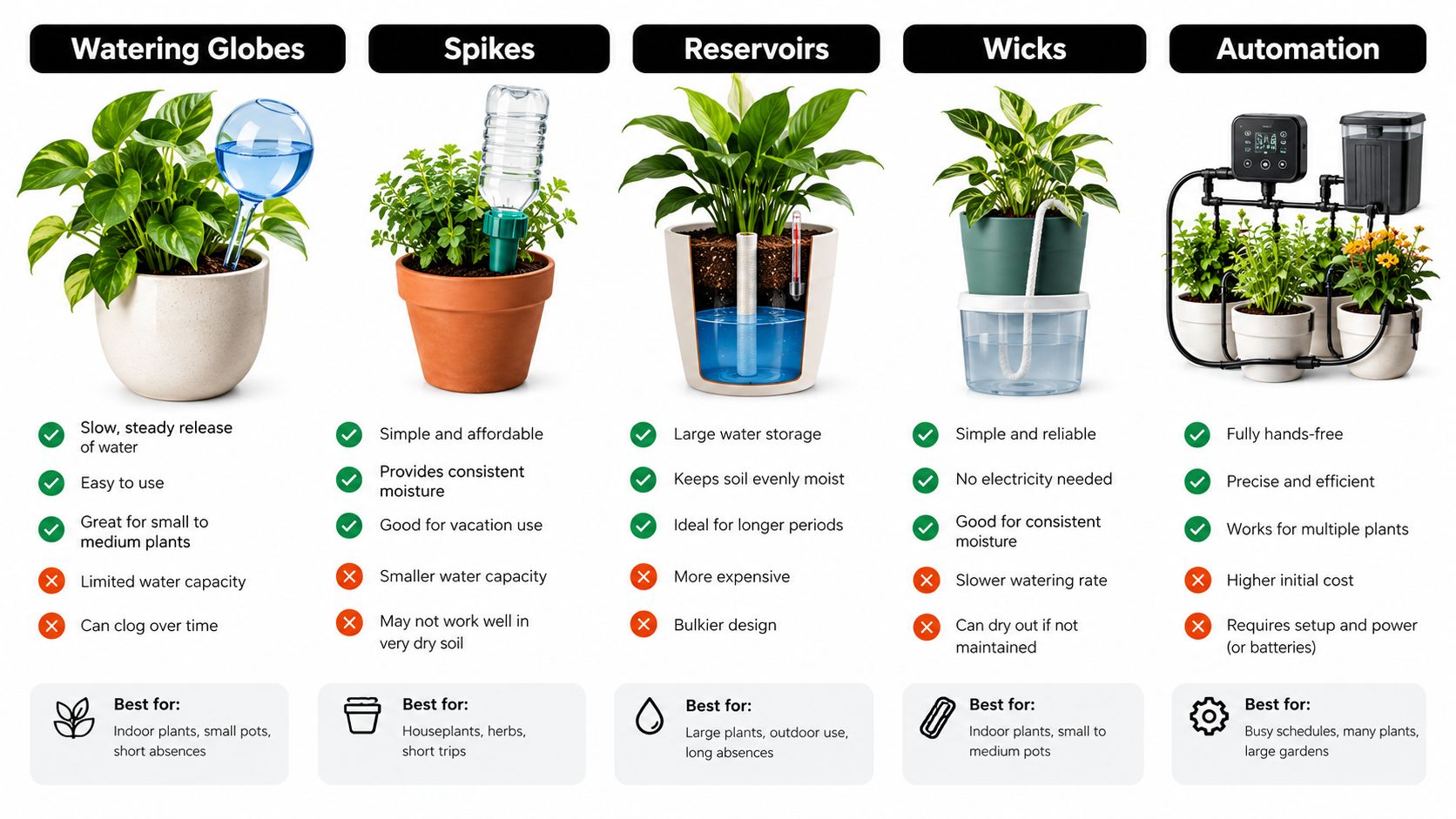
Every watering aid trades convenience for control somewhere else. A globe is simple and visible, but its output depends on soil conditions and installation. A wick draws water through capillary action, but the wick can dry out, shift, or deliver unevenly. A reservoir built into a container holds more water, yet it can keep the lower growing area damp for longer than a particular plant prefers.
Active automation offers scheduling and repeatability. It also adds failure points, including power, programming, tubing, and flow regulation. A device that runs perfectly on a dry test day can still oversupply a small root zone when conditions change.
Plant Watering Device Comparison
| Device Type | Typical Duration | Maintenance | Clogging Risk | Best For | Cost Range |
|---|---|---|---|---|---|
| Glass watering globe | Up to about two weeks per fill, depending on conditions | Refill and clean periodically | Moderate at the stem | Foliage plants, travel, forgotten watering | Varies by size and pack |
| Spike with reservoir | Depends on reservoir and release rate | Check fit, refill, clear outlet | Moderate | Individual pots needing gradual delivery | Varies by material and design |
| Drip system | Depends on reservoir or water supply and settings | Check tubing, outlets, and flow | Moderate to high | Multiple containers with consistent access | Varies by system size |
| Self-watering pot | Depends on reservoir capacity and plant demand | Refill reservoir and inspect indicator or chamber | Low to moderate | Plants suited to a consistently available water source | Varies by pot size |
| Wick system | Depends on reservoir size and wick movement | Keep wick positioned and reservoir filled | Low at the wick, but flow can vary | Groups of compatible plants | Varies by setup |
A watering globe is usually the least complicated option for one or a few pots. Little Green Leaf globes are hand-blown glass bulbs available in 100 ml, 200 ml, and 350 ml sizes, with long stems and packs of 1, 2, 4, or 6. They come in multicolor and clear rainbow designs, with optional plastic anti-clog sleeves for the stems.
Spikes and wicks can work, but they need careful setup. A loose wick may stop making contact with the water, while a spike inserted into dense soil may release poorly or create a narrow wet patch. Drip systems make more sense where many containers need coordinated delivery, but they bring more tubing and maintenance.
A self-watering container can be convenient for a plant that suits steady access to moisture. It isn't automatically safer, though. The plant still determines whether persistent dampness is acceptable. A fuller discussion of self-watering plant pots helps clarify that the reservoir doesn't remove the need to monitor the plant.
The honest duration answer
A globe can last up to about two weeks per fill, but that's an upper estimate, not a guarantee. A thirsty plant, larger pot, warm room, fast-drying container, or 100 ml globe may empty sooner. A 350 ml globe can provide a larger reserve, but the plant may still draw water faster than expected.
Very large pots create another limit. One small globe can't reliably hydrate a large root zone, especially if the stem only wets a narrow area. Multiple appropriately sized globes may be more sensible, provided the plant benefits from gradual moisture.
How Passive and Active Watering Systems Actually Differ
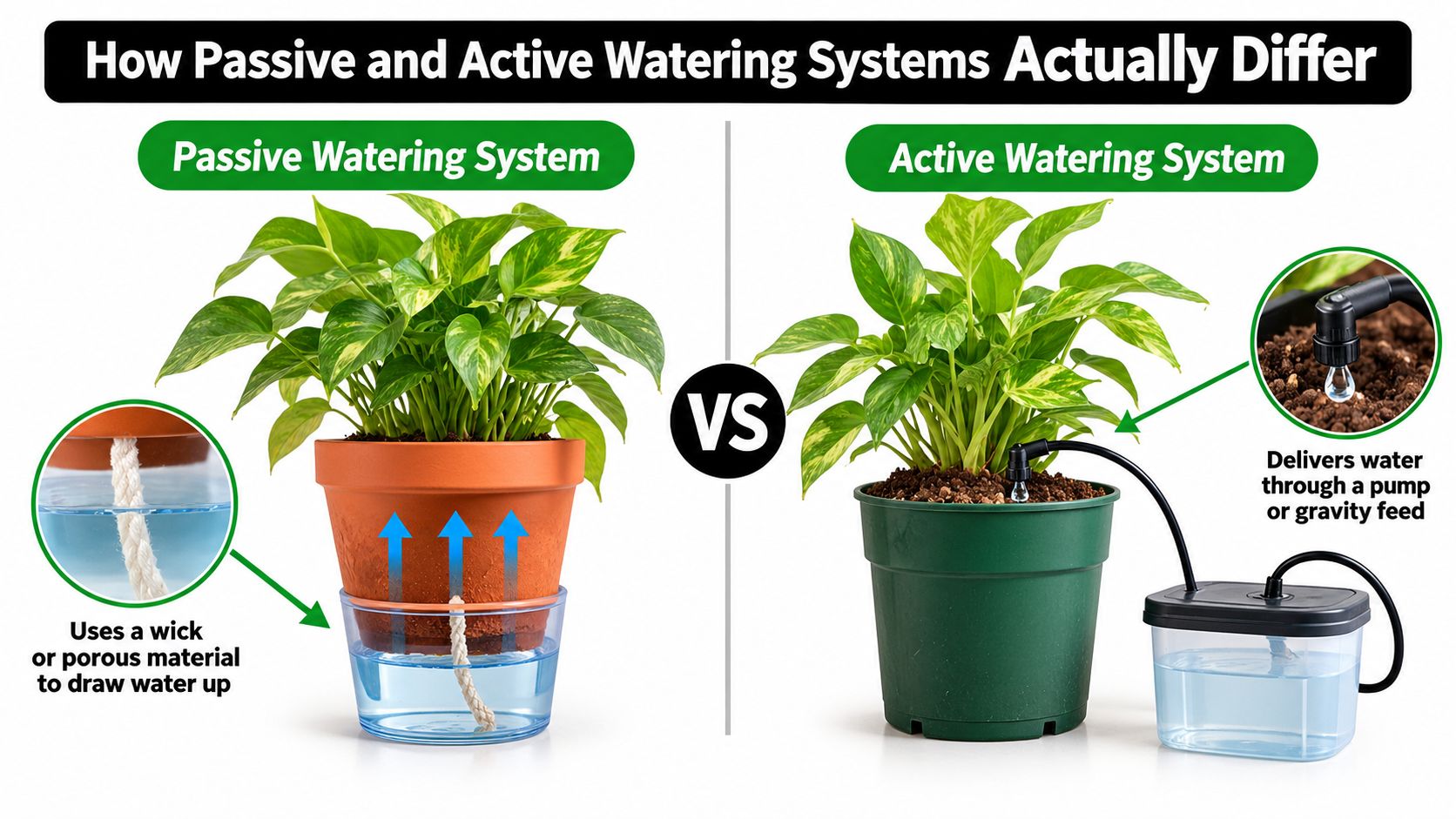
Passive systems respond to conditions around the plant. Gravity-fed globes, wicks, and some porous devices depend on moisture tension, capillary movement, or the changing pressure created as soil dries. Active systems push or release water according to a programmed schedule, often without knowing whether the pot is already wet.
That difference matters in a small container. A scheduled dose can saturate a limited root zone even when the plant has used little water. A passive globe can reduce that risk because release slows when the soil around the stem stays moist. It still isn't foolproof. Poor drainage or an unsuitable plant can remain a problem.
Controlled delivery has a long track record
The principle behind slow, root-directed watering isn't decorative. The Food and Agriculture Organization describes how farmers switching from furrow or sprinkler irrigation to drip systems can reduce water use by approximately 30% to 60% in many countries. Its analysis also connects frequent, controlled applications near the root zone with improved yield in agricultural settings.
An indoor globe isn't an agricultural drip installation, and those results shouldn't be transferred directly to houseplants. The relevant design principle is narrower: small, gradual applications can reduce runoff, evaporation, and deep percolation while keeping moisture near roots.
Why high-tech isn't always healthier
A smart timer can be useful when a collection needs repeated, coordinated watering and someone can verify the settings. It may be a poor fit for plants whose needs change sharply with weather or indoor conditions. If the schedule continues while the soil is still wet, the device follows the clock rather than the plant.
A passive globe has fewer controls, which is both its strength and its weakness. It can provide a gentle buffer for a moisture-loving foliage plant, but it can't distinguish between a healthy drying cycle and a pot with blocked drainage. The owner must still check the soil and remove the globe if saturation persists.
The practical explanation of capillary action in soil helps buyers understand why passive systems can behave differently from timed delivery. Device choice matters as much as the watering schedule.
Matching a Watering Device to Your Situation and Plant Needs
Choosing among the best plant watering devices starts with four questions:
- How long will the plant be unattended?
- Does the plant prefer steady moisture or a dry interval?
- How much checking and refilling is acceptable?
- Will the environment speed up drying?
A person away for several days may only need a tested globe for a suitable foliage plant. A traveler gone for around two weeks needs to consider bulb capacity, plant demand, room temperature, and whether someone can check the pot. Longer absences call for more than choosing the biggest reservoir. A trusted person may need to inspect soil and refill or pause the device.
Start with the plant, not the gadget
Foliage plants that dislike repeated drying can suit a globe when the pot drains freely and the soil is already moist at installation. Outdoor containers and hanging baskets may dry faster in warm weather, so they require closer testing and possibly more than one delivery point.
Succulents and cacti are different. Oklahoma State University Extension says these plants should remain dry for several days before watering, while other extension guidance recommends allowing their soil to dry completely between waterings. A gradual globe can interrupt that wet-dry cycle, so these plants generally shouldn't receive one.
| Situation | Recommended Device | Why It Fits |
|---|---|---|
| A foliage plant is unattended for a short trip | Tested glass globe | It provides a visible reservoir and gradual delivery |
| A moisture-loving plant needs one container monitored individually | Globe or wick | Both can support steady moisture without a complex setup |
| Several compatible containers need linked watering | Wick or drip arrangement | One source can serve multiple plants, with more setup effort |
| A large container dries rapidly outdoors | Larger globe or multiple delivery points | A single small reservoir may not wet enough of the root zone |
| A cactus or succulent needs complete drying | No continuous-release device | The plant's care cycle conflicts with constant moisture |
| A collection requires repeated scheduled watering | Active system with close testing | Scheduling can coordinate containers, but it must be calibrated |
Match globe capacity to the pot
The 100 ml size suits smaller containers and shorter coverage needs. The 200 ml option gives a middle ground for many everyday houseplant pots. The 350 ml size offers the largest reserve in the Little Green Leaf range, but it still shouldn't be treated as a fixed-duration guarantee.
A pilot hole matters when soil is dense. Forcing a glass stem into compacted media can damage the stem or create an unstable angle. A narrow opening made first lets the globe sit securely and reduces the chance of breaking it during installation.
Real-World Scenarios Where the Best Device Saves Your Plants
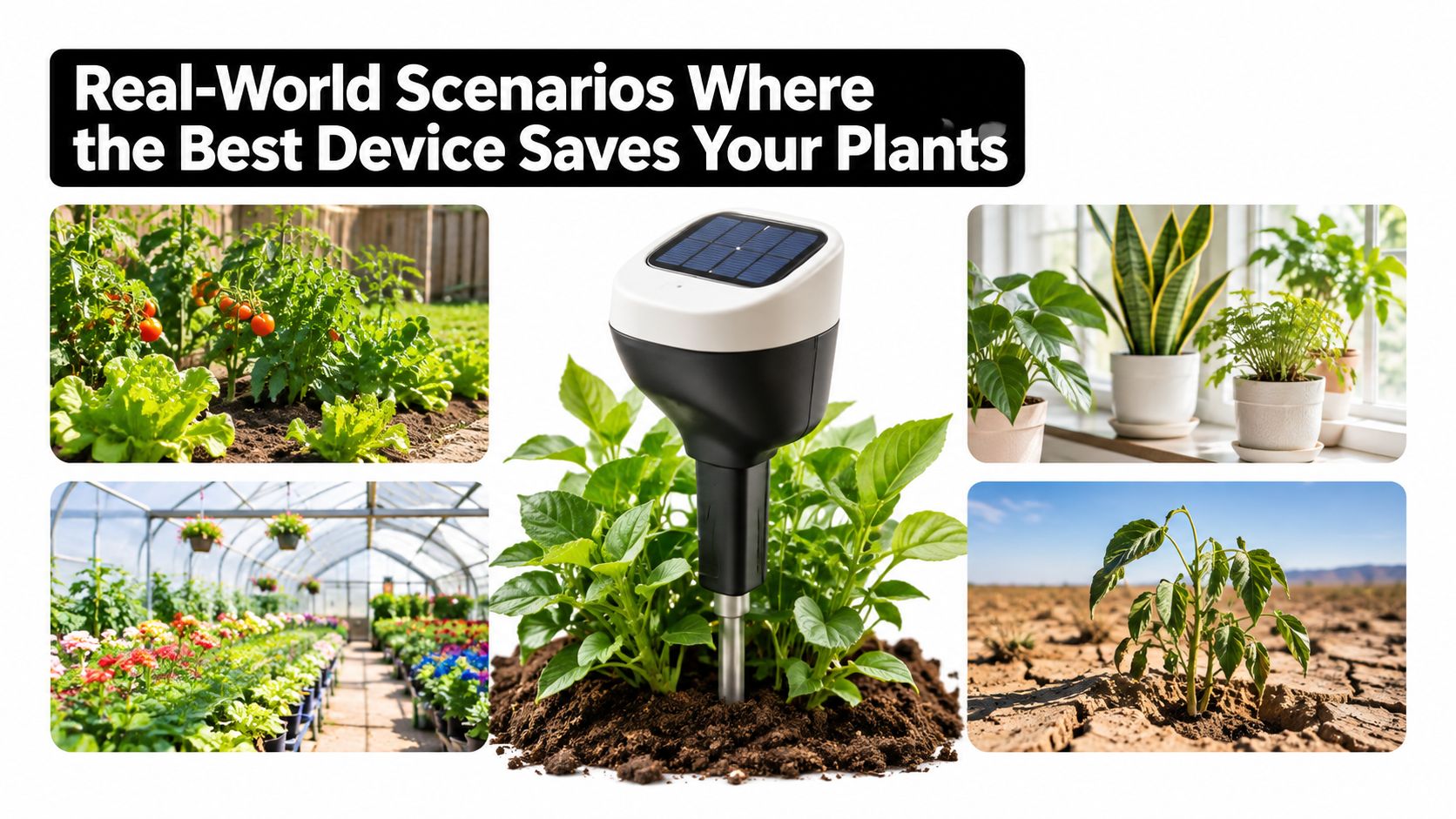
A frequent business traveler has a collection of foliage plants and needs to leave for ten days. The plants are watered first, the soil is checked, and a suitable globe is tested before departure. A passive globe is a reasonable choice for plants that prefer moisture because it can release gradually rather than applying a timed dose to already damp soil.
The traveler still needs to inspect the setup before leaving. A stem that isn't seated properly can leak, while a pot with poor drainage can remain saturated. The device helps with the schedule gap, but it doesn't eliminate plant-specific judgment.
A hot apartment with hanging baskets
Hanging baskets can dry quickly because their containers are exposed on all sides and hold a limited volume of growing media. An individual globe may help one basket, but a group of baskets can demand frequent refilling and repeated checks.
A wick arrangement or coordinated drip setup may be more practical for several compatible containers. The trade-off is complexity. Tubing, connections, and flow points need inspection, and an arrangement that works for one basket may not suit another with different water demand.
An office full of succulents
An office manager notices that the succulents look neglected and considers installing a continuous watering device. That would solve the wrong problem. These plants need a dry interval, so the most suitable approach may be careful manual watering with proper drainage and observation.
A watering globe isn't a universal insurance policy. It's a tool for plants that benefit from gradual moisture, not a replacement for understanding whether the root zone should dry between waterings.
The best device for a drought-adapted plant may be no device at all.
What to Look for in Design and Reliability, Not Just Marketing
A watering device earns trust through repeatable behavior, not an attractive first impression. For a globe, inspect the bulb, stem, opening, and any anti-clog sleeve. The stem needs enough length to reach stable soil, while the glass needs careful handling because it can break if dropped.
A dense pot needs a pilot hole. The globe should be filled, inserted into already moist soil, and positioned at an angle that keeps the stem secure. A small opening is safer than twisting or forcing the stem through compacted media.
Test output instead of trusting the label
Flow-rate accuracy alone isn't enough. Distribution uniformity shows whether water is delivered consistently, and published testing of point-source emitters found substantial variation between models and individual devices. Some tested devices delivered anywhere from 0% to 102% of their manufacturer-rated flow, while more than half achieved application uniformity above 0.90 at the tested low pressure. The findings are reported in this technical evaluation of microirrigation emitters.
For a household globe, a simple test is more useful than marketing language:
- Fill and measure: Record the reservoir level before installation.
- Check the soil: Confirm the plant starts moist, not bone-dry or waterlogged.
- Observe the first two days: Look for pooling, rapid emptying, or no visible delivery.
- Repeat with comparable pots: Compare how consistently similar globes behave.
The installation angle and reservoir height affect gravity-fed output. An anti-clog sleeve can help keep the stem opening clear, but it won't correct unsuitable soil moisture or a damaged globe.
Reliability after repeated use
A good device should be easy to rinse and inspect. Glass globes make the water supply visible, while opaque reservoirs can hide sediment or algae. Any wick, tube, or outlet should be accessible enough to clean rather than treated as disposable.
Little Green Leaf offers hand-blown glass globes in 100 ml, 200 ml, and 350 ml capacities, sold in single and multipack formats, with multicolor and clear rainbow finishes and optional plastic anti-clog sleeves. They're designed for gradual release as surrounding soil dries, which makes them a practical fit for suitable foliage plants, travel, offices, containers, and hanging baskets.
Before leaving, test the exact pot and device together. Check the soil after two days, keep the container's drainage open, and remove the globe if the media stays saturated. That small trial does more for plant safety than choosing a device because its packaging promises a particular vacation length.
How to set up a Little Green Leaf globe for a vacation
- Water the plant first. Bring the soil to an appropriate, evenly moist condition, and make sure excess water can drain away.
- Make a pilot hole. Use a narrow tool when the soil is dense so the glass stem doesn't need to be forced into compacted media.
- Fill the globe. Choose the capacity according to the pot and expected demand, remembering that the duration is an estimate.
- Insert the stem at an angle. Seat it securely in moist soil, then place the globe where it won't be knocked or dropped.
- Check after two days. Look for steady moisture, pooling, leaks, or unusually fast emptying before travelling.
Browse the Little Green Leaf watering globes to choose a capacity and pack suited to the number of compatible plants being watered.
Frequently asked questions
How long does a plant watering globe last?
One fill can last up to about two weeks, but the actual duration varies. Thirsty plants, larger pots, warmer conditions, faster-drying containers, and smaller globes can empty the reservoir sooner.
Do watering globes prevent overwatering?
They can moderate delivery, but they don't guarantee that a plant won't be overwatered. Use them only with suitable plants, start with moist soil, keep drainage open, and remove the globe if the soil remains saturated.
Are watering globes good for vacation?
They can work well for suitable foliage plants during a short trip when tested in advance. A globe isn't a fixed vacation timer, so owners should check how the specific pot behaves before leaving and arrange human help for longer or higher-risk absences.
What size watering globe should I get?
Little Green Leaf offers 100 ml, 200 ml, and 350 ml globes. Smaller pots and shorter coverage needs may suit the smaller capacity, while larger or faster-drying containers may need the larger size or more than one globe.
Can you use watering globes for succulents?
Usually, no. Succulents and cacti generally need their soil to dry, and gradual release can keep roots damp for too long and interrupt their natural wet-dry cycle.
How do you stop a watering globe from clogging?
Start with clean water, make a pilot hole in dense soil, and keep the stem opening clear. An optional anti-clog sleeve can help protect the stem, but the globe should still be rinsed and checked if delivery slows or stops.
Little Green Leaf offers hand-blown glass watering globes in 100 ml, 200 ml, and 350 ml sizes, with single and multipack options for suitable houseplants, containers, and hanging baskets. Choose a globe, test it before the next trip, and visit Little Green Leaf to set up a simpler watering routine that follows soil moisture more closely than a fixed schedule.