

Wick Plant Watering: How Long One Fill Really Lasts
Wick plant watering feeds the root zone with water from a reservoir as the surrounding soil dries. One fill of a glass globe lasts up to about two weeks, less for thirsty plants, large pots, warm rooms and a 100 ml globe, and longer toward 350 ml, with no fixed day count.
That uncertainty matters most on the morning of a trip. A traveler stares at a drooping pothos, fills a globe, and hopes the water reaches the roots. Hope isn't a test. A two day trial at home shows whether the pot stays evenly moist, stays soggy, or stays dry while the bulb still looks full.
Table of Contents
- How Does Wick Plant Watering Release Water?
- Is a Watering Globe Better Than a Spike or Drip?
- Which Plants Suit a Watering Globe and Which Do Not?
- How Do I Set Up a Little Green Leaf Globe?
- Why Is the Plant Dry When the Globe Still Has Water?
- What Do Buyers Ask Before a Trip?
How Does Wick Plant Watering Release Water?
A classic wick system has three parts working together. Water sits in a reservoir. An absorbent cord, fabric strip, or narrow globe stem touches the soil. Roots and dry air then remove moisture from that soil, and the drier mix pulls replacement water along the wet pathway.
That pull is called capillary action. Water molecules cling to each other and to the tiny spaces inside a wick and potting mix. When soil near the roots loses water, the moisture difference draws more water toward the drier area, and when the soil becomes wet again, the pull weakens and delivery slows.
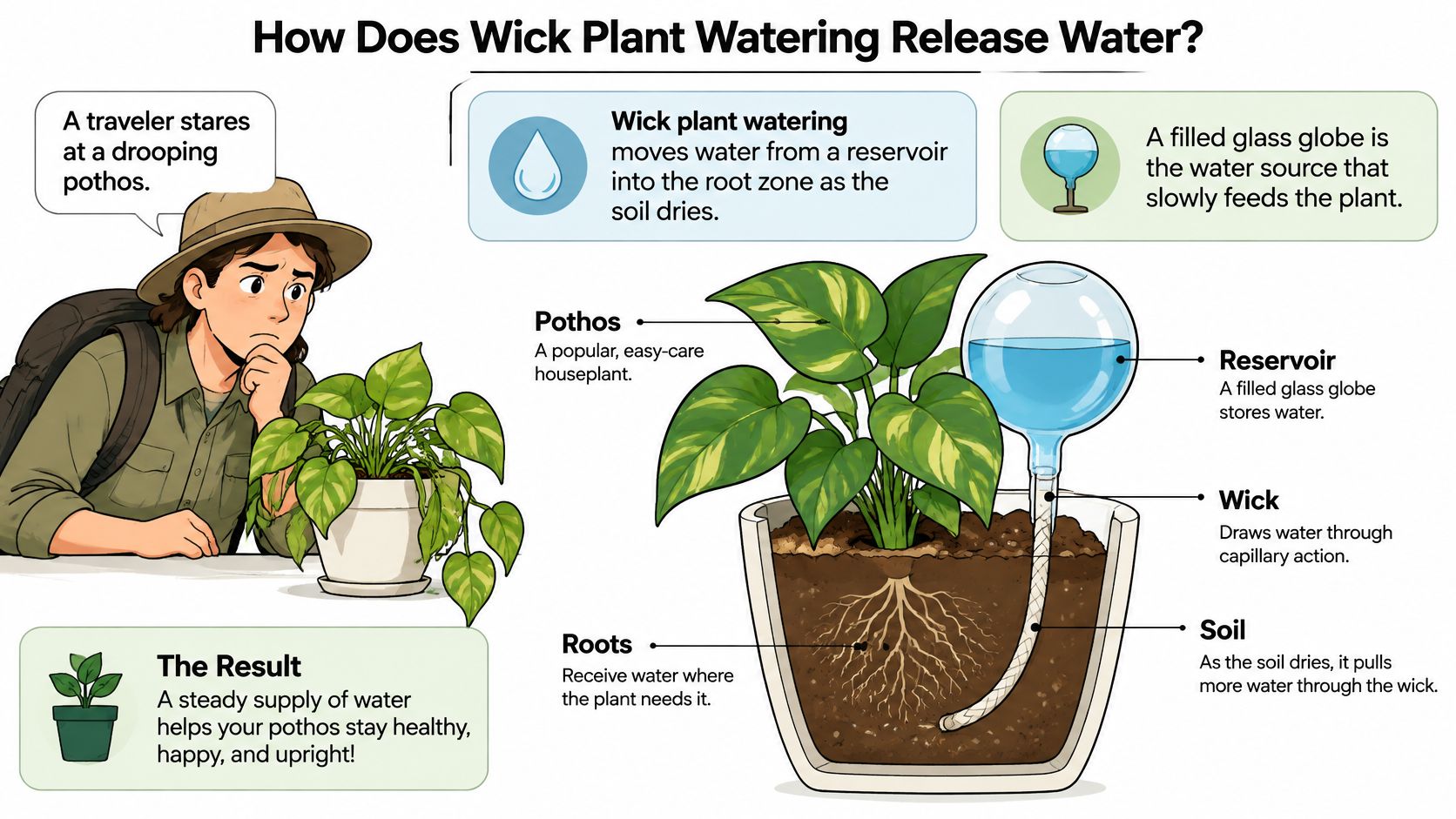
What Changes Inside a Glass Globe
A glass globe uses a related, simpler exchange. The bulb is the reservoir and the long stem sits below the soil surface. As soil dries, air moves through the stem and displaces water into the root zone, then restored moisture slows that airflow and reduces release.
Angle changes the pace. A stem near 90 degrees makes air escape harder and drips more slowly, while insertion near 45 degrees lets water leave more easily. There's no timer, pump, battery, or pressurized emitter deciding the schedule.
The 2018 semi-systematic review in Horticulturae describes wick irrigation as maintaining relatively constant substrate moisture in response to evapotranspiration losses, and it cites controlled work by Yeager and Henley showing 86% less water use than overhead irrigation and 81% less than capillary mat irrigation. Those figures came from controlled systems, not a guarantee for every windowsill. Wick material, soil contact, reservoir height, potting mix, plant size, and room conditions can all change the result. A closer look at capillary action in soil helps explain why contact matters as much as reservoir size.
Why One Fill Rarely Lasts the Same Twice
Capacity sets the ceiling, but demand sets the pace. A 100 ml globe holds the least and empties first, a 200 ml globe suits a typical houseplant pot, and a 350 ml globe gives the largest reserve. Even the largest size shouldn't be treated as a promise of two full weeks.
Heat, bright summer sun, a thirsty fern, and a large volume of soil all shorten a fill. A small pot in a cool room stretches the same amount further. Dry, water repellent mix can also interrupt the pathway before delivery begins, which is why the plant needs watering first.
| Globe size | Pot to match | Fill lasts | Shorter when | Longer when |
|---|---|---|---|---|
| 100 ml | Small pot or desk plant | Shortest of the three, no fixed day count | Thirsty plant, warm room, summer sun | Small pot in a cool room |
| 200 ml | Typical houseplant pot | Up to about two weeks | Large pot or hot room | Small pot in a cool room |
| 350 ml | Larger pot or hanging basket | Longest of the three, ceiling still about two weeks | Summer heat, sun, thirsty foliage | Moderate pot in a cool room |
Practical rule: Test the chosen size on the actual pot for several days before travel, because the bulb level alone doesn't prove the roots are wet.
Is a Watering Globe Better Than a Spike or Drip?
For one to several houseplants during an absence of up to about two weeks, a glass watering globe usually involves the least equipment. A buried wick and separate reservoir suits a pot that will stay in one place for a long period. A drip kit or self watering planter makes more sense when many containers need a shared system or a permanent new pot is acceptable.
The honest verdict depends on scale. A globe is easy to move between pots and easy to inspect because the water level is visible. It isn't the right tool for a very large planter expected to survive on one small bulb, and it can't match the capacity of a big external reservoir.
Where Each Method Fits
A classic wick keeps working while its reservoir contains water, but the setup needs continuous contact between reservoir, wick, and soil. Salt and algae can build on an exposed wick, and the upper part of a tall pot may remain dry. Covering the wick reduces evaporation and keeps the pathway cleaner.
A bottle spike also uses an above soil reservoir, but flow depends heavily on spike pores, bottle seating, and soil texture. Those pores can crust over, and some combinations drain far faster than expected. A drip line offers control, yet tubing, emitters, a supply, and usually a timer add cost and more parts that can clog or disconnect.
A self watering pot hides the reservoir under the soil. That design can work well, but each plant needs that specific container, so cost rises with every pot. A globe avoids repotting and works in an existing container or hanging basket, provided the stem can be inserted safely.
| Method | How long water lasts | Setup | Refill effort | Clogging | Works outdoors | Cost per plant |
|---|---|---|---|---|---|---|
| Glass watering globe | Up to about two weeks, shorter with thirst, large pots, heat, and 100 ml, longer toward 350 ml | Water plant, make pilot hole, fill, insert stem at an angle | Refill bulb when empty | Stem can clog, plastic sleeve helps | Yes, containers and hanging baskets | One globe per pot |
| Classic wick and reservoir | As long as reservoir holds water, no fixed day count | Saturate mix, wet wick, set reservoir below | Top up reservoir | Wick collects salt and algae | Yes if wick is covered | Low, usually DIY materials |
| Watering spike with a bottle | Set by bottle size and soil, no fixed week count | Fill bottle and seat spike | Refill or swap bottle | Spike pores crust and clog | Yes | Low to moderate per pot |
| Drip line | Only while supply and timer run | Tubing, emitters, usually a timer | Check reservoir or tap | Emitters clog | Yes | Higher once a kit is shared |
| Self watering pot | As long as hidden reservoir holds water, no fixed day count | Buy pot with built in well or wick | Fill hidden reservoir | Inlet or wick can clog | Some models only | Higher, one new pot per plant |
What the Long Trial Does and Doesn't Prove
The 12 month greenhouse study held at Jomo Kenyatta University compared overhead hand watering with capillary wick irrigation across money plant, white anthurium, corn plant, spider plant, and red dracaena from May 2015 to April 2016, and the wick system used 3,529 liters against 9,725 liters, a 63.75% reduction that was statistically significant at p≤0.05. That result supports gradual root zone delivery because less water is lost to runoff, drainage, and exposed surface evaporation.
A decorative globe won't automatically reproduce that saving. Wick length, soil structure, climate, and refill habits differ at home. The practical choice still comes back to scale and inspection, a point also covered in the guide to the best self watering devices.
Sizing is the final filter. A small pot points to 100 ml, a typical houseplant pot to 200 ml, and a larger pot or warm room to 350 ml.
Which Plants Suit a Watering Globe and Which Do Not?
A globe keeps soil from drying completely, so plant preference matters more than convenience. It helps foliage that prefers even moisture and can harm plants adapted to a clear dry spell. That distinction should come before any purchase for a trip or gift.
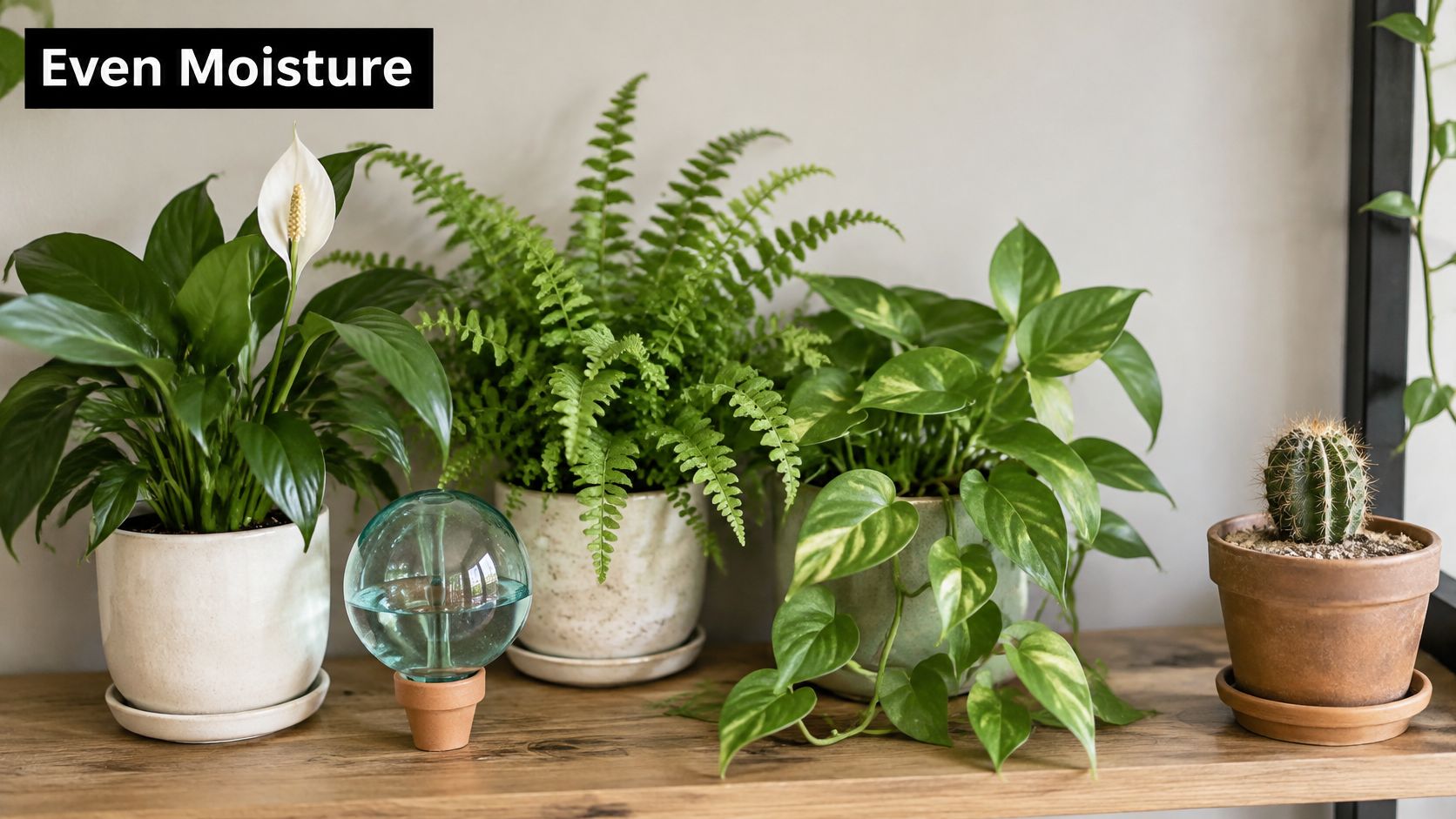
Good candidates include peace lily, ferns, calathea, pothos, philodendron, and spider plant in pots with drainage and an airy mix. These plants still need monitoring, because even moisture doesn't mean saturated soil. A plant that's already struggling in wet mix shouldn't receive a continuous supply.
Plants to Leave Off a Globe
Cacti and most succulents need a different rhythm. They should dry out completely between thorough waterings, then have excess water discarded rather than kept available. Many snake plants and ZZ plants also prefer substantial drying, unless an experienced owner already knows a particular plant and mix tolerate steadier moisture.
If the plant is supposed to dry out, do not use a globe.
The University of Wisconsin Extension houseplant guidance warns that wet soil can lack the air roots need and that a wilted plant in moist soil may have root loss from root rot. That point prevents a common mistake. Drooping leaves beside damp soil can signal damaged roots, not thirst, and adding more water makes the underlying problem worse.
Yellowing leaves, a sour smell, persistently wet mix, soft growth, or fungus gnats also argue for removing the globe. The soil needs air and time to dry before any new watering routine begins. A wick can't rescue roots that have already softened in stagnant mix.
A Five Point Check Before the First Fill
- Drainage works: Water can leave the pot instead of collecting around the roots.
- Mix stays open: Compacted, clay like soil isn't sealing the stem or holding a dense wet pocket.
- Plant likes moisture: The species isn't a cactus, succulent, or other dry cycle plant.
- Room conditions fit: A cool, dim period won't leave water sitting unused for days.
- Inspection is possible: Someone can check below the surface after the first day.
Outdoor containers and summer hanging baskets need a separate judgment. Many contain moisture loving plants and dry by afternoon, so a globe can buffer the hottest part of the day. Heat also empties the bulb sooner, making 350 ml or a mid trip refill more realistic than assuming two weeks.
Gift buyers should apply the same filter. A globe suits a fern or pothos owner far better than a succulent collector. The kindest gift is the one matched to the plants already in the home, not a decorative object that forces the wrong watering pattern.
How Do I Set Up a Little Green Leaf Globe?
Set up the globe before a trip, while you can still check how it waters. Fill the globe, insert it into the soil, then see whether moisture reaches the root zone and the reservoir empties at a suitable rate.
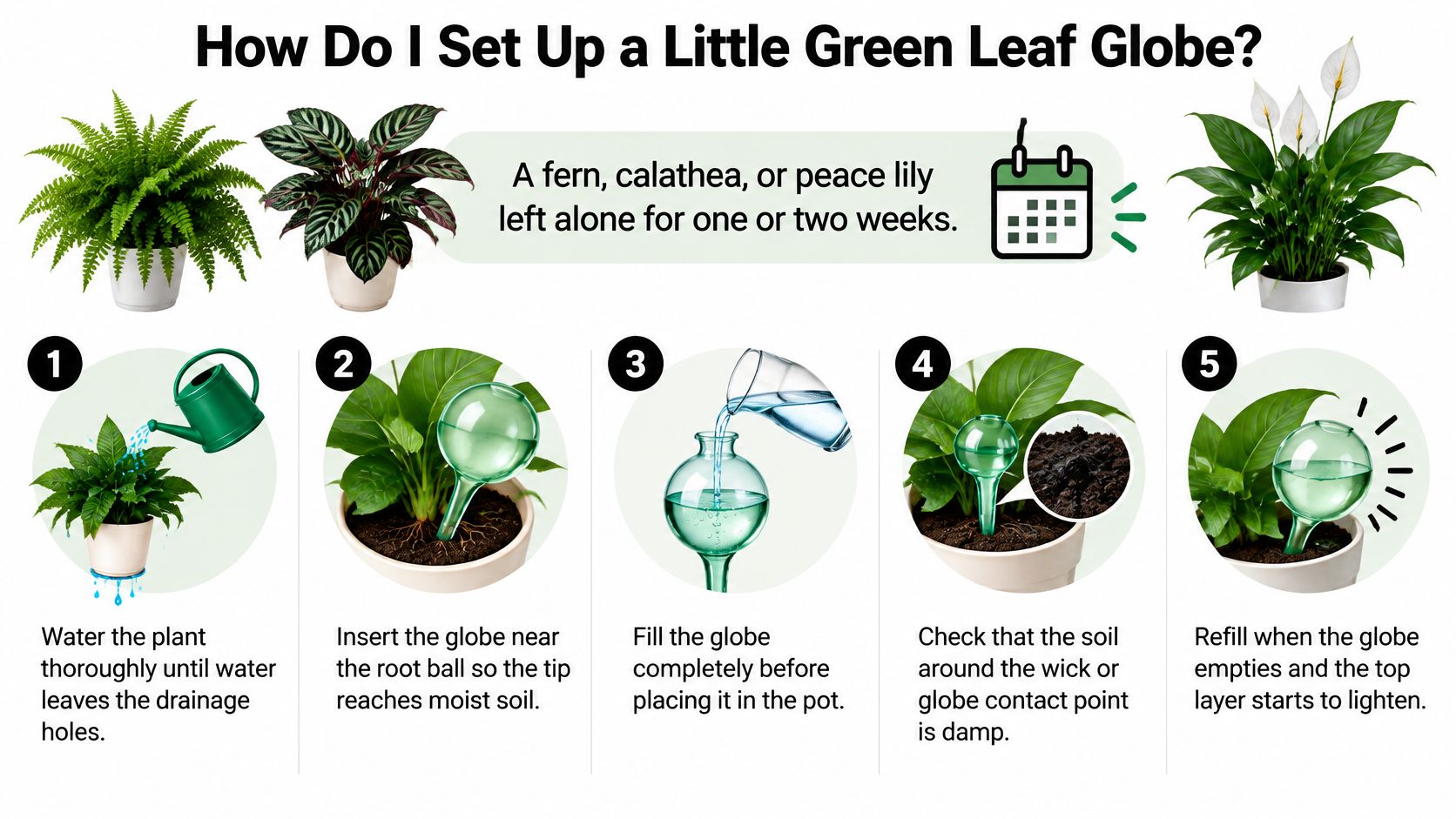
Five Steps From Dry Pot to Working Globe
- Water the plant first: Water thoroughly until liquid leaves the drainage hole, then empty the saucer. Evenly moist soil helps the globe's stem stay in contact with the mix.
- Make a pilot hole: Use a pencil or chopstick to open a spot near the root zone. This gives the glass stem a clear path, rather than forcing it through compacted soil.
- Fill and choose a size: Little Green Leaf globes are available in 100 ml, 200 ml, 350 ml, and a mixed size option. Choose based on the pot and plant's water needs. Optional tip covers can help prevent clogs.
- Insert at an angle: Place the stem in the pilot hole without twisting or forcing it. At 90 degrees, air escapes less easily and water releases more slowly. At 45 degrees, water releases more readily.
- Check after two days: Feel the soil about two inches down, lift the pot, and compare the globe's water level with where it started. Together, these checks help show whether water is reaching the soil or the reservoir is barely changing.
The University of Nebraska–Lincoln Extension guide to wick watering also recommends starting with evenly saturated growing medium and a wet wick in contact with both the water and the substrate. It advises checking the setup after 24 to 48 hours. That early check helps reveal whether the watering pathway is working before you leave.
Adjust Before Travel, Not During It
If the globe empties quickly, try inserting it closer to 90 degrees. If the soil dries while water remains, check that the stem is seated in the soil and that its tip is not blocked. A photo of the starting water level makes small changes easier to spot.
Handle the hand-blown glass carefully. Don't force the stem against stones, thick roots, or compacted soil. Little Green Leaf's decorative globes suit indoor and outdoor plants, and come in multicolor, clear rainbow, and mushroom styles. Optional tip covers and adapters can help with insertion and flow control.
Why Is the Plant Dry When the Globe Still Has Water?
The globe is full, but the leaves are drooping. Often, the water has reached the soil near the stem without spreading far enough to reach the main roots. A reservoir can hold water while the root zone stays dry.
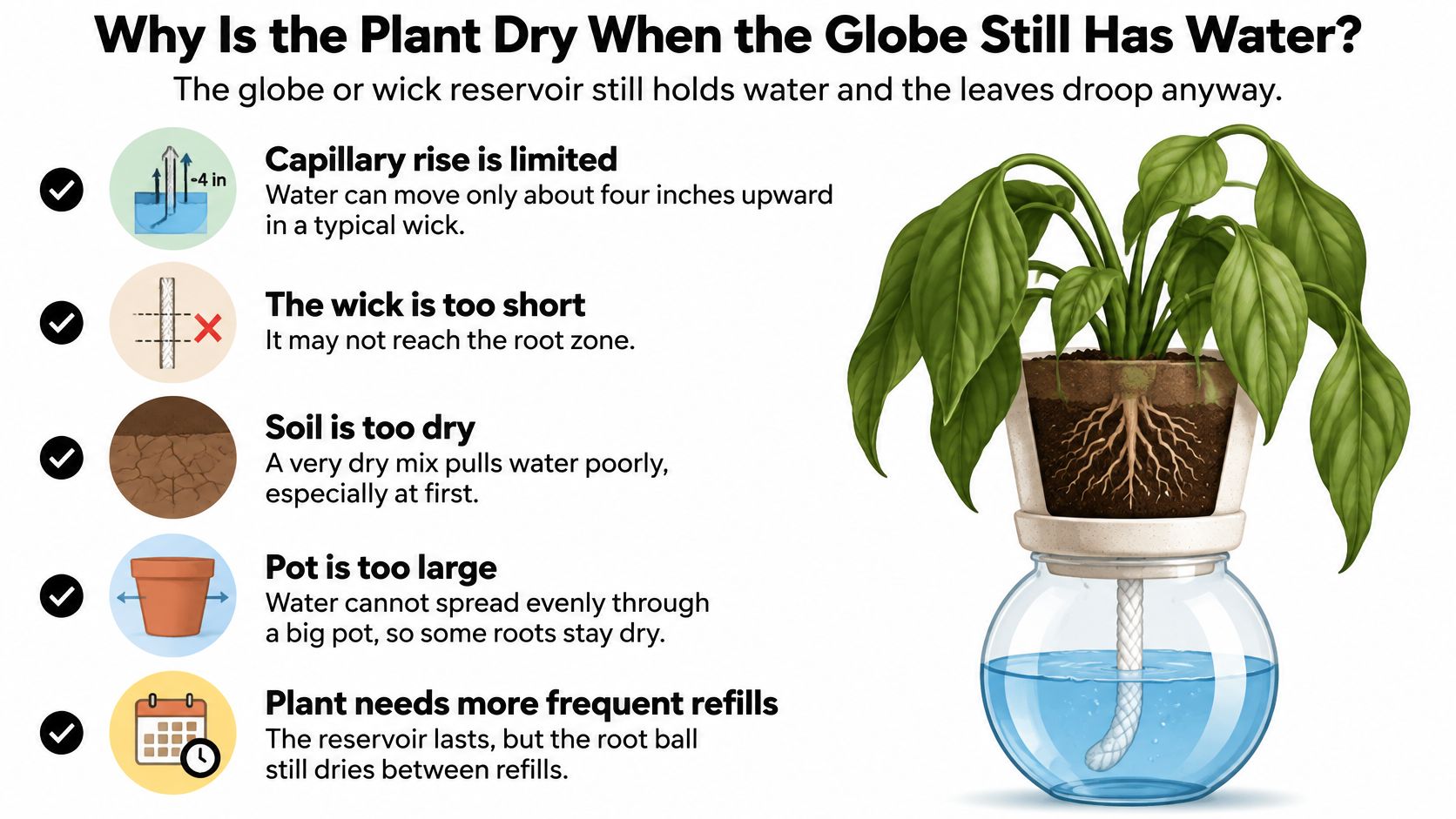
The Hidden Distance Limit
The Kentucky Extension guide to self watering wicking containers explains that capillary water can rise roughly 4 inches above a reservoir under suitable conditions. In a tall pot, lower soil may stay moist while roots higher up or near the edges dry out. Bark-heavy or perlite-heavy mixes can also break up the fine pathways that carry water through the soil.
Check how the globe meets the soil. An air pocket around the stem limits contact. A short wick may end above the main roots, while compacted mix can block the tip. In hot conditions, a narrow water pathway may also struggle to keep up with the plant's demand.
A Short Performance Audit
Use the setup checks from the previous section, then focus on whether water can travel from the globe to the root zone:
- Check contact: Gently inspect whether the stem or wick touches soil along its buried length.
- Inspect the outlet: Look for packed soil, mineral film, or fine particles blocking the tip.
- Watch the change: Before a trip, note the bulb's water level and the plant's condition, then check again after a couple of days.
If the globe's water level barely changes while the plant wilts, inspect the contact and outlet before changing the setup.
Match the Symptom to the Fix
If water stops moving, rinse the stem and clear its outlet. Warm water and a soft brush can remove ordinary film. For fine or sandy mix, use an anti-clog sleeve if available, and make a pilot hole before inserting the stem so soil does not pack into the opening.
If water flows too quickly, the soil may pool or the globe may empty sooner than expected. Set the stem more upright to slow release. If the soil stays persistently wet and leaves turn yellow, remove the globe, let excess water drain, and allow the mix to aerate. A plant that needs a dry cycle should not be kept continuously moist.
What Do Buyers Ask Before a Trip?
How Long Does Wick Plant Watering Last?
A Little Green Leaf globe can hold enough water for up to two weeks, depending on the plant, climate, pot size, and insertion angle. Treat that as a possible maximum, not a promise for every pot.
Can a Watering Globe Replace Checking the Soil?
A globe helps maintain moisture, but it does not tell you whether a plant should stay damp. Before leaving, check that the plant suits steady watering and that the globe is releasing water into the root zone.
Are Watering Globes Safe for Succulents and Cacti?
Usually, these plants are poor candidates. Cacti and many succulents need their soil to dry between waterings, so continuous moisture can work against their needs. Choose a watering method that allows a dry period instead.
What Happens on a Trip Longer Than One Fill?
Plan for another person to check or refill the globe if the trip may outlast its water supply. For more ideas, read this guide to watering plants while on vacation. Try the setup in the actual pot before you leave, so you know whether water reaches the roots.
Which Size Suits a Summer Hanging Basket?
A larger globe may hold more water, but outdoor conditions and the plant's needs still affect how quickly it empties. Check the basket before departure and arrange a refill if the plant may need water before you return.
Are Globes a Good Gift for a Plant Lover?
They can suit someone who grows plants that benefit from steady moisture. Little Green Leaf Plant Watering Globes are hand-blown glass and come in 100 ml, 200 ml, 350 ml, and a mixed size option. The business is trusted by more than 250,000 plant lovers.
On your first morning back, check the soil before refilling the globe. If the soil is moist and the plant looks healthy, the system may have supplied enough water. If the bulb still contains water but the soil is dry, check that its outlet reaches the root zone rather than stopping near the surface.
For moisture-loving plants that need steadier water during busy weeks or travel, Little Green Leaf offers hand-blown glass globes in 100 ml, 200 ml, and 350 ml sizes, as well as a mixed size option. Choose a size for the pot, then check that the setup suits the plant before leaving home. Visit Little Green Leaf to select a globe.