

Watering Globes for Indoor Plants: How They Work
A single filled watering globe can last up to about two weeks, but there's no fixed number of days because duration depends on pot size, soil, and room conditions. For someone packing for a trip, the dependable answer comes from testing the actual plant and pot before departure, not assuming the globe will last until the return flight.
Watering globes for indoor plants can also help owners who forget to water or struggle with uneven moisture. They're supplemental reservoirs, though, not permission to stop checking the soil or add water to an already soggy pot.
Table of Contents
- How Long a Watering Globe Lasts in a Real Home
- The Science Behind How a Watering Globe Releases Water
- Choosing the Right Globe Size for Your Pot
- Setting Up a Little Green Leaf Globe Step by Step
- Plants That Thrive With a Globe and Ones to Avoid
- Globes Compared to Spikes, Drip Systems, and Self-Watering Planters
- Frequent Questions and Travel-Readiness Checklist
How Long a Watering Globe Lasts in a Real Home
The most useful question isn't how long the bulb takes to empty. It's whether the plant stays appropriately moist while the reservoir supplies water.
A globe that still contains water hasn't necessarily watered the whole root zone. A globe that empties quickly hasn't necessarily malfunctioned, either. Plant demand, soil conditions, and the position of the outlet all affect the result.
Oregon State University's soil-water guidance explains why water storage and movement depend on pore structure and water tension. That makes reservoir capacity only part of the duration calculation.
Conditions that change the result
- A larger or thirstier plant can use the available supply faster than a smaller, slower-growing plant.
- A warm room can increase water demand through evaporation and plant uptake.
- A cool, low-light space can reduce demand, leaving the reservoir full for longer.
- Different potting mixes change how water moves away from the stem and remains available around roots.
A small globe in a large floor planter is therefore a poor match for unattended care. Choosing a larger reservoir provides more water, but it doesn't correct an unsuitable soil condition or guarantee coverage for a long absence.
Practical rule: The useful duration ends when the plant needs attention, not necessarily when the bulb becomes empty.
Test the whole watering cycle
A pre-trip trial should begin several days before departure, with the plant in its normal indoor conditions. The owner can observe the reservoir, check moisture at different depths, and compare the pot's weight as the trial progresses.
Texas A&M's houseplant guidance emphasizes that watering needs change with indoor conditions and actual soil moisture. That supports a pot-by-pot trial rather than a calendar promise.
If the plant dries before the planned return date, the setup hasn't passed the test. A larger globe may help, but a longer absence may still require someone to check the plant. If the soil stays excessively wet, extending reservoir duration is the wrong goal.
The Science Behind How a Watering Globe Releases Water
A watering globe combines a reservoir with a narrow outlet placed in soil. Water leaves the bulb, while the surrounding potting mix determines how readily that water moves into nearby pores and toward roots.
Capillary action helps explain that movement. Water adheres to surfaces and holds together through cohesion, allowing it to travel through small spaces. A familiar comparison is a paper towel drawing water upward from a spill.
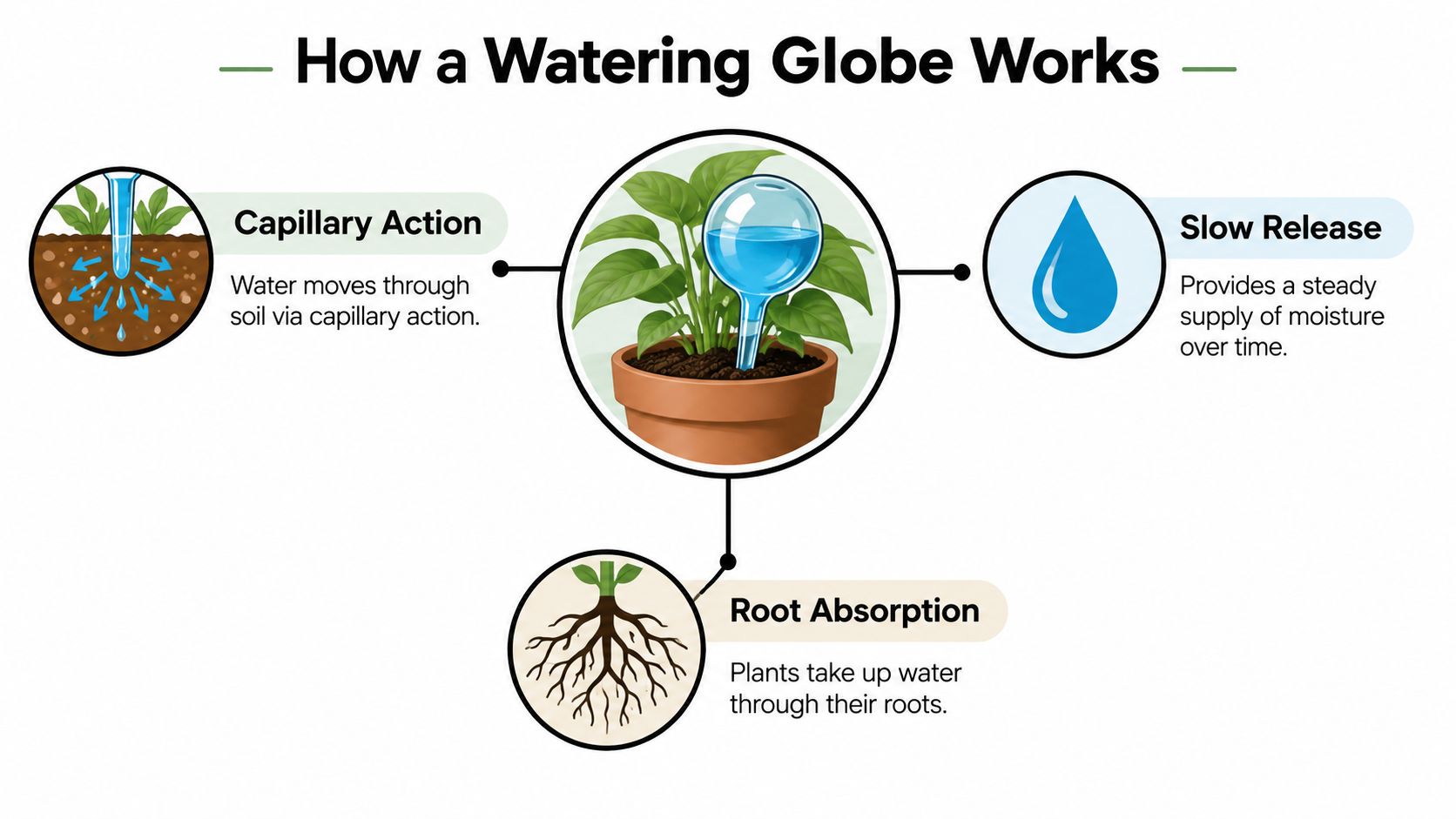
Soil moisture affects redistribution
North Dakota State University's explanation of soil, water, and plant characteristics distinguishes water that drains under gravity from water retained by capillary forces. The retained water matters because plants can use it after excess water has drained away.
When soil near the outlet is drier, water can move into those nearby pores. As that area becomes wetter, the difference in water tension decreases, slowing redistribution. Roots absorbing water and evaporation drying the mix can increase that difference again.
The bulb also needs air exchange to replace water leaving the reservoir. Restricted air entry can slow outflow, but that isn't a precision valve measuring the plant's needs. A globe isn't a mechanical timer or an overwatering safeguard.
The guide to capillary action in soil offers a closer look at how the growing medium influences gradual watering.
Why the surrounding soil still matters
A blocked outlet prevents the intended delivery. Compacted media can interrupt useful movement and leave roots with too little air. A container without drainage can retain excess water regardless of how slowly it arrives.
Gradual delivery can reduce sharp changes in moisture, but it can't make a waterlogged root zone healthy.
This distinction resolves a common beginner concern: slow release doesn't automatically mean safe watering. A globe can provide smaller replenishments between ordinary waterings, but its performance still depends on a draining pot and a plant that benefits from that moisture pattern.
Choosing the Right Globe Size for Your Pot
When you're choosing a globe for a trip, its capacity can look like a promise of how long it will water your plant. Treat it as a starting point instead. A globe's usable duration depends on the pot, growing medium, plant, and room conditions, so a test at home is more dependable than a fixed number of days.
Little Green Leaf offers hand-blown glass bulbs in 100 ml, 200 ml, and 350 ml capacities, with long stems. The smallest holds a modest reserve, the middle size adds a buffer, and the largest holds more water for a suitable plant. The labeled capacity is a clearer guide than comparing a globe to a cup, since cup sizes vary.
Matching Little Green Leaf Globe Size to Pot Size
| Globe Size | Best Pot Diameter | Ideal For | Realistic Duration |
|---|---|---|---|
| 100 ml | Small-diameter pots; no universal diameter cutoff | Compact plants with modest demand | Shorter reserve, confirmed through a trial |
| 200 ml | Medium-diameter pots, depending on plant demand | Everyday supplemental watering for suitable foliage plants | Variable with soil, uptake, and indoor conditions |
| 350 ml | Medium planters or thirstier compatible plants | A larger buffer between complete waterings | Greater reserve, but no guaranteed trip coverage |
Use these selection starting points, not verified diameter specifications. Pot diameter alone doesn't show how deep the container is, how densely roots fill it, or how much growing medium it holds.
Choose for the plant, not just the container
A shallow planter and a deep pot may have the same opening but hold different amounts of growing medium. A densely rooted plant can also use water at a different rate from a smaller plant in the same pot.
University of Wisconsin houseplant-care guidance explains that indoor conditions affect plant care. Warm, actively growing plants generally need water more quickly than those in cool, low-light rooms. Little Green Leaf's 100–350 ml range is product sizing, not a duration estimate. Match a globe to your plant through a trial rather than assuming any size will last for a set number of days.
Before relying on one during a trip, test it in the same pot and room. Check how much water remains and whether the root zone is staying appropriately moist. That gives you a practical estimate for your setup, rather than a marketing number that may not fit it.
For a very large pot, don't make a single small globe the main watering plan. Consider multiple globes only after checking moisture across the root zone, not just beside each stem.
A larger bulb isn't automatically a safer choice. If a plant needs its growing medium to dry between waterings, extra capacity supplies more water without making the globe a better fit.
Setting Up a Little Green Leaf Globe Step by Step
A successful setup begins with the plant's moisture condition, not with filling the bulb. If the lower root zone is already wet, installation should wait.
For a compatible plant that's ready for watering, the following routine establishes a useful starting point. The stem belongs in moist, drained media rather than an extremely dry root ball.
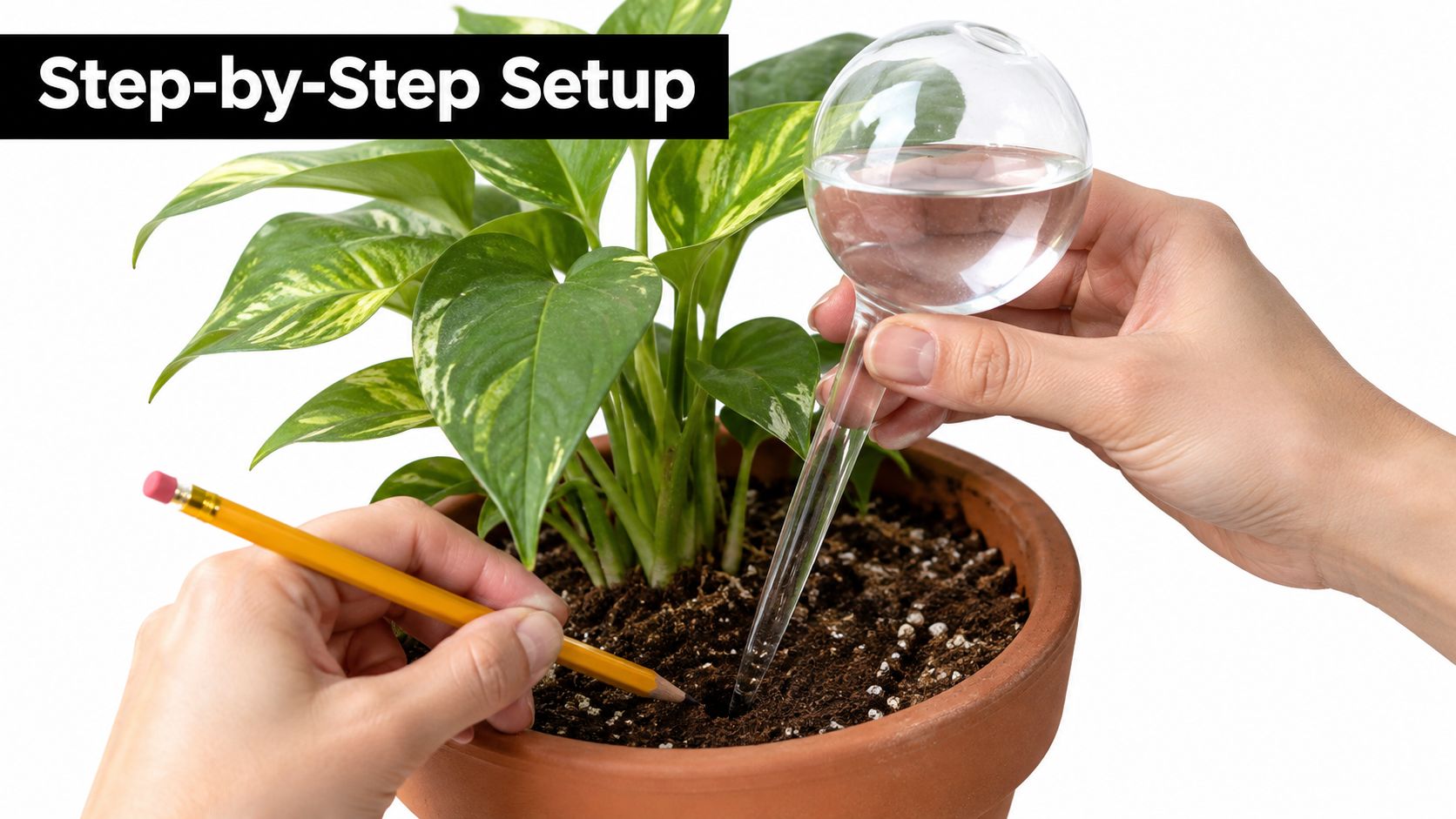
A five-step indoor setup
- Water the plant first. Wet the potting medium thoroughly until water exits the drainage holes, then let the excess drain. Empty any collected water rather than leaving the pot standing in it.
- Make a pilot hole. Use a pencil or finger to create a path for the stem, especially in dense soil. Forcing glass directly into compacted media can pack soil into the outlet and puts unnecessary pressure on the stem.
- Fill the bulb. Fill it under a tap, then cover the opening with a thumb while turning it over. An optional plastic anti-clog sleeve can help protect the outlet, although it doesn't replace the pilot hole.
- Insert at a gentle angle. Guide the stem into the prepared hole without pushing against resistance. The bulb should sit securely rather than lean where a passing hand could knock it.
- Check after two days. Treat this as an initial observation, not proof of travel readiness. Check moisture below the surface, compare pot weight, and continue watching the setup through the intended absence period.
Read the soil, not only the water level
University of Maryland Extension recommends checking about 2 inches into the growing medium rather than watering indoor plants on a fixed schedule. For a globe trial, that deeper check is more informative than the appearance of the soil surface alone.
If the bulb loses water while the soil becomes soggy, the owner should remove it and reassess. If the surrounding soil remains dry, the outlet, insertion position, and reservoir match need inspection.
The setup doesn't replace periodic complete watering. The earlier houseplant-care guidance recommends thorough wetting and drainage to hydrate dry pockets and help prevent uneven salt accumulation.
Plants That Thrive With a Globe and Ones to Avoid
Moisture preference matters more than the label “houseplant.” A watering globe is most useful when the plant benefits from relatively steady moisture and the pot drains freely.
Tropical foliage plants can be candidates, but a familiar name shouldn't replace checking the plant's actual watering requirements. Pothos and philodendrons aren't automatic matches in every room or pot; peace lilies, ferns, and begonias likewise need assessment rather than blanket promises.
Good candidates need a moisture check
A plant that repeatedly dries sooner than its owner can reasonably water may benefit from a supplemental reservoir. The useful outcome is an adequately moist root zone, not permanently wet soil.
Virginia Cooperative Extension's indoor-plant guidance distinguishes the watering needs of tropical houseplants from those of cacti and succulents. It also emphasizes monitoring moisture rather than treating every plant alike.
Plants whose care calls for substantial drying, including ZZ plants where that drying rule applies, are poor default candidates. Their watering pattern matters more than the convenience of leaving a filled bulb in place.
When installation should wait
- Wet lower soil. A dry-looking surface doesn't establish that the roots need more water.
- Missing drainage. A decorative outer pot should not trap drained water around the inner container.
- Dense, persistently soggy media. A globe can't repair a root zone that already lacks adequate aeration.
- Unstable glass placement. A bulb should not sit where children, pets, or routine movement could dislodge it.
Mississippi State University's indoor-plant guidance warns that lower soil can remain moist while the surface looks dry and that poor drainage or compaction can contribute to plant decline.
Cacti and succulents generally shouldn't receive continuous supplemental moisture. University of Minnesota Extension advises thorough watering, drainage, and complete drying between waterings, with reduced watering during low-light winter conditions.
Suitability comes first: A plant that needs a dry interval doesn't become a globe candidate just because its owner is traveling.
Globes Compared to Spikes, Drip Systems, and Self-Watering Planters
Choosing a watering aid starts with the size of the problem. Supplementing a single existing houseplant differs from maintaining a large collection during an extended absence.
The following comparison is a buying framework, not a product ranking. Exact runtime, clog resistance, outdoor suitability, and cost depend on the particular design and installation, so there's no responsible universal figure for those categories.
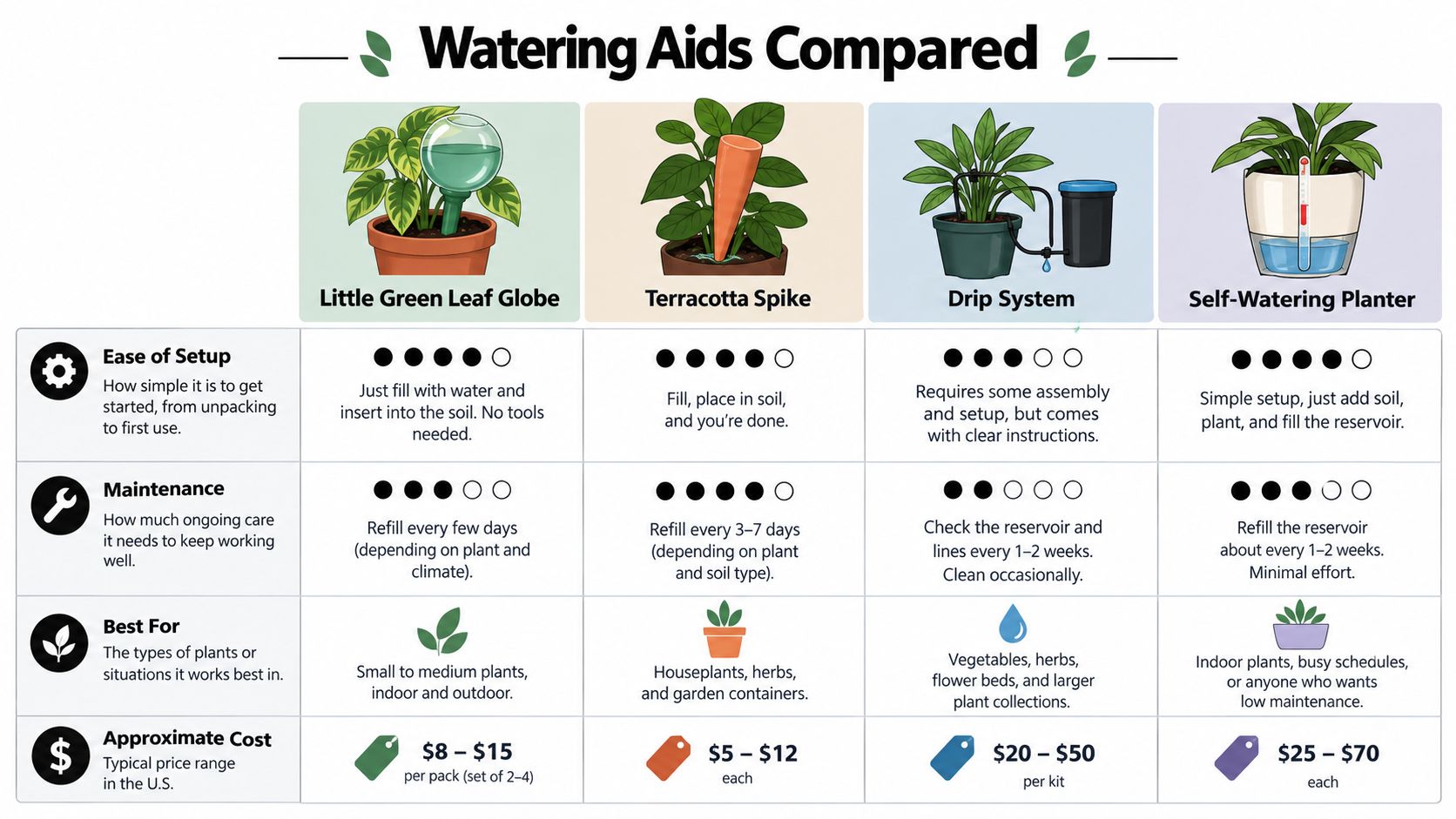
Watering Globes vs Other Plant Watering Aids
| Method | Lasts | Setup | Refill | Clogging | Works Outdoors | Cost per Plant |
|---|---|---|---|---|---|---|
| Glass watering globe | Depends on tested reservoir and plant demand | Fill and insert into a prepared hole | Each bulb is refilled separately | Soil can block the narrow outlet | Suitable containers need a separate trial | Depends on size and pack |
| Terracotta spike | Depends on reservoir and design | Prepare the spike and its water supply | Depends on attached reservoir | Maintenance depends on construction | Check intended use and exposure | Depends on spike and reservoir |
| Drip system | Depends on water supply and operation | Arrange delivery lines and verify output | Supply-dependent | Check outlets and connections | Depends on system specifications | Depends on equipment and plant count |
| Self-watering planter | Depends on reservoir and plant uptake | Establish the plant in a compatible container | Refill the built-in reservoir | Inspect the delivery pathway | Depends on planter design | Depends on planter size and construction |
Match the effort to the situation
A globe offers a straightforward trial in an existing pot without changing the container. Its visible bulb also makes the remaining reserve easy to inspect. The trade-off is individual refilling and a limited supply for each plant.
For a large collection, owners may prefer assessing a system with a shared water supply rather than refilling many separate bulbs. For ongoing forgetfulness, a planter with an integrated reservoir may merit consideration, provided the plant tolerates its moisture pattern.
The discussion of self-watering plant spikes can help clarify another category without assuming that all passive watering aids behave identically.
Outdoor use needs its own trial
An indoor calibration shouldn't be carried over unchanged to an outdoor container or hanging basket. The surroundings differ, and the owner needs to verify both moisture delivery and secure placement.
Cost should be assessed using the actual current product price and the number of plants served. Without those details, assigning a dollar amount or declaring a cheapest option would be misleading. The right choice is the setup that passes the plant's moisture test and fits the owner's refill routine.
Frequent Questions and Travel-Readiness Checklist
Before departure, a brief check can prevent the most avoidable failures. The guide to keeping plants watered while on vacation provides related planning guidance.
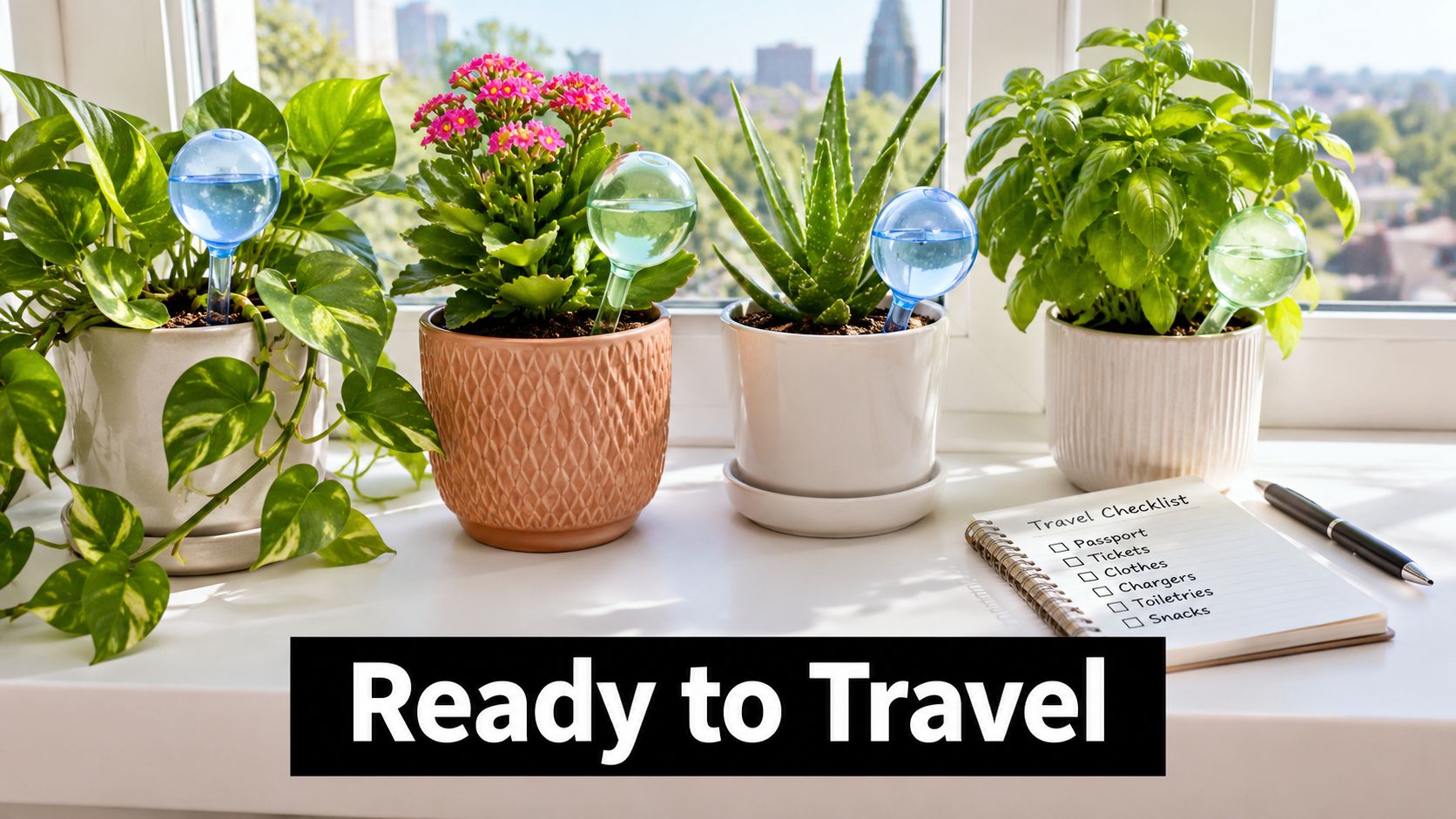
- Calibration completed. The setup has been observed before the trip, not installed for the first time at departure.
- Watering assessed. Compatible plants have received complete watering when needed.
- Pilot hole prepared. The stem enters without force.
- Drainage confirmed. Excess water can leave the container.
- Capacity matched. Each pot has its own tested arrangement and backup plan.
How long do watering globes last?
There's no universal runtime. The dependable estimate comes from observing the individual pot under conditions similar to those expected during the absence.
Do watering globes work for succulents?
They're generally unsuitable for succulents and cacti. Those plants usually need the drying interval described above rather than continued moisture delivery.
Why does a watering globe empty so fast?
Rapid emptying can reflect plant demand, dry media, or insertion conditions. If the soil becomes too wet, adding a larger globe isn't the answer; if the plant still dries, capacity and delivery need reassessment.
How do watering globes get unclogged?
Remove the globe and rinse the stem with warm water. A thin brush may help clear accessible debris, but it shouldn't be forced into the glass.
Are watering globes safe around pets and kids?
Hand-blown glass can break if dropped or knocked over. Globes should be positioned beyond reach and handled without pressure on the stem.
Little Green Leaf offers hand-blown glass watering globes in multicolor and clear rainbow, with individual and multipack options for compatible plants. Plant owners can visit Little Green Leaf to compare the available sizes, then test a globe in a draining indoor pot before relying on it during a trip.