

Self Watering Patio Planter Guide for Easy Care
You've watered the plants before leaving for the weekend, but the balcony gets more sun than expected. When you return, the herbs are limp, the soil feels dry, and you're left wondering whether you watered too much, too little, or just at the wrong time. Outdoor containers can lose moisture quickly because heat and airflow speed evaporation, so even attentive plant owners can struggle to keep patio plants steady.
A self watering patio planter offers a calmer approach. It stores water below the soil and lets moisture move upward gradually, helping reduce the sharp swing between freshly soaked soil and a completely dry root zone. It isn't a magic container, and it still needs observation, but it can make care more consistent for busy households, apartment dwellers, office managers, and travelers.
The sections below will help you understand the system, match it with suitable plants, set it up properly, and recognize the reasons it might still dry out. If you're also shaping a comfortable outdoor space, ideas for patio balustrade design ideas can help you think about safety, layout, and how your planters fit into the balcony or terrace as a whole.
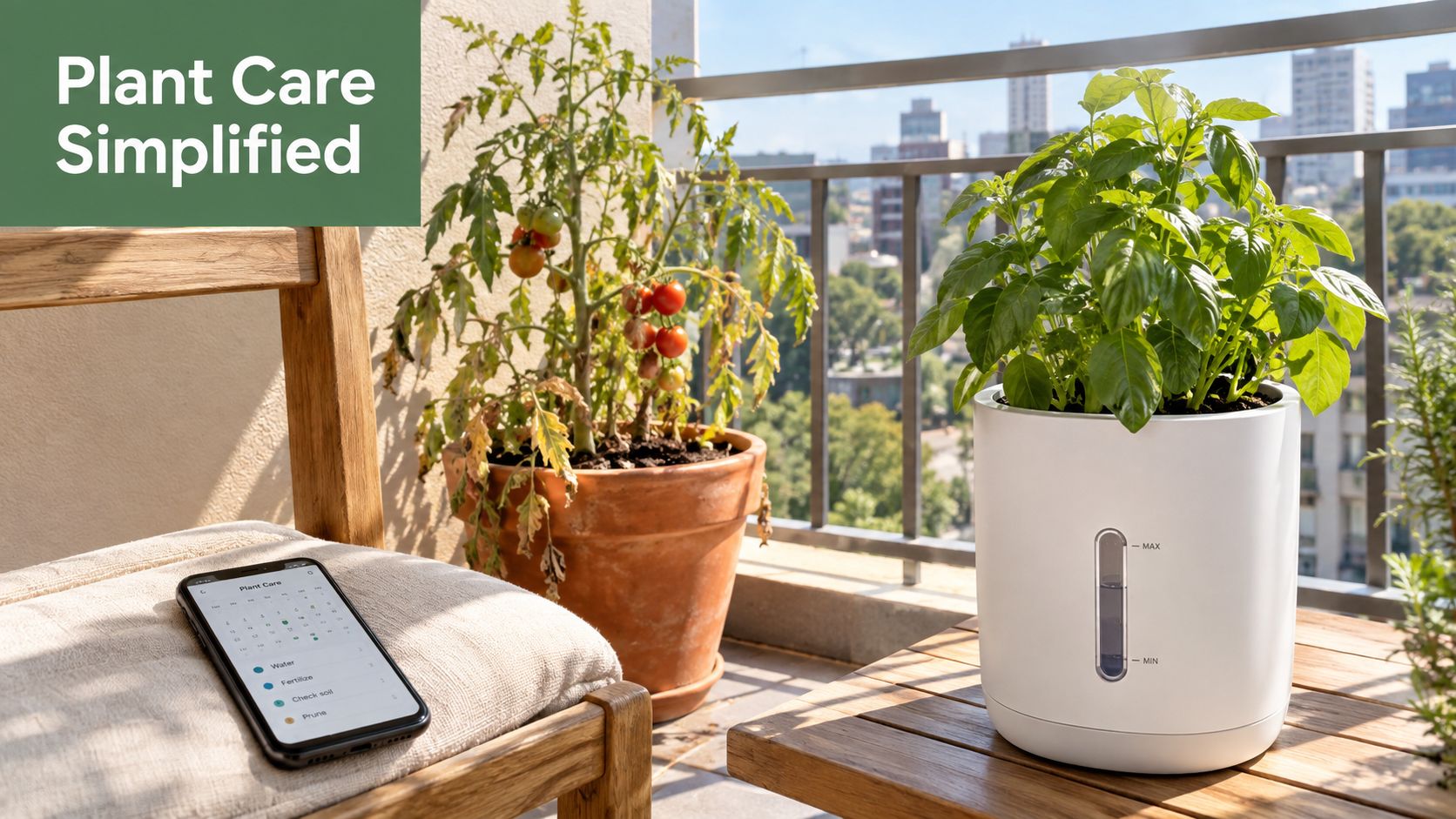
For a gentle introduction to different container styles, you can also explore self-watering containers. The aim isn't to create a patio that needs no care. It's to create one that's easier to read and less stressful to maintain.
Introduction to Effortless Patio Plant Care
A sunny balcony can feel like a tiny garden retreat. You place basil near the railing, add flowering plants beside the door, and enjoy checking new leaves during your morning coffee. Then a busy week arrives. Meetings run late, the weather turns hot, and watering becomes one more task competing for your attention.
That's where a self-watering patio planter can help. Instead of asking you to wet the soil from above every time it begins to dry, the container holds a lower supply of water and supports a slower, steadier movement of moisture toward the root zone. The result feels less like a gadget and more like a small reserve that gives your plants breathing room between checks.
The idea has a long technical history. A United States patent record includes an early 1934 “selfwatering flower vessel”, followed by milestones such as a 1973 “self-watering flower pot,” a 1977 self-watering system for containerized plants, and a 1991 New York Times patent feature describing a planter that responded to changes in soil moisture loss through the planter's weight. Later filings continued through the 1980s, 1990s, and 2000s, including priority dates in 1987, 1988, 1999, and 2008. This history shows that reservoir watering and moisture-responsive release are established container-gardening ideas, not a passing novelty. (United States patent record)
A helpful mindset: self-watering means steadier care, not no care.
Outdoor plants still respond to sun, wind, container size, soil texture, and their own growth rate. You'll need to refill the reservoir, look at the leaves, and adjust when conditions change. The benefit is that your plants don't depend on one perfect watering moment every day.
That makes this style especially useful if you travel, work long hours, garden on a balcony, or want your patio to feel more relaxing. You can begin with one planter, observe how it behaves, and build a routine that feels natural rather than demanding.
How a Self Watering Patio Planter Actually Works
A self-watering planter has two main spaces. The upper section holds the plant and potting mix, while the lower section stores water in a reservoir. A wick, porous bridge, or specially designed contact area connects the supply below with the soil above.
The easiest way to understand the movement is to think of a paper towel touching a spill. Water creeps through the towel's tiny spaces without a pump pushing it. A sponge behaves similarly, drawing liquid into its pores. In a planter, capillary action moves water upward through a wick or suitable potting mix.
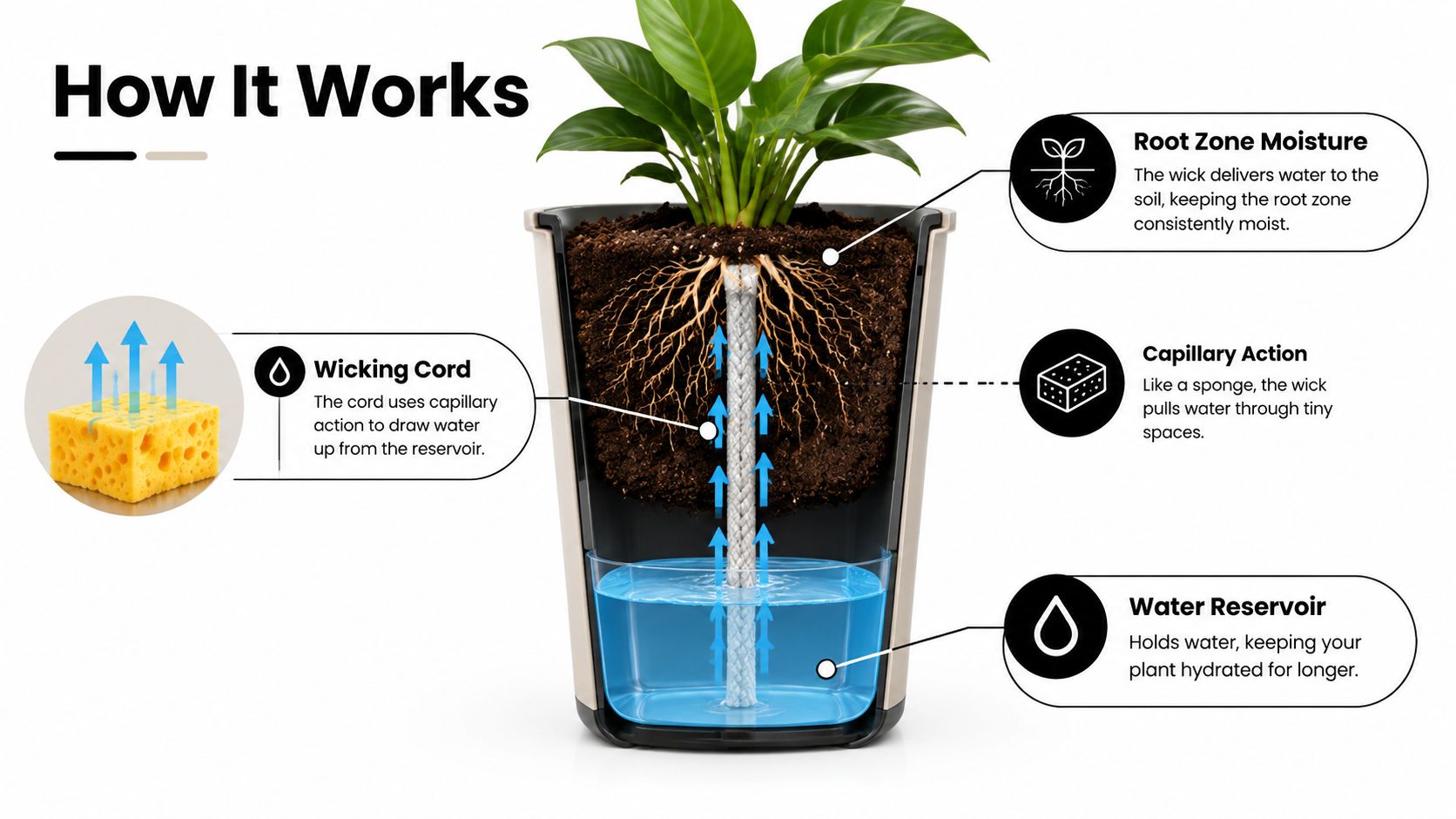
The moisture path
The process is easier to picture in a few simple stages:
- The reservoir holds water below the root zone.
- The wick or porous interface draws moisture upward.
- The potting mix distributes that moisture around the roots.
- As the mix dries, capillary pull increases and more water moves upward.
- As the mix becomes wetter, the pull weakens and the flow slows.
That final step creates a moisture gradient, rather than a continuous flood. The lower part of the container stays closer to the water source, while the upper root area receives moisture according to the balance between evaporation, plant use, and the dampness of the soil. The process is described as a passive, mechanical system, so it doesn't require pumps, timers, batteries, or apps. (Gardening Beyond's educational explanation)
Why separation matters
A well-designed container separates the reservoir from the main root zone with an air gap, divider, or controlled wicking pathway. That space helps keep oxygen available around the roots instead of leaving them directly submerged in standing water. Roots need both moisture and air, so the goal is damp soil with room for oxygen, not a waterlogged pocket.
The wick and soil must also stay in good contact. Finer, porous media can improve upward movement, while heavy or compacted mixes may interrupt the path. This is why a self-watering planter's success depends on the relationship between reservoir capacity, wick contact, soil texture, and plant demand, not on the reservoir alone. (Technical explanation of self-watering planter mechanics)
Benefits of Steadier Moisture for Busy Plant Owners
Top-watering often creates a familiar pattern. You add plenty of water, the soil becomes very wet, and then the container gradually dries as the plant uses moisture and the patio environment pulls water away. If you miss the next check, the root zone can become dry before you notice.
A reservoir system softens that pattern by feeding moisture from below. Independent descriptions of these systems note that bottom-fed moisture can create a more stable moisture band and extend the interval between refills, especially where outdoor heat and airflow increase evaporation. (Reservoir and wicking system description)
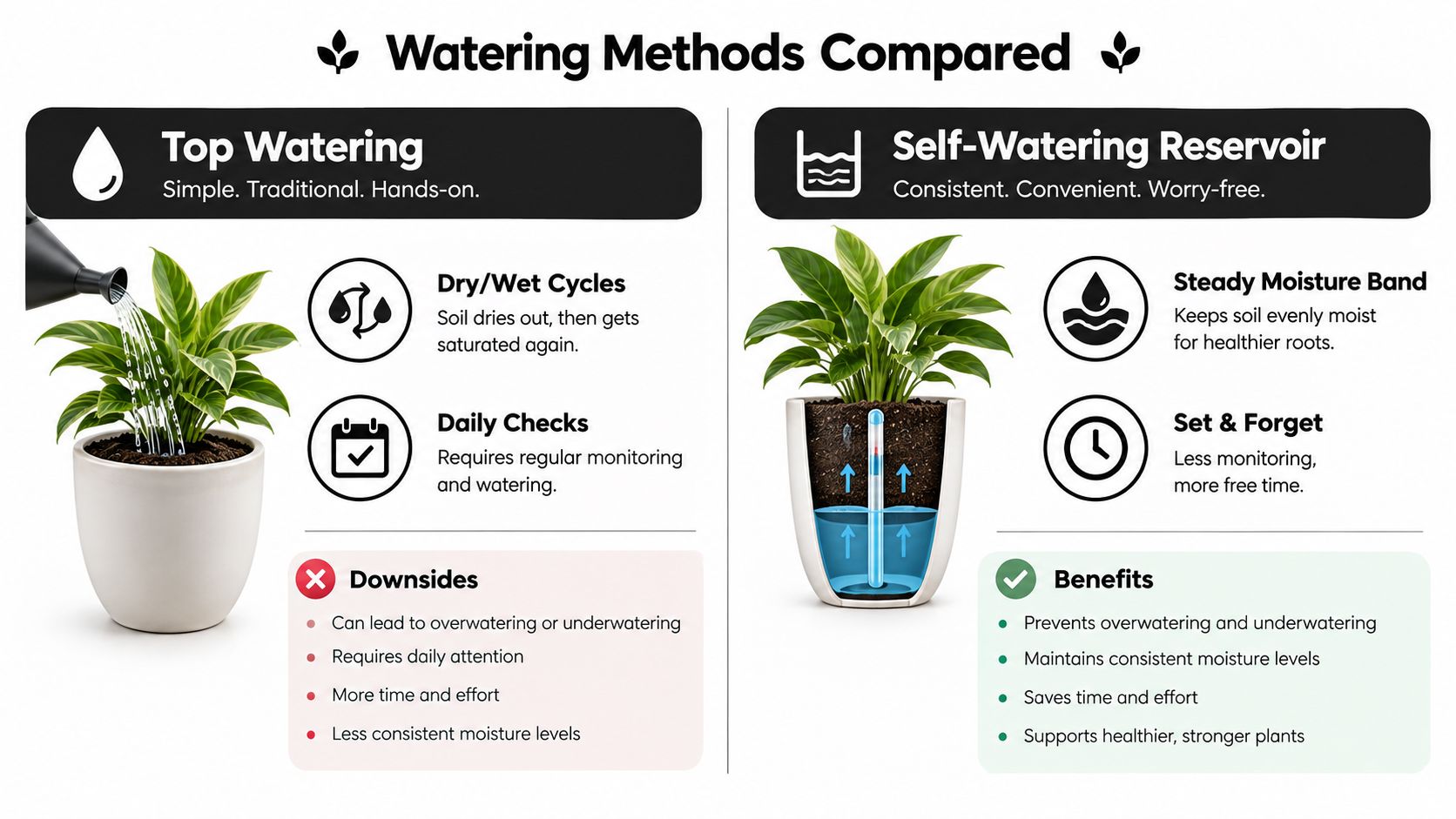
What steadier moisture feels like
You may notice that the plant looks less dramatic between watering days. Leaves don't have to move from perky to wilted as often, and the soil is less likely to alternate between saturated and dusty. That consistency can support healthy root activity because the plant has more dependable access to moisture without relying on repeated heavy top-watering.
The benefits are practical:
- Fewer daily checks: You can replace constant watering decisions with a simple reservoir observation routine.
- More forgiving travel care: A filled reservoir can provide support while you're away, though the exact duration depends on the plant, weather, soil, and container.
- Better balcony convenience: Rooftops, balconies, and patios often sit farther from a hose, so storing water within the planter makes care easier.
- A calmer office routine: Office greenery can be easier to manage when watering doesn't depend on one person remembering every task.
- Less guesswork: The plant's soil and leaves become useful signals, rather than every watering decision feeling like a test.
This approach is especially helpful for people whose plants dry out because of irregular schedules. It can also help protect against the opposite habit, pouring on more water because a plant was allowed to become too dry. Still, steadier moisture isn't suitable for every species. The right pairing matters just as much as the container.
How to Choose the Right Planter and Plant Pairing
Start with the plant, then choose the planter. A reservoir can support herbs, leafy annuals, and many plants that prefer an evenly moist growing medium, but it may be a poor fit for plants that need a pronounced dry-down cycle.
Your potting mix should be light enough for water to travel and air to remain around the roots. A compacted mix can interrupt the wicking path, while a hydrophobic mix may resist water after it has dried. The container should also have a sensible overflow or drainage design, because excess water needs a safe route away from the root zone.
A simple decision matrix
| Plant Type | Moisture Preference | Best Planter Setup | Tip for Success |
|---|---|---|---|
| Herbs such as basil and leafy patio plants | Steady moisture | Reservoir planter with reliable wick or porous bridge | Harvest regularly and check the reservoir during hot weather |
| Flowering annuals | Even moisture during active growth | Patio planter with a visible refill point | Watch the leaves when sun and wind increase |
| Tropical foliage plants | Consistent moisture with air around roots | Separated reservoir and airy potting mix | Don't compress the mix around the roots |
| Succulents and cacti | Dry-down between waterings | Traditional pot with fast drainage | Let the growing medium dry before watering again |
| Plants prone to rot in wet soil | Noticeable drying cycle | Free-draining container without constant bottom moisture | Choose a setup that allows you to control watering directly |
Container size should match both the plant's root system and its water use. A large, thirsty plant in a small reservoir may still dry out quickly, while a small plant in a large, constantly moist container may stay wetter than it prefers. Material also affects the experience. Decorative glass, ceramic, plastic, and other finishes can work aesthetically, but placement and exposure to sun will influence how quickly the planter warms and loses moisture.
If you're planning a larger outdoor arrangement, these outdoor patio design ideas can help you think about seating, circulation, shade, and where water access will be easiest. A beautiful planter works better when you can comfortably reach its refill opening and inspect the plant.
For smaller add-on watering support, Little Green Leaf offers globe sizes of 100 ml, 200 ml, and 350 ml, giving you a way to scale the water supply to the pot and plant rather than choosing one size for every container. (Little Green Leaf's planter reservoir guide)
Setting Up and Using Your Planter With Confidence
A good setup begins with the growing medium. Use a light, porous container mix rather than dense garden soil, and avoid packing it down firmly. The mix needs to hold moisture while leaving connected spaces for water and air to move.
Check the wick or wicking bridge before adding the plant. It should sit securely in the reservoir and make clear contact with the soil above. If the connection is loose, water may remain below while the upper root zone dries.
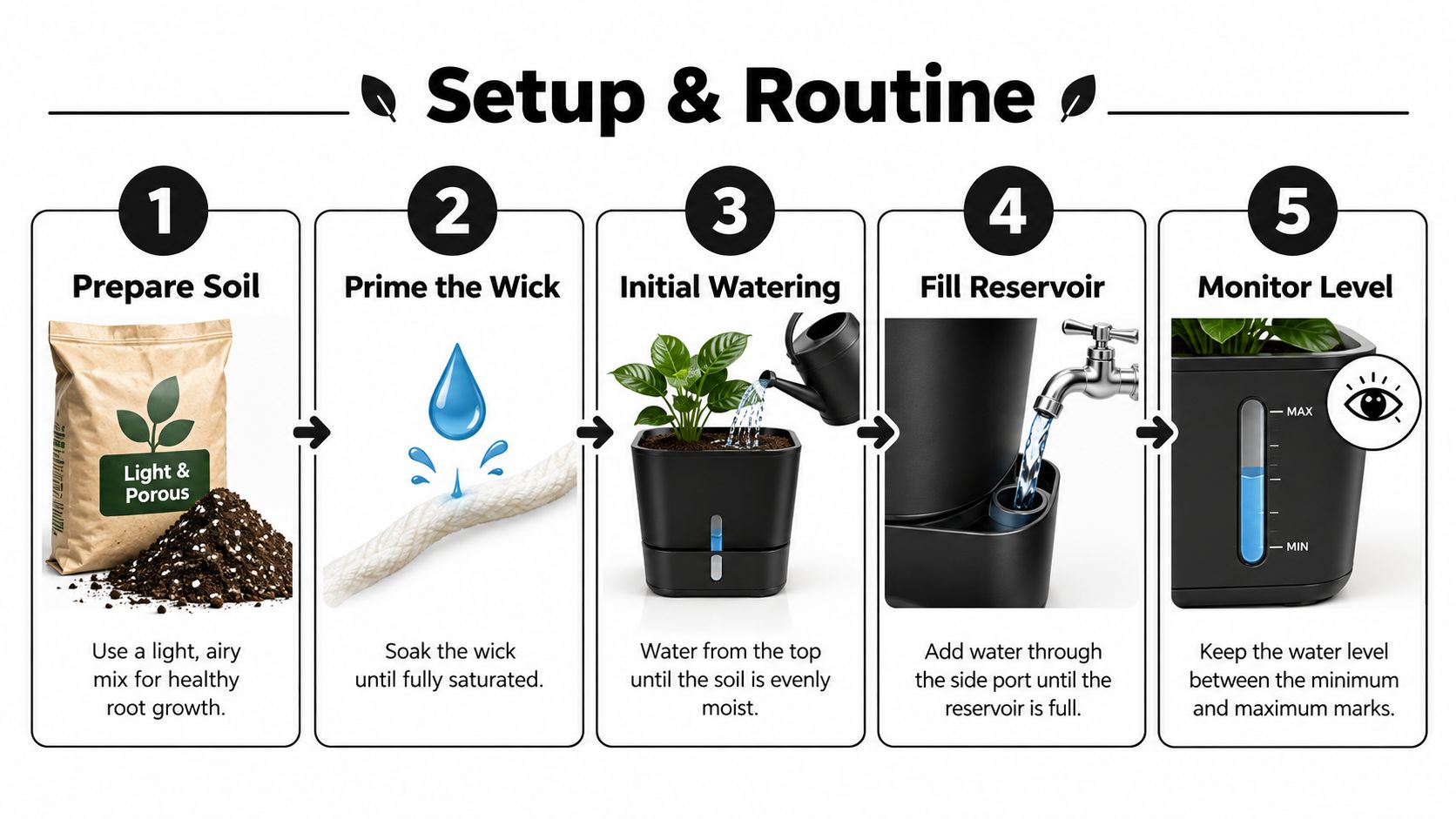
A gentle setup routine
- Prepare the mix. Add the potting medium around the wick or wicking area, keeping the contact point covered.
- Moisten from above. Water thoroughly until the mix is evenly damp. This initial step helps dry soil connect with the reservoir pathway.
- Plant carefully. Set the root ball in place and firm the mix gently. Leave a little space at the top so water doesn't spill over during initial watering.
- Fill the reservoir. Use the planter's refill opening or indicator if one is included. Don't assume the reservoir is full just because the topsoil looks wet.
- Observe the planter. Watch the soil, leaves, and water level as the system settles into its routine.
A decorative watering globe can work as a simple add-on when a full reservoir planter isn't practical. For example, a Little Green Leaf globe can be filled with water and inserted into the soil at a gentle angle. An optional tip cover or adapter can help reduce clogs and improve flow in different soil types.
The globe releases water gradually as the surrounding soil dries, then slows as moisture returns. Like a reservoir planter, it's a passive system, so it doesn't need a timer or battery. The actual duration will vary with plant size, soil, insertion angle, sunlight, wind, and temperature.
Before you travel: Test the setup while you're home. Introducing an unfamiliar watering device immediately before leaving can make it harder to tell whether the flow is appropriate. (Vacation plant-watering guidance)
For the first week, check the soil before refilling automatically. If it feels consistently wet, reduce the supply or improve airflow and drainage. If it dries quickly, confirm that the wick is connected, the mix is absorbent, and the reservoir is large enough for the patio conditions.
Troubleshooting Common Issues and Keeping Things Fresh
A self-watering patio planter can still dry out. The system balances moisture, but it can't overcome a broken connection, unsuitable soil, extreme demand, or a reservoir that's too small for the plant and its location.
When the soil dries despite a full reservoir
Start with the wick. It may have slipped out of the water, shifted during planting, or lost contact with the potting mix. Push the contact area back into position if the design allows, then re-moisten the soil from above so the pathway can start moving water again.
Next, inspect the mix. Compacted soil leaves fewer connected spaces for capillary movement, while hydrophobic mix can repel water after becoming very dry. Loosen the surface gently, avoid pressing the soil down further, and replace badly degraded mix when necessary. Technical guidance identifies wick failure, unsuitable mix, and a reservoir that can't keep up with demand as common reasons these planters dry out. (Common self-watering planter failure modes)
A fast-growing plant in a hot outdoor setting may use water faster than the container can supply it. Recent guidance notes that such plants may need weekly refills rather than monthly in demanding conditions. (Outdoor self-watering planter guidance)
When the soil stays too wet
Choose the plant carefully. Some plants need the soil to dry between waterings, and a constantly moist lower layer can reduce oxygen around their roots. Houseplant extension guidance connects root rot with roots remaining in wet soil for long periods and recommends a well-drained potting mix along with avoiding excessive watering. (Iowa State University Extension guidance)
Look for limp yellowing leaves, soft stems, or a sour smell from the mix. Let the upper layer dry as appropriate for the plant, stop topping up the reservoir temporarily, and consider repotting into a more suitable container if the soil remains saturated.
Keeping the reservoir clean
Mineral salts can collect around the soil and reservoir, while algae may appear where water and light meet. Fungus gnats can also become more noticeable in persistently damp organic material. Empty and rinse the reservoir, wipe away residue, and refresh the potting mix when buildup or odor persists.
Mosquitoes need stagnant water to reproduce, so keep refill openings covered where the design permits and don't allow neglected water to sit indefinitely. A quick inspection during each refill is often enough to catch problems early.
A Calmer Way to Enjoy Your Patio Garden
The most useful self-watering patio planter isn't the one that makes you forget your plants. It's the one that makes their needs easier to meet. You choose a plant that enjoys consistent moisture, give it an airy potting mix, establish the water pathway carefully, and then respond to what you see.
A simple seasonal rhythm keeps the routine manageable. Check the reservoir more often when the patio is hot, sunny, or windy. Refresh tired soil when water stops moving well. Before a trip, fill the system and test it while you're still home. When the weather cools, watch for slower water use instead of following the same refill habit automatically.
Decorative options can fit naturally into that routine. Hand-blown glass globes, for example, can add color and shape while providing a gradual water supply for suitable pots. You can browse decorative self-watering planters when you want care equipment that feels at home among your patio furnishings.
Start with one container rather than changing every plant at once. Once you learn how that planter responds to its location, soil, and plant, you'll have a clear pattern to use elsewhere. Consistent care doesn't need to be perfect. It just needs to be simple enough that you can keep returning to it.
Little Green Leaf offers decorative self-watering globes and self-watering planter options designed to release moisture gradually as soil dries, without timers, batteries, or apps. Visit Little Green Leaf to find a practical, attractive way to make patio plant care steadier for everyday routines and time away.