

Round Plant Support Guide: Styles, Sizing, and Use
A round plant support stabilizes stems and foliage without constricting growth, and the right design depends on the plant's height, spread, stem count, and pot size. For watering while away, a Little Green Leaf globe can release water gradually for up to about two weeks per fill, depending on the pot, soil, temperature, and globe size.
A plant can look perfectly healthy one day and then lean across a shelf, spill over a pot rim, or collapse under the weight of its foliage after watering. A circular support often solves that instability more gently than a single rigid stake, but only when its geometry matches the plant. Support choice matters, and so does watering: a plant that's constantly dry or sitting in saturated soil won't become healthier just because its stems are upright.
Table of Contents
- Why Your Houseplant Needs a Round Plant Support
- Common Styles and Materials for Round Supports
- How to Choose the Right Size and Strength
- Matching Support Type to Plant Architecture
- Simple Steps for Installing Round Supports
- Styling Tips for Indoor Plant Supports
- Key Takeaways for Successful Plant Support
Why Your Houseplant Needs a Round Plant Support
A trailing pothos may start by leaning toward the edge of its pot, while a mature monstera can pull its container off balance as its leaves spread. Ferns and compact flowering plants create a different problem: their stems may not be tall, but their foliage arches outward and becomes difficult to keep tidy. In each case, the plant needs distributed support, not necessarily a taller stake.
A round plant support surrounds the crown or growing stems and creates several contact points around the plant. That arrangement helps guide stems without forcing every shoot into one direction. Research on supported crops shows that support geometry and attachment can affect plant stability, fruit positioning, and harvestable production, although the result varies by cultivar and growing conditions (horticultural research on support systems).
The same principle applies indoors. A circular ring can steady several stems at once, while an open hoop can let an arching plant keep its natural shape. It's especially useful when a plant is top-heavy, multi-stemmed, or spreading beyond the pot rather than climbing vertically.
Practical rule: Support the plant's existing architecture instead of using a frame to impose a completely different one.
Watering still determines whether that structure lasts. Dry soil can leave stems limp, while constantly wet soil can contribute to weak growth and root problems. A gradual watering aid can help even out moisture for suitable plants, but it can't replace checking the growing medium.
Common Styles and Materials for Round Supports
Round supports generally fall into three useful indoor categories: wire cages, plastic rings, and metal hoops. Their differences are less about appearance than about load distribution, flexibility, and how easily the support can be adjusted as stems grow.
Wire cages provide the broadest perimeter structure. They suit plants with several stems or foliage that pushes outward in multiple directions. A cage can be more stable than a narrow ring, but it may look visually heavy in a small room and can crowd plants with delicate or low-growing stems.
Plastic rings are lighter and often easier to place in small containers. They work well for soft stems, compact flowering plants, and plants that need gentle perimeter guidance rather than a rigid frame. Their main weakness is strength. A thin ring may bend when a plant becomes dense or top-heavy.
Metal hoops offer a cleaner silhouette and usually resist bending better than lightweight plastic. They're useful for tall growers and arching stems, but their rigidity means installation must be deliberate. A hoop placed too close to the crown can press against stems as they expand.
| Support style | Best use | Main advantage | Main trade-off |
|---|---|---|---|
| Wire cage | Multi-stemmed, spreading plants | Distributed support around the plant | Can look bulky indoors |
| Plastic ring | Compact plants and soft stems | Lightweight and gentle | May flex under heavy growth |
| Metal hoop | Tall or arching plants | Durable, neat profile | Less forgiving if poorly positioned |
Material also affects the attachment method. Smooth surfaces may need soft clips or loose ties, while textured wire can offer more grip. A decorative support can complement a room, but appearance shouldn't outweigh stability. For a closer look at ornamental support choices, see decorative plant stakes.
How to Choose the Right Size and Strength
Start with the pot diameter, then assess the plant's crown width. The support should sit close enough to catch stems before they fall outward, but it shouldn't compress the foliage into a tight bundle. A support that only matches the current stem position may become restrictive as the plant fills out.
Measure the plant from the soil surface to the highest point that needs guidance. Then note whether the plant has one main stem, several upright stems, or shoots that arch around the pot. A single-stem plant usually needs a narrower support with a strong central anchor. A multi-stem plant benefits from a wider ring or cage with contact around the perimeter.
Support diameter is particularly important for twining plants. Research indicates that overly thick supports can make it difficult for vines to generate enough friction to stay attached, while thinner supports may provide a more effective gripping geometry (research on plant support diameter and attachment). That finding applies most directly to twining vines, not plants that climb with adhesive roots, hooks, or tendrils.
Use this selection sequence:
- Measure the pot: Choose a frame that can be anchored securely without sitting against the container wall.
- Check the crown: Allow room for natural spread rather than enclosing every leaf.
- Count the stems: More stems call for more perimeter contact points.
- Assess the weight: Dense foliage or heavy blooms need a sturdier frame.
- Plan for growth: Install before stems become difficult to move, not after the plant has already collapsed.
A useful plant pot size guide can help place the support decision in context, especially when a container is already crowded.
Matching Support Type to Plant Architecture
An upright, single-stem plant and a sprawling, multi-stem plant shouldn't receive the same frame. The first needs directional stability. The second needs a perimeter that catches stems from several angles without turning the foliage into a rigid column.
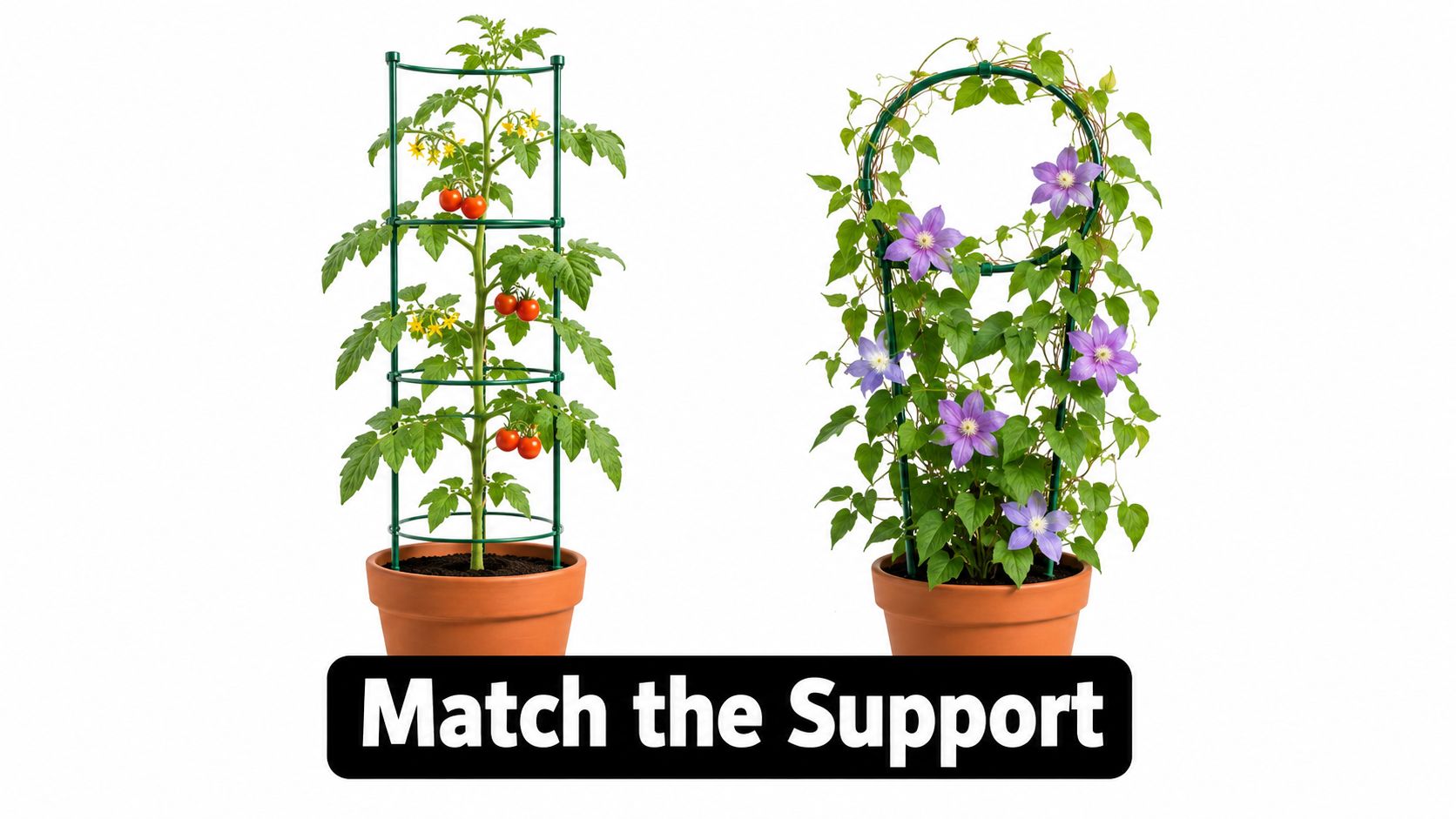
For a plant that leans or becomes top-heavy, a compact ring close to the stem can prevent gradual tilting. For an arching plant, an open hoop is usually better because it supports the stem at its curve instead of forcing it straight. A multi-stemmed plant benefits from a cage or broad circular frame, particularly when stems emerge around the crown.
Climbing plants need closer attention to contact geometry. A round frame can guide a vine around the plant without requiring vertical training, which can be useful in apartments where a tidy, contained silhouette is preferred. The frame should sit near active growing tips, and several loose attachment points are more reliable than one tight tie.
Flowering plants present another trade-off. Their stems may be slender but become top-heavy when buds open. A low ring can support the stems while leaving blooms visible, whereas a tall cage may hide the flowers or make a small plant look oversized.
A support should follow the direction of growth, not simply match the plant's maximum height.
Vining crops can also demonstrate why distributed support matters. In a cucumber experiment, staking improved measured growth and yield indicators compared with unstaked plants, while forked-stick support performed better than straight-stick support and no staking across the reported characteristics (cucumber staking research). For indoor plants, the practical lesson is simpler: several well-placed contact points can stabilize growth more effectively than a single point of attachment.
Guidance on a container cucumber trellis illustrates the broader principle of matching structure to the way stems spread and carry weight.
Simple Steps for Installing Round Supports
Install the support while stems are still flexible. Mature stems can become mechanically vulnerable, and research on supported liana growth shows that attachment influences stem flexibility as plants develop (research on stem stiffness and supported growth). Early placement also reduces the need to bend a heavy stem sharply into position.
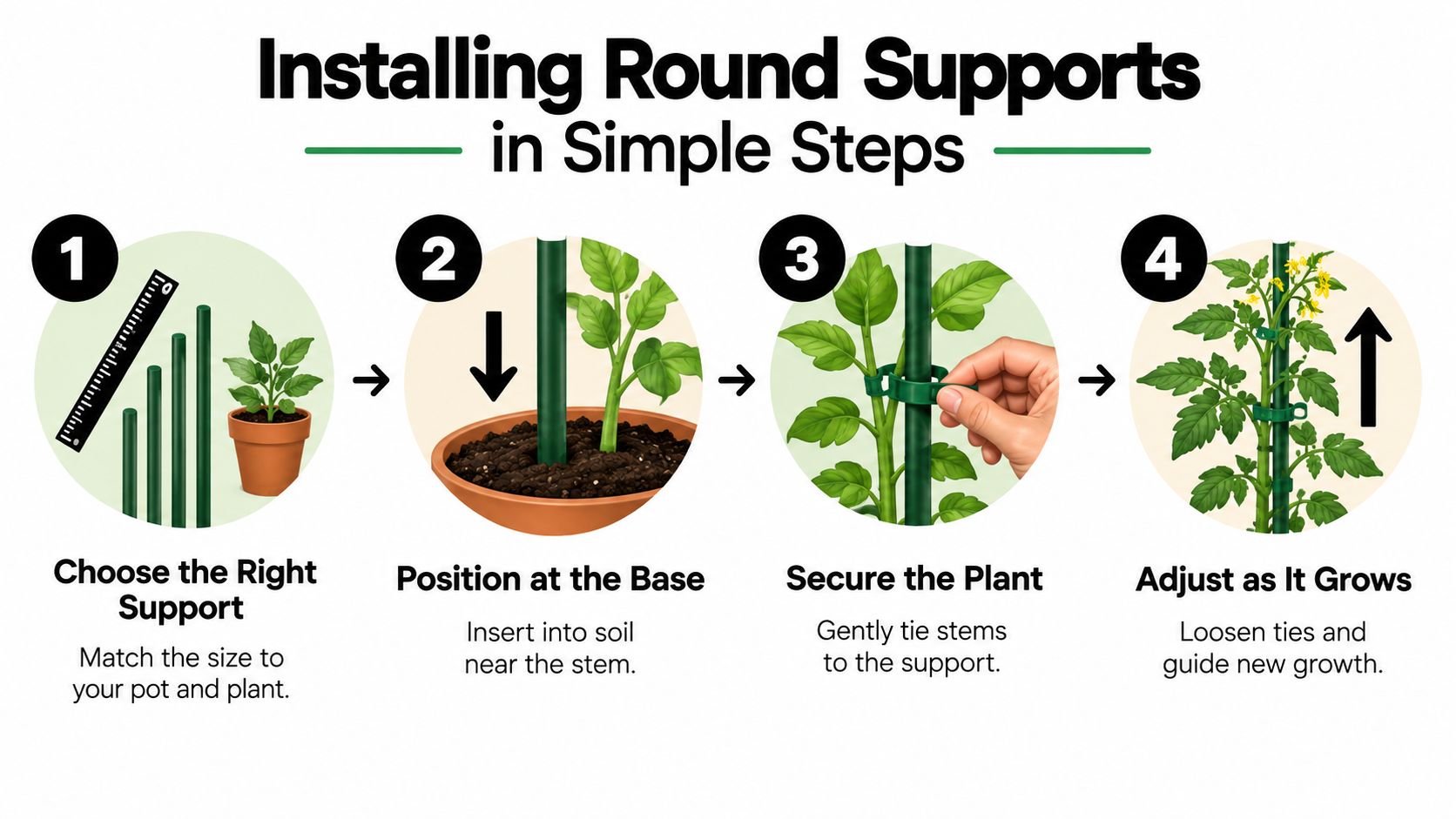
- Choose the frame first. Match its diameter and strength to the plant's crown, stem count, and container.
- Position it near the base. Insert the legs or anchors into the growing medium near, but not directly through, the main root crown.
- Make a pilot hole when needed. Dense or compacted medium can resist insertion and increase the risk of bending roots or damaging the support. Use a narrow tool to create a path before placing the support.
- Guide stems loosely. Use soft clips or ties with room for expansion. The support should guide the stem, not pinch it.
- Recheck as growth continues. Loosen ties, move clips, and make sure no stem is trapped against the frame.
A circular support should contact young stems without constricting them. Wind, handling, and movement can repeatedly load slender stems, so several loose attachment points usually protect the plant better than one tight fastening.
Glass watering globes require similar care during setup. They should be filled and inserted carefully, because glass breaks if dropped, and a stem may need a pilot hole in dense soil.
Styling Tips for Indoor Plant Supports
A support becomes part of the plant display as soon as it enters the pot. Choose a finish that either blends with the stems and container or provides a deliberate contrast. Dark metal can recede behind deep foliage, while a bright ring can frame pale leaves or colorful blooms.
The best-looking support is usually the one that does its job without drawing attention. A cage that rises far above the foliage may dominate a small plant, while a ring hidden completely inside dense leaves may fail to catch stems where support is needed. Position the structure so it's visible enough to look intentional but not so prominent that it becomes the focal point.
Keep watering access in mind. A frame shouldn't block the growing medium or make it difficult to check moisture below the surface. Houseplants shouldn't be watered on a fixed weekly schedule. The Royal Horticultural Society recommends checking moisture because plant type, pot size, season, and growing conditions change watering needs (RHS houseplant growing guidance).
For a tidy display:
- Coordinate the finish: Match metal tones with the pot or nearby furnishings.
- Preserve access: Leave enough open soil to check moisture and water thoroughly.
- Avoid visual crowding: Use a lower ring for compact plants and a broader frame for spreading foliage.
- Protect the stems: Keep ties loose and inspect contact points after watering.
A well-styled support should make care easier, not turn routine watering into a cramped, awkward task.
Key Takeaways for Successful Plant Support
A round plant support succeeds or fails on fit. If a plant keeps collapsing to one side, flopping over the rim, or throwing new growth past the pot, the problem is usually not a lack of support in general. It is a mismatch between the support's shape and the way that plant grows. Plant architecture comes first. Upright single stems need a different kind of control from clumping stems, arching foliage, or vines that circle and search.
That is why round supports work so well for certain houseplants. They spread pressure around the outside of the plant instead of creating one hard point of contact. For multi-stem and broad-crowned plants, that perimeter hold often keeps the plant looking natural while still preventing splaying, leaning, and stem fatigue. For a plant with one dominant stem, a ring can still help, but only if it guides surrounding growth rather than trying to replace the focused stability a stake gives.
Choose the frame with the mature plant in mind, not the plant on the day you install it. Check the pot width, crown spread, stem count, and the weight the foliage or flowers are likely to carry later. A ring that sits too tight will compress stems and spoil the outline. One that is too wide often looks substantial but does very little. Twining plants add another trade-off. They need a support diameter they can grip, so a thick circular rod may suit the look of the pot while giving the vine very little purchase.
Timing matters. Install early, before stems harden into the wrong position and before the root ball becomes crowded enough to make insertion awkward. In dense compost, make a pilot hole first. It reduces drag on the support and lowers the chance of damaging roots. Once the frame is in place, guide stems loosely with clips or soft ties, then check again after watering and after the plant has been moved. Foliage weight shifts, and a support that looked right on day one can start rubbing stems a week later.
Watering and support are linked in practice, even though they solve different problems. A weak, repeatedly wilted plant will not sit well in any frame. A plant in overly wet compost can also slump, which is why support should never be used to hide a watering problem. For containers, the Royal Horticultural Society advises thorough watering as needed rather than guessing, and offers a useful benchmark of about 10% of container volume per watering, followed by drainage (RHS container watering guidance). A watering globe can help smooth out moisture between checks, but it does not replace a proper soak or regular inspection of the compost.
For people who travel or are prone to missing routine watering, a glass globe can be useful if it is matched to the plant and pot rather than used automatically. Little Green Leaf offers decorative glass watering globes in different capacities, and they work best as a supplement for plants that want steadier moisture, not for succulents, cacti, or anything that should dry between waterings. Placement matters here too. Keep the globe clear of the support ring and away from the crown so neither the frame nor the stem is under pressure. Visit Little Green Leaf to choose a decorative globe and pair steadier watering with support that matches the plant's natural form.
FAQ
What is a round plant support used for?
A round plant support steadies stems, foliage, and heavy blooms from several sides at once. It is especially useful for plants that arch, spread, grow in clusters, or become top-heavy as they fill out.
How do you choose a round plant support?
Start with the plant's growth habit. Then measure the pot, look at the crown width, and count the main stems. Choose a frame that supports the outer growth without crushing it, and use a stronger material where growth is dense or heavy.
Can a round plant support help a leaning houseplant?
Yes, if it is installed before the lean becomes fixed. Set the support close to the base, guide the growth gradually, and avoid forcing an older stem into a sharp correction.
How do you install a round plant support in dense soil?
Make a narrow pilot hole before inserting the support. This helps the frame slide in more cleanly and reduces the risk of root disturbance.
Can a watering globe be used with a round plant support?
Yes. Place the globe where it will not push against the frame or the stems. Water the plant properly first, insert the globe into moist soil, and watch how it behaves in that pot rather than assuming the same release rate every time.
How long does a watering globe last?
A Little Green Leaf globe can last up to about two weeks per fill, but that depends on capacity, pot size, plant demand, temperature, and airflow. The RHS recommends adjusting routine container care to conditions rather than relying on a fixed schedule (RHS container maintenance guidance).
How to set up a Little Green Leaf globe for a supported houseplant
- Water the plant first if the compost is dry, then let excess water drain.
- Make a pilot hole if the potting mix is dense, keeping clear of the main stem and crown.
- Fill the globe and make sure the neck will not press into stems.
- Insert it at an angle into moist soil, positioned away from the support frame.
- Check after two days to confirm the compost is staying appropriately damp and the globe is releasing water gradually.