

Plant Waterer: How Long One Fill Lasts and Why It Varies
One fill of a plant watering globe lasts up to about two weeks, and it runs out faster in small globes, thirsty plants, large pots and warm rooms. That range isn't a hedge. It's the honest answer, because a 350 ml bulb in a cool hallway and a 100 ml bulb beside a sunny window are doing very different jobs.
Think about the last time you noticed a problem. You got home late, saw the peace lily slumped, filled a jug and soaked it until water ran into the saucer. Two days later the lower leaves went yellow. Most houseplant watering happens in that pattern: long dry gaps followed by a flood, with nothing in between that resembles steady moisture at the roots.
A plant waterer in the form of a glass globe interrupts that cycle. It holds a reservoir above the root zone and lets the soil pull water as it dries, so the plant gets a steady supply instead of a weekly drenching. The trade is real, though: the globe can't be measured in exact days, it can't fix a pot with no drainage, and it's the wrong tool for anything that wants to dry out completely.
Table of Contents
- How Long One Plant Waterer Fill Lasts by Pot Size
- How a Plant Waterer Releases Water as Soil Dries
- Which Plants Suit a Plant Waterer and Which Do Not
- How to Set Up a Plant Waterer Step by Step
- Plant Waterers Compared With Spikes, Drip and Self-Watering Pots
- Overwatering and Underwatering Signs to Check First
- Using a Plant Waterer for Vacations and Long Trips
- Pick the Right Globe Size and Set It Up Today
- Plant Waterer Questions Answered
How Long One Plant Waterer Fill Lasts by Pot Size
Pot size is the biggest single lever on how long a fill lasts, and it's the one you can measure before spending anything. The Oklahoma State University Extension houseplant care fact sheet reports that small pots may need watering every 2-3 days, while large pots may need water only every 7-14 days. The same source explains that smaller containers dry out faster and distribute water less uniformly, and that the interval shifts with temperature, humidity, season, plant species, growing medium and light.
That spread is why no globe can promise a fixed day count. A 100 ml globe in a small pot is feeding a small root volume that dries quickly, so it behaves less like a two-week reservoir and more like a two to three day top-up. A 350 ml globe in a large planter sits in a much bigger moisture bank, and water moves through that bank slowly.
| Pot size | Globe size | Watering interval without a globe | Expected fill |
|---|---|---|---|
| Small pot | 100 ml | Every 2-3 days | Shorter than two weeks; check at 2-3 days |
| Medium pot | 200 ml | Feel the mix every few days until you know the pot | Up to about two weeks; check sooner in warm rooms |
| Large pot or planter | 350 ml | Every 7-14 days | Up to about two weeks; recheck as demand rises |
What Shortens a Fill
Four conditions drain the bulb faster than the label suggests:
- A big, leafy plant: more leaf surface means more water leaving the plant each day, so the root zone pulls harder on the reservoir.
- A sunny window or warm room: heat and light speed up evaporation from the mix and transpiration from the leaves at the same time.
- A coarse, fast-draining mix: chunky bark and perlite hold less water per litre than a dense peat or coir blend, so the bulb empties sooner.
- A small globe in a large pot: one stem can't reach a wide root zone, so the bulb runs dry while the outer mix is still parched.
What Stretches a Fill
Shade, a cooler room and a modest plant in a modest pot all push in the other direction. So does a mix that holds moisture well, and a bulb with more capacity than the plant strictly needs.
Judge by the pot, not the label. A globe that empties in four days in one room and twelve in another is working correctly both times. The plant's demand changed, not the product.
The check that works at any size is a finger pushed about 2 inches into the mix near the stem. Dry at that depth means top up the bulb or swap in a full one. Damp means wait, even if the glass looks empty, because the plant hasn't finished what it already has.
How a Plant Waterer Releases Water as Soil Dries
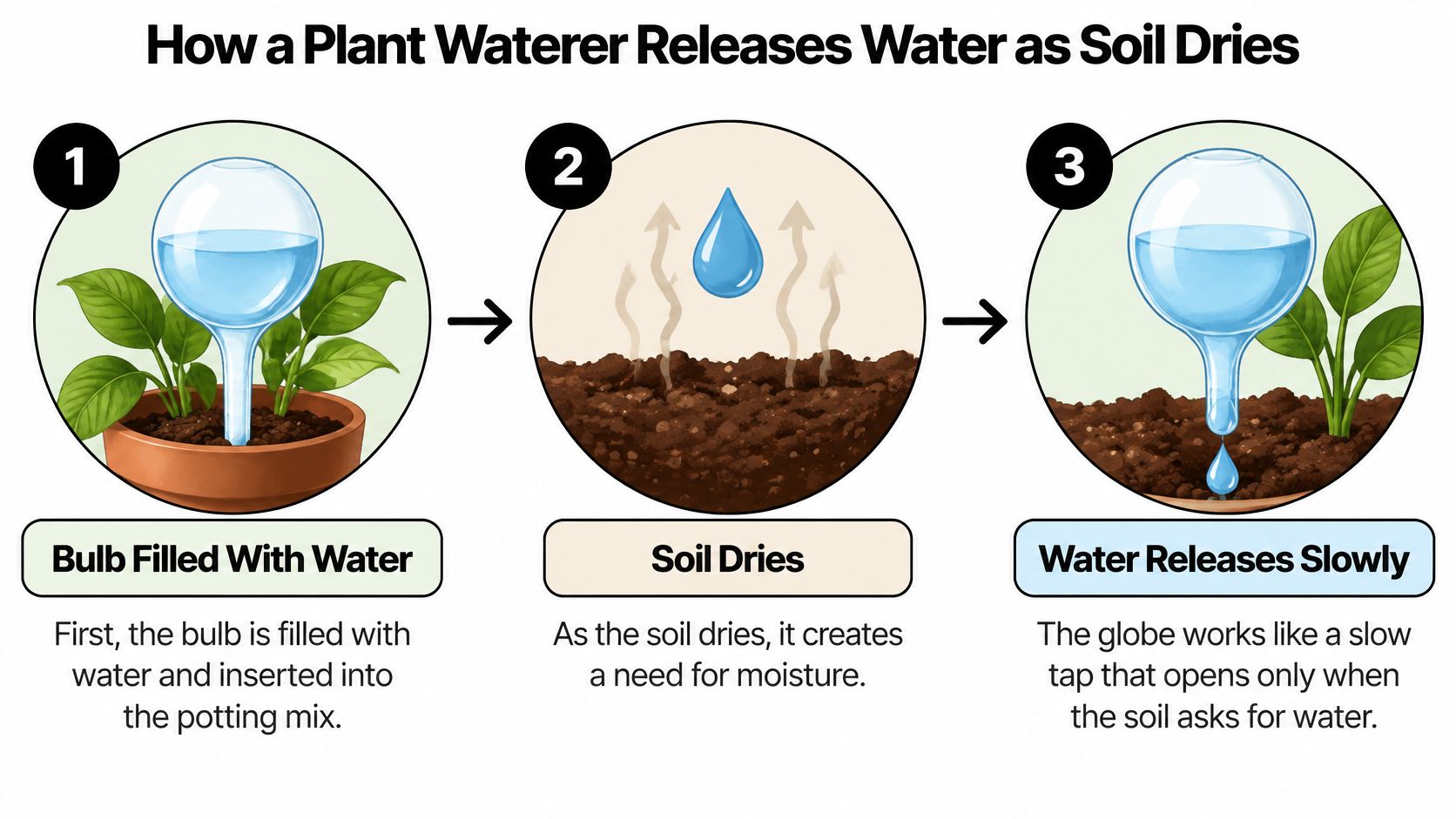
A watering globe behaves like a slow tap that opens only when the soil asks for water. Nothing inside it counts hours. No timer, no battery, no app notification. The moisture level in the mix does the switching, and that's the entire mechanism.
Bulb Filled With Water
The hand-blown bulb holds a reservoir above the root zone. You fill it, then push the stem into moist mix. Because the mix is already damp, very little moves at the start. That quiet beginning confuses people who expect to see the level drop within an hour.
Soil Dries
As the mix loses moisture, oxygen flows through the stem and gently displaces water from the globe into the root zone. Water also creeps sideways through the mix by capillary action in soil, which is why one stem can moisten a wider area than it physically touches.
Water Releases Slowly
When moisture levels are restored, airflow slows and water release reduces on its own. The globe effectively brakes, then restarts when the surrounding mix dries again. Delivery follows dryness instead of a calendar.
The stem's fit decides how well any of this works. A stem sitting loosely lets air escape around it rather than through the water column, and the bulb drains too fast. A stem jammed into compacted mix can block its own opening and stall the flow, leaving a full globe and a dry plant.
The principle scales far beyond a windowsill. The Food and Agriculture Organization reports that agriculture accounted for approximately 70% of worldwide water withdrawals in 2000, and the history of irrigation is largely an argument for delivering water in step with demand rather than in bursts.
The soil sets the pace, not the clock.
Which Plants Suit a Plant Waterer and Which Do Not
Start with the limit. A globe keeps soil moist, so it suits plants that want even moisture and it's wrong for anything that needs a dry interval. That one rule sorts most of the decision before you look at a single pot.
| Plant type | Suits a globe? | Reason |
|---|---|---|
| Moisture-loving houseplants in small or medium pots | Yes | Globe keeps soil evenly moist between visits |
| Plants in large pots | Only with a 350 ml globe | One small globe cannot supply a big root zone |
| Plants in bright, warm spots | Check more often | Heat and light speed water use |
| Outdoor containers and hanging baskets in summer | Yes, with a matched size | Sun and wind dry them fast; inspect during heat waves |
| Cacti and succulents | No | They need soil to dry fully between waterings |
| Plants that need drying out | No | Continuous slow release keeps soil wet |
Why Cacti and Succulents Are the Wrong Match
Cacti and succulents store water in their tissue and expect the mix to go dry between drinks. University of Minnesota Extension advises watering these plants thoroughly until water exits the drainage holes, discarding the excess after a few minutes, and allowing the soil to dry out completely between waterings. It also warns that repeated shallow watering can cause distorted growth. A globe does the opposite of all three, adding small amounts as the mix dries, which is exactly the pattern these plants fail in.
The Size Question in Large Pots
One small globe in a wide planter is a token gesture. The stem wets a column of mix and the rest of the root zone stays dry, so the plant looks unchanged and the bulb empties. Use the largest bulb for a big container, and in a very wide pot set two globes on opposite sides rather than one in the middle.
Run the Test Before You Commit
Give any new setup a few days before you trust it with a plant you care about. Firm, upright leaves and a mix that feels like a wrung-out sponge mean it's working. Yellowing lower leaves or a sour smell at the rim mean the mix is staying too wet, so pull the globe and let the pot breathe.
Readers setting up a collection in a small flat often run out of sill space before they run out of plants, and creating a compact indoor garden is a useful companion read when you're deciding how many pots you can realistically keep watered by hand.
How to Set Up a Plant Waterer Step by Step
Setup takes about a minute a pot, and most failures come from skipping the first move or forcing the stem where it doesn't want to go. Work through these five in order.
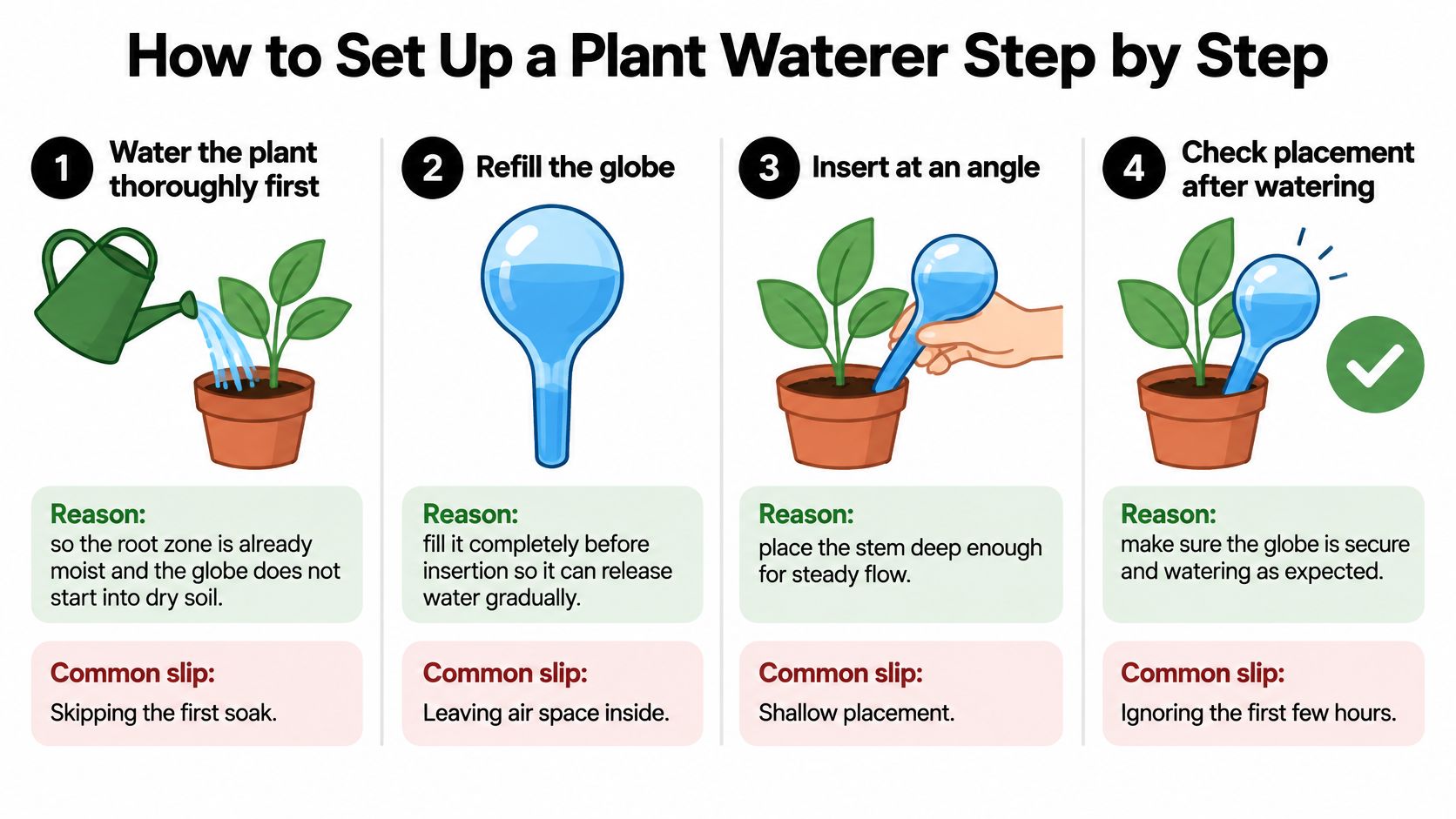
- Water the plant thoroughly first. Give it a normal, full watering and let the excess drain away, so the root zone is already moist when the stem goes in. A globe started in bone-dry mix sits there doing very little, because dry soil pulls slowly and unevenly. The common slip is skipping this soak because the bulb is already full.
- Make a pilot hole in dense mix. Push a pencil or a chopstick in to the depth the stem needs, then withdraw it. Compacted mix has nowhere for the glass to travel, and forcing it can snap the stem or the bulb. The common slip is leaning on the bulb to drive it down.
- Fill the bulb to the top. Hold it upright under the tap, fill it completely, then cover the opening with a finger while you move it to the pot. Air left inside has to escape before water can move, so a half fill gives a shorter, less predictable run. The common slip is a large air pocket left at the top.
- Insert the stem at an angle. Seat it into the pilot hole at roughly 45 degrees rather than straight down. A globe pushed in at 90 degrees makes it harder for air to escape, which slows the drip, while angling it lets water release more easily. The common slip is jamming it vertically into a tight hole.
- Check after two days. Confirm the bulb is still releasing, the stem sits firmly, and the mix is damp rather than soggy. Two days is long enough for a problem to show and short enough to fix it before the plant suffers. The common slip is filling the bulb and walking away for a week.
When a Globe Slows Down
If the flow nearly stops, empty the bulb, rinse it with warm water and clear the stem with a thin brush or a pipe cleaner. For fine or dense mixes, fit an anti-clog sleeve over the stem before the next fill, then make a fresh pilot hole. Glass breaks if it's dropped, so store globes on a shelf rather than in a bucket with tools.
What a working setup looks like after 48 hours: the bulb has dropped a little, the mix around the stem is damp rather than wet, and the leaves are firm. If the bulb is empty and the mix is dry, the water ran down the side of the pot instead of into it.
Plant Waterers Compared With Spikes, Drip and Self-Watering Pots
A globe is the right tool for one pot, or a handful of pots, that need steady moisture while you're away or forgetful. It's the wrong tool for twenty pots on a fixed schedule. Line the options up on the criteria that decide it.
| Option | How long one fill lasts | Setup effort | Refill effort | Clogging risk | Works outdoors |
|---|---|---|---|---|---|
| Plant watering globe | Up to about two weeks per fill | Fill, then push stem into moist soil | Refill bulb when empty | Possible in dense soil; anti-clog sleeves help | Yes, including hanging baskets |
| Terracotta spike | As long as the bottle attached to it takes to empty | Fill a bottle, push the spike into moist soil | Unscrew and refill the bottle | Pores block with fine soil and mineral salts | Yes, in a shaded container |
| Drip system | Set by the timer and reservoir you choose | Needs tubing run to each pot and a planned layout | Refill or reconnect the reservoir | Emitters block with grit and mineral crust | Yes, with outdoor-rated tubing and timer |
| Self-watering pot | Set by reservoir size and the pot's demand | Built into the pot; fill once planted | Pour into the fill tube or opening | Wick and drainage holes crust over | Yes, if the pot has an overflow |
Setup effort separates the four fastest. A globe is fill and push, one minute per pot, with no layout decisions. Drip needs tubing cut to length, emitters placed and a water source planned. A self-watering pot asks for nothing at install but commits you at purchase, since the reservoir is the pot.
Clogging is the criterion people underestimate. A globe stem can block in dense mix, which is why the pilot hole and the sleeve matter. Spikes clog at the ceramic pores, drip emitters clog with grit and mineral buildup, and self-watering pots crust over where the wick meets the mix. Every slow-delivery method needs an occasional clean, and self-watering plant spikes run into the same problem in fine potting soil.
Outdoors, a globe earns its place in containers and hanging baskets, which dry out faster than anything else in summer. Wind and sun push demand up, so lift the bulb and look during heat waves. Drip handles outdoor use well but it's a plumbing job, not a one-pot fix.
Cost per plant depends on what you already own. Price a globe against the number of pots you need covered, and note that a drip system costs roughly the same whether it feeds four pots or forty.
Choose by count: few pots and irregular care point to globes. Many pots on a fixed routine point to drip or self-watering pots.
Overwatering and Underwatering Signs to Check First
The test that beats any gadget is a finger pushed into the mix. The University of Maryland Extension recommends checking the plant and soil rather than following a calendar, with a finger test about 2 inches deep: dry soil means water is probably needed. It identifies wilting and gray-green foliage as signs of excessive dryness, while leaf drop or yellowing can point to excessive moisture.
Read the two symptom sets separately.
- Too dry: wilting, drooping stems, gray-green or dull foliage, and a pot that feels light when you lift it.
- Too wet: yellowing or dropping leaves, persistent wetness at the surface, a sour smell from the rim, and roots that look soft or dark rather than firm and pale.
A globe changes the picture in both directions. A drooping plant in a properly drained pot can recover within a few days once steady moisture returns, because the root zone stops swinging between drought and flood. A globe pushed into mix that's already soggy just adds more water, and root problems get worse rather than better.
The 48-hour rule: check the soil and the leaves once a day for the first two days. If the mix stays wet or the leaves start to yellow, take the globe out.
Persistent wetness usually points to drainage, not to the globe. A pot with no holes, a saucer left full, or a dense mix that holds water like a sponge will stay wet no matter how slowly water arrives. No watering device fixes a container that can't drain.
Scale matters here too. The same principle that keeps a small pot evenly moist shows up in big trees, whose trunks and root zones buffer water between rains, as these examples of Australia's remarkable gums and figs show.
If the signs say dry, refill the bulb or water by hand and recheck in two days. If they say wet, pause the globe, check the drainage holes and let the top half of the mix dry before it goes back in.
Using a Plant Waterer for Vacations and Long Trips
A globe covers a short trip for suitable plants, and it isn't a substitute for care on a multiweek absence. That distinction decides everything about how you plan.
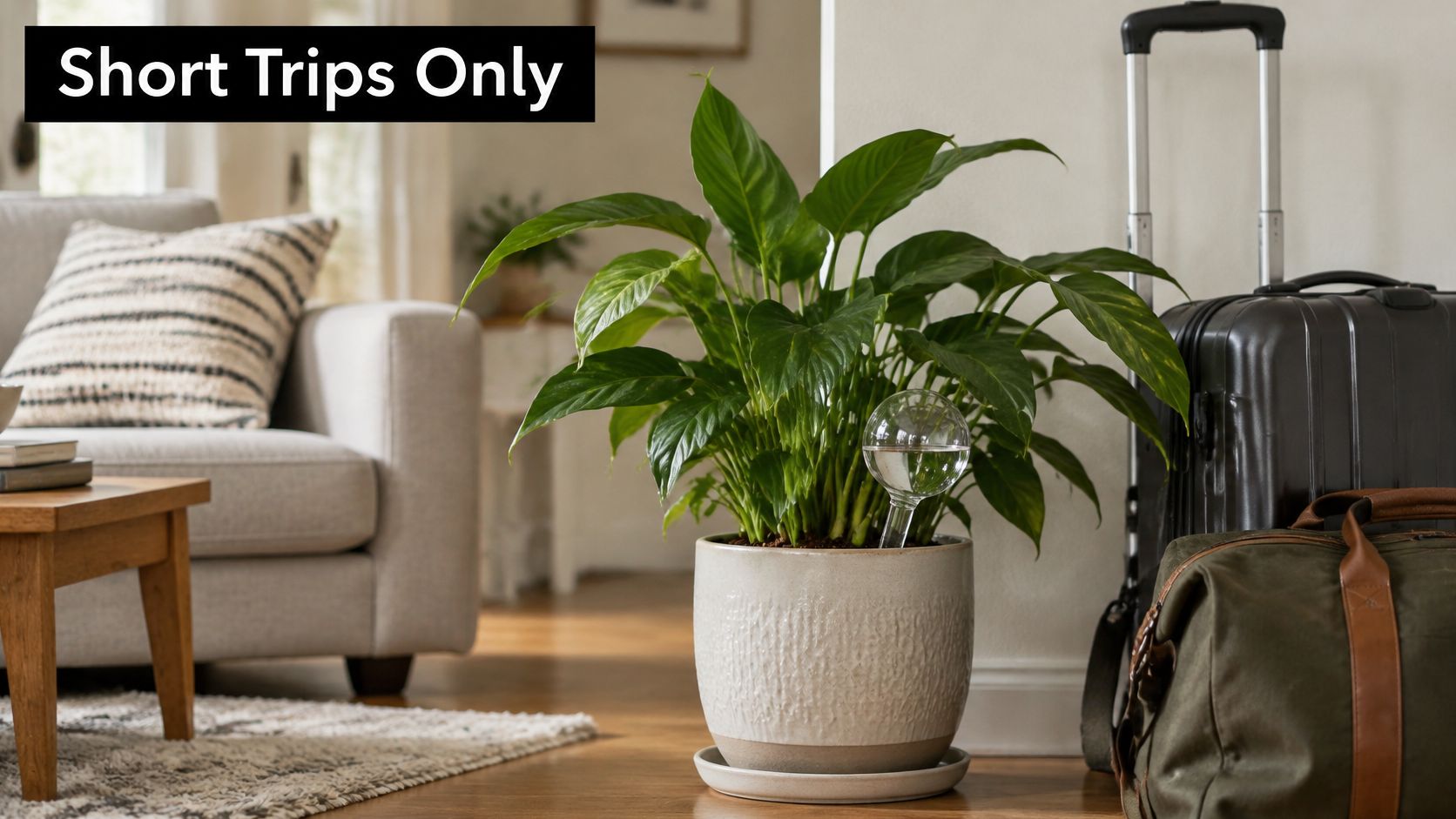
The Royal Horticultural Society holiday care guidance makes the same split. It notes that thoroughly watering houseplants before a short summer absence may be enough, while longer absences need additional measures such as a wick connected to a water reservoir or capillary matting. It also recommends asking someone to water the plants when you're away for more than a few days. A filled globe sits in that gap as one practical option for individual pots.
A Travel Protocol That Works
Work through this in the week before you leave:
- Test the setup for several days. Fill a globe, insert it, and watch how fast the level drops in your actual room at your actual temperature.
- Measure the water loss. Note how much the bulb gave up in three days, then judge whether it will still have water on the day you get back.
- Move plants back from the worst sun and away from draughts. A plant beside a hot window can use several times the water of the same plant in a shaded corner.
- Group only plants with compatible needs. Crowding a moisture-lover against a plant that wants to dry out helps neither, because the humid pocket stays wet.
- Arrange a check-in for longer trips. Anyone with a key can top up a bulb or spot a leaking pot far earlier than you can from another country.
Why Capacity Alone Predicts Nothing
A stated reservoir size tells you how much water exists, not how long it will last. Room temperature, pot size, mix texture, light and the plant's own thirst all decide that, and they vary from one windowsill to the next. The test run is the only number that means anything for your plants.
One last caution. Drought-tolerant plants shouldn't get a continuous supply while you're away. Their low demand means steady moisture can do more harm than a dry week would, so leave those without a globe and water them before you go.
For a longer planning checklist covering wicks, grouping and timing, see how to keep plants watered while on vacation.
Pick the Right Globe Size and Set It Up Today
A thirsty plant in a small pot may need a different globe from a slower-growing plant in a larger planter. Match capacity to the pot and the plant's watering needs, then check how the soil responds.
Little Green Leaf Plant Watering Globes are hand-blown glass and come in 100 ml, 200 ml and 350 ml sizes, as well as a mixed-size option. Choose a size that suits the pot, and remember that capacity alone cannot predict how long the water will last.
Fill the globe, insert it into the soil, and let it release water gradually as the soil dries. Set it at 90 degrees for a slower drip or 45 degrees for easier water release. Check the soil by hand, too: the globe supports watering, but it does not replace checking whether a plant's needs are being met.
Little Green Leaf's Plant Watering Globes are on sale for $12.45 USD.
Plant Waterer Questions Answered
How long does a plant watering globe last?
Up to about two weeks on a single fill, with less for thirsty plants, big pots, warm rooms and the smallest globes. Test your own setup for a few days before a trip so you know your real number rather than the label's.
Can I use a plant watering globe for succulents?
No. Succulents and cacti need the mix to dry out fully between waterings, and a globe prevents exactly that. Use globes on ferns, peace lilies, pothos and other plants that prefer even moisture.
How do I stop a plant watering globe stem from clogging?
Make a pilot hole with a pencil before inserting, fit an anti-clog sleeve for fine or dense mixes, and rinse the bulb and clear the stem when flow slows. A thin brush or pipe cleaner shifts the compacted mix inside the stem.
Will a plant waterer keep my plants alive on vacation?
It can cover a short trip for suitable plants in well-drained pots. For longer absences, arrange for someone to check the plants or add a second measure, because one reservoir has a limit no matter how carefully it's set.
Is a plant waterer better than a watering spike or drip system?
A globe suits one pot or a few pots with irregular care, and it's simple to set up and refill. Drip or a self-watering pot suits a large collection on a fixed routine, where tubing and reservoirs pay off across many plants.
Little Green Leaf makes hand-blown glass watering globes that release water as the soil dries, so a pot that crisped up last week is already being looked after while you're elsewhere. The range runs from 100 ml for small pots up to 350 ml for planters, with anti-clog sleeves for dense mixes. Pick the size that matches your thirstiest pot at Little Green Leaf and set the first globe up before your next trip.