

Plant Water Absorption: How Your Plants Actually Drink
Your pothos droops after one missed watering, then seems to collapse after you give it a little extra. A peace lily may look thirsty even while its pot feels damp. These mixed signals can make plant care feel like a test you're always about to fail.
The problem usually isn't your attention. Watering advice is often reduced to rigid rules, even though plants respond to soil, roots, light, air, and leaves as one connected system. Once you understand plant water absorption as a continuous path from soil to root to leaf, the guesswork becomes much easier.
Why Watering Feels Harder Than It Should
A plant doesn't drink because the calendar says it's watering day. It absorbs water when moisture is available to active roots and when the rest of the plant can keep that water moving. A bright windowsill, a dry apartment, a compacted potting mix, or damaged roots can all change how quickly that process happens.
That's why two plants in similar pots may need different attention. A pothos in bright light can lose water faster than one in a dim hallway. A plant with healthy, spreading roots may absorb a drink efficiently, while a plant sitting in airless, soggy soil may struggle even though moisture is visible.
A useful shift: Don't ask only, “When should I water?” Ask, “Can this plant absorb the water that's already there?”
The first clue is the soil, but surface appearance can mislead. A crusted top may hide a dry root zone, while a wet surface may sit above roots that are starved of air. A moisture meter can add another perspective, provided you interpret its reading alongside the plant and the potting mix. This guide to understanding moisture meter readings can help you use the tool as an observation aid rather than a substitute for judgment.
Healthy watering is less about perfect timing than about restoring a steady rhythm. You'll get there by following the water from soil particles into root hairs, up the stem, and out through the leaves, then using that understanding to make small, repeatable care decisions.
How Plants Actually Absorb Water
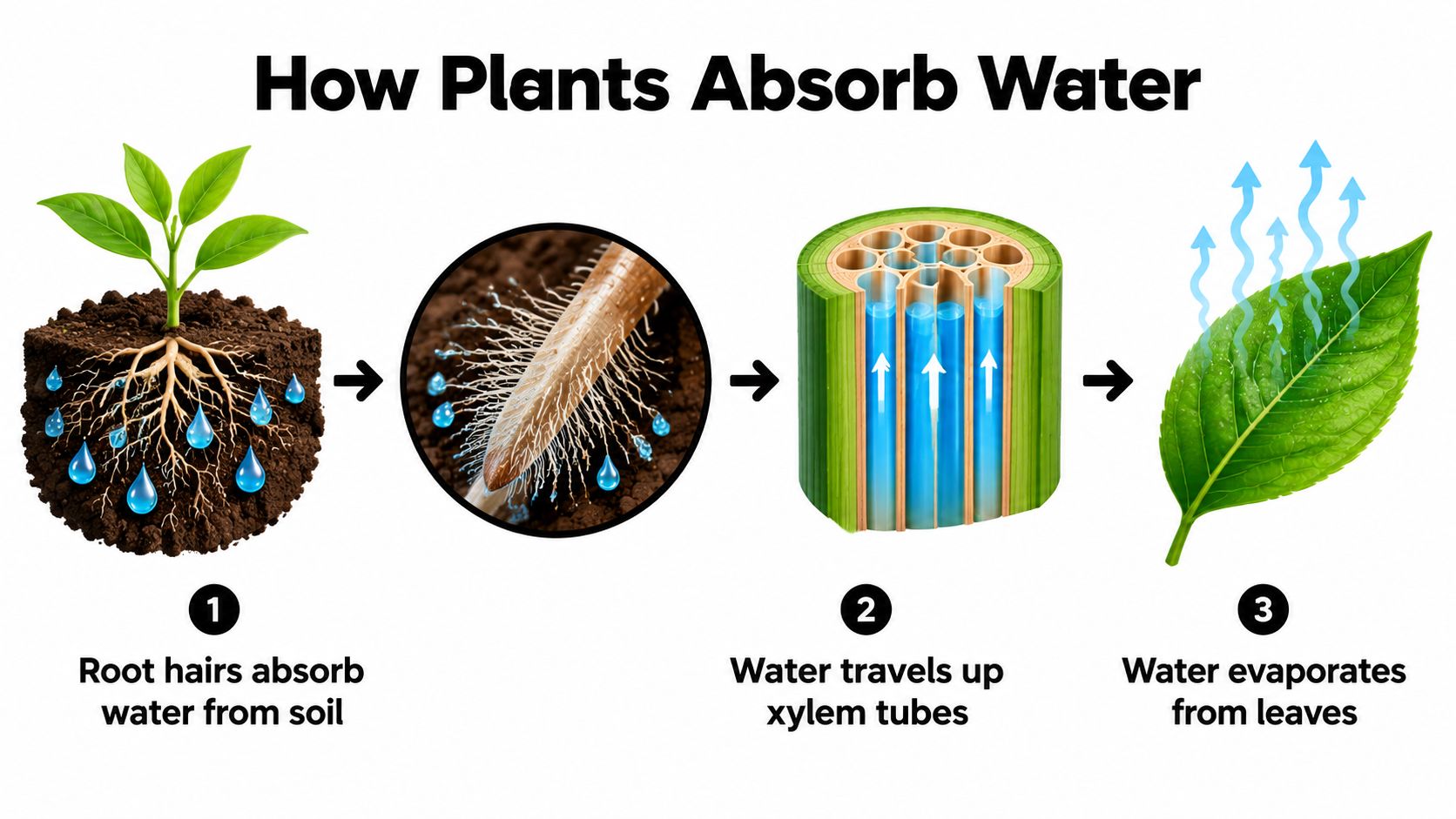
Think of the plant as a straw that begins in the potting mix and ends at the leaves. The straw works only when each part of the route is connected.
The route begins in the root zone
Water sits in the small spaces between soil particles. Fine root hairs extend into those spaces, increasing the contact area between the plant and the moist mix. Water enters root cells by following a water-potential gradient, moving from soil that has greater water potential, meaning it's less negative, toward root tissues with lower water potential. The Royal Horticultural Society's explanation of how plants absorb water describes this soil-to-root gradient and the upward movement that follows through xylem.
The movement isn't evenly spread across every part of a root. Research summarized in this overview of transpiration and root water movement reports that the apoplast made up about 5% of root cross section yet contributed 57 ± 8% of total water uptake across the cortex in one cellular-scale study. The same source describes an experiment in which seminal roots supplied 92% of cereal plant water uptake, while adventitious roots supplied 8%. Root architecture matters, so water that reaches active roots is more useful than water that floods the pot.
Leaves keep the straw working
After water enters the roots, it travels through xylem vessels in the stem. Evaporation from tiny openings in the leaves creates negative pressure that pulls the water column upward, a process explained through the cohesion-tension mechanism in this plant water relations review from Nature Scitable.
Most absorbed water doesn't remain stored in plant tissues. The same review states that plants retain less than 5% of water absorbed by roots for cell expansion and growth, while around 90% moves back to the atmosphere through transpiration. That's why root uptake is closely tied to leaf evaporation. When leaves transpire actively, uptake can increase. When stomata close or soil dries, the flow slows.
Capillary action also helps water move through narrow spaces in soil and roots, while cohesion holds water molecules together and adhesion helps them interact with plant tissues. The U.S. Geological Survey's explanation of capillary action makes this easier to picture in a container. Thorough watering helps connect the root-zone spaces, but a healthy, aerated mix keeps the pathway open afterward.
What Helps or Hurts Water Uptake
A plant absorbs water well when moisture, oxygen, roots, and evaporation demand remain in reasonable balance. None of these factors works alone.
Start with the potting mix. Loose, crumbly material lets water spread around roots while leaving air-filled spaces behind. Dense or pebbly soil may repel water, drain unevenly, or leave some roots dry while other areas stay saturated. Materials such as perlite, bark, and coco coir can change the structure of a mix, but the right choice still depends on the plant and container.
Root condition matters just as much. Circling roots may press tightly against the pot, while damaged roots can't absorb efficiently even when the surrounding mix is moist. A plant can therefore look thirsty because its root system is struggling, not because you've failed to pour enough water.
Light changes the demand side of the system. In brighter conditions, leaves generally evaporate more water, which can strengthen the pull through the plant. In a dim corner, uptake may slow because the plant's water loss is lower. Dry indoor air can increase evaporation from leaves, while humid air can reduce that demand.
Farm and garden systems face the same basic challenge at a larger scale. If you're curious about how growers manage stored water and reliable delivery, why farms need plastic storage tanks offers useful context about water storage beyond houseplant care.
Look at the whole setting: A dry room, bright light, compacted mix, and small root system can create a thirsty plant faster than any single factor would.
These conditions interact. A plant in bright light may cope well with frequent drying if its roots have air and the mix wets evenly. The same plant may wilt in damp soil when compacted conditions reduce root function. That apparent contradiction leads to one of the most important ideas in plant water absorption: wet soil doesn't always provide usable water.
When Wet Soil Still Leaves Plants Thirsty
A pot can feel wet while the leaves droop. That seems impossible until you separate water present from water available.
Water moves because of differences in water potential. Moist soil usually has a higher, less negative water potential than roots, creating the gradient that supports uptake. As soil dries, its water potential becomes more negative and the remaining water becomes harder for roots to access. Plant-available water is commonly described as the range between field capacity, approximated at −0.03 MPa, and the permanent wilting point, approximated at −1.5 MPa, as explained in this soil-water guide from Iowa State University.
A sponge gives us a simple comparison. A wrung-out sponge still holds useful water, but it also contains air. A waterlogged sponge holds plenty of water while pushing air out. Roots need both moisture and oxygen, so a saturated, compacted pot can limit root function and slow absorption.
The same problem can arise when salts build up in the soil. Salt-rich conditions can make water less available to roots even when the mix looks damp. For a practical way to check soil moisture with DIY tricks, use more than a glance at the surface. Feel deeper into the mix, notice how quickly water drains, and observe whether the plant improves after the soil returns to a healthier balance.
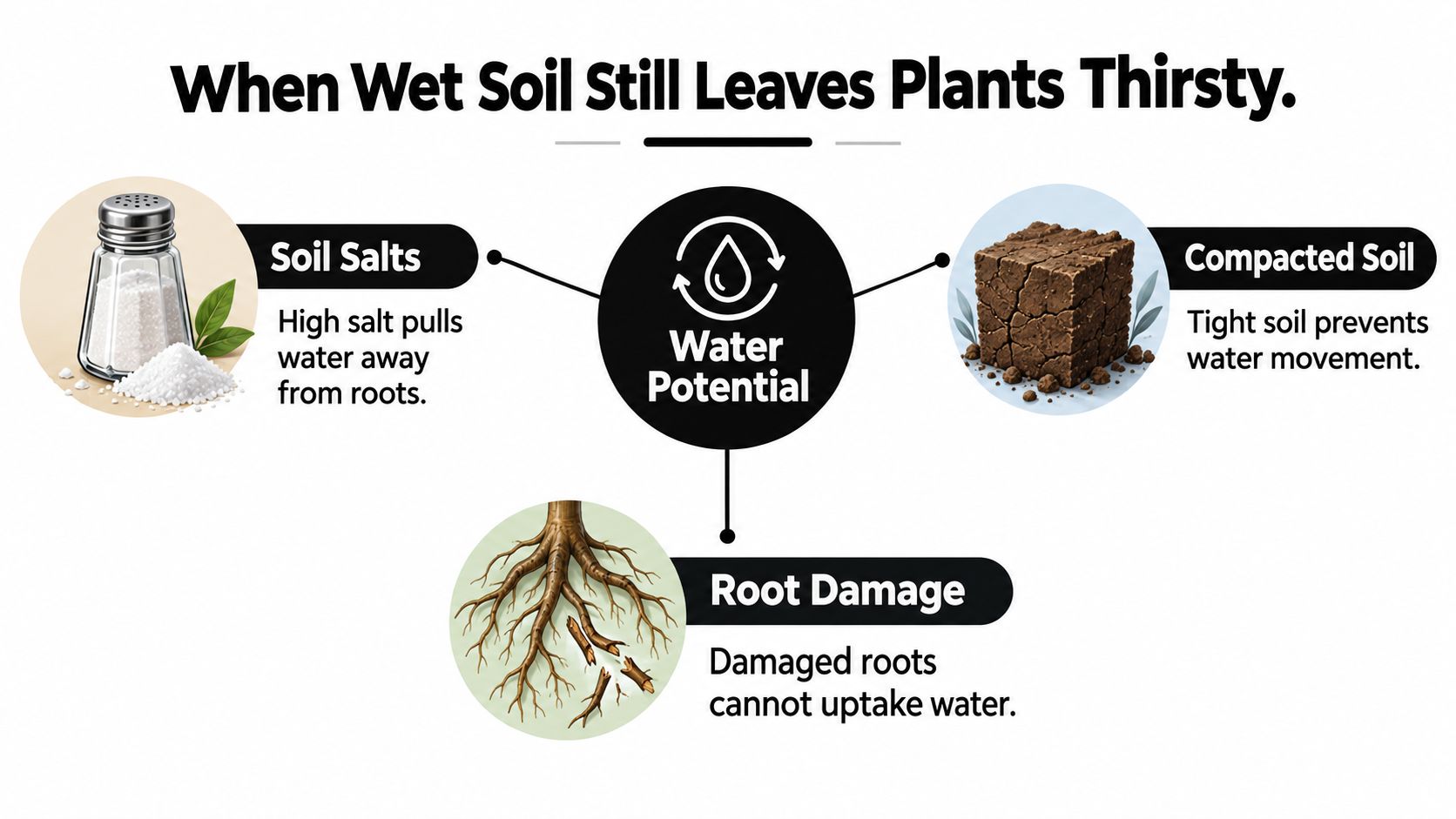
Overwatering and underwatering can produce similar leaf symptoms because both can reduce root function. If leaves wilt in soggy soil, adding more water may deepen the problem. Check drainage, root health, and mix structure before reaching for the watering can again. Guidance on what causes root rot in plants can help you recognize when wet conditions have become a root-zone issue.
Reading the Signs of Poor Absorption
Plants communicate through patterns rather than one perfect symptom. A drooping leaf can mean dry soil, damaged roots, low light, or a sudden environmental change. Read the leaves together with the soil and, when appropriate, the roots.
Leaf signals
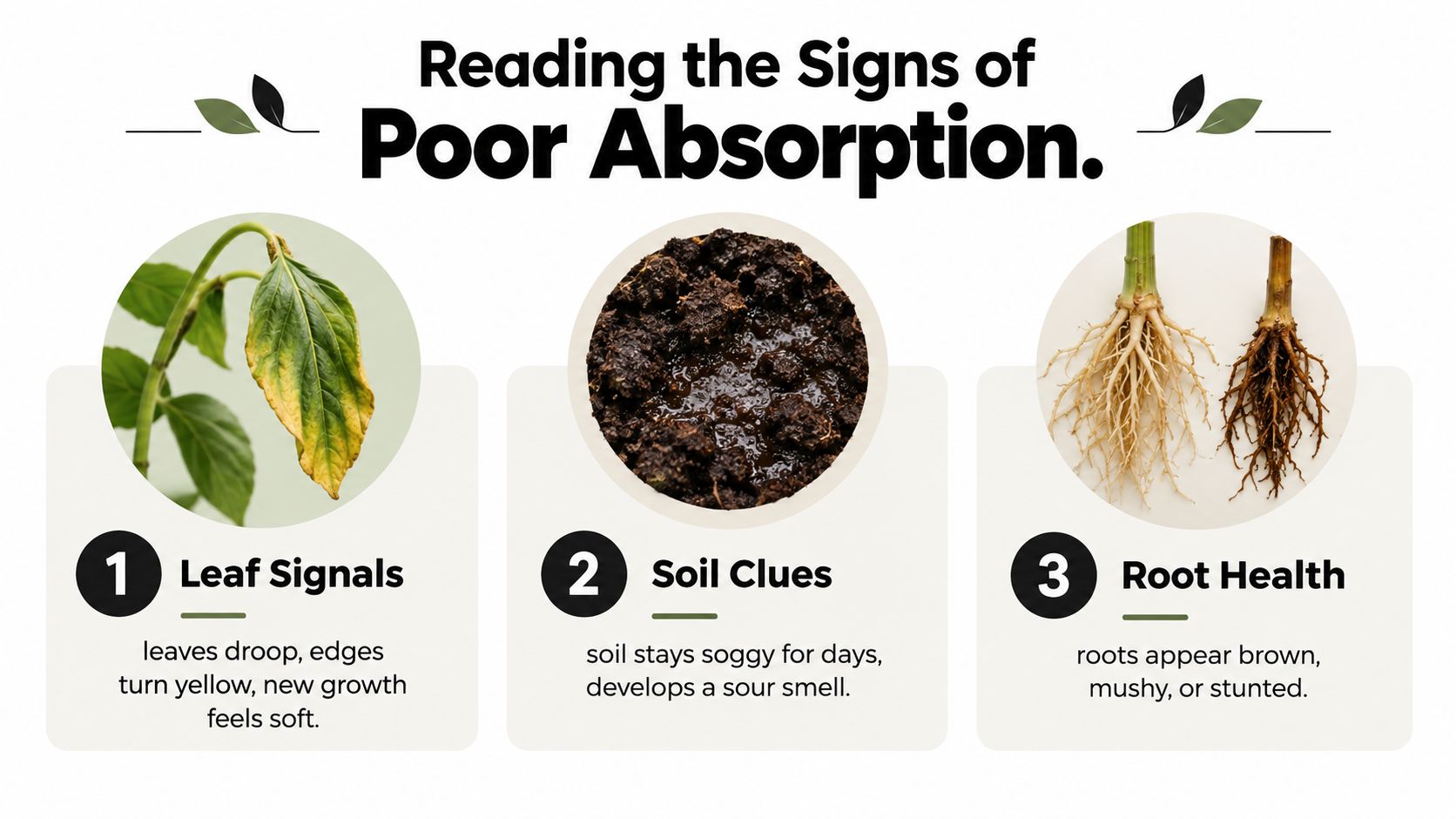
Drooping leaves suggest that water loss is exceeding replacement, but the timing matters. If a plant perks up after the root zone is appropriately watered, dryness may have been the main issue. Yellowing edges or soft new growth can point toward prolonged stress, yet they don't identify the cause on their own.
Soil clues
Soil that stays soggy for days deserves attention, especially when drainage holes are blocked or the container is too large for the root mass. A sour smell may indicate poor aeration and declining root conditions. Surface crusting can also interfere with even wetting, causing water to run around the root ball instead of moving through it.
Root health
Roots are easiest to assess during repotting. Healthy roots generally feel firm, while dark, mushy roots suggest decay and dry, shriveled roots suggest prolonged lack of moisture. Stunted or tightly circling roots may limit the plant's ability to reach fresh water.
Keep a simple weekly note for each plant: soil feel, leaf posture, light exposure, and the last thorough watering. You're not building a laboratory record. You're learning the plant's normal rhythm, which makes unusual changes easier to notice without turning every droop into an emergency.
Simple Habits That Support Steady Hydration
Watering works best as a steady soil-to-leaf pipeline. When the root zone has usable moisture, roots can take it in, stems can carry it upward, and leaves can release it. Water thoroughly when the mix needs it, pouring slowly so it spreads through the wider root zone. Continue until a little excess leaves the drainage holes.
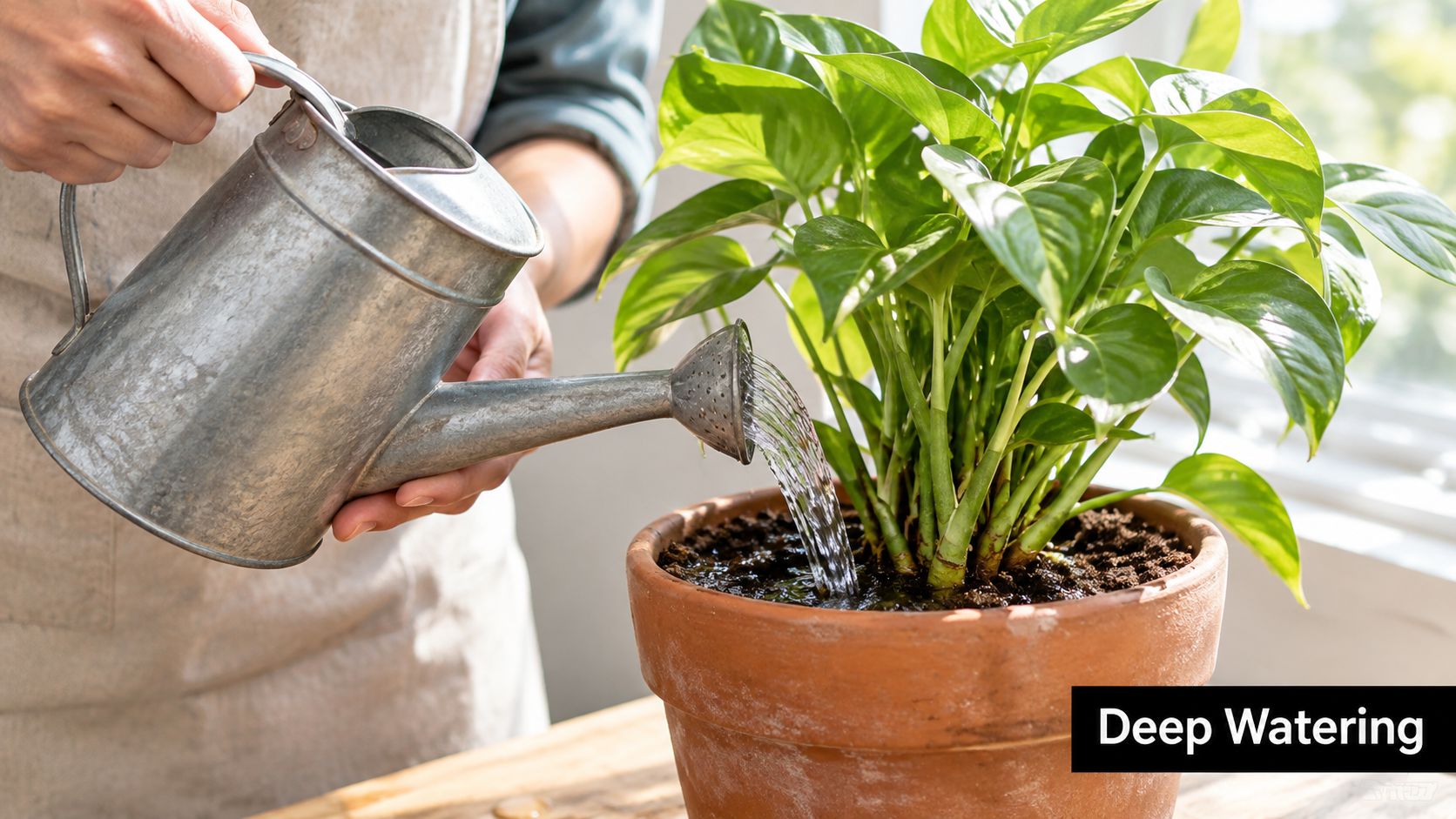
A calendar cannot account for changing light, humidity, temperature, or pot size. Check the mix instead. Insert a finger about 1.5 to 2 inches into the potting soil and water when that depth feels dry, following this houseplant watering frequency guide. Tropical foliage plants may need water around every 7 to 14 days in summer, while succulents may go 2 to 4 weeks or longer, depending on their conditions.
Give roots a workable home
Roots need both moisture and air. Choose a mix that holds water without remaining airless. Perlite can create drainage space, bark can add structure, and coco coir can retain moisture. Match those materials to the plant's natural habitat and to how quickly its container dries.
Repot when roots circle densely, water runs straight through, or the plant dries unusually fast. A larger pot can hold excess wet soil around a small root ball, leaving roots with less air. Pot size should support the existing root system rather than provide more room.
Light and humidity set the pace of the pipeline. Bright light may increase water loss, while a humid room can slow evaporation. Check plants in different locations at different intervals instead of copying a single schedule.
A decorative self-watering globe can release water gradually as nearby soil dries. It may help maintain steadier root-zone moisture while you travel or manage a busy routine. Test whether water flows, place the globe carefully, and keep checking the surrounding mix. Slow delivery cannot fix blocked drainage, rotting roots, or unsuitable soil.
The following video offers a visual companion to the basic watering process:
Use the globe as a support tool, not a guarantee. Healthy hydration still depends on workable soil, living roots, and a watering rhythm that matches the plant's conditions.
Bringing It All Together for Confident Care
Watering becomes calmer when you follow a rhythm instead of a rigid rule. You are maintaining a living pipeline from soil to roots, stems, and leaves. Roots need moisture and air together, while the leaves set the pace at which water leaves the plant.
Before watering, pause and read the whole setup:
- Watch the plant: Morning leaf posture gives you a clearer baseline than temporary evening changes.
- Check the container: Drainage holes should remain open, with no standing water trapped beneath the pot.
- Read the environment: Light, humidity, temperature, pot size, and root condition all affect how quickly the root zone changes.
- Compare over time: Notice whether the plant recovers after watering and whether new growth stays firm.
A moisture meter can help you compare one check with another, especially while learning how a particular pot dries. A decorative self-watering globe can release water gradually as nearby soil dries, helping maintain steadier root-zone hydration for a traveler or a busy apartment dweller. Test its flow first, position it carefully, and keep observing the surrounding mix. Slow delivery cannot correct blocked drainage, unsuitable soil, or damaged roots.
Neither tool replaces the plant itself. Leaves, soil, and container condition show whether water is reaching active roots and continuing upward through the plant.
Plants can hold some water between drinks, so one missed watering does not automatically undo your care. Resume a balanced routine instead of compensating with a heavy flood, then allow the root zone time to respond.
The aim isn't perfect care. It's repeatable care that keeps moisture and oxygen available to active roots.
Plant water absorption becomes easier to understand as a continuous soil-to-leaf process. Support the pipeline with workable soil, living roots, suitable light, and steady observation. Adjust as the plant and its surroundings change.
Little Green Leaf offers decorative self-watering globes designed to release water gradually as soil dries, giving busy plant owners and travelers a simple way to support steady root-zone hydration. Visit Little Green Leaf to explore hand-blown glass globes that make everyday plant care feel more consistent and confident.