

Plant Sitter Checklist: Hand Off Watering in Five Steps
A suitcase is open, the taxi is booked, and a friend has agreed to water the plants. Then the helpful part starts. That friend, acting as plant sitter, gives every pot a generous daily pour, moves a fern into bright sun for a treat, and leaves saucers full for extra insurance. A written handoff sheet with clear moisture thresholds prevents that well-meant damage. A watering globe then covers the gap between checks for up to about two weeks per fill, not a fixed number of days.
Table of Contents
- What to Write on the Plant Sitter Handoff Sheet
- How Long One Globe Fill Lasts While You Are Away
- Matching Globe Size to Pot Size and Plant Type
- How to Set Up Plant Watering Before You Leave
- Three Moisture States and What to Do With Each
- Plant Sitter Questions People Actually Search
What to Write on the Plant Sitter Handoff Sheet
A plant sitter doesn't need a daily watering schedule. The sitter needs a written sheet and a moisture rule, because each pot dries at its own speed. Container size, pot material, light, temperature, humidity, and growing medium all change that speed, so calendar dates can't decide the job.
The work starts before departure. According to Purdue Extension guidance on houseplant care, a reliable protocol begins 24 to 48 hours before departure with a plant-by-plant moisture baseline, checking about one-third of the soil depth in smaller pots and 1 to 2 inches in larger pots, and watering only when that zone is dry or barely moist. That baseline shows the sitter what normal feels like for each pot, rather than leaving the sitter to guess from the surface.
The seven fields
| Handoff field | What to write | Why it matters |
|---|---|---|
| Plant name and location | Plant name, window or room, distance from heat or direct sun | Sitter can find and recognise each plant |
| Moisture test | Depth to check, one-third of pot depth for small pots, 1 to 2 inches for large pots | Replaces a calendar with an observable threshold |
| Watering action | If dry at the test depth, saturate until water exits the drainage hole, then empty the saucer | Stops both a dry lower root zone and well-meant overwatering |
| Do-not-move list | Plants that stay put, and any that must not be fertilised or repotted | Prevents stress from moving plants |
| Drainage rule | Empty saucers after watering, no standing water | Protects roots from sitting wet |
| Globe record | Size (100 ml, 200 ml or 350 ml), fill date, starting reservoir level, refill rule | Shows whether a globe is draining at the expected rate |
| Escalation rule | Send a photo before adding more water | Lets the owner decide on unclear symptoms |
A simple map belongs beside the first field. Mark the sunny window, the radiator, and any drafty door. A plant near heat dries faster than the same plant in a cool corner, and the map explains that difference before the sitter has to interpret it.
One filled line makes the format obvious:
Pothos, east window, 200 ml globe filled Tuesday, water only if dry at one-third depth, then empty the saucer.
The watering action field shouldn't list a neat millilitre dose. Saturating until water exits the drainage hole sets the amount by the pot itself, and emptying the saucer finishes the job. Small surface splashes do the opposite. They darken the top layer while the lower root zone stays dry, and a full saucer keeps roots wet after the pour.
The sheet decides. The sitter doesn't improvise, move plants for better light, or add a safety watering because a leaf looks sad. If a symptom isn't covered by a threshold on the sheet, the escalation rule takes over and the owner decides from a photo.
How Long One Globe Fill Lasts While You Are Away
One fill can last up to about two weeks, and the range exists for a reason: plant type, climate, pot size, and the angle the globe is inserted all pull that span shorter or longer. A 100 ml globe in a warm room empties fast, while a 350 ml globe in a cool corner stretches the same fill. Plan the trip around the range, then let the handoff sheet's thresholds cover the gap the globe cannot.
The mechanism is passive. Fill the bulb, set the stem in already moist soil, and the soil draws water gradually as it dries. As the soil dries, oxygen flows through the stem and gently displaces water from the globe into the root zone. A reservoir feeds moisture at the pace the soil demands rather than on a schedule, which is why the same setup drains faster beside a sunny window than in a cool room.
Choosing by trip length
| Trip length | Passive setup only | Sitter visit | Best combination |
|---|---|---|---|
| A few days | Thorough watering before leaving is often enough for most houseplants | Not needed | Pre-trip watering, optional globes in thirsty pots |
| About one week | Globes sized to each pot, check on return | Optional mid-trip check | Globes plus one mid-trip soil check |
| About two weeks | One globe fill can last up to about two weeks, depending on pot and plant | One visit to check soil and reservoirs | Globes plus one sitter visit |
| Longer than two weeks | Globes alone are not enough for thirsty or large-pot plants | Regular visits with moisture checks | Sitter with written thresholds plus globes |
The rows share one job: match the passive setup to the longest stretch without eyes on the plants. The sheet already records globe size, fill date, and starting reservoir level, so the trip length chosen here sets how often someone reads those fields.
A visit at this stage is an inspection: read each reservoir, then check the soil at the test depth. A reservoir still full after several days usually means a stem that has stopped releasing water or soil that stayed wet enough to never pull. An empty one means the sheet's refill rule takes over.
On return, the owner reads each reservoir first, then checks the soil. Refilling only makes sense when the test depth is dry.
Matching Globe Size to Pot Size and Plant Type
Pot size sets the first guess. According to RHS guidance on looking after your garden on holiday, watering frequency depends on the medium, season, light, temperature, humidity, plant species, and pot size, with small pots needing water every two to three days and large pots only every seven to fourteen days. That spread is why one globe size can't be treated as universal.
| Pot size | Typical watering interval | Globe to try first | Notes |
|---|---|---|---|
| Small pot | Every 2 to 3 days | 100 ml | Dries fastest, so expect the most refills |
| Medium pot | Every 3 to 7 days | 200 ml | Confirm refill timing during the pilot run |
| Large pot | Every 7 to 14 days | 350 ml | A single small globe won't cover a large pot in heat |
Treat the table as a starting point and confirm the pick with a two-to-three-day pilot in the actual room, because a medium pot beside a sunny window can drink like a small, thirsty one. When two sizes both look workable, I size up: a reservoir still releasing water beats a smaller bulb that ran dry mid-week. The guide to globe bulb sizes helps match the 100 ml, 200 ml, and 350 ml options, including the mixed size option, before the pilot begins.
One more limit frames the choice. A single fill lasts up to about two weeks, and the actual span shifts with plant type, climate, pot size, and the angle the globe is inserted. The globe covers the gap between the checks written on the handoff sheet; it never replaces them.
Plants and pots a globe cannot cover
- Succulents, cacti, and plants that must dry out: A globe keeps soil moist, the wrong regime for anything needing a clear dry period, so these stay on the handoff sheet with no globe.
- Very large pots and thirsty plants: One 100 ml bulb won't bridge a hot week in a big container, and thirsty species drain any size faster, so pair the globe with a scheduled sitter check.
- Dense, packed soil: A pencil pilot hole goes first, then the stem slides in at an angle, so roots aren't crushed and the neck doesn't jam.
- Spots where glass gets knocked: Hand-blown glass breaks on impact, so filled globes stay off the floor and away from pets and foot traffic.
Optional tip covers help prevent clogs when fine soil keeps packing into the neck. They don't rescue a wrong size, and they don't change the list above.
The choosing rule stays short. Match the row, run the pilot, exclude what belongs on the sheet alone. For those plants, the sheet's moisture thresholds are the whole plan.
How to Set Up Plant Watering Before You Leave
Setup happens after the sheet, the size choice, and the trip-length row are already decided. Rushing those decisions on departure morning is how globes end up in the wrong pots. Owners sorting flights and packing at the same time can browse vacation planning tips early enough that plant setup gets its own calm slot, not the final ten minutes.
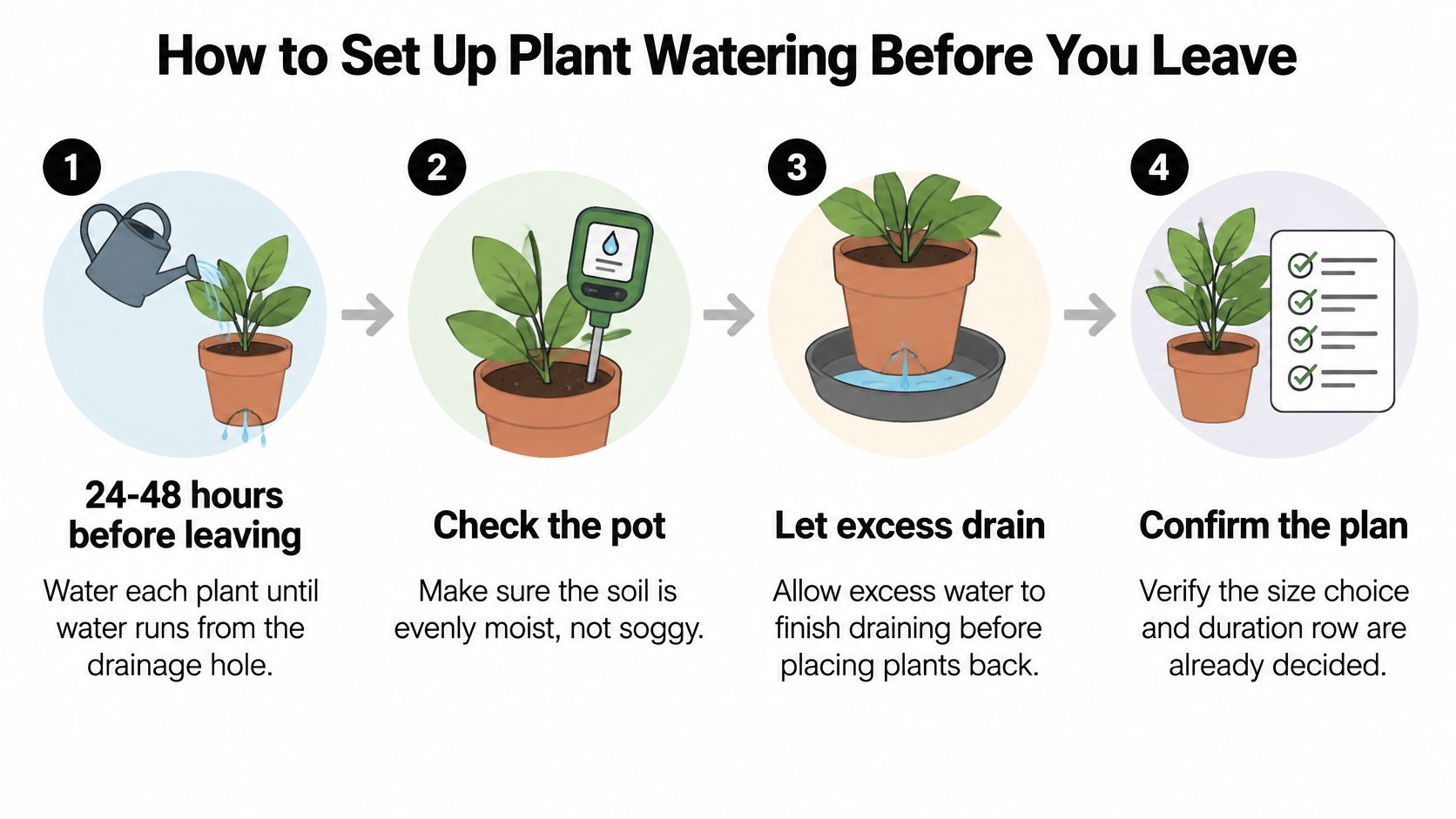
Five setup steps
- Water thoroughly at 24 to 48 hours before leaving. Water each plant until water runs from the drainage hole, then empty the saucer. Skipping this step leaves dry pockets in the lower roots that a globe can't correct, because a globe maintains moisture rather than rewetting a dry root ball evenly.
- Check the named test depth and describe it. Push a finger or a clean wooden skewer to the depth written on the sheet and note what dry soil feels or looks like for that pot. The usual slip is writing only "check soil," which tells the sitter nothing about depth.
- Fill the globe and insert it into moist soil. Use the size already chosen, 100 ml, 200 ml, or 350 ml. In dense soil, make a pilot hole with a pencil, then push the stem in at an angle. Forcing the stem straight down compacts soil around the opening and can damage roots.
- Record the starting level. Write the fill date and the starting reservoir level on the globe line of the sheet. Without a starting mark, a half-empty globe on day three means nothing, because nobody knows where it began.
- Run a two-to-three-day pilot. Keep light and temperature close to what the room will hold during the trip, then compare root-zone moisture, reservoir loss, leaf firmness, and drainage. Fast loss points to heat, a loose soil channel, or too much flow. No loss points to a clog or soil that's already wet enough.
Little Green Leaf globes are hand-blown glass globes that keep plants hydrated automatically once they're filled and inserted into soil, and they suit indoor and outdoor plants. Glass still needs sensible placement away from foot traffic, because a drop breaks it. Owners who want the broader routine can read the guide to watering plants while away, then choose sizes on the Little Green Leaf product page.
A good pilot result is boring. Stable moisture, an empty saucer, firm leaves, and a reservoir falling slowly after two days.
If the pilot fails, the fix happens before the trip, not by phone during it. Resize the globe, remake the pilot hole, or move that plant to sitter-only care.
Three Moisture States and What to Do With Each
Every visit uses the same three-state rule. According to Utah State University Extension guidance on indoor plants, the sitter adds nothing when soil is cool and moist, waters or refills to the written limit when it's dry at the test depth, and removes standing water when it's saturated, with stable moisture without standing water as the practical benchmark across the test period. The guide to telling if soil is dry gives the owner a simple way to show that test during the walkthrough.
| Soil condition | Sitter action | Report to owner |
|---|---|---|
| Cool and moist at test depth | Add nothing, note the reading | No |
| Dry at test depth | Water or refill up to the written limit, then stop | Only if the limit was reached |
| Saturated or heavy pot | Empty saucer, remove standing water, improve drainage, add no water | Yes |
| Yellowing lower leaves, fungus gnats or soft stems | Do not add water, take a photo | Yes, send the photo first |
Cool and moist is the state that tempts helpers most. The plant looks fine, the watering can is right there, and a little extra feels harmless. It isn't needed, and the correct action is to note the reading and walk away.
Dry at the test depth earns action, but only up to the written limit. The sitter waters or refills, confirms drainage has finished, empties the saucer, and stops. Saturated soil earns the opposite response. Standing water comes out, drainage improves, and no water goes in, whatever the calendar says.
Warning signs to report, not fix
Persistently wet soil, a pot that stays heavy, fungus gnats, and soft stems point toward too much moisture and poor root aeration. Adding water because the plant looks unwell makes that pattern worse. Yellowing lower leaves need reporting for a different reason. Yellow leaves alone don't show whether the cause is water, light, or pests, so the sitter sends a photo and the owner decides.
Globe reservoirs carry their own signals. A reservoir emptying unusually fast suggests high evaporation or a loose soil channel letting water run through. A reservoir that never drops suggests a clogged stem or soil that's already soggy. Both readings go on the sheet.
No universal success rate exists for this kind of care. Species, potting mix, container shape, and indoor climate vary too much. Stable moisture without standing water is the benchmark that means something.
Plant Sitter Questions People Actually Search
How often should a plant sitter come by
Trip length sets the visit schedule, so match check-ins to the trip-length guidance above rather than a fixed daily routine. Whatever the interval, each visit is a moisture check against the written thresholds on the handoff sheet. The sitter tests soil at the marked depth, reads the reservoirs, and acts only when the sheet calls for it.
Do watering globes replace a plant sitter
A globe handles hydration between checks. It cannot interpret what it finds. The questions a sitter answers are diagnostic: is this soil dry because the plant drank, or because the globe ran empty days ago? Is that flat reservoir a clogged stem, or soil already holding enough water? A person can pull the globe, check the stem for blockage, feel the soil, and decide. Glass cannot.
Can a watering globe go in a succulent or cactus
No. Succulents and cacti need soil to dry, and a globe keeps soil moist. Those plants stay globe-free, and the sitter waters only when the test depth is dry and the sheet allows it.
What if the stem clogs or the globe never empties
Fit the optional anti-clog sleeve, clear and remake the pilot hole, and reinsert at an angle. A flat reservoir means a clog or already-wet soil, and either reading goes on the sheet rather than triggering a manual pour. If clearing the stem and remaking the hole still leaves the reservoir flat, the soil is holding enough moisture and no action is needed.
Fill in the seven-field handoff sheet, size each globe to its pot, and let a plant sitter inspect instead of guessing. Little Green Leaf offers hand-blown glass watering globes in 100 ml, 200 ml, and 350 ml sizes that release water gradually as soil dries, covering the gap between sitter checks for suitable houseplants. Choose the sizes each pot needs at Little Green Leaf before the next trip is packed and waiting.