

Indoor vs Outdoor Plants Watering Needs
You've watered the indoor pots before leaving for a week, but the outdoor hanging basket is already dry again by late afternoon. Watering globes can help bridge that gap, releasing moisture gradually for up to about two weeks per fill, depending on pot size, soil, plant thirst, temperature, and globe capacity. They're useful for many indoor and outdoor containers, but they aren't suitable for succulents, cacti, or plants that need their soil to dry out.
Table of Contents
- Why Indoor and Outdoor Watering Routines Differ
- Managing Indoor Moisture and Humidity
- Outdoor Containers and Rapid Moisture Loss
- How to Set Up a Watering Globe for Any Pot
- Choosing the Right Watering Aid for Your Setup
- When Not to Use a Watering Globe
- Common Questions About Globe Longevity and Care
Why Indoor and Outdoor Watering Routines Differ
You water an indoor pot on Monday, then find its soil still damp days later. Outside, the same routine can leave a hanging basket wilted by afternoon. The difference between indoor and outdoor plants often comes down to moisture management rather than light or temperature alone.
Indoor containers usually lose water slowly in a stable room. That gives roots time to stay wet, especially when watering follows a calendar instead of a soil check. Outdoor pots face wind, heat, and direct exposure, so their limited soil volume can dry rapidly. A missed check may leave roots struggling before the next watering.
The practical challenge is delivering moisture steadily. Repeatedly soaking a dry indoor pot can stress roots, while allowing an outdoor container to swing from damp to completely dry can weaken the plant. Check the growing medium before watering, and adjust the routine to the plant, pot, and conditions.
Practical rule: Water according to the plant's moisture condition, not a recurring weekday.
Wilting is an unreliable signal by itself. Poorly aerated, overwatered soil can also leave foliage limp. For a useful explanation of those warning signs, see the guide to signs of overwatering from Prestonwood Commercial Landscape Services.
A watering globe can bridge these two routines. Its reservoir releases moisture gradually as the surrounding soil dries, reducing the need for one large, irregular watering. That suits plants that prefer steadier moisture and helps owners who travel, forget checks, or care for containers in both indoor and outdoor conditions. It still requires sensible placement and occasional inspection, because no reservoir can correct unsuitable soil, poor drainage, or a plant that needs to dry between waterings.
Managing Indoor Moisture and Humidity
Indoor plants benefit from a relatively stable environment, but stable conditions don't eliminate watering mistakes. Major extension guidance places many houseplants around 65 to 75 °F during the day and 55 to 68 °F at night, while many perform best at 40 to 60% relative humidity. Humidity below 20% can injure many houseplants, according to the Pacific Northwest Gardener's Handbook.
That dry indoor air can increase moisture loss, but the pot may still dry more slowly than an outdoor container. The result is an awkward pattern: a plant dries at the surface, receives water too soon, and remains wet deeper down. A better routine is to check about 1 inch below the surface before watering, then soak the pot thoroughly and let excess water drain, as described in Virginia Cooperative Extension's container watering guidance.
Consistency matters more than a fixed calendar
A watering globe is useful when the plant prefers reasonably even moisture and the owner struggles to maintain a steady routine. Its narrow stem and reservoir release water gradually rather than flooding the pot. As the soil dries, suction draws water from the globe, while wetter soil slows the release.
That doesn't mean a globe replaces observation. If a pot sits in a tray, it shouldn't remain in standing water for more than 60 minutes, because prolonged saturation can deprive roots of air. A globe also shouldn't be inserted into already waterlogged soil. The plant should be checked first, watered appropriately, and allowed to drain.
Indoor humidity can be managed separately. Owners looking for room-level humidity equipment can shop for home humidifiers online through EcoQuest Purifiers, but added humidity won't correct a pot that's being watered too often. For a practical routine built around checking rather than guessing, see this indoor plant watering schedule.
Outdoor Containers and Rapid Moisture Loss
Outdoor containers lose moisture faster because several stresses arrive together. Wind increases evaporation, warm conditions accelerate drying, and exposed containers receive more intense light than a typical indoor pot. A hanging basket can be especially demanding because it has limited reservoir space and is surrounded by moving air.
The RHS recommends daily checks for containers from spring through autumn and twice-daily checks in hot weather. An ACT government container guide describes daily watering for tubs in summer and weekly watering in winter. Those schedules aren't promises for every plant, but they show why outdoor watering changes sharply with season and weather.
Why fixed schedules fail outside
A container that was adequately watered yesterday may need attention again today. A shaded patio pot, a windy balcony basket, and a large protected planter won't lose moisture at the same rate. The same outdoor plant may also need a different routine after a sudden change in temperature or exposure.
Outdoor movement creates another risk. Plants shifted from indoors to a brighter setting need gradual acclimation, because direct sun and faster drying can cause scorch and stress. The broader change involves more than brightness. Irradiance, temperature swings, and moisture loss all shift together, as explained in the peer-reviewed research on indoor growth environments.
A watering globe can reduce the burden of frequent checks for suitable patio containers and hanging baskets. It won't stop a pot from drying rapidly, and it can't compensate for a container that's far too large for the reservoir. It does provide a measured supply between hands-on waterings, which can be valuable during a short trip or a busy stretch of summer.
For more ideas focused on outdoor container hydration, see this outdoor automatic watering system guide for plants.
How to Set Up a Watering Globe for Any Pot
Little Green Leaf glass watering globes are hand-blown glass bulbs with a long stem. They're available in 100 ml, 200 ml, and 350 ml capacities, with packs containing 1, 2, 4, or 6 globes in multicolor and clear rainbow designs. Optional plastic anti-clog sleeves can help protect the stem opening.
The setup is simple, but the order matters. The plant should be watered first, because the globe is designed to maintain moisture gradually, not replace a thorough initial watering. Dense soil may also resist the stem, so forcing the glass can damage the globe or compact the planting area.
Self-watering globes use a mechanical feedback loop. Drying soil creates suction that pulls water from the reservoir, while the narrow neck limits flow so the water releases gradually instead of flooding, as explained in this overview of self-watering globes.
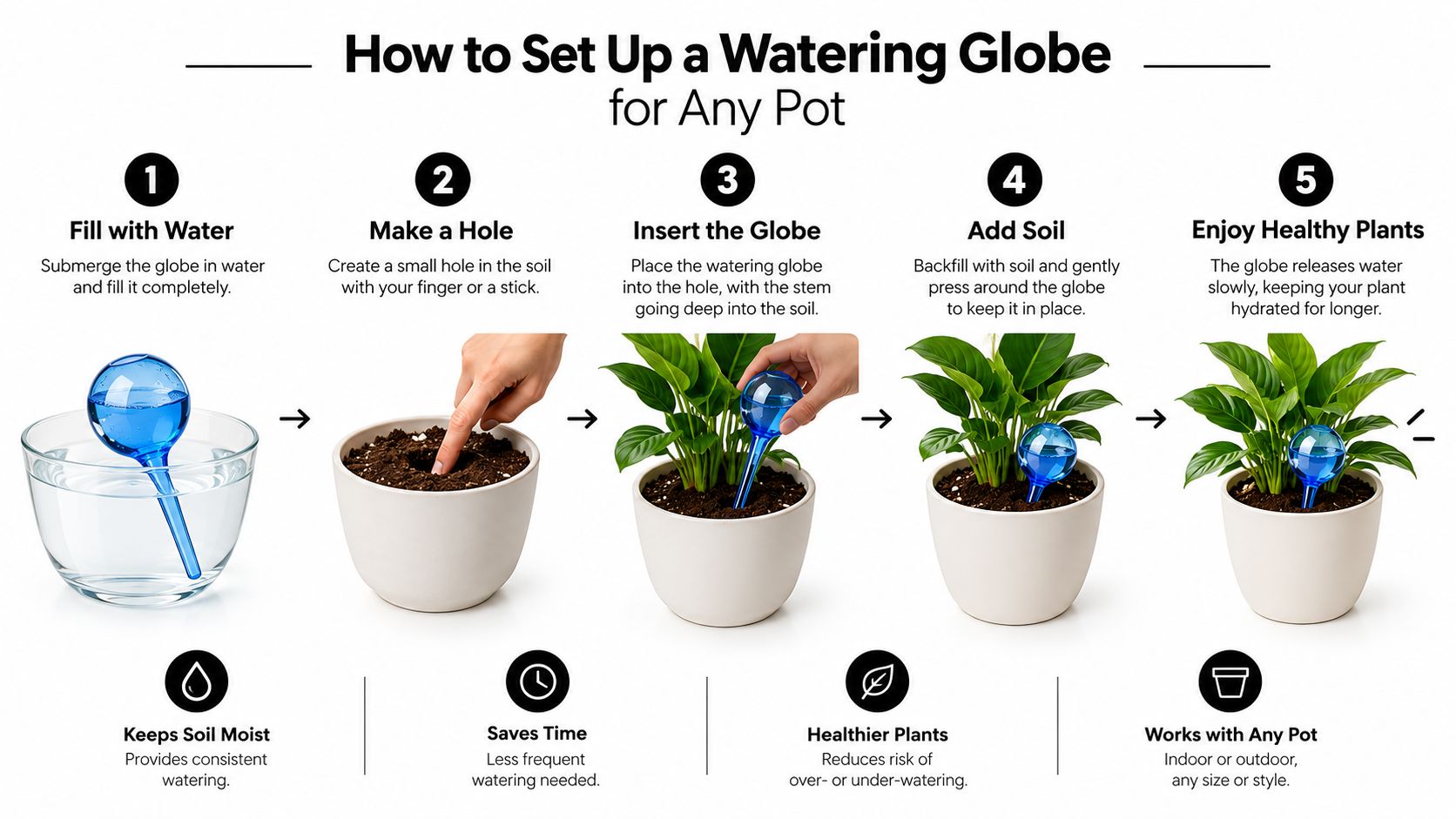
Five steps for indoor and outdoor pots
- Water the plant first. Check the soil about 1 inch below the surface. If it's dry, water thoroughly until excess drains from the bottom, then let the pot finish draining.
- Make a pilot hole. Use a narrow plant stake or similar clean implement in dense soil. The hole should make insertion easier without creating a loose channel around the stem.
- Fill the globe. Add clean water to the bulb, keeping the stem opening clear. A full globe gives the longest possible interval, but the exact duration depends on the plant, pot, soil, temperature, and globe size.
- Insert the stem at an angle. Place the stem into the pilot hole rather than pushing directly through compacted soil. An angled position can help stabilize the globe, especially in an outdoor pot exposed to movement.
- Check after two days. Look for a stable globe, normal soil moisture, and a stem that isn't blocked. If the bulb empties unusually quickly, inspect the fit and the plant's moisture demand before refilling.
For a closer walkthrough, read how to use watering globes. A globe should be removed and cleaned if the stem clogs. Rinse the bulb and stem, clear residue gently, and allow the parts to dry before storing or refilling.
Choosing the Right Watering Aid for Your Setup
Watering globes suit individual pots where gradual delivery is useful and the owner still wants a simple, visible tool. They aren't a universal answer. A large planting area, a very large container, or a plant that must dry substantially between waterings calls for a different approach.
The capacity also matters. The 100 ml size fits smaller watering demands, while 200 ml and 350 ml reservoirs provide more water for larger or thirstier containers. No single capacity guarantees a fixed number of days. Little Green Leaf describes use for up to about two weeks depending on conditions, and the smallest globe will generally empty sooner than the largest one when other factors are equal.
Watering aid comparison matrix
| Method | Duration per fill | Setup effort | Clog risk | Best environment |
|---|---|---|---|---|
| Glass watering globe | Up to about two weeks, depending on capacity and conditions | Low, after making a pilot hole when needed | Stem can clog if soil or residue blocks it | Individual indoor pots, patio containers, and hanging baskets |
| Porous watering spike | Varies with reservoir and soil conditions | Moderate | Opening can clog in dense soil | Individual containers where gradual delivery is preferred |
| Drip irrigation system | Depends on reservoir, flow setting, and system design | Higher, with more components to arrange | Emitters and narrow passages can clog | Multiple containers or larger coordinated setups |
| Self-watering planter | Reservoir duration varies by planter and plant demand | Moderate, usually during initial setup | Wicking paths can need maintenance | Containers designed for ongoing reservoir use |
Cost per plant depends on the purchase price, pack size, reservoir capacity, and how many containers the setup serves. A single globe is easy to assign to one plant, while a coordinated system may spread one source across several containers but require more installation and maintenance.
For a medium outdoor planter, a 350 ml globe can be a practical fit when the plant accepts consistent moisture and the pot isn't so large that one reservoir becomes insignificant. For a massive floor plant or broad garden area, a single small globe is unlikely to supply enough water. The honest choice depends on the container's demand, not the appearance of the accessory.
When Not to Use a Watering Globe
Watering globes keep soil moist. That is precisely why they're a poor fit for succulents, cacti, and plants that need to dry out between waterings. A steady supply can leave these plants wetter than they prefer, especially indoors where evaporation is slower.
They're also unsuitable as a substitute for assessing a plant before a trip. A dry pot should receive a proper watering and drain first. A saturated pot doesn't need an additional reservoir just because its owner is leaving town.
Physical and capacity limits
Glass requires sensible placement. A globe can break if dropped, knocked against a hard surface, or placed where people and pets regularly brush past it. Outdoor containers in busy walkways deserve extra care, and the bulb should be handled by the reservoir rather than forced by the stem.
Capacity is another boundary. A single small globe won't sustain a very large pot through peak summer heat. Outdoor wind and heat can outpace the reservoir, while a thirsty plant may draw water faster than a less demanding one. In those situations, the owner may need more than one appropriately sized globe or a different watering arrangement.
The product also won't correct poor drainage or an unsuitable watering routine. If soil stays wet for days, leaves become soft and yellow, or the plant wilts while the pot remains saturated, adding water is the wrong response. If the soil is dry, dusty, and pulling away from the container, the plant needs a thorough rehydration before a globe is installed.
Common Questions About Globe Longevity and Care
How long do watering globes last?
A full Little Green Leaf globe can provide water for up to about two weeks, but that isn't a fixed promise. Small globes, thirsty plants, large pots, warm rooms, wind, and outdoor heat can shorten the interval, while the 350 ml size can extend it compared with the smaller capacities.
What size watering globe do I need?
Little Green Leaf offers 100 ml, 200 ml, and 350 ml globes. Smaller pots with moderate moisture needs generally require less reservoir capacity, while larger or thirstier containers may benefit from a larger globe, provided the plant likes consistently moist soil.
How do you stop a watering globe from clogging?
Make a pilot hole in dense soil instead of forcing the stem into compacted material. An optional plastic anti-clog sleeve can help protect the stem, and regular rinsing of the bulb and stem removes residue before it restricts flow.
Do watering globes work for outdoor plants?
They can work for suitable outdoor containers and hanging baskets, particularly when heat and wind make daily checks difficult. They won't keep every outdoor pot hydrated for the same duration, so the globe should be tested before a trip and matched to the container's demand.
Are watering globes good for succulents?
Usually, no. Succulents and cacti generally need their soil to dry out, while a watering globe is designed to release moisture gradually and keep the root zone damp.
Can watering globes replace checking the soil?
No. They reduce the need for frequent manual watering, but owners should still check the plant, inspect the globe, and watch for unusually fast emptying or persistent saturation. A watering aid works best as a buffer, not as a guarantee.
Little Green Leaf offers hand-blown glass watering globes in 100 ml, 200 ml, and 350 ml sizes, with multicolor and clear rainbow options for indoor pots, outdoor containers, and hanging baskets. Visit Little Green Leaf to choose a globe capacity and pack size that matches the watering demands of the plants being managed.