

Indoor Plant Accessories That Actually Help Plants Thrive
Standing beside a row of houseplants that look healthy, many plant owners still face the same problem: one pot is bone dry, another is soggy, and a third will need watering during the next trip away. Watering globes can release moisture for up to about two weeks per fill, but the actual duration depends on the plant, pot, growing medium, temperature, and globe capacity, so they work best as a moisture buffer rather than a replacement for checking the soil.
Table of Contents
- What Counts as an Indoor Plant Accessory
- How Self-Watering Globes Actually Work
- The Seven Categories Worth Knowing
- Watering Globes Against Every Other Watering Option
- Setting Up a Watering Globe the Right Way
- Matching Accessories to Your Space and Routine
- Accessories That Look Helpful but Cause Problems
- Quick Answers and a Simple Starter Bundle
What Counts as an Indoor Plant Accessory
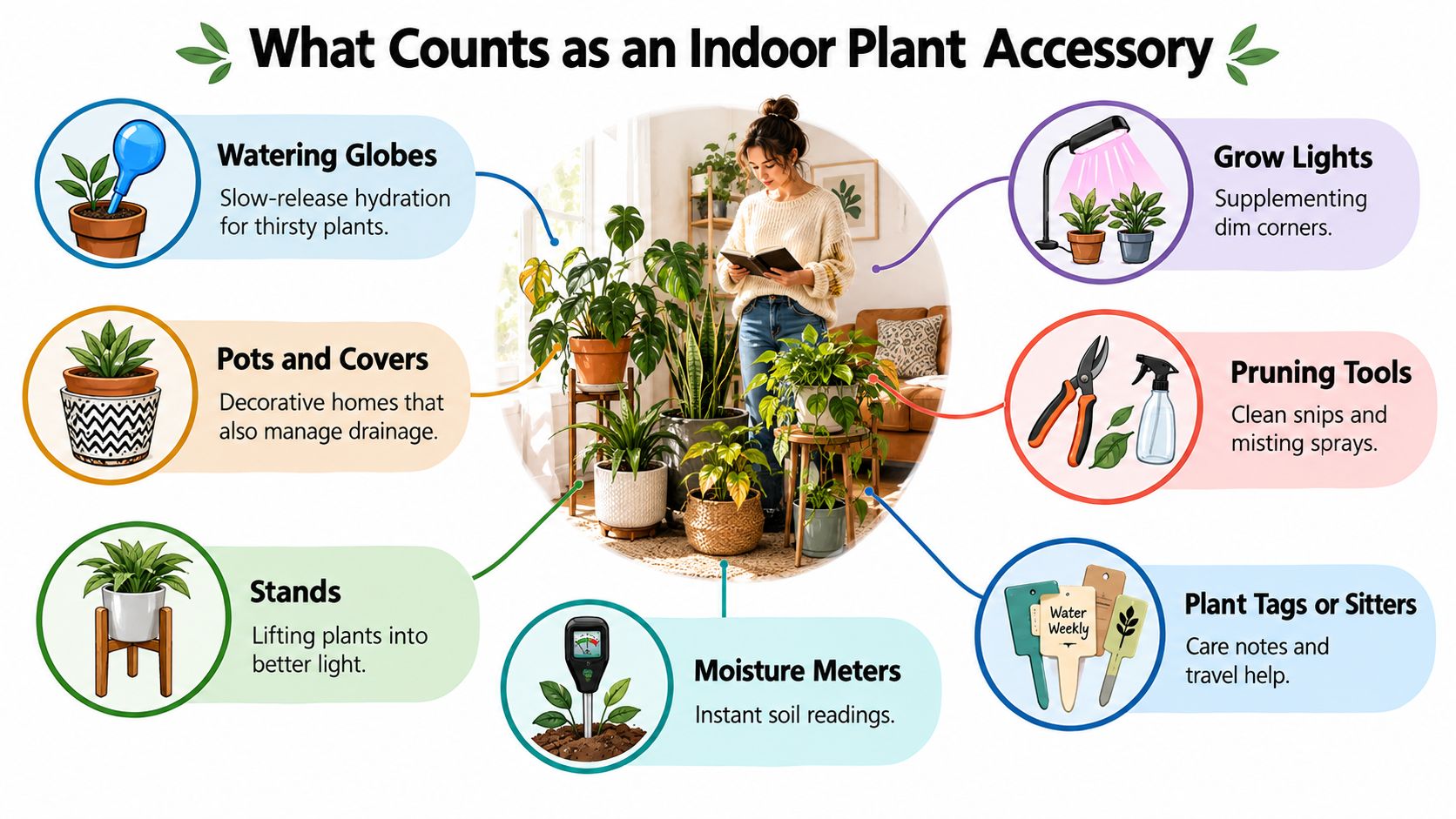
An indoor plant accessory earns its place when it changes how water, light, air, or physical support reaches a plant. The usual categories include watering globes, pots and covers, stands, saucers, grow lighting, humidifiers, soil amendments, and hand tools. Some accessories solve a care problem directly. Others only change how a plant looks.
Watering deserves the first place in that conversation. Inconsistent moisture can leave leaves yellow, edges crisp, or roots sitting in conditions that stay wet for too long. A decorative cover may make a pot more attractive, but it won't correct a plant that repeatedly dries out or receives too much water at once.
Function comes before finish
A useful accessory should make watering more predictable, reduce mess, improve access to the plant, or help the owner notice a problem sooner. That doesn't make appearance irrelevant. A well-designed object can do its job while fitting naturally into a living room, office, shelf, or balcony.
Pots with drainage help excess water leave the root zone. Saucers protect floors and furniture. Stands improve the way plants use available space and keep containers away from some surfaces. Grow lights and humidifiers address environmental conditions, but they don't solve a missed watering schedule.
For a reader whose main worry is how much water a plant needs and how often it needs it, a watering globe is the anchor accessory. A practical overview of related tools appears in plant care accessories for everyday houseplant routines, but the buying decision should still begin with the plant's moisture preference and the owner's routine.
How Self-Watering Globes Actually Work
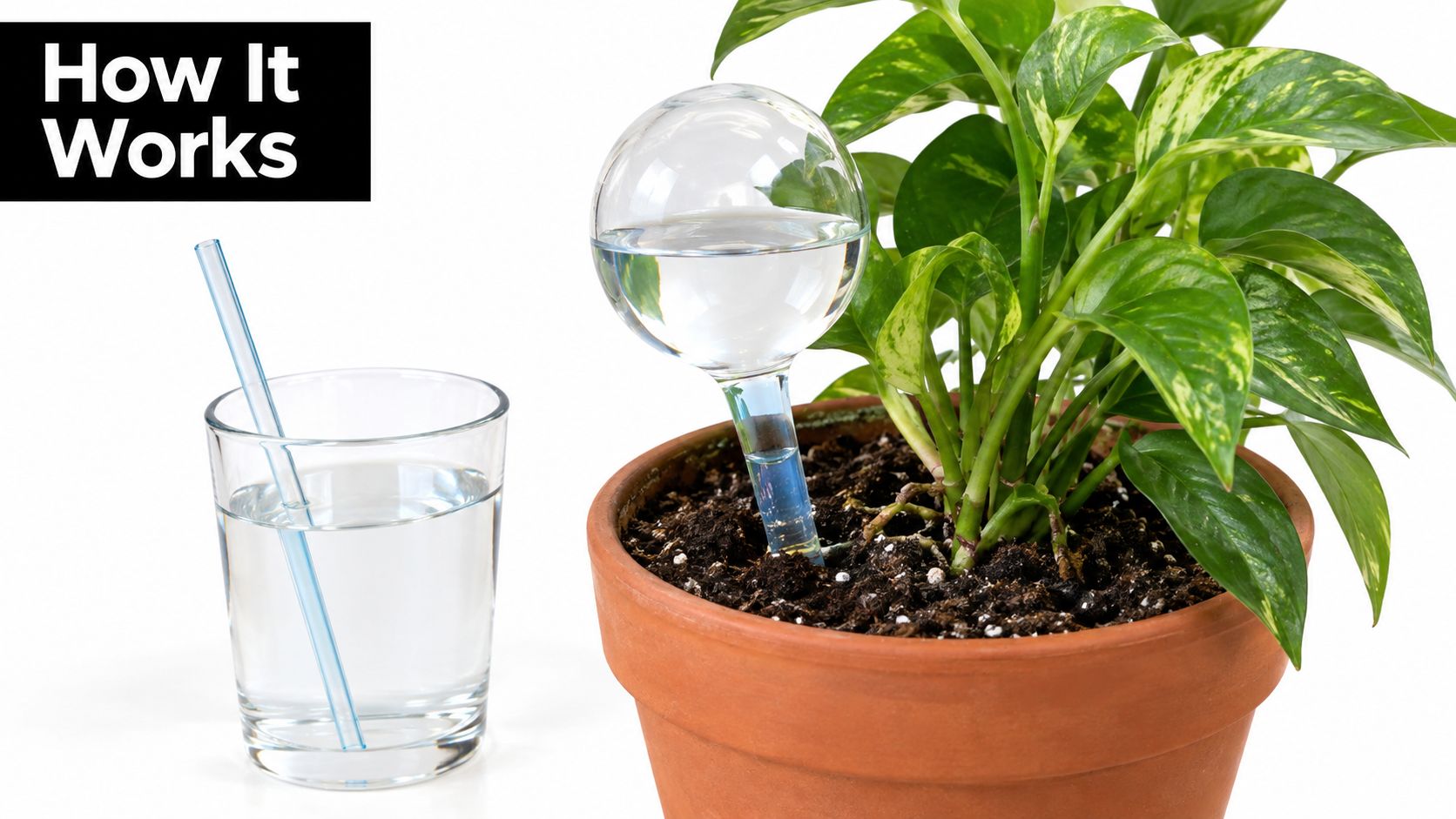
A self-watering globe is a water-filled glass bulb with a narrow stem that sits in the potting mix. Its action is passive. As the surrounding root zone dries, the soil draws moisture from the globe through the stem. As the soil becomes wetter, that pull weakens, so the release slows.
The process is easier to understand with a straw. A straw moves liquid because a pressure difference pulls water upward. In a globe, the drier soil creates a similar demand through the narrow delivery path. Once the soil has more moisture, the difference between the water source and the root zone becomes smaller.
Why the soil controls the flow
The globe doesn't decide how thirsty the plant is. The potting mix structure, initial saturation, stem position, root mass, temperature, airflow, and plant demand all influence how quickly water moves. Fine pores help sustain upward movement, while coarse, fast-draining material may deliver water differently. Dense, slow-drying material can also cause a globe to release moisture too slowly or keep the root zone wet for too long.
Technical guidance on capillary action in soil helps explain why the same accessory can behave differently in two nearby pots. A globe placed into a small, thirsty plant may empty sooner than one placed into a larger pot with lower water demand.
A full fill can last up to about two weeks, but that isn't a fixed promise. A source reviewing watering globes describes release over roughly one week, while guidance on passive wick and reservoir systems places many matched setups around 7 to 14 days. Both observations point to the same practical conclusion: globes extend the watering interval, but they don't eliminate plant checks.
Practical rule: A globe should stabilize moisture between normal waterings, not turn an unknown watering routine into a completely hands-off one.
The Seven Categories Worth Knowing
The most useful way to judge indoor plant accessories is to ask what happens to the plant if the accessory is removed. If nothing changes except the appearance of the room, the item is decorative. If the root zone, moisture consistency, water mess, or access changes, it may earn its space.
| Category | Problem Solved | Effort | Verdict |
|---|---|---|---|
| Watering globes | Irregular watering and short absences | Low after setup, with occasional checks | Worth considering for consistently thirsty plants |
| Pots and covers | Poor drainage or unattractive nursery containers | Moderate selection and monitoring | Pots with drainage are useful; covers should not trap runoff |
| Stands | Crowded floors, awkward access, and limited display space | Low, but they need stable positioning | Useful when they improve access or protect surfaces |
| Saucers | Water escaping onto floors and furniture | Very low | Practical for almost every indoor container |
| Grow lighting | Dim spaces where plants struggle to receive enough light | Moderate, including placement and routine | Useful when natural light is insufficient |
| Humidifiers | Dry indoor air around moisture-sensitive plants | Moderate, because cleaning and monitoring are required | Helpful only when the owner can maintain them |
| Soil amendments and hand tools | Poor drainage, difficult handling, or uncertain care | Moderate to high, depending on the task | Buy when a specific watering or maintenance problem exists |
The watering category
Watering globes address the most familiar failure pattern. A plant owner remembers a pot only after leaves droop, then adds a large amount of water and repeats the cycle later. A passive globe can provide a slower supply while the soil dries, which is especially useful for apartment owners, office plants, hanging baskets, and people who travel.
The category isn't suitable for every plant. It should be treated cautiously with plants that need the soil to dry, and it isn't appropriate for succulents or cacti.
The supporting categories
A pot with drainage can prevent excess water from remaining around roots, while a cover can hide a plain nursery container. The cover becomes a problem when it catches runoff and leaves the inner pot sitting in water. Saucers are simple but valuable because they make thorough watering less disruptive.
Stands, lighting, and humidity tools can improve the growing environment, yet they don't correct a missed watering schedule. Soil amendments and hand tools can make watering easier to manage, but they require the owner to understand what the plant and container are already doing.
The functional winner depends on the failure being solved. For uneven hydration, a globe has a more direct role than a stand or decorative cover.
Watering Globes Against Every Other Watering Option
No single watering aid fits every container. A globe suits a plant owner who wants passive moisture delivery without installing a larger system, while a different approach may suit a collection with unusual water demand or a container designed to hold a reservoir.
| Option | Water Volume | Refill Frequency | Typical Cost | Setup Difficulty | Best Plant Types | Main Limitation |
|---|---|---|---|---|---|---|
| Watering globe | Limited by bulb capacity, with Little Green Leaf sizes of 100 ml, 200 ml, and 350 ml | Refill when empty, sometimes up to about two weeks depending on conditions | Per-plant purchase | Low, but the stem needs correct insertion | Medium pots and consistently thirsty houseplants | Not suitable for plants that need to dry, or very large pots with one small globe |
| Spike | Limited by its attached reservoir | Often frequent for thirsty plants | Per-plant purchase | Low to moderate | Small containers with moderate demand | Delivery can be uneven and the opening can clog |
| Drip system | Can serve several plants from a larger reservoir | Depends on reservoir size and demand | Higher initial setup | Moderate to high | Larger collections with repeat watering needs | More equipment and adjustment than a windowsill usually needs |
| Self-watering pot | Built-in reservoir matched to the container | Refill when the reservoir is low | Higher per-plant purchase | Moderate, because the pot must be selected correctly | Plants that prefer more even moisture | The container is less flexible and still needs monitoring |
| Hand watering | Based on the amount poured at each session | Set by the owner and plant demand | Lowest equipment cost | Low | Plants with changing or dry-between-watering needs | Easy to forget or apply unevenly |
A globe is a sensible middle ground for a forgetful owner with a medium-sized tropical plant. It offers more autonomy than a simple watering session without the installation burden of a collection-wide system. For a large group of plants with closely managed watering needs, choosing an irrigation system requires a different set of trade-offs.
The wrong tool is a globe placed in a very large pot, used on a plant that needs dry intervals, or expected to manage a high-demand container without any follow-up checks.
Setting Up a Watering Globe the Right Way
A globe works more reliably when the initial setup starts with evenly moist soil. The common mistake is inserting it into bone-dry, compacted mix and then assuming the bulb has failed when the water rushes out or barely moves.
Five steps for a plant before a short trip
- Water the plant first. Thoroughly water it the day before, allowing the mix to become evenly moist rather than saturated and dripping.
- Inspect and fill the globe. Fill the Little Green Leaf glass globe with room-temperature water. Check the bulb and stem for cracks or chips before placing it near the plant.
- Make a pilot hole. Use a narrow implement to open a path in dense soil. Forcing the stem directly into compacted mix can clog the opening or damage roots.
- Insert the stem at an angle. Place it near the root zone, not directly against the plant stem. An angled position gives the globe better stability and reduces the chance of tipping.
- Check the release after two days. A slow bubble pattern and gradual water movement are reassuring signs. If the reservoir drains in hours, remove it and reassess the soil, angle, and plant demand.
An optional anti-clog sleeve can help keep material out of the stem. Glass also breaks if dropped, so the globe should be handled carefully and positioned where pets, children, and loose cords won't knock it over.
For a globe suited to a small, medium, or larger pot, visit the Little Green Leaf watering globe product page.
Matching Accessories to Your Space and Routine
The right accessory mix changes with the owner's schedule. A frequent traveler has a different problem from an apartment renter with limited space, while a gift buyer needs something approachable rather than a complicated care system.
The frequent traveler
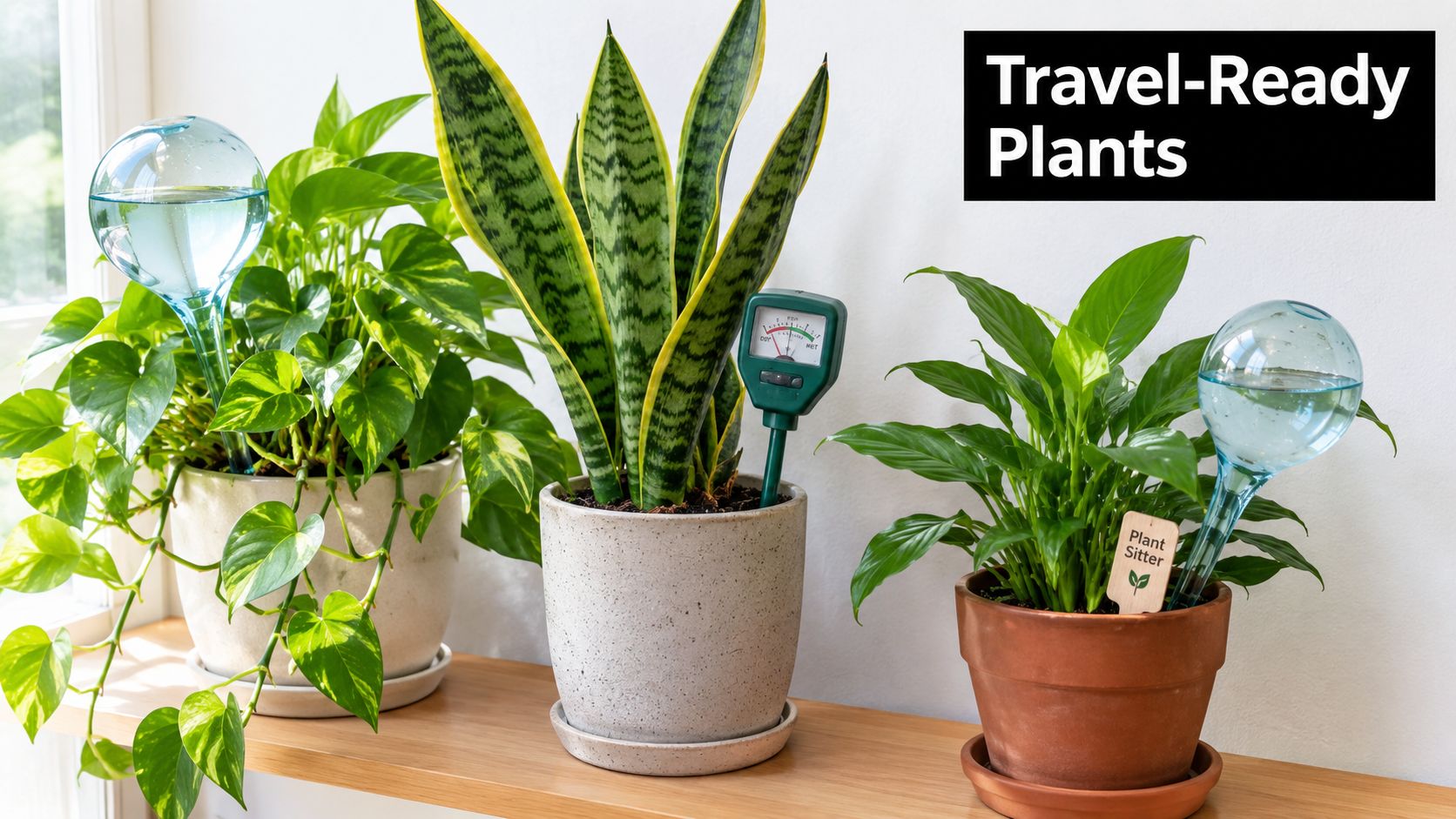
A traveler benefits from two larger-capacity globes, a simple way to check soil moisture, and a plant-sitter tag with basic care notes. The globes support moisture during a short absence, but the owner should still water appropriately before leaving and test the setup ahead of the trip.
A single small globe shouldn't be expected to serve a large pot. Capacity needs to match the container and the plant's demand, and a warm room or strong airflow can shorten the interval before a refill.
The apartment renter
A renter with a small window may value a slim stand, supplemental grow lighting, and a saucer before adding decorative pieces. If the plants regularly dry out between care days, a globe can become the most useful part of the arrangement because it addresses the watering gap directly.
Compact spaces also magnify mistakes. A cover that hides runoff, an unstable stand, or a globe inserted into compacted soil can create more work than it removes.
The gift buyer
A plant-curious friend may appreciate a decorative globe paired with a basic hand tool and a short care card. The useful gift explains what the item does, which plants should receive it, and why the soil should be checked rather than left unattended.
The repeated essentials are simple: a container that drains, a way to prevent water mess, and a watering method that matches the plant. Those items carry over because every room and routine still has to deal with moisture reaching the root zone at the right pace.
Accessories That Look Helpful but Cause Problems
More equipment doesn't automatically produce healthier plants. Some indoor plant accessories create a false sense of control, especially when they hide the issue of inconsistent watering.
A decorative outer pot without drainage can collect runoff beneath the inner container. The plant may look tidy while its roots remain in standing water. Moisture meters can also produce inconsistent readings when the probe meets different parts of a mixed growing medium, so a reading should support, not replace, observation of the plant and soil.
Humidifiers need maintenance and sensible use. In an enclosed room, excessive moisture around leaves and surfaces can create new problems. Decorative pebble trays often look purposeful but do little when they aren't holding an effective source of evaporation close to the plant.
When a globe should stay out of the pot
Watering globes aren't suitable for:
- Succulents and cacti, which generally need the root zone to dry rather than stay steadily moist.
- Plants that require dry intervals, because passive water delivery can keep the medium wetter than intended.
- African violets with fuzzy leaves, where careless water placement can damage the foliage.
- Dormant plants in winter, when water demand may drop and the same refill can remain available for too long.
- Very large pots with one small globe, because the bulb may not provide enough water for the whole root zone.
A useful test: If an accessory needs daily babysitting, it may be the wrong tool for an average plant owner.
A globe that empties unusually fast, fails to release water, or tips over needs troubleshooting rather than immediate replacement. Checking the pilot hole, stem position, soil moisture, and bulb condition usually reveals whether the accessory matches the container.
Restraint is a feature. The healthiest setup is often the one that solves the watering problem without adding another routine that the owner can't maintain.
Quick Answers and a Simple Starter Bundle
You leave for a short trip, return to a wilted plant, and wonder whether a watering globe would have prevented the problem. It might have, provided the plant, pot, soil, and globe were a suitable match.
How long does a watering globe last?
A watering globe can last up to about two weeks per fill. Many common setups release water over roughly one week, while passive reservoir systems often provide water for 7 to 14 days. A medium plant in moderate conditions may fall at either end of that range.
Heat, airflow, plant thirst, pot size, soil structure, and globe capacity all affect the result. A 100 ml, 200 ml, or 350 ml bulb holds a different reserve, and a thirsty plant may empty any of them sooner.
Treat the duration as a planning guide, not a promise. Check the soil and the globe rather than relying on the calendar alone.
Are glass watering globes safe for pets?
Glass globes can work in homes with pets when they are positioned securely and kept out of reach. They can break if a curious animal knocks one onto a hard floor, so placement and careful handling matter more than appearance.
A stable position also helps the globe deliver water as intended. If a pot sits where a pet can reach it, choose a safer location before filling the bulb.
Can you use a globe on any plant?
No. A globe suits plants that tolerate or prefer consistently available moisture, including many thirsty tropical houseplants. Succulents, cacti, plants that need the soil to dry, and dormant plants with slower water use need a different approach.
A watering aid cannot change a plant's moisture requirements. Match the accessory to the plant first, then consider the pot and your routine.
Do watering globes really work?
They work when the globe, plant, container, and growing medium are compatible. As the surrounding soil becomes wetter, the passive system can slow delivery. That helps reduce the sharp change between very dry soil and one heavy watering.
A globe acts as a buffer, not a replacement for checking the soil. It cannot fix poor drainage, a clogged stem, an unsuitable plant choice, or a container that is far too large.
A starter bundle for practical care
Build the bundle around the problem you need to solve. The globe supports steadier moisture, while the other items address drainage, moisture judgment, or insufficient light.
| Item | Why It Is in the Bundle |
|---|---|
| One Little Green Leaf watering globe | Provides gradual moisture between regular checks |
| Well-draining terracotta pot | Gives excess water a way to leave the root zone |
| Basic moisture meter | Adds another reference when soil moisture is difficult to judge |
| Small grow light | Supports plants in a dim indoor position |
The watering globe is the anchor purchase for an owner who forgets to water or applies it unevenly. The pot supports safer watering, the meter can build confidence when the soil is hard to read, and the light addresses a separate environmental need. None of these accessories replaces observing the plant.
Little Green Leaf offers hand-blown glass watering globes in 100 ml, 200 ml, and 350 ml sizes, with multicolor and clear rainbow designs, sold in packs of 1, 2, 4, and 6. For a practical way to steady watering during busy weeks or short trips, visit Little Green Leaf and choose a globe that matches the plant's size and moisture needs.