

Plant Care Accessories That Keep Plants Thriving
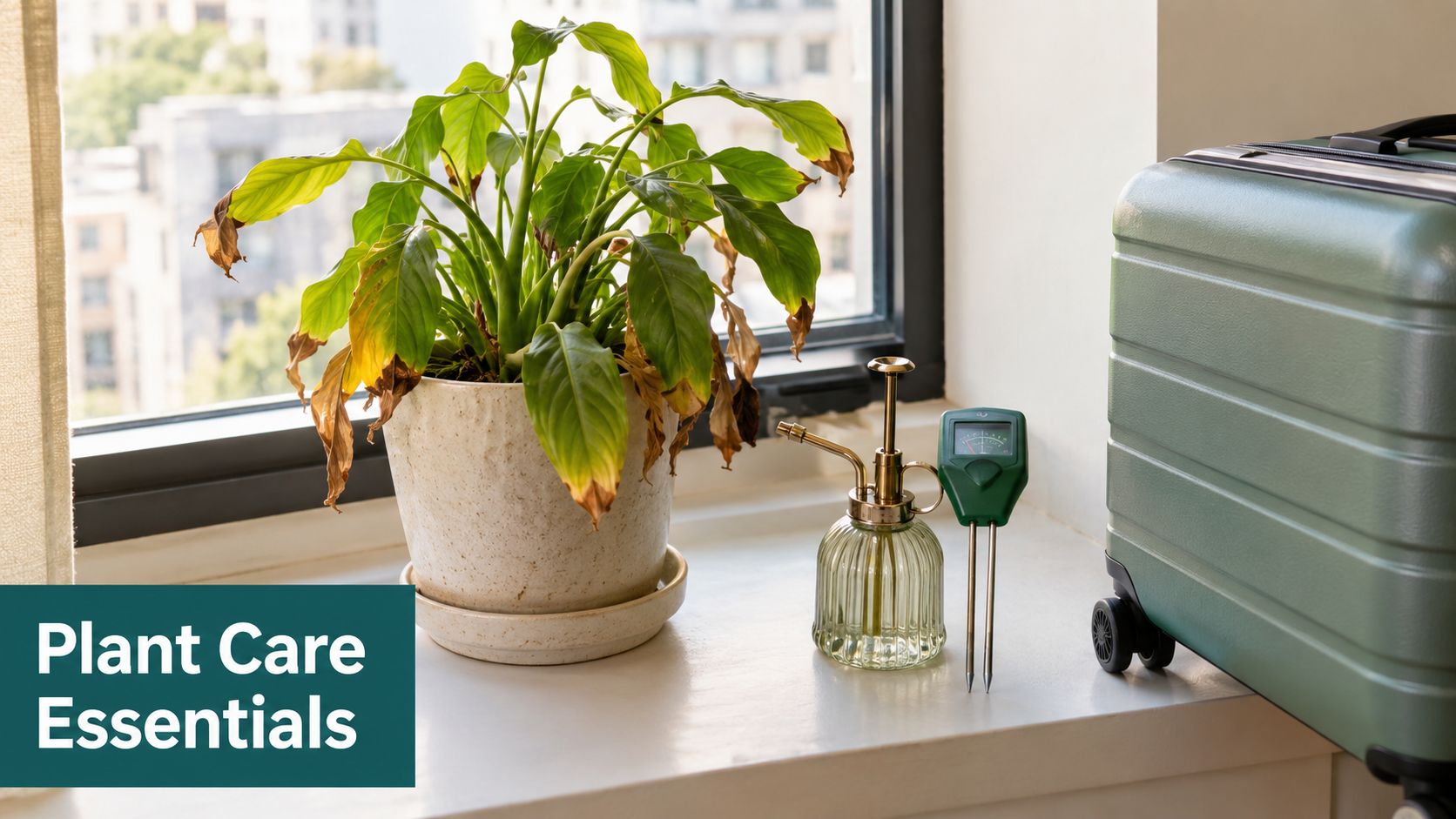
You're rushing out the door for a trip, and the plant by the window already looks a little tired. The soil feels dry, the apartment air is warm, and you're trying to decide whether one generous watering will help or create a new problem. Plant care can feel like another task to remember, especially when your schedule changes.
The right plant care accessories can make that routine steadier without filling your home with gadgets. A watering globe can slow delivery, a moisture meter can reduce guesswork, and a grow light can support a dim corner. These tools don't replace attention, but they can make the space between waterings more forgiving.
Introduction to Plant Care Accessories for Everyday Confidence
A busy plant owner rarely needs more complicated instructions. They need a simple way to notice what a plant needs, respond without overcorrecting, and keep that care going through workdays, travel, and changing seasons.
That's why accessories are most useful when you choose them for a specific care problem. If soil dries before you remember to water, look at a gradual watering aid. If you keep second-guessing whether the pot is dry below the surface, use a moisture meter alongside a finger check. If a plant sits far from a bright window, consider a light support rather than moving it from place to place.
Houseplants have become part of ordinary home life across several major markets. In France, indoor plants represented 35% of plant purchases among households, while flowering and green indoor plants together held 17% of total flower and plant market revenue in Germany in 2021. In Canada, Statistics Canada reported that 21% of people grew fruit, herbs, vegetables, or flowers indoors for personal use in 2021, and potted plant sales exceeded CAD 1.1 billion in 2022. These figures are reported in this overview of houseplant ownership and spending. The practical message is simple: plant care supports everyday routines, not only specialist hobbies.
Start with the habit, not the accessory
Before buying anything, ask what keeps going wrong. Do you forget watering, water too often, struggle with dim light, or find that dry indoor air affects delicate foliage? The answer points toward a smaller, more useful purchase.
A good accessory should make care easier to repeat. It shouldn't create another object that needs constant cleaning, charging, refilling, or adjustment. For many people, the quietest solution is the most helpful one because it reduces mistakes without demanding attention every day.
How Plant Care Accessories Support Healthy Growth
Plants don't need accessories for their own sake. They need suitable moisture, light, air, and room for roots to function. Accessories help you deliver those conditions with fewer sharp swings.
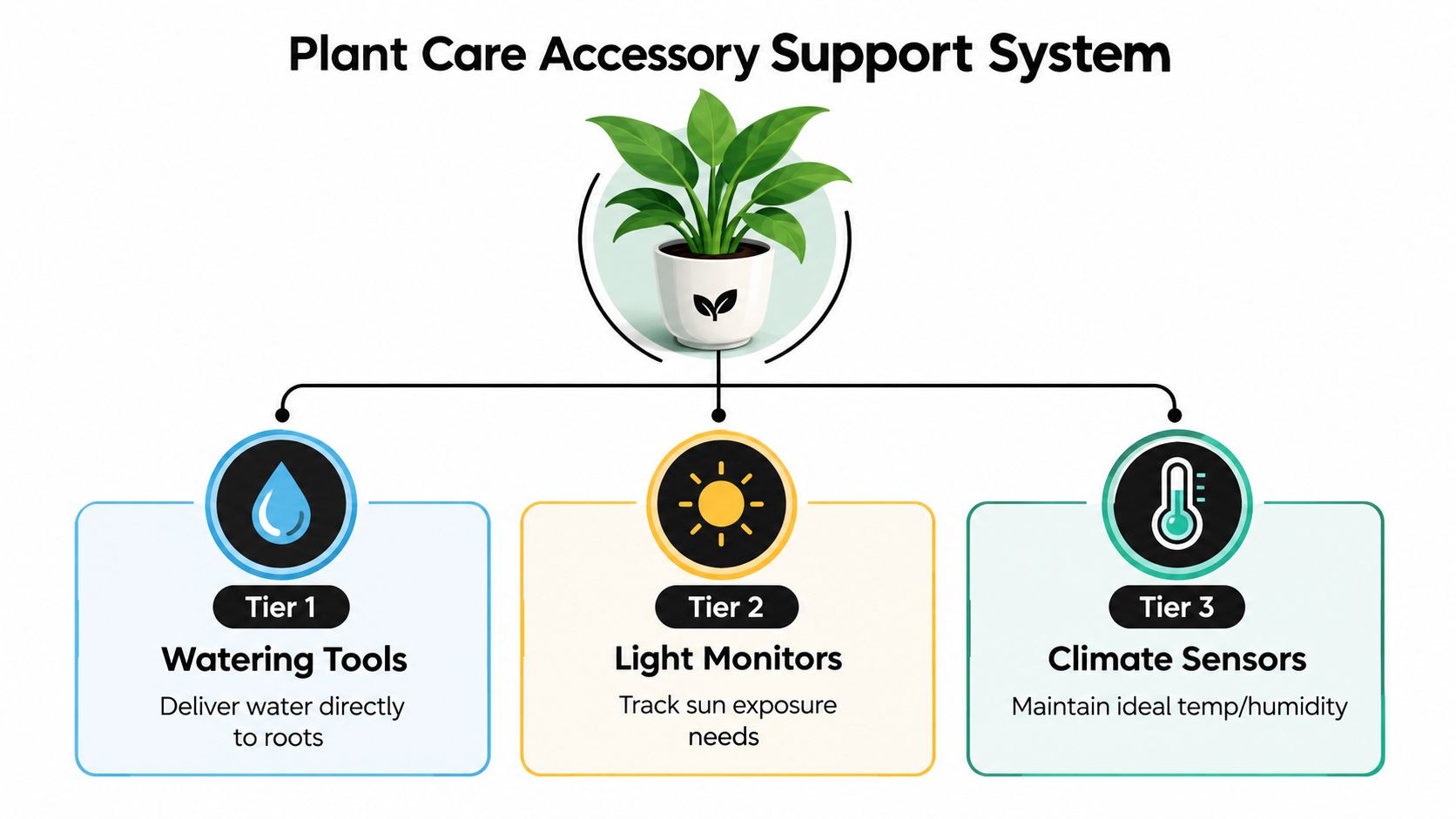
Think of the tools as a small support system. A watering aid is like carrying a water bottle when you know you'll be away. A grow light works more like sunscreen in reverse, supplying the light a plant can't reach indoors. A humidifier or pebble tray can soften a dry room without turning the entire space into a greenhouse.
Stability matters more than intensity
Roots respond poorly to repeated extremes. A pot that becomes bone dry and then receives a flood may experience a very different pattern from a pot that receives moderate moisture more evenly. Independent irrigation research found that sprinkler irrigation created a fast moisture spike followed by a sharp decline from percolation losses, while layered subsurface drip maintained more even moisture and higher residual water at a depth of 12 cm. The irrigation research on root-zone moisture behavior helps explain why delivery near the root zone can be more useful than wetting the soil surface.
Moisture-sensing systems follow the same principle. Studies described systems that began watering around 25% to 30% soil moisture and stopped after moisture rose above about 50%, keeping the soil within a moderate range rather than allowing severe drying followed by saturation. The research on automatic watering based on soil moisture indicators provides that threshold context.
The best accessory quietly prevents a mistake you already know you make.
A moisture meter won't tell you every detail about a plant, and a self-watering pot won't make unsuitable soil suitable. Use each tool as a gentle prompt. Check the plant, observe the leaves and soil, then let the accessory support a repeatable response.
For a practical introduction to interpreting readings, see this guide to understanding moisture meter readings. The aim isn't perfect measurement. It's greater confidence before you water.
Essential Types of Plant Care Accessories and What They Solve
Start with the failure mode, then choose the tool. A decorative object that doesn't address your plant's actual problem may look lovely while adding little value.
| Plant Care Problem | Accessory Type | Best For |
|---|---|---|
| Soil dries between regular waterings | Self-watering globes or watering spikes | Busy owners, travel preparation, thirsty plants |
| Water needs to move gradually through the pot | Sub-irrigated pots | Plants suited to a controlled reservoir system |
| Dry air affects humidity-sensitive foliage | Pebble trays, humidifiers, or cloches | Tropical plants and small display areas |
| A room lacks useful natural light | Grow lights or reflective stands | Apartment corners and interior shelves |
| You can't judge moisture below the surface | Moisture meter and soil aerator | Beginners, dense soil, and larger pots |
| Leaves or stems need regular attention | Pruning shears and cleaning tools | Routine shaping, removal of damaged growth, and hygiene |
| Small pests appear on leaves or stems | Sticky traps and gentle treatment tools | Early observation and contained indoor care |
Watering tools
Self-watering globes release water gradually as surrounding soil dries. They're useful when you want a visible reminder and a buffer between waterings, but they can empty too quickly if inserted into very dry soil. Pre-moistening the soil and making a small tunnel for the globe's neck can help prevent clogging, as described in this guide to using self-watering bulbs.
Watering spikes attach to a reservoir and suit owners who prefer a replaceable bottle or refillable container. A narrow flow path can be useful in small pots, but it still needs observation because soil type and angle affect delivery.
Sub-irrigated pots hold water below the soil and draw moisture upward. They can support consistency, but they aren't appropriate for keeping every plant constantly wet. For a broader look at delivery methods, explore these water irrigation systems.
If you refill a container-based system, a compatible pump or spout can make pouring cleaner and more controlled. Fillaree's options for pump spouts for refillable soap offer an example of the kind of refill hardware that can help when a reusable bottle is part of your setup.
Humidity, light, and soil tools
Pebble trays and cloches can create a more localized humid pocket, while a humidifier affects a wider area. Grow lights support plants in low-light rooms, and reflective stands can help direct available light without adding another electrical device.
Soil tools solve a different problem. A moisture meter helps you check deeper soil, while an aerator can open compacted areas carefully. Pruning shears, leaf-cleaning cloths, and sticky traps support observation and maintenance rather than watering itself. Pick one tool for one recurring problem, then give yourself time to learn how it behaves.
How to Choose the Right Accessories for Your Plants and Routine
The right choice starts with your routine, not the product shelf. A person who works from home and checks plants daily needs a different setup from someone who travels often or manages greenery in a shared office.
First, measure the practical details
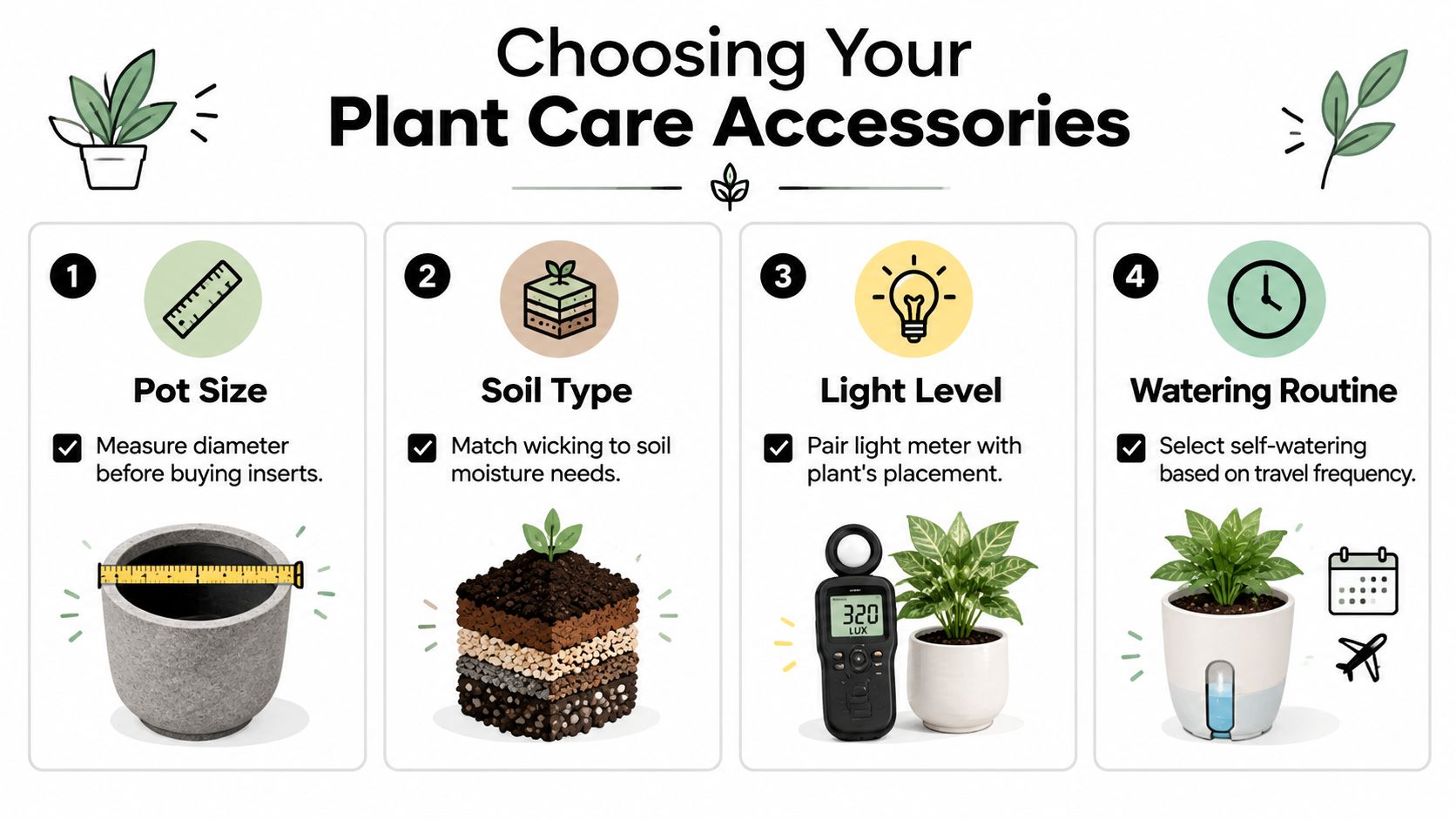
Begin with the pot. Note its diameter, depth, drainage, and whether the soil is airy or dense. A large globe may overwhelm a small pot, while a tiny reservoir may offer little help in a fast-drying planter.
Then consider the plant's drinking pattern. Succulents and cacti generally prefer a dry period, while many tropical foliage plants appreciate more even moisture. Humidity-sensitive plants may need a cloche or localized humidity support, but that doesn't mean their roots should stay soaked.
Use a simple decision filter
- Check your schedule: If you're home often, a moisture meter may be enough. If you leave regularly, consider gradual delivery.
- Check the pot size: Match the reservoir or globe to the amount of soil, and avoid placing a large water source in a very small container.
- Check the light: A light meter or grow light can help in a dim apartment, but the tool should support the plant's placement rather than compensate for a completely unsuitable location.
- Check the soil: Dense soil may hold water longer, while airy mixes can dry faster. Flow control matters more when moisture moves quickly.
- Check the refill burden: A tool only reduces effort if its maintenance fits your life. A system that needs frequent adjustment may not help a busy owner.
Small and high-risk plants need a lighter touch
Small pots can dry quickly, but they can also become saturated quickly. Use a narrow-flow accessory, test it while you're home, and observe the soil before leaving it unattended. For a humidity-loving plant in a small setup, pair gentle humidity support with careful root-zone checks instead of adding water from several directions.
Choose the accessory that removes the most uncertainty with the fewest new tasks.
Everyday Use Cases for Busy Owners Travelers and Small Spaces
A traveler preparing for time away doesn't need to create a miniature irrigation system. The first step is ordinary plant care: check the soil the night before or the morning of departure, and water only if the top inch is dry. This travel guidance comes from the Washington Post's houseplant watering advice, which also notes that drought-tolerant plants such as snake plants, ZZ plants, and cacti may go several weeks without water.
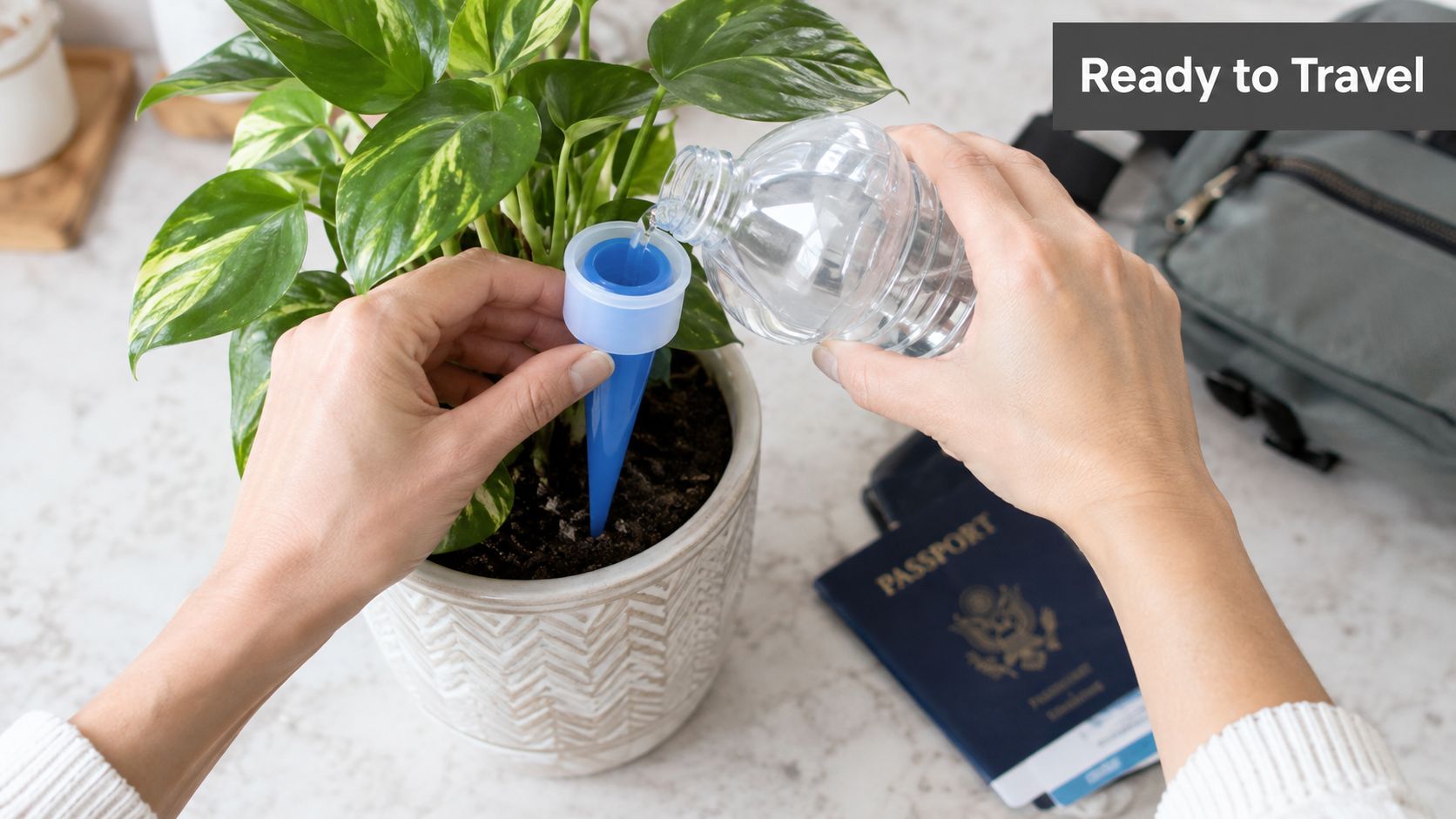
For a plant that needs more regular moisture, a globe or watering spike can add a buffer. A routine guide reports that watering globes commonly work for about 2 to 5 days for many plants, depending on plant size, environment, and flow rate, while other care guidance describes suitable setups lasting roughly 1 to 2 weeks. Those ranges appear in this watering globe guidance, and they show why testing at home matters before travel.
A dim apartment corner
An apartment dweller may face two separate issues. A plant can receive too little light near an interior wall, while heated or cooled air makes the surrounding space feel dry. A small grow light can support the light problem, and a pebble tray or humidifier can address the local air conditions.
Pairing tools works best when each has a separate job. Don't use extra watering to solve low light, and don't rely on misting alone to replace suitable placement. Check soil moisture before adding water, especially for small pots that have little room for error.
Here's a short visual demonstration of a watering spike in use:
A shared office plant shelf
An office manager needs a routine that survives weekends, meetings, and changing attention. Choose sturdy pots with clear drainage, group plants with similar light needs, and keep one moisture meter nearby for a quick check. A simple watering log can help several people avoid watering the same plant twice.
The vacation plant watering guide can also help organize preparation before an absence. In shared spaces, the most valuable accessory is often the one that makes the plant's status easy to read.
Pairing Maintenance and Styling Tips for Long Lasting Results
Even a thoughtful accessory can cause trouble if you install it in dry, compacted soil or forget to check how quickly it delivers water. A few small habits keep the system gentle.
Prepare before inserting
Water the soil normally first if it has become very dry. Then make a small pilot hole with a chopstick or similar tool before inserting a globe. Pressing a narrow glass tip directly into hard soil can damage the tip or create an uneven path for water.
Fill the accessory, insert it at a stable angle, and watch the first few hours while you're still home. If the reservoir empties unusually fast, reposition it, inspect the opening, or reduce the flow with an appropriate adapter if the design allows one.
Keep roots breathing
A reservoir isn't a command to keep the root ball wet all the time. Guidance for sub-irrigated planters explains that many plants need roots to dry for a couple of days between waterings, and that roots sitting in water indefinitely can deteriorate. It also notes that soil that dries too much may stop transferring water from the reservoir until you rehydrate it from above. These points are covered in this explanation of how sub-irrigated pots work.
A watering accessory should soften dry periods, not erase the plant's need for air around its roots.
Clean glass, openings, and tips regularly. Mineral residue and bits of soil can slow flow or create a clog. Check the soil before every refill, and adjust for seasonal changes rather than assuming the same setting will work forever.
Make function look intentional
Match the scale of the accessory to the pot. A subtle globe can sit beside foliage as part of the display, while a larger planter may need a more substantial reservoir. Tip covers and adapters can help with different soil textures and make insertion easier.
Styling becomes simpler when every visible item has a job. Pair a decorative globe with a moisture meter stored nearby, or place a pebble tray beneath a humidity-sensitive plant while keeping the surrounding surface easy to wipe. Beauty doesn't need to compete with care.
Simple Next Steps for Confident Care and Thoughtful Gifting
Plant care accessories work best when they reduce guesswork. A moisture meter can help you pause before watering, a grow light can support a dim placement, and a gradual watering tool can make a busy schedule less disruptive. None needs to turn plant care into a technical project.
Start with one plant. Identify the habit that causes the most stress, then choose one accessory that addresses that habit. Watch how the soil, leaves, and refill pattern respond before adding anything else.
Decorative self-watering globes can also make thoughtful gifts because they combine a useful routine with a visible accent. They suit a new plant owner, a frequent traveler, or someone settling into a new home, especially when you choose a size that matches the recipient's pot and watering needs.
You don't have to create a perfect system. You only need a calmer one that helps you care consistently.
Little Green Leaf offers decorative self-watering globes designed to release water gradually as soil dries, along with plant-care accessories for everyday routines and thoughtful gifting. Visit Little Green Leaf to find a simple helper for one plant, one pot, or your next plant gift.