

Hanging Plant Waterer for Baskets That Need Water Daily
A basket that looked comfortable at breakfast can droop by the time its owner gets home, since a warm hanging basket can dry fast enough to wilt a plant between morning and evening.
One fill of a hanging plant waterer lasts up to about two weeks, usually much less in a hot, exposed basket. A globe works as a reserve in the soil, releasing water as the mix dries and buying time between soakings, though the basket still needs checking.
The useful question is whether the stored water reaches the roots slowly enough, and lasts long enough, for that basket. A short trial settles it better than a promised number of days: fill the globe and watch how fast the basket empties it.
Table of Contents
- How Long One Fill Lasts in a Hanging Basket
- How a Hanging Plant Waterer Releases Water
- What Makes a Basket Empty Faster
- Globes, Spikes, Drip Kits, and Self-Watering Pots Compared
- Plants and Baskets That Should Skip a Globe
- How to Set Up a Little Green Leaf Globe in a Hanging Basket
- Watering Hanging Plants While You Are Away
- Hanging Plant Waterer Questions Answered
How Long One Fill Lasts in a Hanging Basket
The number on the package is a ceiling, and a hanging basket rarely cooperates with ceilings. A filled hanging plant waterer, usually a glass globe seated in the mix, can hold out for up to about two weeks under favorable conditions, but plant type, climate, pot size, and the angle of the stem all pull that figure downward. Even the insertion angle changes the schedule: a stem near 90 degrees releases water more slowly, while 45 degrees lets it flow more freely, so the same bulb can empty at different speeds in identical pots.
Globe size and how long one fill lasts by basket
| Basket | Usual watering without a globe | Globe size | One fill lasts about |
|---|---|---|---|
| Smaller hanger than a 10-inch container | More frequent checks than a larger basket, especially in heat | 100 ml | Days of cover rather than weeks; a short trial shows the real interval |
| About a 10-inch hanging container | Every one to two days; potentially more often in hot weather | 200 ml | A bridge between thorough waterings, checked on that one-to-two-day rhythm |
| Larger basket or heavy plant load in direct sun | Often daily during hot weather | 350 ml | More stored water, still quick to drain in heat; let a trial set the check interval |
| Cool indoor hanging pot with a modest plant | Water when its root zone reaches the plant's drying threshold | 200 ml or 350 ml | Up to about two weeks under suitable conditions |
These are starting matches, not tested capacity-to-pot guarantees. The only duration that counts for a given basket is the one a short trial produces: fill the globe, watch when it empties, and plan around that result.
The watering interval, rather than the advertised ceiling, is the figure a globe has to beat. Smaller pots dry even faster than a 10-inch basket, and a hot, exposed porch shortens every interval in the table. A reservoir that carries an indoor hanger through an absence may offer only a modest buffer outdoors in summer. A globe that empties early is still doing its job; the basket uses water faster than the bulb holds.
Choosing capacity without false precision
A 100 ml globe is a reasonable starting point for a small indoor hanger with modest demand. A 200 ml globe offers more reserve for a typical basket, while 350 ml gives a warmer location or a heavier plant load more stored water.
The largest size is the most likely to approach the upper duration limit when conditions permit. Even so, a heavily planted basket in full sun can outpace any bulb, which is why the observed trial matters more than the size chart.
Practical rule: A globe should extend the interval between moisture checks, not persuade a plant owner to ignore a basket that already dries daily.
Before the globe goes in, the root ball needs even, appropriate moisture. Filling a reservoir beside an already parched basket asks a small supply to do the work of a full watering, and the first fill will drain quickly while the mix catches up.
How a Hanging Plant Waterer Releases Water
A glass globe works like a small canteen the roots sip from. The comparison is useful as long as it doesn't suggest that roots directly control a valve. Soil moisture and air movement govern the release.
Consider a hanging fern in a loose container mix. Its owner fills the bulb and seats the long stem in already-moist soil. As the mix dries, air can travel up the stem, displacing water from the bulb into the root zone; when moisture returns, airflow slows and water release eases.
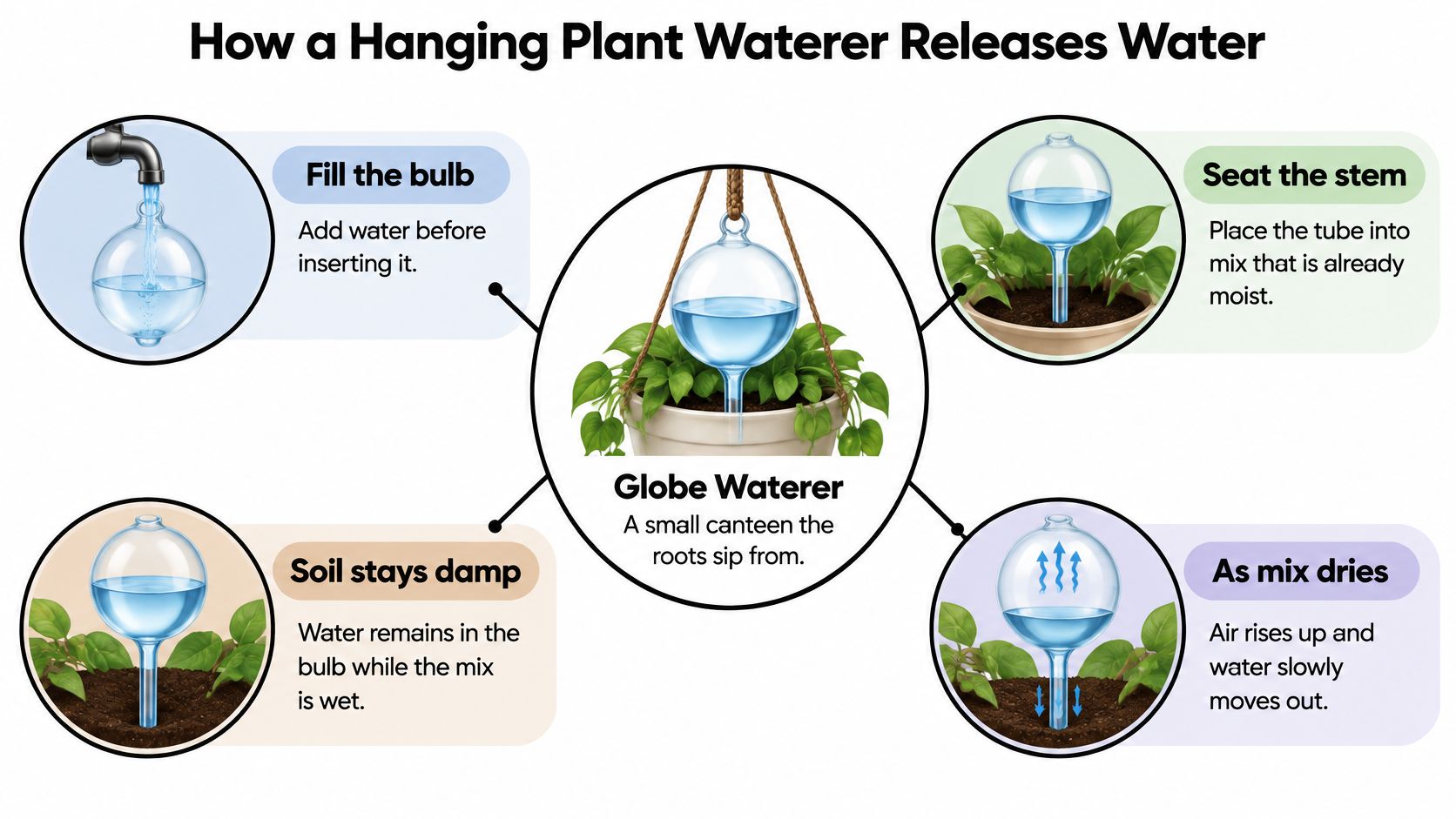
Slow delivery still needs absorbent soil
There isn't a timer, battery, or app deciding when to water. That simplicity makes setup important: the outlet must sit where the mix can absorb and distribute the water.
Utah State University Extension explains that irrigation applied faster than soil can absorb it causes runoff, and identifies plant-available water as the important variable. Its guidance describes keeping many plants just below field capacity, approximately 75–90% soil moisture. That isn't a universal houseplant target or a reason to keep every basket visibly wet.
For home use, moist but aerated is the more useful observation. A globe can't correct compacted soil, an obstructed outlet, or poor drainage.
What a useful release looks like
The bulb's water level should fall while moisture remains available beyond the immediate outlet. A damp streak directly beneath the stem doesn't establish that the whole root ball has been watered.
- Continuous drainage: Persistent dripping after the basket has finished draining suggests excessive delivery or unsuitable growing conditions.
- Dry surrounding mix: A damp outlet beside dry roots suggests poor distribution, insufficient capacity, or a blockage.
- No level change: A stationary water line calls for an outlet inspection before the globe is trusted.
A slight insertion angle can help release water, but a faster drip isn't automatically better. The correct setting is the one that maintains suitable moisture without leaving the basket saturated.
What Makes a Basket Empty Faster
Two identical globes, two neighboring baskets, two very different refill schedules. One globe sits inside a cool room with a modest plant and barely drops for days. The other hangs beside a sun-warmed wall in moving air and drains before the weekend.
University of Maryland Extension recommends daily container checks, especially in summer, because drying changes with container material, size, weather, sunlight, and wind. Small containers dry faster than larger ones, and porous unglazed terra-cotta and wood lose moisture through their sides more readily than plastic or metal. A hanging basket adds exposure on every side, so it gives up moisture faster than a pot of the same volume sitting on the ground.
Separate storage from demand
A small basket holds little stored moisture, so its condition can change within a single hot afternoon. A larger basket holds more mix, but a heavy plant load can consume that buffer just as fast. Pot size alone doesn't settle the choice.
Plant demand matters just as much. A lush fern or densely planted flowering basket in warm, dry air may work through its reserve faster than a small plant in a cool office. A larger globe adds storage, but the plant's demand stays the same.
University of Missouri Extension identifies light, temperature, relative humidity, plant age and size, and container characteristics as watering factors. It also notes that most potted-plant roots occupy the bottom two-thirds of the container, so a dry surface says little about conditions where the roots sit.
Watch the water line and the root zone
A short observation routine tells you more than any promised number of days on the packaging.
- Record the starting level: A photograph makes the water line easy to compare without marking decorative glass.
- Inspect the following day: A falling level confirms movement, but soil still needs checking away from the outlet.
- Compare again the day after: The pattern shows whether the globe supplies a useful buffer or empties too quickly for the absence you have in mind.
- Refill according to moisture: A low bulb isn't permission to add water if the basket remains excessively wet.
Treat whatever number this trial produces as yours, not a universal figure. A globe that empties by the following morning in midsummer is playing a supplemental role: it buys time between daily soaks, and it isn't evidence that the basket can be left unattended.
Once you know how fast your basket drains a globe, a guide on how often to water hanging plants gives you a starting interval for your checks, which your own water-line observations then tighten or loosen.
Globes, Spikes, Drip Kits, and Self-Watering Pots Compared
For a small collection of hanging baskets, a glass globe is a straightforward option because it needs no hose, timer, or replacement pot. For an entire porch that must stay watered through a long absence, a properly installed drip arrangement can be the more practical choice.
The distinction is stored water versus an ongoing supply. A globe works like a canteen: useful between refills, sized by what it carries, and finite. A connected system can keep delivering water, but brings installation, scheduling, and maintenance responsibilities.
Hanging basket waterers compared
| Method | How long it covers | Setup and refill | Clogging | Works while hanging | Cost pattern |
|---|---|---|---|---|---|
| Glass watering globe | Up to about two weeks; often much less in hot sun | Fill and insert; refill when appropriate | Soil can block the stem; a sleeve can help | Yes, without power or a hose | A globe for each basket, sized to demand |
| Terracotta spike plus bottle | Until the attached bottle empties | Seat the spike and support an inverted bottle; replace or refill it | Soil and mineral deposits can obstruct delivery | Possible, but bottle support can be awkward overhead | Spike and bottle for each plant |
| Automatic drip | While the water supply and controls function | Install tubing and emitters; check connections and scheduling | Emitters need inspection for blockages | Yes, including rows of porch baskets | Shared installation across multiple baskets |
| Self-watering pot | Until its reservoir needs replenishing | Move the plant into a compatible planter and top up its reservoir | Wick or outlet maintenance may be needed | Only if specifically designed and rated for hanging | Replacement planter for each plant |
These categories solve different problems. A bottle balanced above an overhead basket may be inconvenient to refill, while a floor-standing reservoir planter stays floor-standing even though it waters automatically.
When the simpler option stops being simpler
A globe suits an existing basket whose owner wants less frequent attention without installing equipment. It also makes individual testing easy: each basket can receive an appropriately sized reserve, then show over a few days whether it is bridging the gap between soakings or emptying too fast to matter.
For a long railing filled with baskets, repeatedly lifting and refilling bulbs may become more work than maintaining shared tubing. Drip wins when the job calls for sustained delivery across many containers, provided its flow and drainage are checked before departure.
A finite reservoir can't replace an unlimited supply, however gradually it empties.
A multi-week absence without anyone available to refill is a poor match for globes alone. A basket that cannot shed excess water is also a poor match, because changing the watering device leaves the underlying container problem untouched.
For a closer look at inserted watering aids, this guide to self-watering plant spikes explains how spikes relate to globes. The useful comparison is installation and refill effort, plus how each option behaves once the basket is hanging overhead.
Plants and Baskets That Should Skip a Globe
Succulents, cacti, and plants that require a pronounced drying period shouldn't receive continuous supplemental moisture from a globe. That includes a hanging string-of-pearls or cactus basket. Their watering needs don't change to moisture-loving because the container hangs.
A very large basket is another poor match for a single small reservoir. A wet patch near the stem can give false reassurance while much of the root ball remains dry.
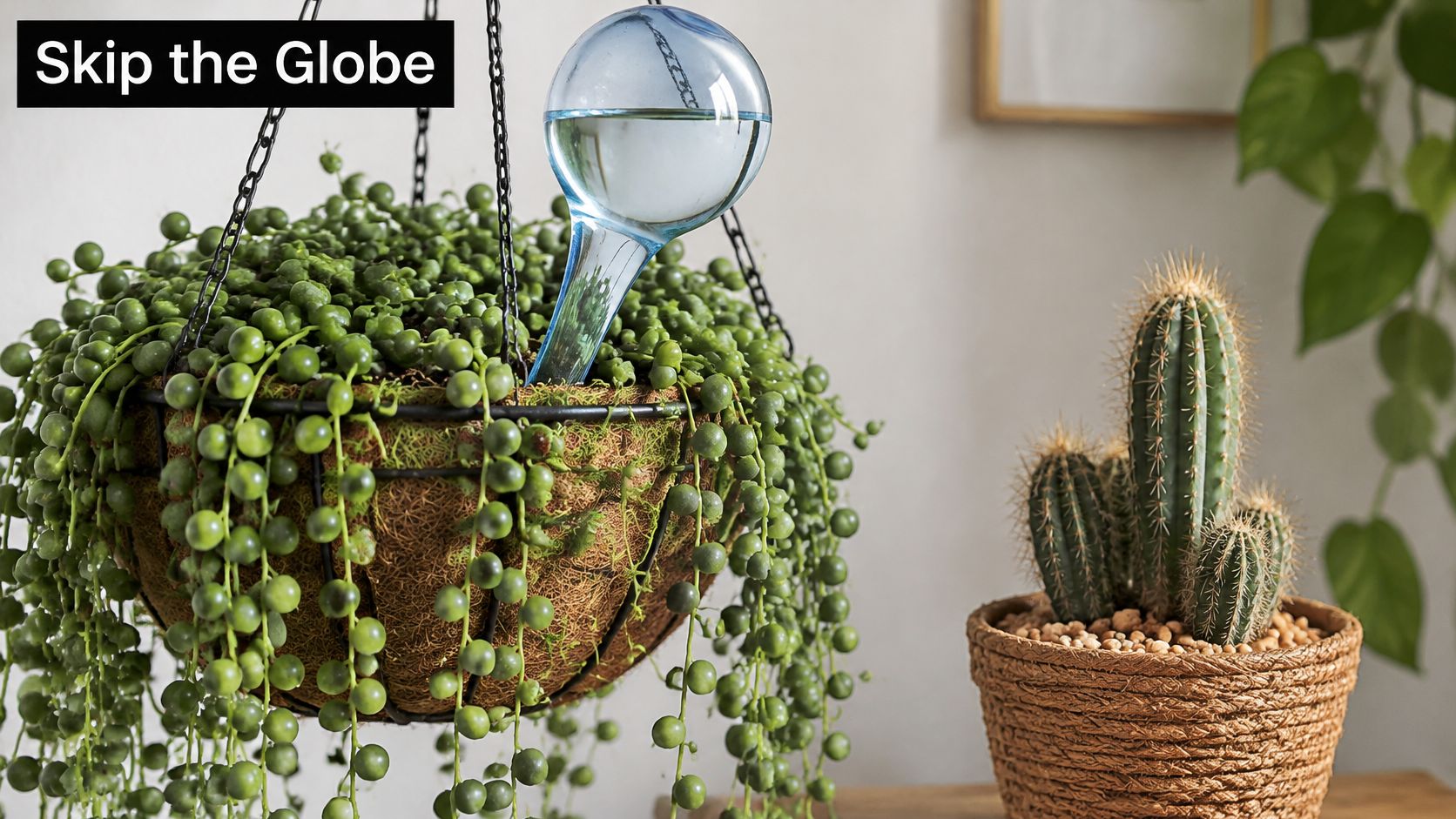
Drainage comes before convenience
University of Maryland Extension explains that air and water occupy spaces around roots, and that roots can suffocate when excess water cannot drain. A suitable basket therefore needs open drainage holes and a free-draining container mix, not dense garden soil.
A decorative outer container mustn't trap a puddle beneath the growing pot. A globe is intended to support usable moisture, not maintain standing water.
- Already-wet mix: Installation should wait until the plant needs supplemental moisture.
- Heavy rain: The globe should be removed if the outdoor basket remains saturated.
- Reduced demand: An extended dim, cool period calls for another moisture assessment rather than automatic refilling.
Wilting doesn't always mean thirst
University of Maryland's indoor watering guidance notes that overly dry plants may wilt and turn gray-green, while overly wet plants may yellow or drop leaves. A wilted plant with damp soil needs investigation, not another reservoir.
Moisture should be checked below the surface and away from the stem outlet. A narrow wet streak doesn't prove that water has spread evenly.
Glass also needs sensible handling. A dropped globe can break on a hard floor, so filling and insertion are safest with the basket lowered onto a stable, protected surface.
How to Set Up a Little Green Leaf Globe in a Hanging Basket
Setup is simple, but the basket should start in the right condition. A globe works best as a bridge between real soakings, so the pot still needs the basic watering habit that keeps the whole root ball healthy. Iowa State University Extension advises watering hanging baskets when the surface becomes dry and applying water until it flows from the bottom; hot, sunny baskets may need watering once a day.
The basic process is fill, insert, and let slow release support the plant. The steps below make that bridge steadier in a container that can dry from every side.
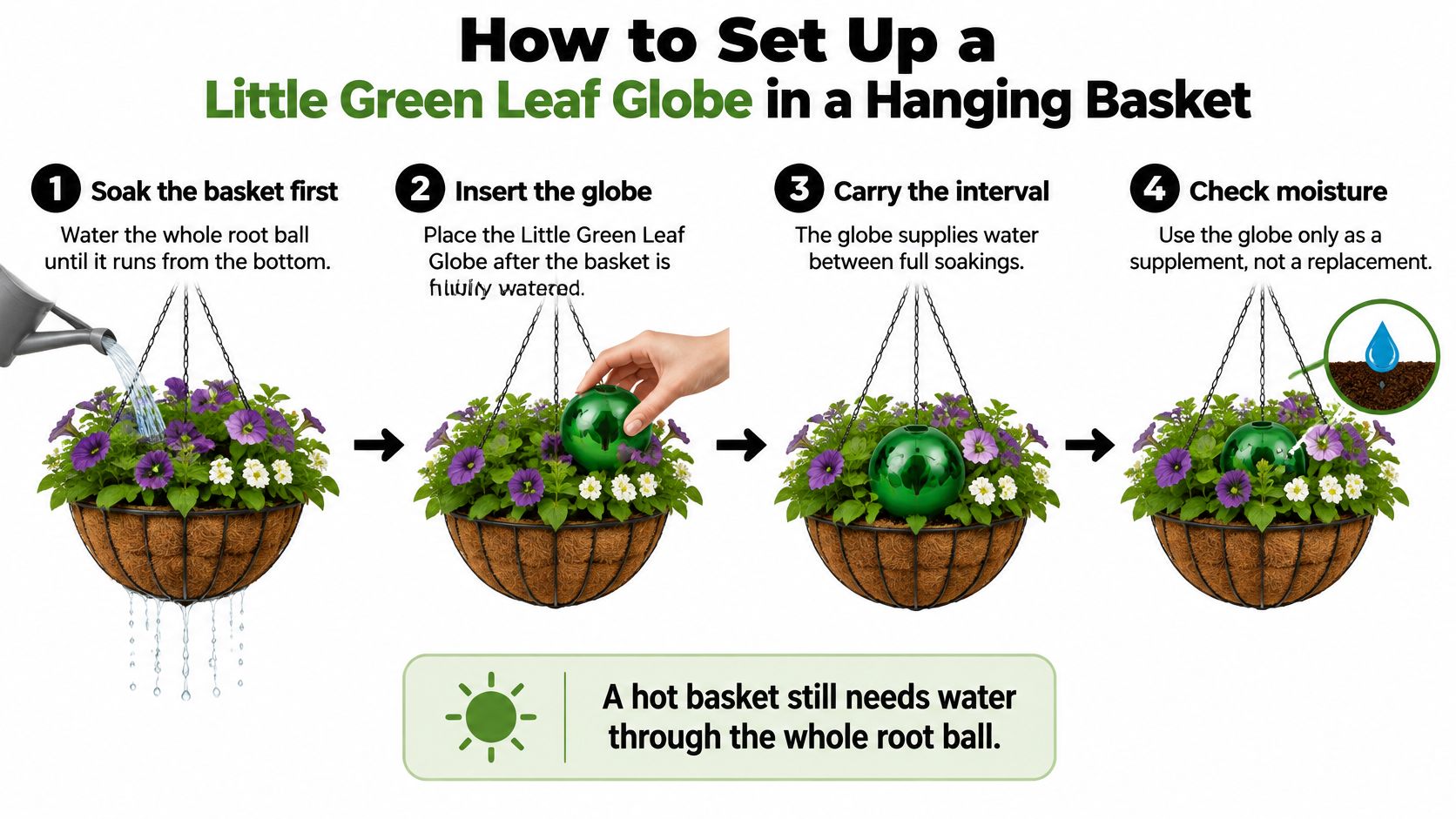
Five steps for a useful trial
- Start from a normally watered basket. Give dry mix a thorough drink across the root ball, then let excess water finish draining before the globe goes in.
- Make a pilot hole with a pencil. An opening in visible, accessible mix protects the glass stem from being forced through resistance, especially in dense soil. The pencil shouldn't be driven through a tightly packed root mass.
- Fill the globe and fit the optional tip cover. The selected capacity should match the basket's observed demand. A tip cover can help prevent clogs, while inspection still matters.
- Insert at a slight angle into the main root zone. Placement against the rim or beyond the root ball can leave water poorly distributed. The bulb should remain supported without pressure on the glass.
- Read the result with the moisture-check routine described earlier. Use those observations to decide whether the globe needs refilling, repositioning, cleaning, or removal.
Cleaning between uses
An empty globe can be rinsed through the bulb and stem with warm water. A thin brush helps clear the stem, provided it isn't forced against the glass.
The globe should dry before storage or its next prepared use. Persistent residue or an obstructed outlet needs attention before another unattended trial.
Departure check: Successful installation means suitable root-zone moisture, and the bulb emptying is only part of that.
Watering Hanging Plants While You Are Away
For an absence of about a week, some houseplants may need only an appropriate moisture check before departure. Hanging baskets deserve their own assessment, because exposed containers can use their reserves much faster than sheltered indoor pots. A globe works best as a bridge between the thorough waterings a basket still needs, so the question is always how long that bridge holds in your conditions.
Botanicaly's vacation-watering guide recommends matching the method to each plant and trip length and testing a globe about a week ahead. The same short observation trial used during setup applies here: it shows whether the water level falls at a steady pace, stalls completely, or leaves the mix too wet, while there is still time to adjust the plan.
Match the plan to the observed result
Let the trial determine the travel plan. A globe that empties before the intended return needs a refill arrangement, another watering plan, or a shorter unattended interval.
- For a short absence: A slowly drying basket may be adequately supported by a tested globe after an appropriate initial watering.
- For a longer trip: A helper should have clear instructions for checking soil, soaking when needed, and refilling only when conditions justify it.
- For an exposed summer basket: A globe alone isn't a dependable plan for a fortnight away. Temporary shelter from harsh sun can reduce demand, though the basket still needs a watering arrangement behind it.
Leave instructions for the basket, not just the bulb
A shaded fern and a sun-facing flowering basket shouldn't receive identical instructions. A helper needs to know which container to inspect, what suitably dry mix feels like, and where excess water should drain. The more exposed the basket, the more specific those instructions should be.
A full bulb also shouldn't be taken as proof that the system is working. A blocked stem may leave water visibly available while the roots dry out, so anyone checking in should feel the mix rather than just glance at the glass.
Run the final trial in the basket's intended travel location, since a basket moved to shade behaves differently from the one you tested in full sun. For absences that need more than a last-minute fill, further planning material is available in this guide on how to keep plants watered while on vacation.
Hanging Plant Waterer Questions Answered
How often should a hanging basket be watered with a globe?
Water when the root zone reaches that plant's drying threshold, even if the bulb still holds water. The globe bridges the gap between thorough soaks; in a sunny summer basket that gap can shrink to a day.
Will a watering globe last two weeks outdoors in summer?
Treat two weeks as an upper limit reached only in favorable conditions. Run one short trial in the basket's real spot: note when the globe empties and when the mix reaches the drying point, then plan around the earlier result. Plant type, heat, pot size and insertion angle all move that result.
Can a watering globe be used on a succulent hanging pot?
No. Succulent and cactus baskets need drying periods that steady added moisture can interrupt.
How can the glass stem be stopped from clogging?
Make a pilot hole first so soil doesn't pack the opening during insertion; an optional sleeve can help in fine mix. If water stays in the bulb while the mix dries, clear the stem rather than assuming the roots are hydrated.
How is a watering globe cleaned?
Rinse the empty bulb and stem with warm water and use a thin brush gently inside the stem. Let the glass dry and check for cracks before storage.
Little Green Leaf offers hand-blown glass watering globes in 100 ml, 200 ml, 350 ml, and mixed-size options for indoor and outdoor containers. For a hanging basket that needs help between thorough waterings, a visit to Little Green Leaf is a practical next step toward choosing a capacity and running a short trial before relying on it while away.