

Glass Watering Globes for Plants: How They Really Work
A glass watering globe can release water for up to about two weeks, but the time depends on pot size, soil, temperature, and the globe's size. The more useful question is whether the plant and pot are suited to continuous slow moisture.
A drooping pothos after a busy week is usually a reminder that the problem isn't the plant's willpower. It's the watering gap. A glass watering globe solves that gap by giving the root zone a small, steady supply instead of one big soak.
Table of Contents
- Why Glass Watering Globes Work and What Changes
- The Soil Physics Behind a Watering Globe
- Matching Globe Size to Pot Size
- How to Set Up a Little Green Leaf Globe Step by Step
- The 48 to 72 Hour Calibration Method
- Watering Globes Compared to Spikes, Drip, and Self-Watering Pots
- Honest Limits of Glass Watering Globes
- Glass Watering Globe Questions Answered
Why Glass Watering Globes Work and What Changes
A glass watering globe is a hand-blown reservoir with a long stem that goes into moist soil and lets water move out gradually as the mix dries. For a beginner, the simplest way to think about it is this, the globe replaces a single splash of water with a slow feed that can last up to about two weeks per fill, depending on the plant and container.
That range is real, but it isn't fixed. Smaller pots, warmer rooms, thirsty plants, and 100 ml globes empty sooner, while a 350 ml globe in a medium planter in a cooler room can reach the longer end of that range. The point is not to promise a calendar date, it's to create a buffer between watering sessions.
Why the duration changes so much
Container plants swing between wet and dry faster than plants in the ground because the root volume is limited and the potting mix dries more quickly. Extension guidance notes that containers can need watering much more often during warm, sunny conditions, so a globe works best as a buffer, not as a magic timer. The plant still sets the pace through its size, its leaf load, and the environment around it, not through the glass itself. (University of Idaho Extension)
Practical rule: if a pot already dries fast on a normal week, the globe won't change that biology, it only slows the refill cycle.
For people who travel, forget, or water unevenly, that slow release is the standout appeal. The globe gives the soil a steadier chance to stay in range without demanding daily attention, which is why the conversation should start with fit, not with a fixed number of days.
The Soil Physics Behind a Watering Globe
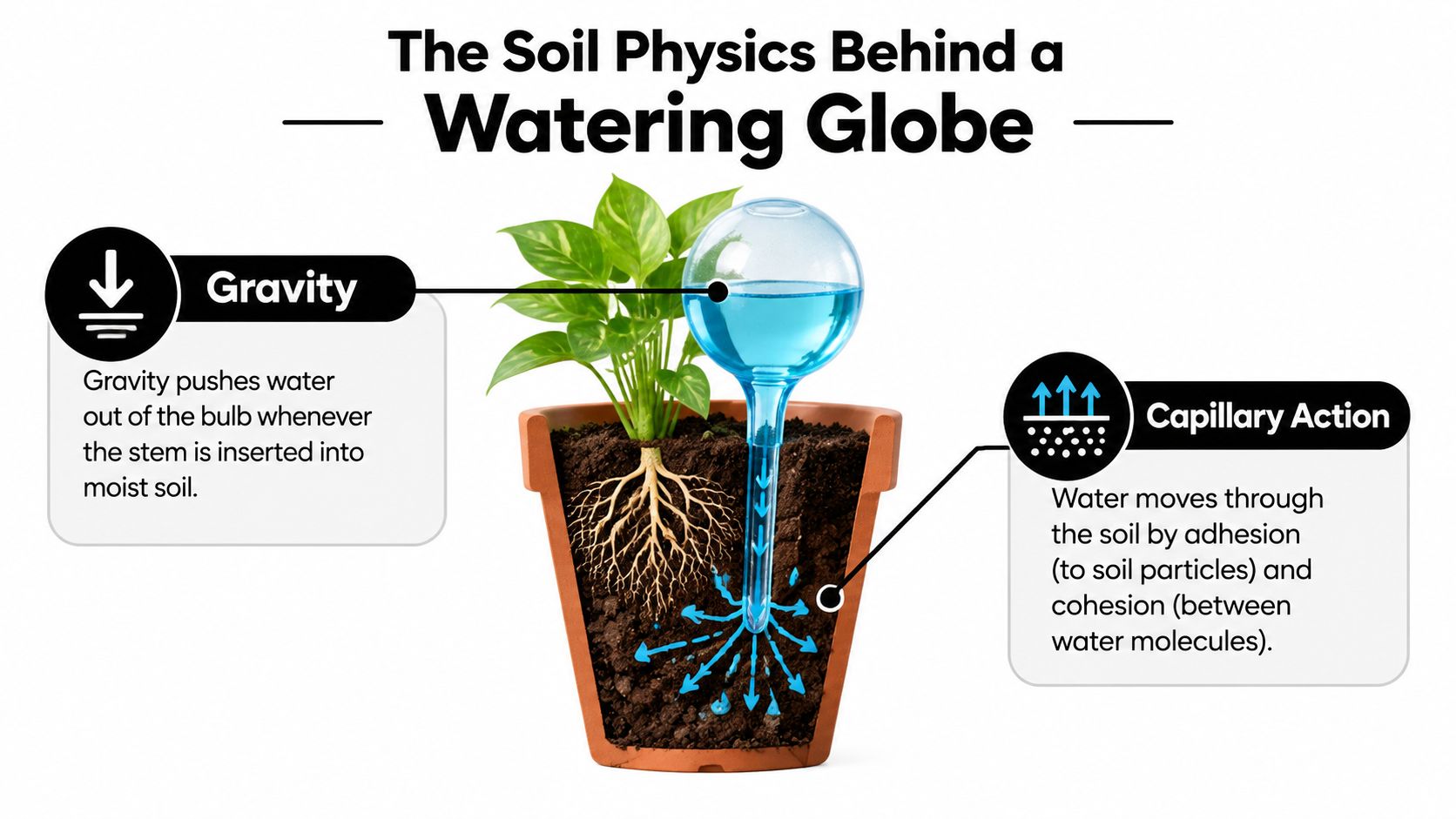
A watering globe works because gravity pulls water toward the opening while capillary action draws that water into the potting mix. The globe has no timer inside it. It keeps releasing water until the soil gets wetter and the flow slows.
Water spreads through dry fibers until the towel is damp enough that movement slows. Soil behaves the same way, only its pore spaces come from particles instead of fibers.
What the potting mix is doing
A mix with larger pores drains quickly and moves water mostly downward. A finer mix holds water longer and spreads it more slowly in several directions. That is why the same globe can seem generous in one pot and too fast in another, even when nothing about the glass has changed.
The outlet matters too. The stem needs to sit inside the root zone, not pressed against the container wall, and drainage holes need to stay open. A globe cannot fix a pot that stays saturated, because low oxygen around the roots still damages roots. Nebraska Extension notes that wet soil can reduce oxygen in the pore spaces and contribute to root rot, which is why drainage matters as much as the globe itself. (Nebraska Extension)
Dry soil pulls water more readily, wetter soil slows the exchange. This explanation of capillary action in soil makes the same point in plainer terms, and the simple takeaway is easy to test at home.
Set the globe in a plant for 48 to 72 hours and watch the soil, not the glass. If the mix stays soggy, the globe is delivering faster than that pot can use water. If the soil is still dry near the root zone, the globe is too small, the soil is too coarse, or the stem is not seated well. That short calibration window tells you more than any promised long interval, because it shows how your own room, pot, and mix behave together.
Matching Globe Size to Pot Size
The easiest way to size a globe is to match it to the pot, not to guess by feel. A 100 ml globe works for smaller pots and tight tabletop groupings, 200 ml fits a typical houseplant in a modest container, and 350 ml gives more buffer when a planter needs longer between refills.
Glass Watering Globe Size vs Pot Size
| Globe Size | Best Pot Diameter | Typical Duration Range |
|---|---|---|
| 100 ml | Under 5 inches | Shorter end of the range |
| 200 ml | 4 to 6 inches | Mid-range use |
| 350 ml | 7 inches and up | Longer end of the range |
That table is a starting point, not a promise. Oklahoma State University Extension notes that small pots may need water every two to three days, while large pots may need watering no more than every seven to fourteen days, and those needs shift with season, temperature, humidity, plant type, and potting medium. A globe has to fit that pattern, not override it. (Oklahoma State University Extension)
How to choose without overthinking it
Start with the gap you are trying to cover. A weekend away usually points to a smaller reservoir, a workweek can justify a mid-size globe, and a longer trip may call for the largest size the pot can safely handle.
If you are unsure what counts as a small pot versus a medium planter, the plant pot size guide walks through the diameter ranges.
Rule of thumb: choose the smallest reservoir that can bridge your real absence without keeping the mix wet longer than the plant likes.
Bigger is not automatically better, especially in smaller containers. Extra volume can keep the soil wetter than the roots prefer, so the best fit is the one that matches both pot size and how quickly that mix drinks water.
How to Set Up a Little Green Leaf Globe Step by Step
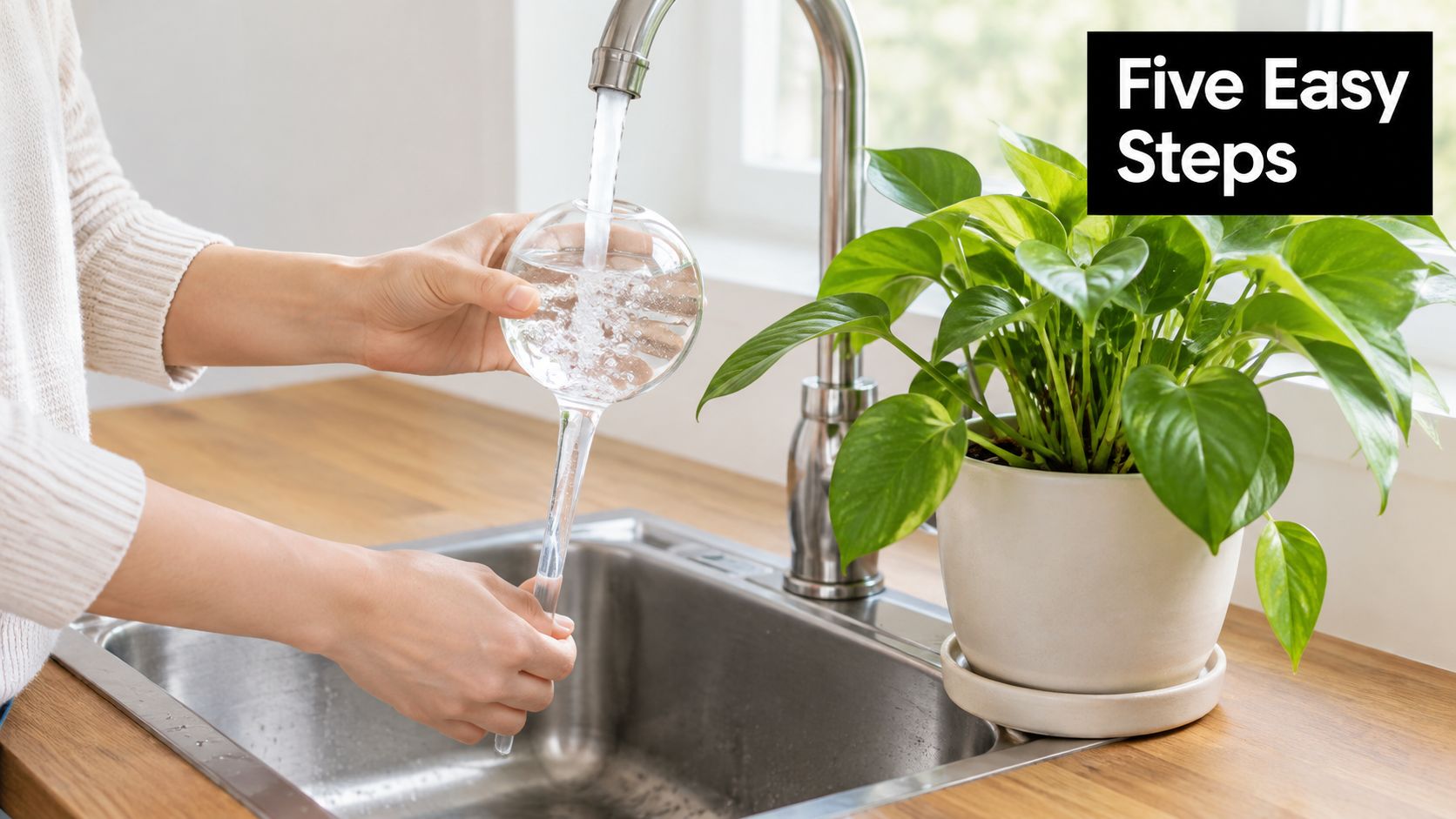
A good setup starts before the globe goes in. The soil should already be lightly moist, so the globe can release water into mix that spreads it through the root zone instead of pushing it down a dry tunnel.
- Water the plant first. Start with soil that feels damp, not soaked. Very dry mix can behave like a sponge left too long in the sun, taking water unevenly and leaving pockets untouched.
- Make a pilot hole. Use a pencil or chopstick to open a path for the stem. In tighter pots, that small channel helps prevent cracked glass and keeps the opening from getting squeezed shut.
- Fill the globe slowly. A slow fill gives you fewer bubbles and makes the globe easier to seat. If your globe has an anti-clog sleeve, it can help in denser mixes, where fine particles are more likely to shift around the opening.
- Insert at a slight angle. Aim the stem into the root zone, not hard against the pot wall. That placement helps the moisture spread where roots can reach it.
- Check the soil after a couple of days. The top should not be soggy while the lower mix stays dry. If the globe empties too fast, or hardly changes at all, the fit needs adjusting.
Treat the first setup like a trial run. A globe is not just a fill-and-forget tool, it is a small water source that has to match your pot, your mix, and how quickly that soil drinks.
The 48 to 72 Hour Calibration Method
A new globe should be judged like a small experiment. Fill it, note the starting level, then watch the water line and the soil for the next 48 to 72 hours instead of trusting a generic “up to two weeks” claim.
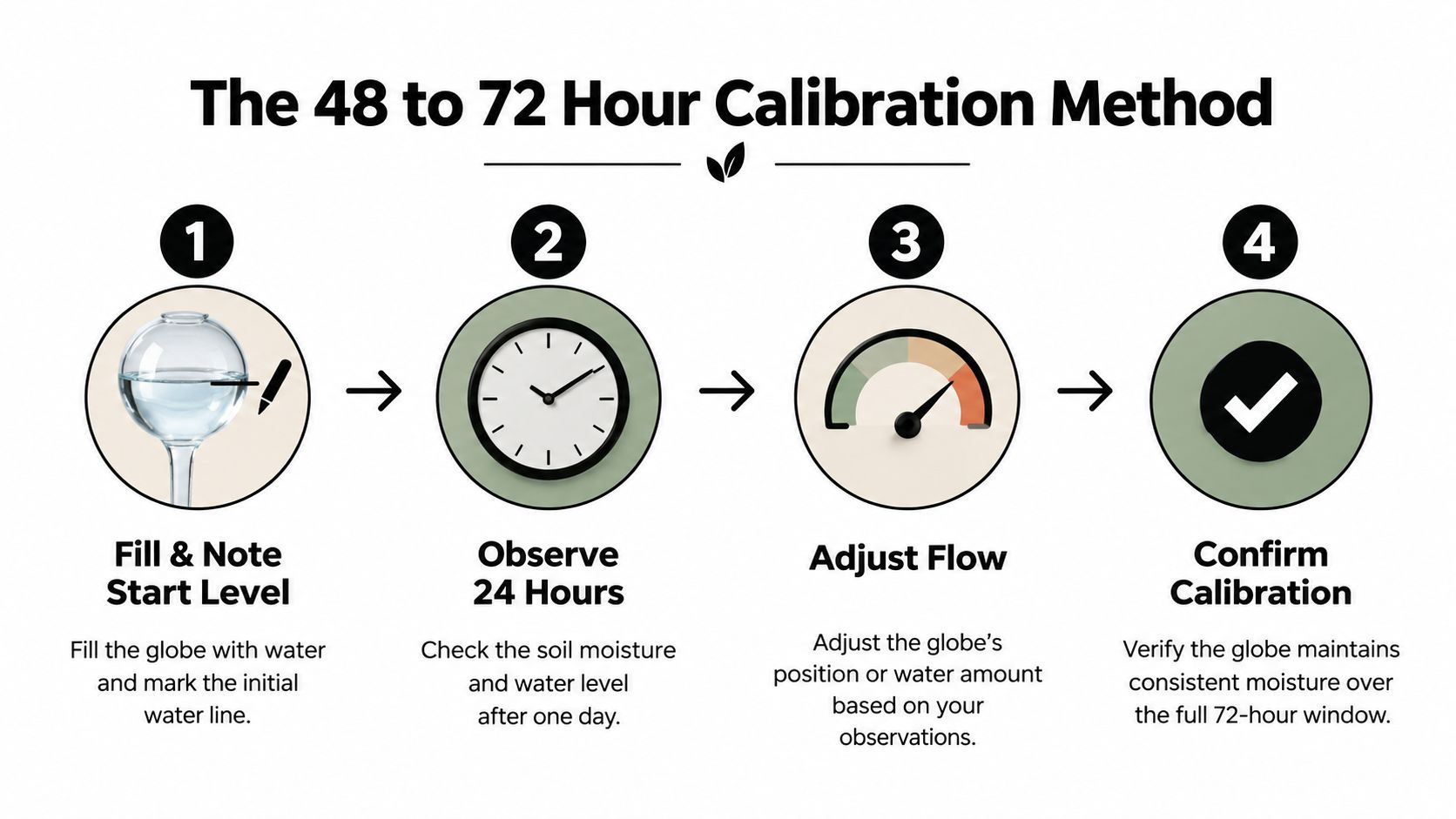
What each signal means
- Rapid emptying: the mix may be loose, the opening may be too large, or the pot may be pulling water faster than expected.
- No visible movement after 48 hours: the soil may be compacted, the stem may be pressed against the wall, or the outlet may not be seated in the root zone.
- Persistently wet surface: the soil was probably already saturated before insertion, so the globe is adding moisture to an already wet pot.
- Water pooling at the base: drainage isn't keeping up, and the container needs a different setup before any globe can help.
The point of the calibration window is to match the globe to the actual room, not an abstract ideal. That matters because container plants can behave very differently from one apartment to another, even when the plant name is the same. University of Arizona Extension explains the same moisture logic in passive irrigation, dry soil draws water more strongly while wetter soil slows release, and the practical result is that the pot itself governs the flow. (University of Arizona Cooperative Extension)
How to adjust after the test
If the globe drains too fast, a smaller reservoir may be the better choice. If the soil stays wet, reduce the reservoir size, change the insertion angle, or move to a coarser setup that doesn't hold water so long. If nothing seems to happen, the issue is usually seating, soil compaction, or a poor drainage situation, not the globe brand.
A globe is useful when it can be tuned to the plant. It becomes frustrating when the owner expects one fill to behave the same way in every pot.
That 2- to 3-day check is the most honest way to predict real-world performance, because it uses the plant's own reaction instead of a blanket promise.
Watering Globes Compared to Spikes, Drip, and Self-Watering Pots
The best watering aid depends on how much setup a person wants, how many plants need coverage, and whether the goal is decoration or scale. Glass globes are simplest for a few indoor pots, while other systems suit different routines.
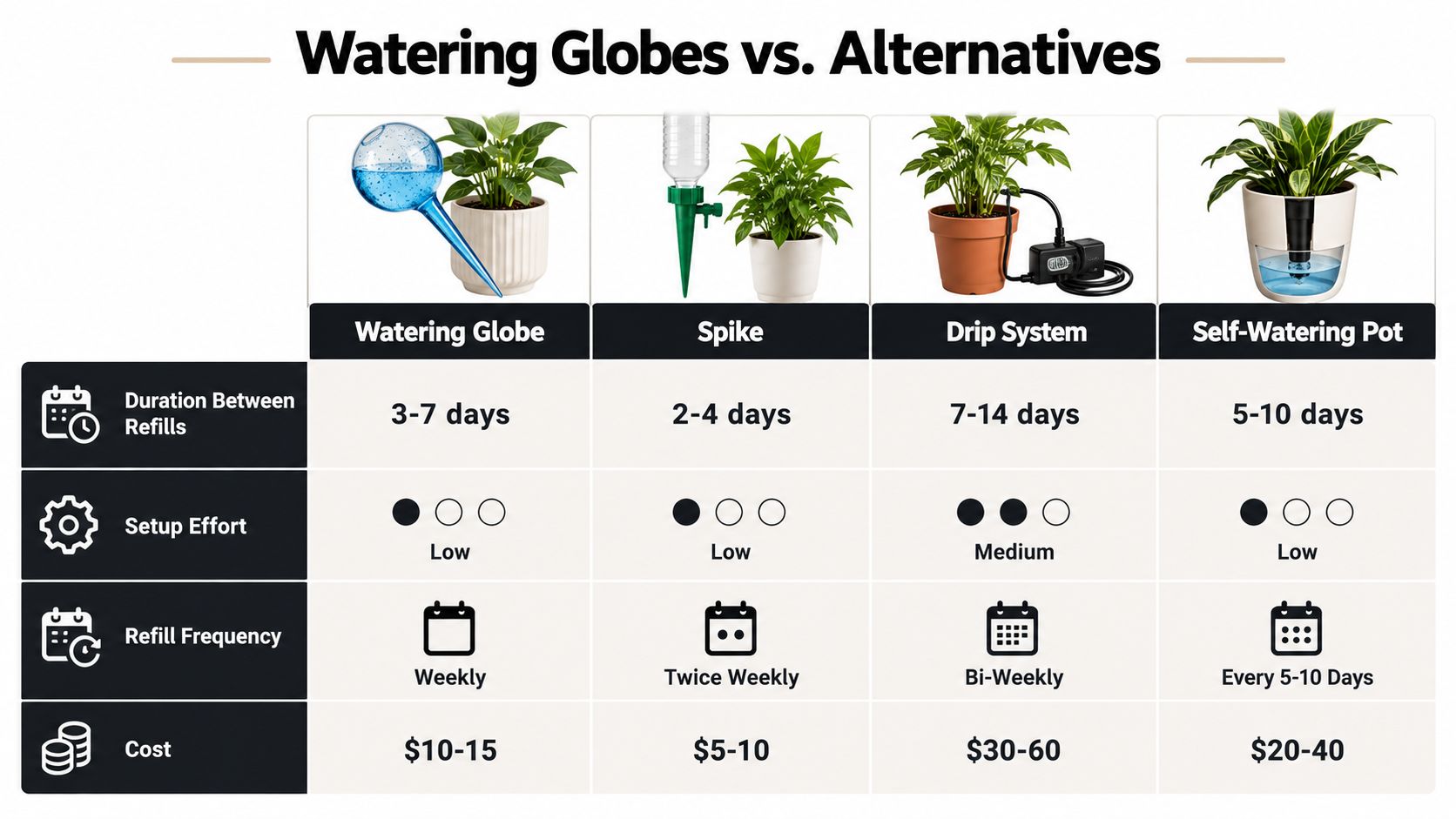
Watering Globes vs Spikes vs Drip vs Self-Watering Pots
| Method | Duration | Setup | Refill Effort | Clogging Risk | Works Outdoors | Cost per Plant |
|---|---|---|---|---|---|---|
| Watering Globe | Short to moderate, depends on pot and fill size | Very low | Low | Can clog in dense soil | Sometimes, depending on exposure | Low to moderate |
| Spike | Short to moderate | Low | Low | Can clog at the stem | Yes, in suitable containers | Low |
| Drip | Moderate to longer coverage | Higher | Moderate | Tubing and emitters can clog | Yes | Higher |
| Self-Watering Pot | Moderate | Moderate | Moderate | Built into the reservoir system | Yes | Moderate to higher |
Watering globes are most comfortable for people who want a decorative, electricity-free option for a handful of pots. They're less useful when the owner needs a larger, more controlled system that feeds many containers at once.
Where each method fits
- Globe: good for short trips, visual appeal, and small collections.
- Spike: useful when the owner wants a more soil-responsive feed at root depth.
- Drip: better for scaling across several plants, but it asks for tubing and a reservoir.
- Self-watering pot: helpful for moisture-loving plants, but it locks the owner into a specific planter style.
For a deeper look at the spike-style option, the related guide on self-watering plant spikes gives a different angle on passive moisture delivery. The core decision is not which tool is cleverest, it's which one fits the number of pots, the trip length, and the amount of maintenance a person will tolerate.
Honest Limits of Glass Watering Globes
A globe works best in the right setup, and that honesty prevents a lot of avoidable problems. Succulents and cacti need time to dry between waterings, so a constantly moist root zone works against them. Virginia Cooperative Extension gives those plants a very different watering rhythm from tropical foliage, which is why a slow-release globe fits moisture-loving containers better than dry-loving ones.
When to skip it or change the setup
A single small globe can fall short in a very large planter, especially in a warm room or with a thirsty plant. Dense soil can also close around the stem if you do not make a pilot hole first, which slows the flow and makes the globe seem faulty when the trick is the insertion point.
Glass has a simple physical limit. It can break if dropped, so placement matters in homes with active kids, curious pets, or crowded shelves. That does not make the product fragile in normal use. It only means the owner should treat it like glass, not like a rubber accessory.
Safer alternatives by situation
- Succulents and cacti: skip the globe and let the mix dry fully between waterings.
- Very large pots: use more than one globe or choose a different watering method.
- Dense, compacted soil: refresh the setup, make a pilot hole, or loosen the mix.
- High-risk placement: move the plant to a safer spot where the glass will not be knocked over.
Prolonged wetness can reduce oxygen around roots, so the key issue is whether the plant can breathe while it drinks. A globe should never keep a root zone wet enough to cut off oxygen.
Glass Watering Globe Questions Answered
How long does a glass watering globe last for plants?
A globe can last up to about two weeks, but the actual window depends on pot size, soil, temperature, and reservoir size. Smaller pots and warmer rooms usually shorten that window, so the same globe may behave differently from one home to another.
Can a watering globe be left for more than a week?
Yes, if the plant, pot, and soil can handle slow, steady moisture. The better check is to run a short calibration first and see whether the pot stays evenly moist without lingering soggy.
How do you unclog a watering globe stem?
Remove the globe, rinse the stem with warm water, and make sure the opening is not packed with compacted soil. If the mix is dense, a pilot hole and a slightly different insertion angle often prevent the clog from coming back.
How do you clean a glass watering globe?
Rinse it between refills and wipe the inside if mineral residue starts to build up. Clean glass helps the stem keep flowing evenly, while buildup can slow the release and make the globe empty unevenly.
Can a watering globe be reused forever?
It can be reused many times if it stays intact and clean. In practice, breakage, residue, or a change in the plant's watering needs usually ends its useful life before the glass itself does.
How can a person tell if the globe is releasing too fast or too slow?
Too fast usually looks like a quick drop in the water line and soil that stays overly wet. Too slow looks like little change after two days, which usually means the stem placement, soil contact, or drainage needs adjustment.
For readers comparing sizes, setup, and fit, the earlier sizing and comparison sections are the most useful reference points before buying.