

Glass Plant Watering Bulbs: How Long a Fill Really Lasts
A filled glass plant watering bulb can provide water for up to about two weeks, but it may empty sooner in a large pot, a warm room, or a setup with a thirsty plant and a small globe. If the soil dries out while the owner is busy or away, a bulb can release water gradually, but its reservoir size alone can't guarantee a set number of days.
Table of Contents
- What Glass Plant Watering Bulbs Are and How They Work
- How Long One Fill Lasts and What Changes It
- Which Plants Suit Watering Globes and Which to Avoid
- Choosing the Right Globe Size for Your Pot
- Globes Compared With Spikes, Drip and Self-Watering Pots
- How to Set Up and Keep a Little Green Leaf Globe Working
- Frequently Asked Questions About Watering Globes
What Glass Plant Watering Bulbs Are and How They Work
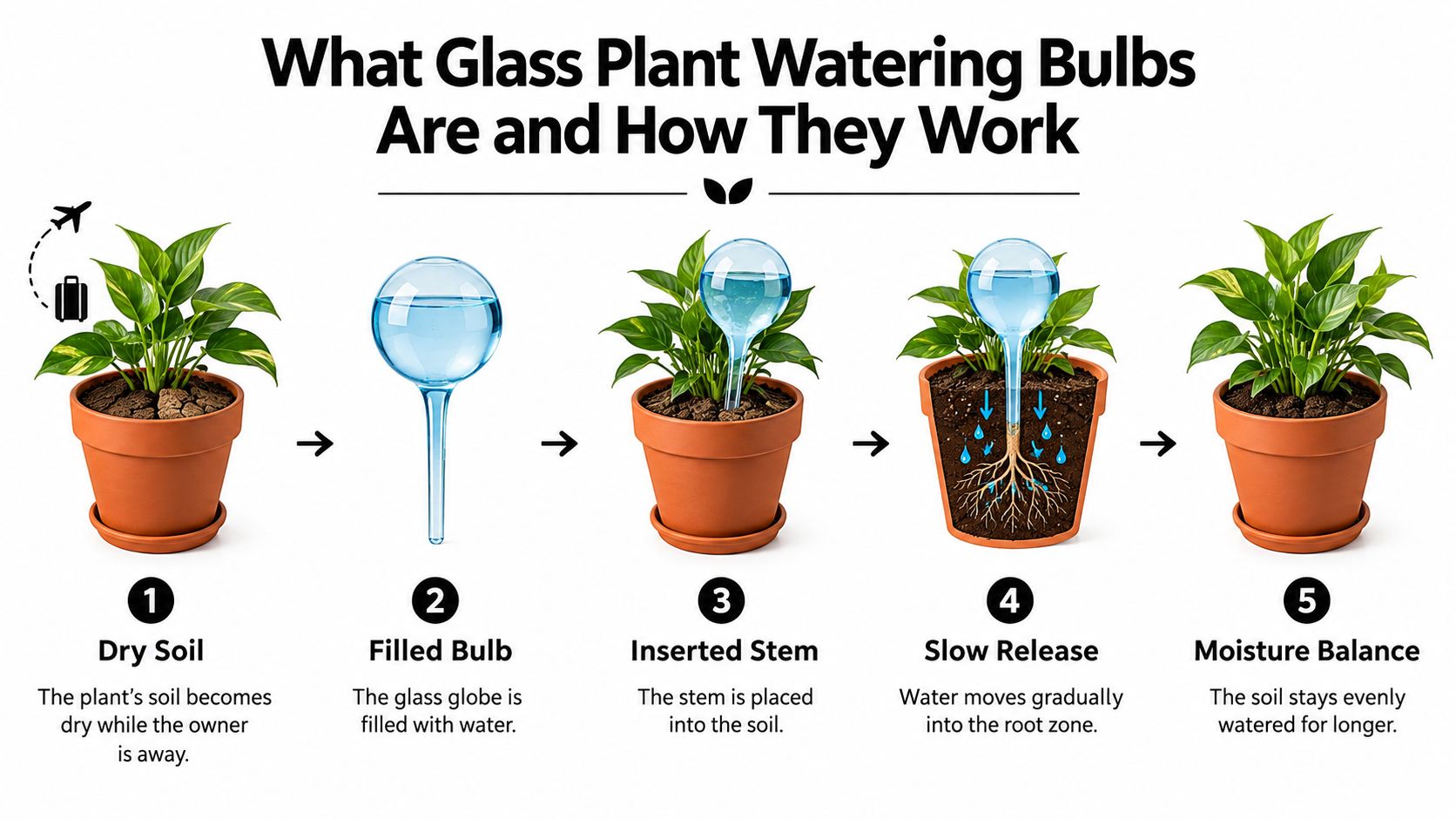
A glass plant watering bulb is a small water reservoir with a narrow stem that sits in the potting mix. Once filled and inserted into moist soil, it releases water as the surrounding soil dries. It doesn't use a timer, pump, or electronic sensor to decide when to water.
Think of it as a water tank with a narrow outlet beside the roots. Water moves from the bulb into the soil under the influence of gravity and capillary action, the same forces involved in how moisture moves through soil. Water continues moving after soil reaches field capacity, the point at which excess water has drained away. Capillary action holds some of that moisture in the soil's pores, where plants can use it. Narrower pores create stronger capillary effects, as explained in this overview of soil water and capillary action.
Why soil changes the flow
The stem releases water into the nearby root zone. As that soil dries, the conditions that draw water from the bulb change, and more water can move into the surrounding pores. When the soil is already moist, the difference driving that movement is smaller. This is a gradual physical process, not precise moisture measurement, so a bulb can't guarantee that every part of the pot stays evenly wet.
The soil's pore structure matters. Coarse, sandy mixes tend to drain quickly and provide less upward or sideways capillary movement, while finer-textured soil can move water farther but more slowly. Compaction, pot depth, insertion angle, the plant's water use, and evaporation can all affect what happens around the stem.
What the capacity tells you
Little Green Leaf glass plant watering bulbs are hand-blown glass reservoirs in 100 ml, 200 ml, and 350 ml sizes. Those measurements describe how much water a bulb can hold, not how many days it will water a plant. A larger reservoir holds more water, but the plant, pot, and surrounding conditions still determine how quickly that water leaves the bulb.
That's why a capacity label is a starting point for choosing a size, not a watering promise. Matching the bulb to the pot and checking how the soil responds will give a more useful expectation than relying on volume alone.
How Long One Fill Lasts and What Changes It
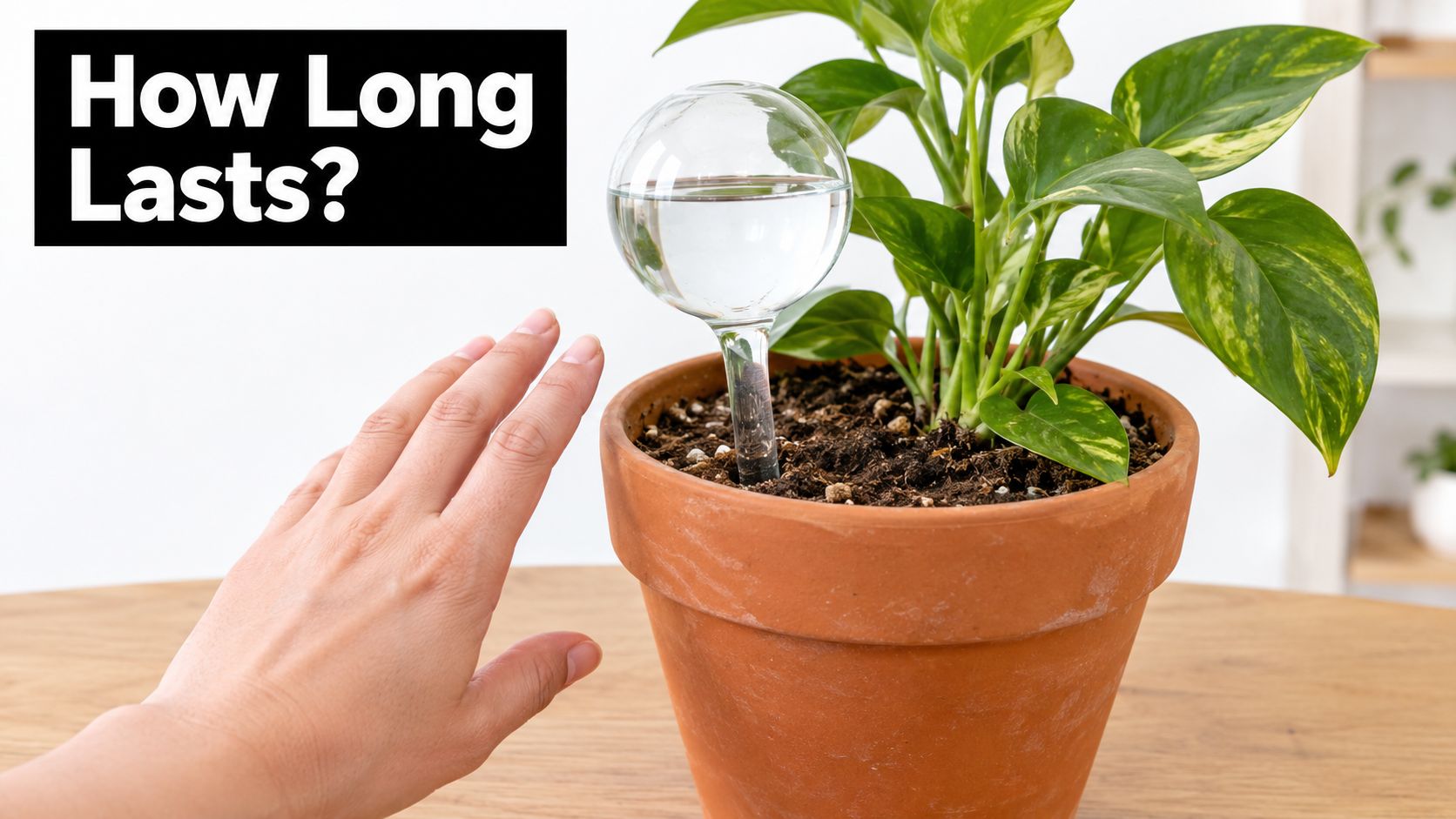
A fill can last up to about two weeks, but that's a possible upper limit, not a guaranteed duration. The bulb may empty sooner when the plant needs more water, the room is warm, the pot dries quickly, or the reservoir is small. A 350 ml bulb generally holds more water than a 100 ml bulb, but the same size can behave differently in two different pots.
Why the same bulb lasts different lengths of time
A larger pot holds more growing medium, so it may dry at a different rate from a small pot. But that doesn't mean a bulb in a large pot will necessarily last longer: one small reservoir may not supply enough water to meet the needs of a large plant. Warm conditions and evaporation can also speed drying, while a plant that uses water quickly may draw more from the bulb.
The outlet and the soil around it matter, too. A stem inserted at an angle, a blocked opening, or a loose channel created during insertion can change how water enters the pot. Even when two bulbs have the same capacity, their useful intervals can differ because their setups aren't identical.
There's no universal houseplant watering schedule. The University of Maryland Extension's guidance on watering indoor plants recommends checking the soil rather than following a calendar, including feeling the growing medium about 2 inches deep to see whether it's dry.
Practical rule: Watch the soil during the first few days of use. The bulb's reservoir level and the moisture below the surface tell more about your setup than a fixed day count.
A globe can help maintain moisture between manual checks, but it shouldn't replace them. For more detail on why water moves through soil pores, see this explanation of capillary action in soil.
Which Plants Suit Watering Globes and Which to Avoid
A watering globe suits plants that prefer consistently moist soil better than plants that need the growing medium to dry between waterings. It's easy to assume that steadier moisture is always helpful. It isn't: a plant that needs a dry period can struggle if the soil stays wet.
Moisture-loving houseplants such as peace lilies, calatheas, ferns, prayer plants, African violets, and fittonias may be candidates, provided the pot drains and the bulb doesn't keep the root zone saturated. Use a globe during everyday care only if the soil dries regularly enough to suit that plant. For travel, test the setup before leaving, and aim for evenly moist soil rather than a pot that remains waterlogged.
When continuous moisture is the wrong fit
Succulents and cacti are poor candidates for a globe left in place. Virginia Cooperative Extension describes thorough but infrequent watering for these plants, at about once or twice a month, compared with tropical houseplants that may need watering once or twice a week. Those ranges illustrate why a globe designed to keep soil moist may conflict with a plant's preferred wet–dry cycle. See the Extension's houseplant watering guidance.
Snake plants, ZZ plants, ponytail palms, and many orchids also prefer drying between waterings, so continuous globe use may not suit them. Plants that need a long dry period are better managed with observation and watering that matches their needs.
A single small bulb also isn't a dependable answer for a very large pot. Before choosing one, check the plant's moisture preference, the pot's drainage, and how quickly the root zone dries. Then decide whether the bulb belongs in that setup all the time, only during a trip, or not at all. For people weighing upkeep across planted areas, this resource on facility grounds cost control offers broader planning context.
Choosing the Right Globe Size for Your Pot
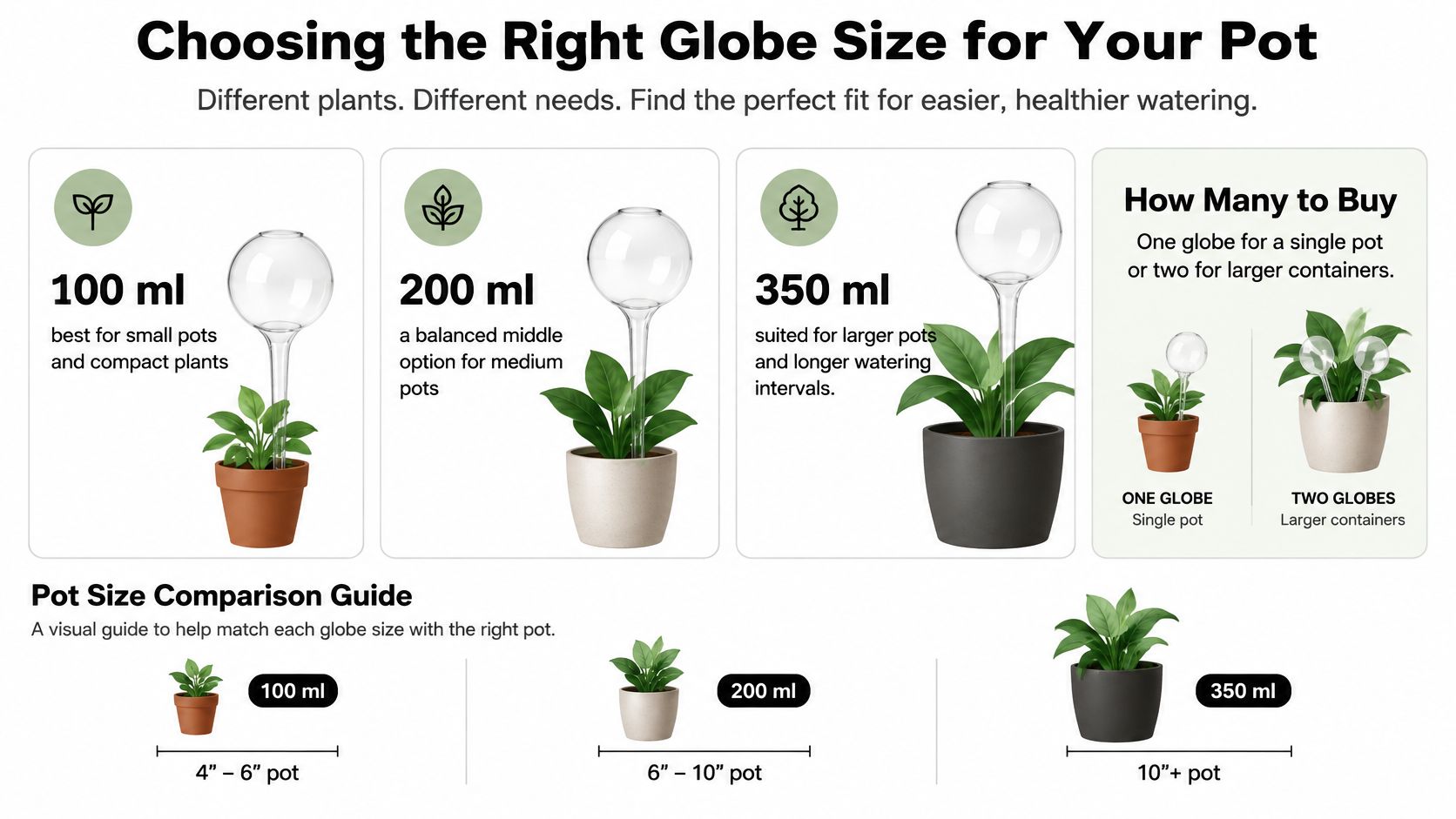
Little Green Leaf offers 100 ml, 200 ml, and 350 ml glass bulbs. A larger capacity can hold more water, but no size is a universal match for a specific pot. The best starting point is to consider the pot's size, how quickly its soil dries, and how much water the plant uses.
A simple size guide
- 100 ml: A practical starting choice for a small pot or compact plant that doesn't use much water. In a larger or fast-drying setup, it may need refilling sooner.
- 200 ml: A middle option for a medium pot or a plant with moderate water needs. Check the soil after insertion to see whether the delivery suits the pot.
- 350 ml: The largest of the three capacities and a possible choice for a larger container or higher water demand. It still may not provide enough water for a very large pot on its own.
Pot size affects watering needs, but it doesn't determine them by itself. Oklahoma State University Extension notes that small pots may need watering every 2 to 3 days, while large pots may need it no more often than every 7 to 14 days. Plant type, growing medium, light, temperature, humidity, and season can also affect how quickly a pot dries, so those intervals aren't promises for a particular plant. The Extension's houseplant care guidance explains why one bulb can't be assigned a reliable duration based only on pot size.
Choosing a pack
The bulbs are sold in 1, 2, 4, and 6 packs, which can suit a single plant or a group of pots. Start with the plants that dry out most often rather than assuming every plant needs a globe. If a container is large, consider whether one bulb can reach the area you want to keep moist; a single small bulb may not be enough.
For a gift, the recipient's pot size and watering habits matter more than choosing the largest capacity. A guide to plant pot size can help make that match.
Rule of thumb: Choose a capacity to suit the pot and plant, then test the release. Reservoir size can help set expectations, but only the actual soil response can show whether the match works.
Globes Compared With Spikes, Drip and Self-Watering Pots
A glass globe is a simple option for supplying water to one pot without a timer or power source. It isn't automatically the right tool for every plant or every time away. A larger group of plants, a very large pot, or a plant that needs a clear wet–dry cycle may call for a different approach.
| Option | How Long It Lasts | Setup Effort | Refill Effort | Clogging Risk | Works Outdoors | Cost Per Plant |
|---|---|---|---|---|---|---|
| Glass watering globe | Up to about two weeks, depending on the setup | Fill and insert the stem into moist soil | Refill each globe as needed | Stem can clog with soil | Can suit outdoor containers and hanging baskets; monitor more closely in heat | One globe can serve an individual pot |
| Watering spike | Depends on its reservoir and the setup | Insert the spike and connect its water supply | Refill the reservoir | Outlet or passage may clog | Suitability depends on the design and container | Depends on the setup |
| Drip system | Depends on the water supply and system settings | Requires arranging the delivery to plants | Refill or maintain the water supply | Emitters or lines can clog | Can serve outdoor plants if the setup suits them | Shared setup may serve multiple plants |
| Self-watering pot | Depends on the pot's reservoir and plant demand | Use a pot designed with a reservoir | Refill the pot reservoir | Water passages may need cleaning | Depends on the pot and conditions | Each plant needs a compatible pot |
Pick for the job, not the label
A globe makes sense when a plant in an individual pot needs gradual water between checks, especially if the owner wants a visible reservoir and a simple setup. It has no batteries, timers, or apps. The trade-off is that a glass stem can clog, the glass can break if dropped, and a small reservoir may not meet the needs of a thirsty plant or a large pot.
A drip system may fit a group of plants better because it can supply several pots. A self-watering pot serves the container as a whole, while a spike offers another way to deliver water into soil. Each setup has different installation and maintenance needs. More detail on how self-watering plant spikes compare with globes can help clarify that choice.
For one or a few compatible plants, a globe is a straightforward aid. For many plants, consider whether a shared system would be easier to maintain. For a plant that needs to dry out, don't choose a tool just because it promises hands-off watering. Match the method to the number of pots, their size, and the plant's moisture pattern.
How to Set Up and Keep a Little Green Leaf Globe Working
Good setup starts with the soil, not the bulb. Very dry potting mix can contain cracks or channels that let water run away from the area where it's needed. The USDA Natural Resources Conservation Service guidance on soil moisture recommends wetting very dry soil before installation and checking moisture at multiple depths after 24 to 48 hours.
Five setup steps
- Water the plant first. Thoroughly wet very dry soil and let excess water drain. A globe is for gradual maintenance, not a replacement for rehydrating a neglected, bone-dry pot.
- Make a pilot hole. Use a pencil or another narrow implement to open a path into dense soil. This helps the glass stem enter without being forced.
- Fill the bulb. Fill the reservoir with water before turning the stem toward the soil.
- Insert the stem. Place the tip near, but not directly against, the active root zone. Set it at a slight angle, and avoid pushing it into a spot where roots or compacted soil block the opening.
- Check the root zone. After two days, feel the soil at more than one depth. The surface can look dry even while the soil lower down remains moist.
Keep the opening clear
If the stem stops releasing water or soil blocks the opening, remove the globe carefully and rinse the stem and reservoir. An optional plastic anti-clog sleeve can help when soil repeatedly obstructs the stem. A pilot hole is especially useful in dense soil, where forcing the stem can clog or damage it.
Handle the bulb gently when filling, inserting, and removing it. The hand-blown glass can break if dropped, so set it down securely rather than leaving it near the edge of a counter. Little Green Leaf offers the bulbs in 100 ml, 200 ml, and 350 ml sizes, with multicolor and clear rainbow designs, in packs of 1, 2, 4, or 6; the product page is available through the call to action below.
Frequently Asked Questions About Watering Globes
How long does a plant watering globe last?
One fill can last up to about two weeks, but the interval shifts with pot size, plant demand, temperature, soil type, and globe capacity. Water leaves the stem only when the surrounding soil dries enough to pull it out. A thirsty plant in warm, fast-draining mix will empty a globe sooner than a small plant in cool, moisture-holding soil, so check the soil during the first few days to learn your plant's actual pace.
Can I use a watering globe for a two-week vacation?
A globe may help during a trip of up to about two weeks, but it can't guarantee that a plant will have enough water for the whole absence. Run a trial for several days before leaving and confirm the soil stays moist without becoming saturated. A larger reservoir in a bigger pot leaves more margin for error than a small globe in a small pot.
Which plants should not use watering globes?
Skip succulents, cacti, and other plants that prefer a dry-down between waterings. A globe keeps supplying moisture whenever the soil starts to pull water, and that steady availability works against the dry cycle these plants need. Very small pots are also a poor match, since even a modest reservoir can hold the limited soil volume wetter than the plant tolerates.
How do I stop a watering globe stem from clogging?
Soil packed against the stem tip is what stops the flow. Guide the stem into a pre-made hole rather than pushing it through compacted mix. If it clogs anyway, lift the globe out, rinse the stem, and refill; an optional plastic anti-clog sleeve can reduce repeat blockages in dense soil.
Do watering globes work in hanging baskets and outdoor pots?
They can suit outdoor containers and hanging baskets that dry quickly. Warm air and higher plant demand shorten the time between refills, because the soil pulls water out faster as it dries. Test the setup outdoors rather than assuming it will last as long as it does indoors.
Match the reservoir to the pot, then test the release for a few days before relying on it during travel. Visit Little Green Leaf to choose a glass plant watering bulb size and pack that fit the plants being watered.
Little Green Leaf offers hand-blown glass watering globes in 100 ml, 200 ml, and 350 ml sizes, designed to release water gradually as soil dries; choose a capacity and pack that fit the plant's moisture pattern.