

Black Coleus Plant Care Guide for Thriving Foliage
You've brought home a black coleus plant because its leaves look almost velvety, nearly black, and wonderfully dramatic. Then, after a warm afternoon or a missed watering, the foliage suddenly droops, and you wonder whether you've made a terrible mistake.
You haven't. Black coleus can be surprisingly forgiving when you understand its simple preferences: bright but gentle light, rich soil that drains well, and steady moisture. Once those pieces work together, this colorful foliage plant can suit a small apartment, an office, or a shaded patio with very little fuss.
Why Black Coleus Captivates Plant Lovers
At a garden center, black coleus often stops people in their tracks. Its ruffled leaves may look like dark velvet, while flashes of burgundy, purple, or red appear along the veins and margins. In a pale ceramic pot, it becomes an instant focal point. In a mixed container, it gives softer green plants the kind of contrast that makes the whole arrangement feel intentional.
That drama can make the plant seem delicate or demanding. In reality, coleus is generally a practical choice for beginners because it responds quickly to care. When the soil becomes too dry, it may wilt dramatically, but that visible response also gives you an early warning. Restore appropriate moisture, improve the light if needed, and the plant often has a chance to recover.
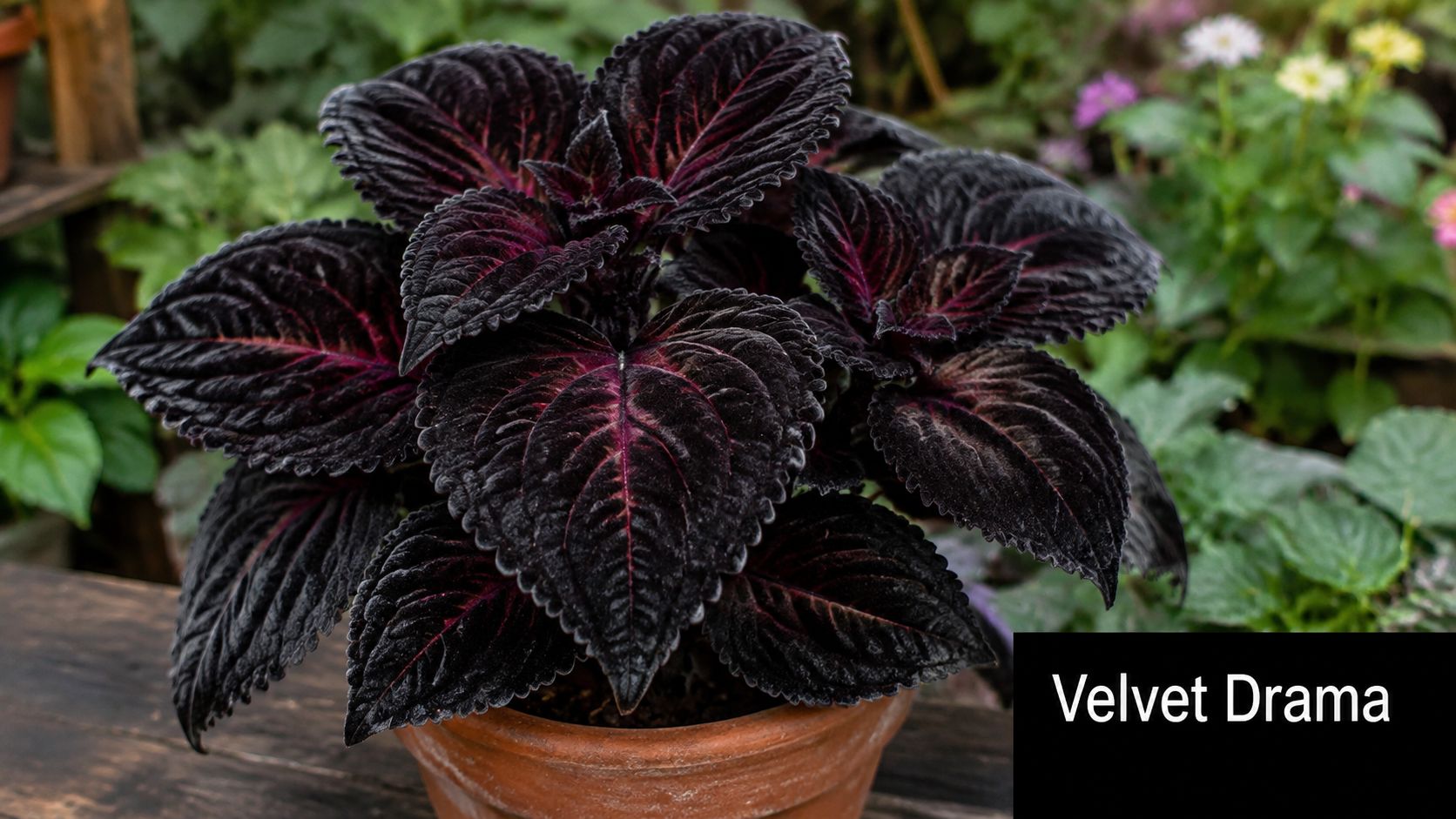
Its bold foliage works especially well in containers, patio planters, shaded corners, and indoor displays. A black coleus plant can stand alone as a sculptural accent, or you can pair it with silver, lime, cream, or soft pink foliage for contrast. For more ideas about creating balanced plant groupings, explore this guide to decorating with houseplants.
A reassuring rule: The plant's appearance is dramatic, but its routine doesn't need to be.
Start with a location where you can easily check the soil and notice changes in the leaves. That simple habit matters more than finding a perfect schedule. Your coleus will show you what it needs, and you'll become better at reading those signals with practice.
Understanding What Black Coleus Really Is
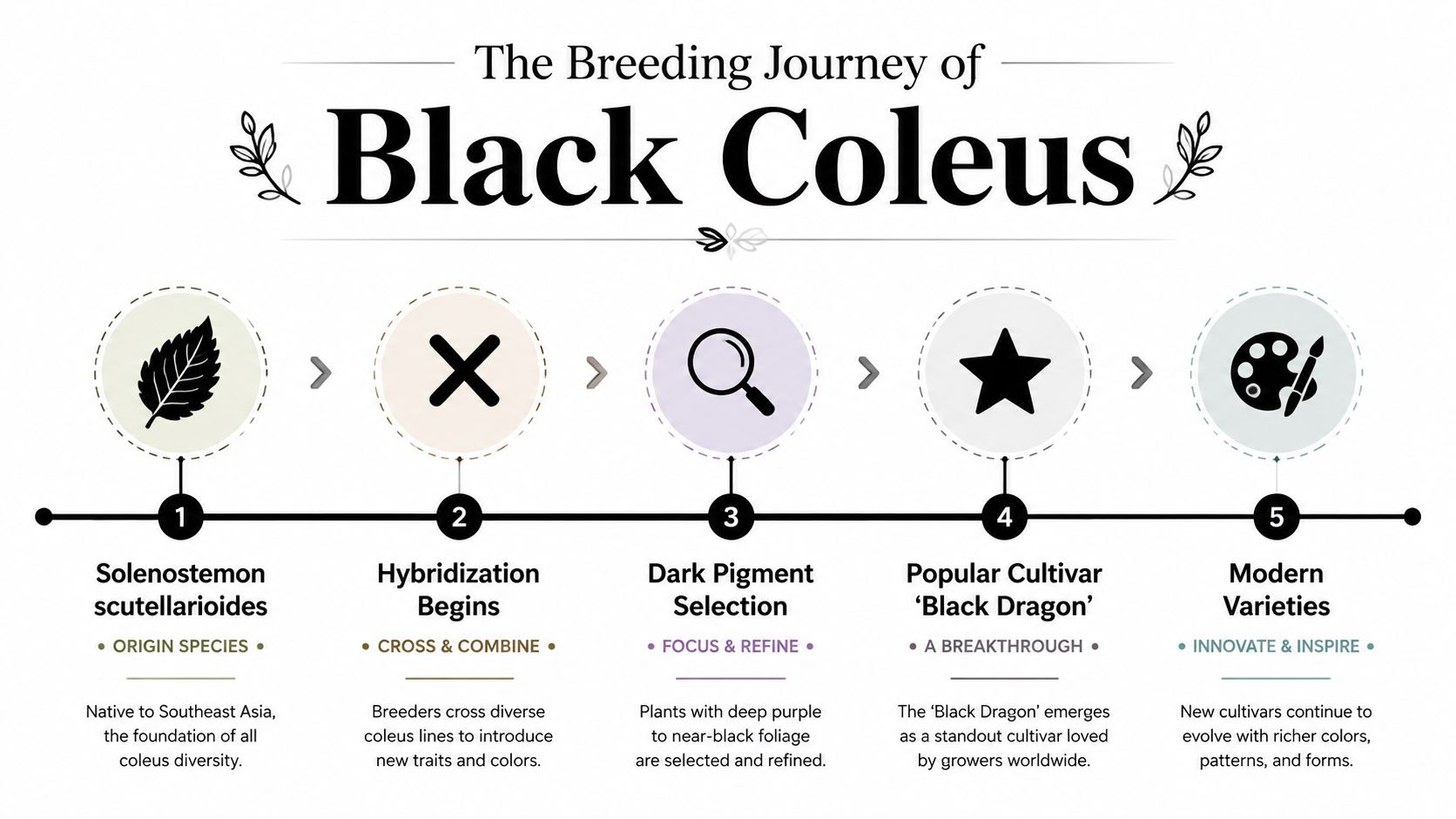
A black coleus is not a separate species. It belongs to a dark-leaved cultivar group within Coleus scutellarioides. Older references may call the same species Solenostemon scutellarioides or Coleus blumei, as recorded by the North Carolina Extension Gardener Plant Toolbox.
Its botanical history helps explain why coleus foliage comes in so many patterns and shades. The species originated across Southeast Asia, New Guinea, and northern Australia, then spread through wider introduction into tropical regions. It reached Europe from Java in 1851. By 1877, growers could choose from a much broader range of leaf colors, and seeds sold for 43 US cents each.
A long breeding story
Coleus breeding revived in the early 1940s. By the 1980s, improved cultivars had made coleus the tenth most important bedding crop in the United States. Modern dark forms, including ‘Black Dragon’, come from this extended ornamental breeding history. Their deep foliage reflects selection by growers rather than leaves that naturally evolved as black in the wild.
The color also explains a common indoor-care surprise. Dark leaves contain strong anthocyanin pigments, which can make them appear nearly black while still showing purple, burgundy, or red undertones. Those tones are normal. They do not automatically indicate fading, disease, or poor care.
Dark pigmentation may help limit excess light reaching deeper leaf tissue, but it does not make the plant safe from every lighting mistake. Indoors, insufficient light can weaken the rich color, while harsh sun through glass can scorch the surface. Consistent moisture matters too. A thirsty coleus can wilt suddenly, like a soft cloth losing its shape, so steady watering helps prevent the dramatic collapse that often alarms new owners.
If you compare dark foliage plants, remember that coleus has different needs from succulent care for dark Echeveria. Echeveria generally suits a drier, brighter routine, while black coleus performs better with a more consistently moist root environment.
Light, Soil, and Water Essentials
If a black coleus suddenly collapses beside a bright window, the problem may be light, dry soil, or both. These needs work together. Bright conditions can dry the pot faster, while dim conditions slow evaporation and leave wet soil in place longer.
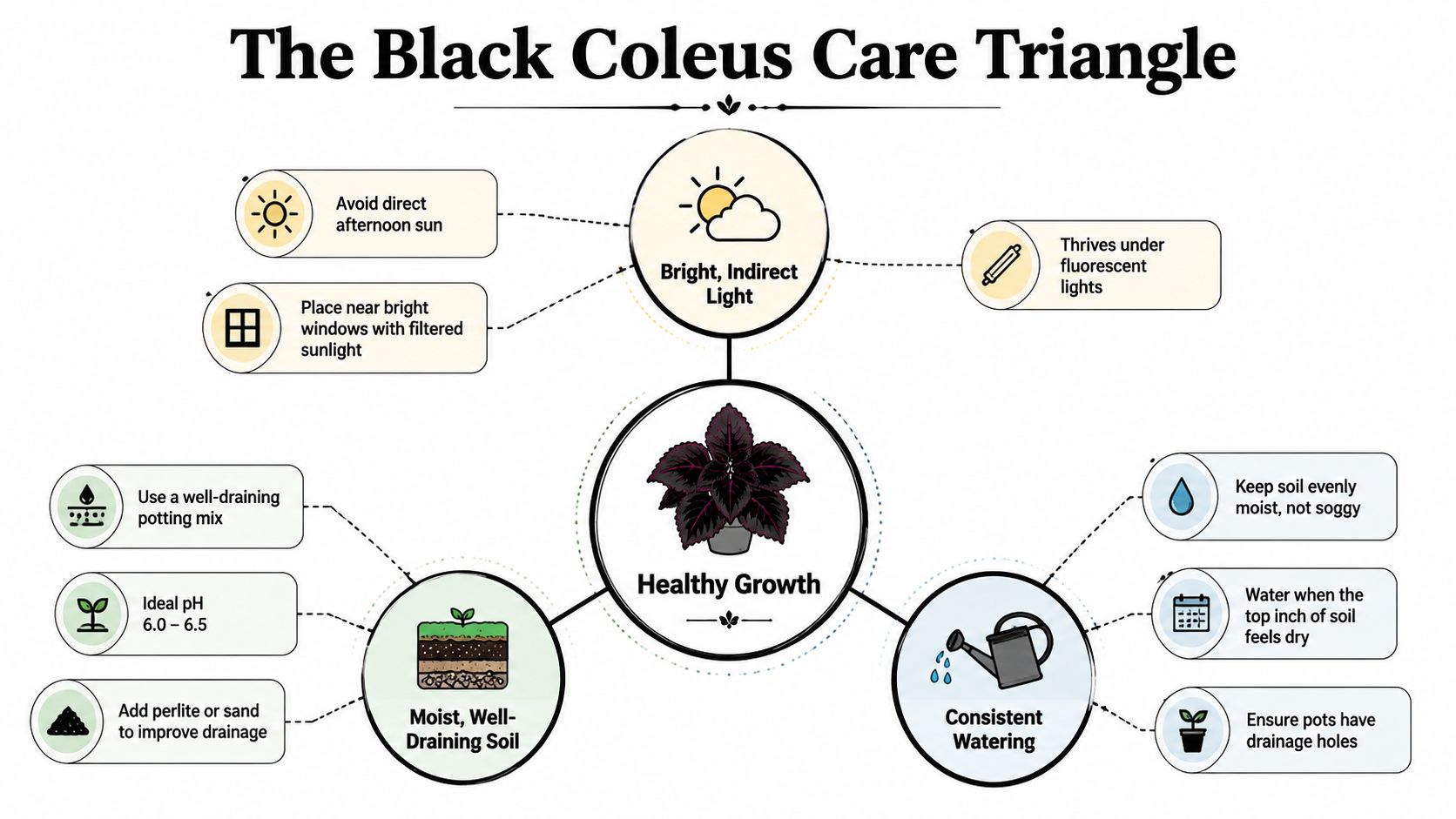
Start with the window. Most black coleus cultivars prefer part shade to shade, and ‘Black Dragon' is listed for part shade to shade with moist, well-drained soil in Texas Master Gardener plant information. Indoors, bright indirect light is a dependable choice. Gentle morning sun may suit the plant, but strong afternoon light through glass can scorch leaves, especially when the roots are already dry.
Why dark leaves still need careful light
Anthocyanins create the deep red, purple, and near-black colors that make these leaves so striking. Research on coleus varieties found that these pigments can reduce green light reaching deeper leaf tissue, which may help limit excess photon load in high light University of Minnesota Conservancy research. The pigment offers some protection, not complete protection from sunburn.
Use the leaves as your guide:
- Soft, bright light: Color usually stays richer, and the foliage remains firm.
- Harsh afternoon light: Pale patches or crispy edges may appear.
- Very dim light: Stems can stretch, and the dark coloration may become less intense.
Build a moisture-friendly root zone
Choose a rich, well-draining potting mix, or loam-based soil that holds water without turning dense and airless. The roots need moisture and oxygen, so use a container with drainage holes.
Check the soil instead of watering by calendar. Let the top 1 to 2 inches of mix dry, then water thoroughly until moisture reaches the root zone Hydrobuilder plant-care guidance. Bright light and heat may make the pot dry sooner, so inspect it more often during hot periods. Coleus has thin leaves and relatively shallow roots, which can make a dry plant wilt quickly.
A simple diagnosis helps:
Practical rule: Dry soil with wilted leaves usually indicates underwatering. Wet soil with wilted leaves points toward poor drainage or root trouble.
Consistent moisture matters because a thirsty coleus can lose its firmness dramatically, like a soft cloth collapsing when it is no longer supported. Soil that dries too far can cause rapid wilting and slower growth. Constantly wet media raises the risk of root rot. If you travel often, a dripping rain cloud plant waterer may help steady moisture between checks, but it should support soil checks rather than replace them. For a broader container routine, follow this guide to how to water houseplants.
Popular Black Coleus Varieties to Consider
‘Black Dragon' is the best-known example for gardeners who want a compact plant with a strong dark-leaf effect. University and botanic garden descriptions identify it as an annual with ruffled foliage, a mature size of about 12 inches high and wide, and a preference for partly shaded locations with moist, well-drained soil North Carolina Extension Gardener Plant Toolbox. Texas A&M horticulture materials list its foliage colors as black, purple, and red, with a typical height of 12 to 14 inches, width of 10 to 12 inches, and spacing of 10 to 42 inches Texas A&M AgriLife Extension plant information.
A botanic garden description adds an especially useful visual detail: the leaf centers can be bright red while the edges are deep purplish black, creating a molten-lava effect North Carolina Extension Gardener Plant Toolbox. That makes ‘Black Dragon' a strong choice when you want dark foliage with movement rather than a flat, uniform color.
| Cultivar | Height | Width | Leaf Features | Light Preference |
|---|---|---|---|---|
| ‘Black Dragon' | About 12 inches, or 12 to 14 inches in Texas A&M guidance | About 12 inches, or 10 to 12 inches in Texas A&M guidance | Ruffled leaves, bright red centers, deep purplish-black edges | Part shade to shade |
| Other dark-leaved coleus forms | Varies by cultivar | Varies by cultivar | May show burgundy, purple, red, ruffled, scalloped, or patterned foliage | Usually part shade to shade |
The table's variation matters because “black coleus” describes a visual group, not one uniform cultivar. Read the plant label before choosing a pot or border position. A compact form may suit a desk or narrow windowsill, while a more vigorous selection may need the breathing room of a patio container.
Regardless of the variety, choose based first on available space and preferred leaf shape. Care difficulty usually isn't the deciding factor, because dark coleus forms share the same basic preference for gentle light and evenly moist, well-drained soil.
Propagating Black Coleus from Cuttings
A healthy black coleus can become several matching plants with one stem cutting. This is especially useful when you want to preserve unusually deep foliage color or a ruffled leaf shape, since seed-grown plants may not repeat the parent's appearance.
Choose spring or early summer, while the plant is actively producing new growth. Select a firm, healthy, non-flowering stem with fresh leaves and no visible pest damage. Flowering stems may root, but non-flowering growth is the easier starting point, according to Nadia's Garden propagation guidance.
Take and prepare the cutting
Use clean, sharp scissors or pruning snips, then follow these steps:
- Choose healthy growth. Pick a sturdy stem with several leaves.
- Cut below a node. Take a 4 to 6 inch cutting just below a node, where the leaves join the stem. The node is the rooting point, so this cut places it at the base of the new plant.
- Remove lower leaves. Clear the lower section so leaves do not sit underwater or decay in damp soil.
- Choose a rooting method. Place the bare lower stem in clean water, or insert it into moist soil.
- Provide gentle light. Set the cutting in bright, indirect light rather than direct sun.
Warm conditions help roots form. Garden Gate propagation guidance recommends temperatures between 60 and 75°F, along with bright, indirect light that helps limit scorching.
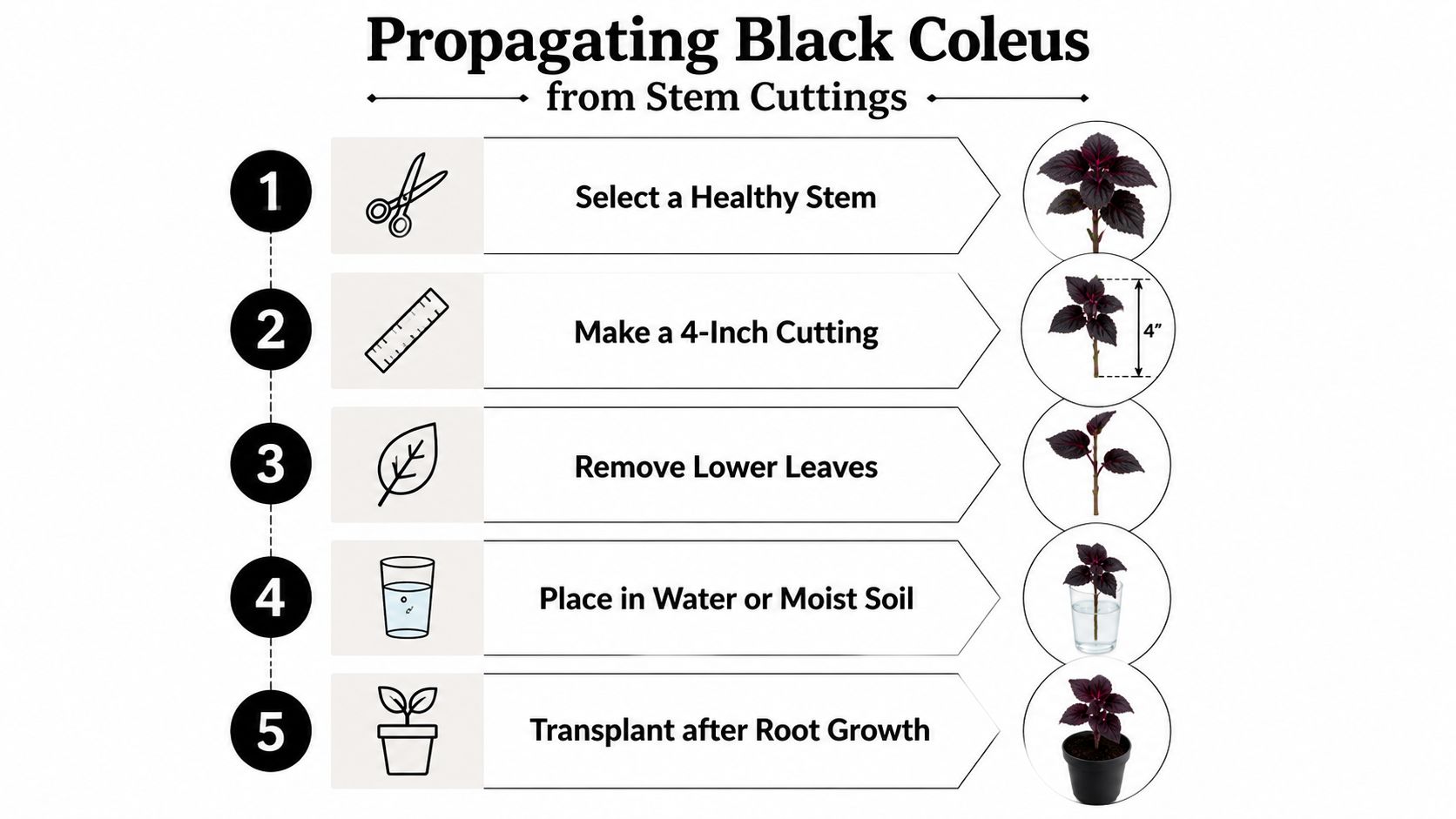
With water propagation, keep the lower node submerged while the leaves remain above the waterline. With soil propagation, keep the medium lightly moist, not saturated. Once a healthy root system develops, transfer the cutting to a small pot filled with well-draining mix and continue using gentle light as it settles.
The process needs little equipment. A clean glass, a small pot, and one healthy stem are enough to begin. For a similar beginner-friendly method, this guide to Swedish ivy propagation shows how healthy stem growth can produce new plants.
For a visual demonstration, watch the following propagation video.
Troubleshooting Common Black Coleus Problems
A wilted black coleus plant can look alarming because its leaves lose firmness quickly. Start with the soil, not the foliage. If the soil feels dry below the surface, water thoroughly and move the plant away from harsh light while it recovers. If the soil is already wet, adding more water can worsen the underlying problem, so inspect drainage and allow excess moisture to escape.
Use symptoms to identify the cause
| Symptom | Likely cause | Helpful response |
|---|---|---|
| Leaves wilt and soil feels dry | The root zone has dried too far | Water thoroughly, then monitor moisture more closely |
| Leaves wilt while soil stays wet | Poor drainage or root stress | Check drainage holes and the condition of the potting mix |
| Dark color looks less intense | Light may be too dim | Move the plant toward brighter indirect light |
| Crispy patches or scorched edges | Excessive direct light, especially with limited water | Shift to morning sun or bright indirect light and keep moisture steady |
| Fine webbing or stippled leaves | Possible spider mites | Isolate the plant and inspect leaf surfaces closely |
| White, cottony clusters | Possible mealybugs | Isolate the plant and remove visible pests carefully |
Low light can reduce the intensity that makes a dark cultivar appealing, but increasing light too abruptly can create a new problem. Move the pot gradually toward a brighter position, watching for leaf scorch and checking whether the soil dries faster.
Read the leaves together with the soil. A wilted plant isn't automatically thirsty, and a dark plant isn't automatically unhealthy.
Spider mites and mealybugs are common houseplant concerns, especially when plants experience stress or sit in crowded indoor conditions. Check leaf undersides, stem joints, and new growth during routine watering. Early detection makes the response calmer and more manageable.
Pruning can also help a tired plant look fuller. Remove damaged leaves with clean scissors, correct the growing conditions, and give new growth time to develop. Coleus often responds well when the owner fixes the routine instead of making several dramatic changes at once.
Styling and Placement Ideas for Every Space
A black coleus plant works best where its foliage can be seen clearly. Place a compact specimen on a bright table near a window with filtered light, or use a larger container as a shaded patio focal point. Pale pots, silver foliage, and lime-green companions bring out the purple and red undertones without competing with the dark leaves.
For a mixed container, let the coleus provide the visual weight. A trailing plant can soften the rim, while a lighter upright plant adds height and contrast. In an office, a single dark-leaved coleus can make a neutral corner feel more finished, provided someone can check its soil consistently.
Pet placement deserves equal attention. Neutral plant references describe coleus as slightly toxic to humans and moderately toxic to animals, with possible skin or stomach irritation if brushed against or ingested Plantquility plant-care reference. Keep the pot away from cats and dogs that chew foliage, and choose a stable location where leaves won't brush against frequently handled surfaces.
Busy owners and travelers can make care easier by using a self-watering globe or another gradual watering aid. These tools can support consistent moisture while you're away, but they work best when you test them at home first and continue checking the soil. The goal is balanced hydration, not permanently saturated compost.
A simple placement test brings everything together:
- Check the light: Bright indirect light is a dependable indoor starting point.
- Check the soil: Keep the root zone evenly moist with reliable drainage.
- Check access: Put the plant somewhere you'll notice it before the leaves become severely wilted.
- Check safety: Keep it beyond the reach of pets and young children who may touch or taste foliage.
Little Green Leaf offers decorative self-watering globes designed to make consistent plant care easier for homes, offices, and travel days. Visit Little Green Leaf to explore practical glass watering accessories that pair neatly with a black coleus plant and help you feel more confident about keeping its foliage vibrant.