

Watering Office Plants: How Often and When Globes Help
Office plants have no fixed watering day: check the soil about 2 inches down and water when that layer feels dry. One watering globe fill lasts up to about two weeks, less for thirsty plants, big pots, warm rooms and small globes.
The familiar advice to water every Friday confuses a convenient reminder with a plant's actual needs. In a shared office, the better system is a named caretaker, a soil check and a watering log, with a globe providing a reserve between checks.
Table of Contents
- How Often Office Plants Need Water and How Long a Globe Lasts
- A Simple Office Watering Routine That Works
- Overwatering and Underwatering Signs to Watch For
- Watering Globes Versus Spikes, Drip and Self-Watering Pots
- How to Set Up a Watering Globe for an Office Plant
- Decide Which Office Plants Get a Globe
- Plant Watering Globe Questions Buyers Ask
How Often Office Plants Need Water and How Long a Globe Lasts
No two pots in the same office dry at the same speed. Heating, air-conditioning, low light and irregular occupancy all change how fast moisture leaves the soil, and a large plant squeezed into a small container can run dry well before a small plant in a roomy pot. The University of Maryland Extension recommends checking roughly 2 inches below the surface and watering when that layer feels dry, with shallower checks for smaller containers.
Check depth and watering gap by container
| Pot or situation | Where to check the soil | Typical gap between waterings |
|---|---|---|
| Smaller containers | Top 1/2 inch | Shortest; small volumes can dry between routine rounds |
| 8–10 inch containers | Top 1 inch | Water once the checked layer feels dry |
| Larger pots | About 2 inches down | Longest; the bigger reservoir still needs verifying |
Treat each gap as a possibility and let the soil decide. When a check shows the layer has dried, water slowly across the surface and let the excess drain away. Log the reading either way, because a record of how fast each pot dries is what turns these ranges into a real schedule.
A larger globe holds a bigger reserve. Little Green Leaf offers globes in 100 ml, 200 ml and 350 ml sizes plus a mixed option, and a thirsty plant can drain the largest of them well before the maximum duration. The water still has to reach the whole root zone, so size the globe to the pot and the plant rather than to the length of the trip.
The soil controls the release. As the mix dries, oxygen travels down the stem and displaces water into the root zone; once moisture returns, airflow slows and the drip tapers off on its own. Insertion angle changes the pace: a globe set near 90 degrees restricts airflow and drips slowly, while one at about 45 degrees releases water more freely. One fill can last up to two weeks, though plant type, climate, pot size and angle all move that figure. Either way, the globe covers the days between checks, and the checks still set the schedule.
Planning for time away
A week away usually fits inside a globe's working duration, provided the caretaker has watched it perform through a few normal cycles first. Before departure, check the soil, water any pot that needs it, let drainage finish and confirm the globe is releasing.
An absence approaching the two-week ceiling needs a refill plan or a named helper. For longer stretches I recommend setting the globe more upright to slow the drip, but any closure beyond a single fill requires someone to walk the route and inspect the pots in person.
Schedule inspections on the calendar. Let the soil decide whether watering happens.
A Simple Office Watering Routine That Works
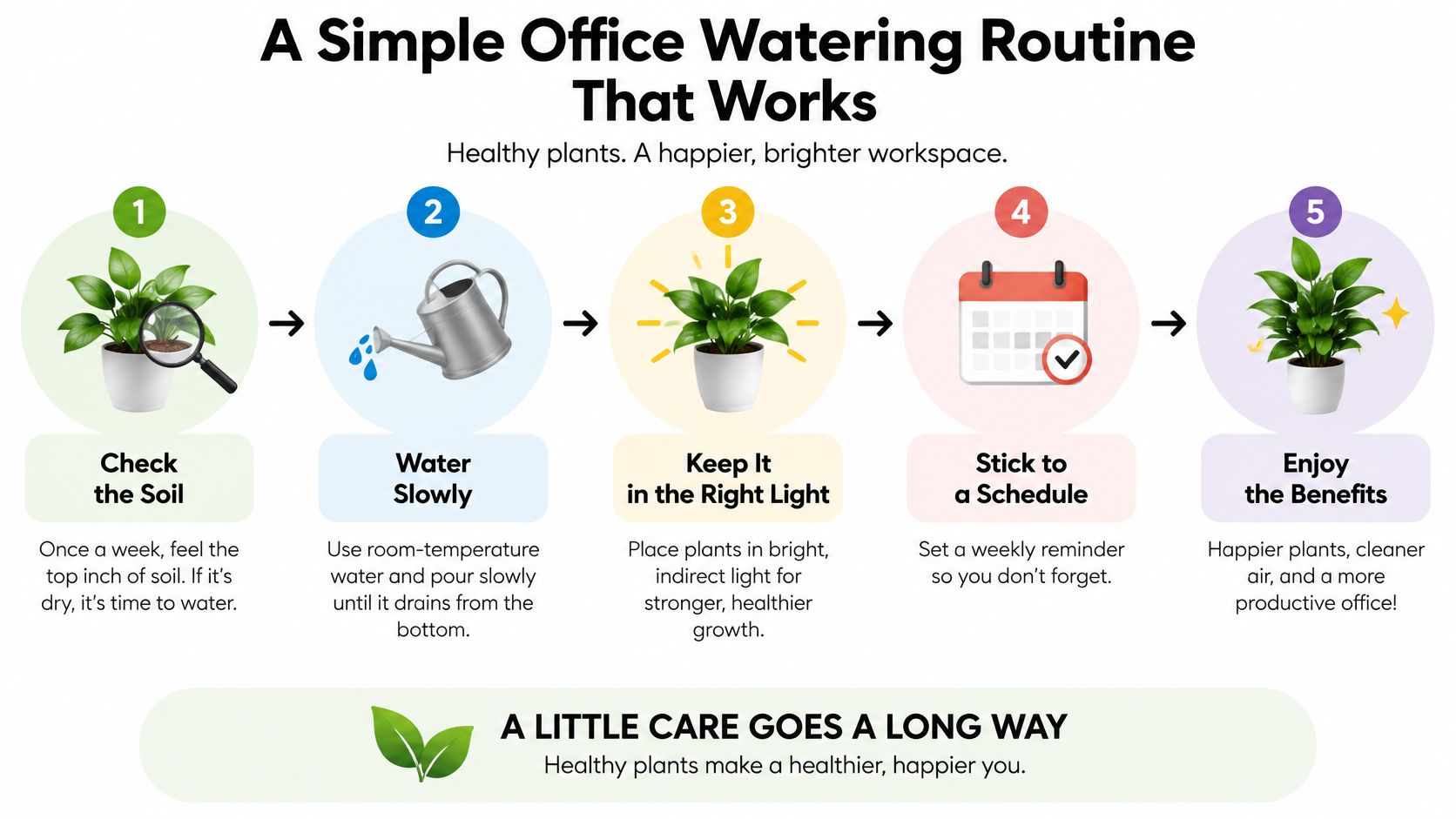
Shared responsibility works only when someone owns the decision. A plant left to everyone can receive several well-meant waterings, while another gets none because each employee assumes a colleague handled it.
The Utah State University Extension houseplant guide supports inspecting pots at least weekly and checking about 5 cm (2 inches) into the medium, or approximately one-third of its depth, before deciding whether to water.
Assign responsibility before adding equipment
- Group comparable pots. Plants with similar container sizes and exposure can share an inspection route, although each pot still needs its own check.
- Name a primary caretaker and a backup for each group. Record both names on the log so sick days and closures don't leave ownership unclear.
- Check the growing medium, not just the leaves. A finger test should reach below the dry-looking surface; unusually fast-drying pots need attention between routine rounds.
- Water only the pots whose checked layer has dried. Pour slowly across the surface until water exits the drainage hole, then discard runoff after drainage finishes.
- Record the result. Note the inspection date, whether the soil was wet, damp or dry, whether water was added and whether drainage occurred.
- Before a closure, inspect the entire group. Water eligible pots and prepare tested globes for suitable plants, rather than soaking every container automatically.
Make the log useful to the next person
Say a plant beside a warm window dries quickly while a similar-looking plant under a shelf stays damp. Giving both the same amount of water on the same day can leave the first thirsty and the second waterlogged.
The log should distinguish an inspection from a watering. An entry saying “checked, still damp, no water added” prevents a colleague from interpreting an unchanged watering date as neglect.
A card beside the pot can work as well as a shared sheet, provided everyone uses the same record. The indoor plant watering schedule guide helps turn reminders into inspection appointments rather than automatic watering orders.
After repeated rounds, the caretaker can identify fast-drying pots, slow-drying pots and reservoirs that need closer supervision. The useful outcome isn't a perfectly uniform schedule. It's a routine another employee can follow without guessing.
Overwatering and Underwatering Signs to Watch For
| Symptom | Soil condition | Likely cause and first fix |
|---|---|---|
| Drooping leaves | Wet | Possible root loss or root rot; stop watering and check the roots |
| Drooping leaves, soil pulling from pot | Dry | Underwatering; water thoroughly until water drains out |
| Gray-green foliage | Dry | Excessive dryness; water fully, then recheck below the surface |
| Yellowing or leaf drop | Soggy | Excess moisture; hold water and empty the saucer |
| Crispy leaf edges | Dry | Underwatering; slowly rehydrate the root ball and let it drain |
These combinations guide the first response; a leaf symptom alone isn't a diagnosis. Crispy edges, for example, don't justify watering when the soil underneath remains wet.
Wilting isn't proof of drought
The most damaging reflex is adding water to every drooping plant. Roots in constantly wet soil can lose access to oxygen and deteriorate, leaving the plant unable to take up water even though its pot is full of it.
The University of Maryland Extension watering guidance identifies wilting and gray-green foliage as signs of excessive dryness, while yellowing or leaf drop can indicate excessive moisture; its moisture check reaches about 2 inches into the soil.
A caretaker should therefore feel the growing medium before reaching for the watering can. Wet soil plus drooping calls for investigating drainage and root condition, not another refill.
Where a globe helps and where it doesn't
A globe can bridge drying between visits. It can't restore damaged roots, open a blocked drainage hole or make a waterlogged container safe.
For a dry plant, thorough watering comes before reservoir installation. For a soggy plant, the globe stays out while the caretaker addresses standing water and allows an appropriate drying period.
First response: Check the soil before treating the symptom. A drooping plant may need less water, not more.
The handover check can stay short:
- Moisture: Has the relevant checking depth dried enough for this plant?
- Drainage: Can excess water leave the inner pot freely, without collecting around its base?
If either answer is unclear, adding a reservoir isn't the next step.
Watering Globes Versus Spikes, Drip and Self-Watering Pots
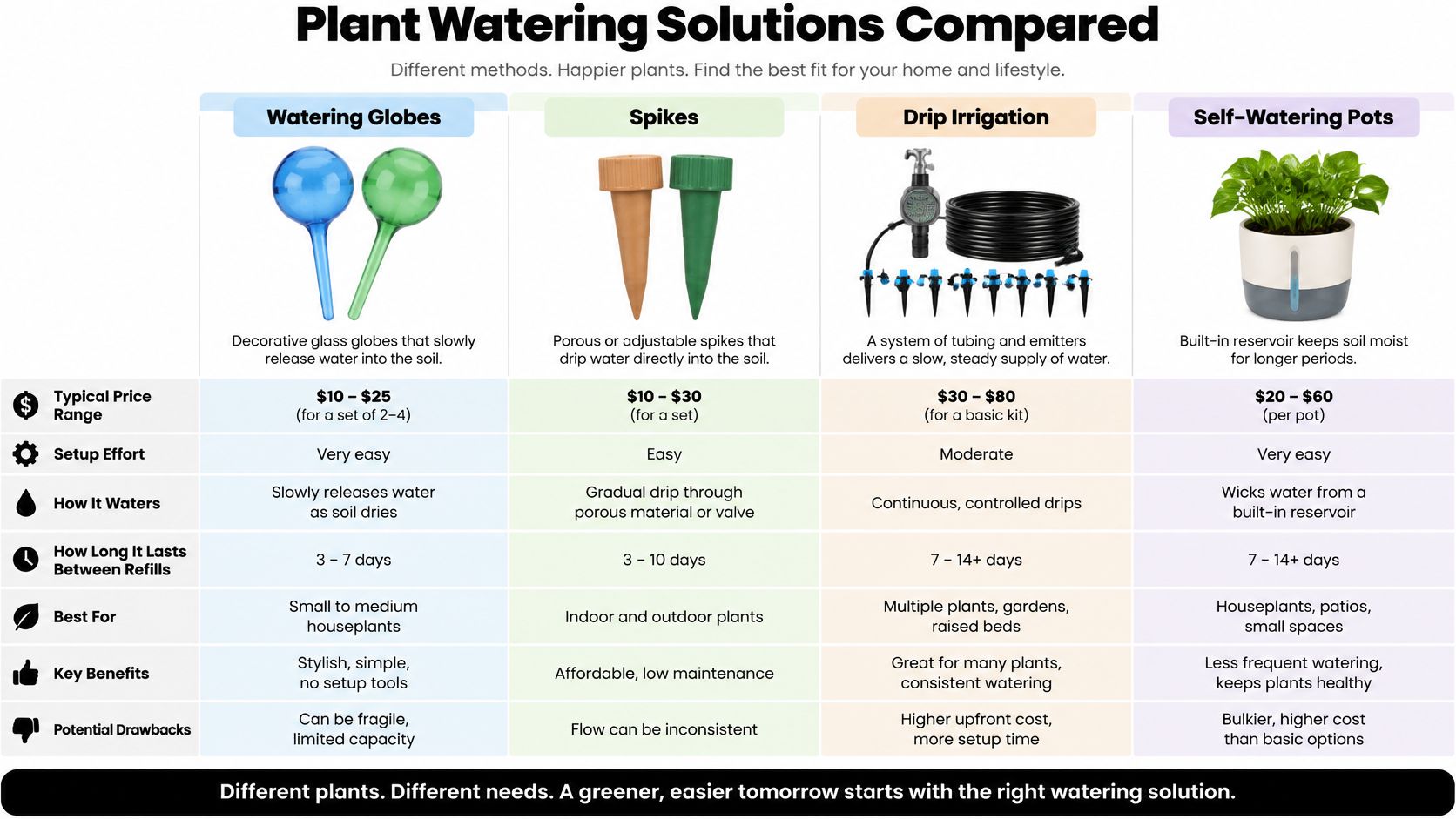
| Option | How long one fill lasts | Setup and refill | Clogging and upkeep | Outdoor use |
|---|---|---|---|---|
| Watering globe | Up to about two weeks, less for thirsty plants or small globes | Fill, insert into moist soil and refill when empty | Dense soil can block the stem; tip covers help | Suitable for containers and hanging baskets |
| Terracotta spike | Reservoir volume and tested delivery rate set the refill point | Fill the attached reservoir and insert the spike | Inspect the outlet and clean deposits | Use a model intended for outdoor containers |
| Drip system | Stored-water capacity or a connected supply sets operating time | Install tubing and emitters for the plant group | Check outlets for blockage, leaks and uneven delivery | Suitable with outdoor-rated components |
| Self-watering pot | Reservoir capacity and plant uptake set the refill point | Refill the built-in reservoir | Keep the filling route and overflow clear | Suitable when designed to manage outdoor rainfall |
Match the equipment to the office
Scattered desk and shelf plants suit globes. Each pot gets a visible reserve without tubing, power or an app. The trade-off is that someone still has to inspect and refill each reservoir individually.
A long bank of plants may justify drip delivery, especially when a suitable water supply is nearby. Installation takes more work, and an unnoticed leak can damage office furniture or flooring, so supervision matters.
A self-watering pot makes more sense when replacing containers is already planned. It's a bigger change than adding a globe, and the caretaker still needs to understand the reservoir and overflow arrangement.
Terracotta spikes are another gradual-delivery category, not a guaranteed solution to longer absences. The self-watering plant spikes comparison helps clarify the practical differences without assuming that every device releases water at the same rate.
Compare work per plant, not just the purchase
A small office may benefit more from straightforward setup than from centralized irrigation. A larger collection may justify additional installation work if it reduces repeated individual refills.
Cost per plant should include the reservoir or container, installation components and the time spent checking the system. Without a specific configuration, a precise cost comparison would be misleading.
The Washington State University Extension houseplant handbook recommends monitoring soil dryness and thoroughly watering the root ball until drainage occurs. Any watering aid should support that plant-care standard, not substitute for checking whether roots receive water and excess can escape.
Globes aren't always the answer. Their strongest use is a modest collection of suitable plants where the main problem is forgetting between otherwise sensible inspections.
How to Set Up a Watering Globe for an Office Plant
A globe should be tested during normal office occupancy, not installed for the first time immediately before everyone leaves. That gives the caretaker a chance to detect fast emptying, a blocked stem or poor soil contact.
Prepare the pot and install the reservoir
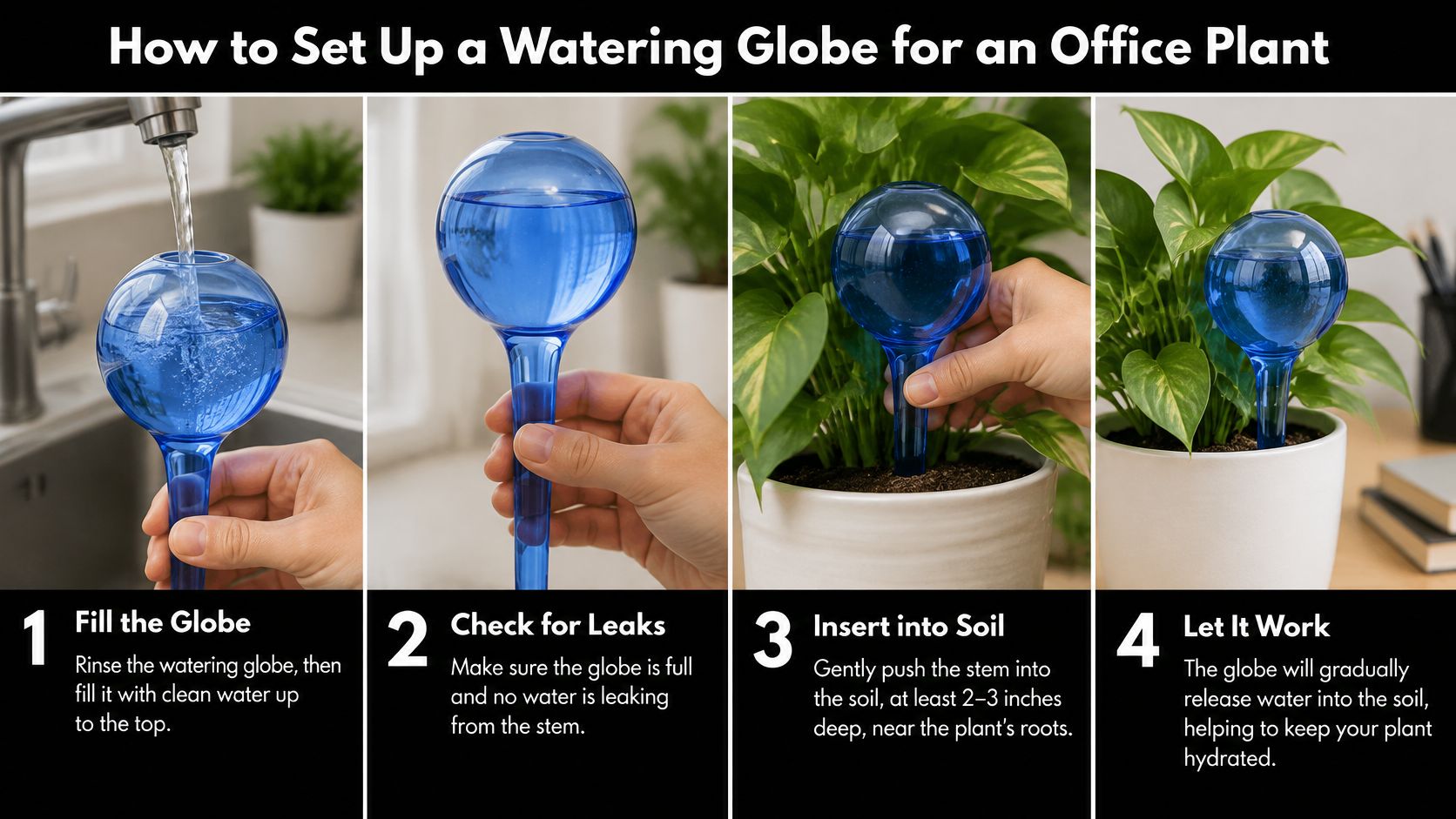
- Water first when needed. Thoroughly hydrate a dry root ball and let it drain. Check beneath the surface to confirm that water reached the growing medium rather than running straight down the pot's sides.
- Make a pilot hole with a pencil in dense soil, deep enough to accept the stem. Keep the hole away from the plant's crown and don't force glass through compacted material.
- Fill with clean water. Choose the reservoir capacity for the pot's observed drying rate, rather than choosing solely by appearance.
- Insert the stem at an angle with the bulb supported securely. An insertion around 45 degrees allows easier release than a near-vertical position; soil should contact the stem without requiring force.
- Check after two days. Look for gradual reservoir use and moisture near the stem. An unchanged level with dry soil suggests a delivery problem; rapid emptying calls for checking the installation and the plant's demand.
Test duration rather than assuming it
Oklahoma State University Extension notes that small pots may need water every 2–3 days, while large pots may need watering every 7–14 days, with season, temperature, humidity, species and potting medium affecting frequency.
Those are watering intervals, not measured globe runtimes. They explain why identical reservoirs can need different refill routines.
A small globe on a warm, sunny desk may empty faster than a larger reservoir serving a less thirsty plant in a cool corner. A large, actively growing plant can reverse that expectation, so reservoir size alone can't predict performance.
Clear blockages without stressing the glass
If delivery slows, remove the globe gently and rinse the bulb and stem with clean water. Check the outlet for trapped soil before reinstalling it.
An optional plastic anti-clog sleeve can help keep soil out of the stem. It doesn't remove the need for a pilot hole or a delivery check.
Glass breaks if dropped or levered sideways. Support the bulb during removal, avoid pulling against resistance and keep filled globes away from desk edges and busy walkways.
Decide Which Office Plants Get a Globe
A globe earns its place when a plant's moisture needs match gradual delivery and someone still owns the soil check and the log. The reserve serves the routine, and the routine is what keeps shared plants alive.
Moisture-demanding tropical houseplants, including suitable pothos and peace lilies, are the strongest candidates. They need aerated soil and drainage that keeps the root zone oxygenated. A compacted or already soggy mix has to be corrected before any globe goes in.
Sort the collection before buying
- Globe-friendly plants: Healthy tropical plants whose soil dries predictably between checks.
- Hand-check plants: Very large pots, plants with uncertain drainage and containers with uneven moisture. One globe cannot serve a very large root zone on its own.
- Plants to skip: Succulents, cacti and any plant that needs a pronounced drying period.
Virginia Cooperative Extension recommends thorough but infrequent watering for succulents and cacti, roughly once or twice per month, a rhythm continuous moisture release would override.
The office desk plant guide helps group likely candidates. A short pilot on a few plants, with each globe's emptying noted in the log, beats outfitting the whole office at once.
Choose a manageable reserve
Little Green Leaf's hand-blown glass watering globes come in 100 ml, 200 ml and 350 ml sizes plus a mixed-size option, in multicolor, clear rainbow and mushroom designs. Capacity should follow what the soil checks and the log actually show: bigger globes add reserve for thirstier plants, and the smallest suits a desk pot that dries quickly.
Measured water use and safe placement drive the choice. A globe does one job in a shared routine: it holds soil moisture steady between checks and the next logged watering.
Plant Watering Globe Questions Buyers Ask
How long does a plant watering globe last?
Up to two weeks on a single fill, depending on plant type, climate, pot size and the angle the globe is inserted. The useful number for planning is the observed empty time in each specific pot, so the caretaker should note it in the watering log during the first weeks and let that interval, not the maximum, shape expectations.
How often should I water office plants?
When the soil says so, not when the calendar does. The caretaker checks below the surface on a set day, logs the reading, and waters only the pots whose appropriate layer feels dry. Small pots that dry quickly get checked more often; the log turns those differences into a workable schedule.
Can I use a watering globe for succulents or cacti?
Keep them on a hand-watering routine instead. These plants need a pronounced drying period between thorough waterings, while a globe releases moisture continuously, so they sit outside the shared reserve system entirely.
How do I stop a watering globe stem from clogging?
An optional plastic tip cover shields the outlet from packed soil. If release still slows over time, the caretaker should remove the globe gently and rinse the bulb and stem with clean water before reinserting it.
Will a watering globe fix soggy or overwatered soil?
A globe is a reserve for plants that already drain well, so it stays on hold until the wet pot recovers. Withhold water, check the drainage, and only add a reserve once the soil cycles between moist and dry again.
Little Green Leaf offers decorative glass watering globes that serve as a reserve for suitable office plants between moisture checks. Visit Little Green Leaf to choose a capacity for a supervised trial, then keep a named caretaker and a simple watering log in place.