

Soil pH for Blue Hydrangea: How to Test and Lower It
Blue hydrangeas need soil pH between 5.0 and 5.5, where aluminum becomes available to the roots and helps turn the flowers blue. If you've been watering faithfully and still get pink blooms, the issue may be soil chemistry rather than plant care.
You planted a hydrangea expecting cool blue flower heads, then spent the season watching the buds open pink or lavender. It's a common weekend-gardening surprise, and it doesn't mean you've failed. For a pH-responsive hydrangea, color depends on a relationship between soil acidity, aluminum availability, moisture, and consistent maintenance.
Why Your Hydrangea Blooms Turn Pink Instead of Blue
The most likely explanation is that the soil has drifted away from the acidic range your plant needs. Hydrangea macrophylla, commonly called bigleaf hydrangea, produces blue flowers when aluminum is available to its roots. Soil acidity makes that aluminum more soluble, allowing the plant to take it up and express blue color in the blooms.
University of Georgia explains that flowers turn blue at pH 5.5 and below, while Clemson identifies pH 5.0 to 5.5 as the blue-flower range and pH 6.0 and above as the pink range. The University of Massachusetts similarly reports that most bigleaf hydrangeas produce blue flowers below pH 5.5 and pink flowers above pH 6.5, with purple or mixed shades often appearing in between. You can review the university guidance from the University of Georgia on hydrangea bloom color and soil pH.
The simple chemistry behind the color
Think of pH as a gatekeeper. In acidic soil, aluminum is more available in the soil solution, where roots can absorb it. As pH rises, aluminum can bind more tightly to soil particles, leaving less available for the plant and allowing pink, red, purple, or mixed tones to dominate.
Research summarized by Washington State University describes the same pattern across studies conducted from 1949 through 1998, with highly acidic soils, generally around pH 3.5 to 5.5, favoring blue flowers and soils around pH 5.5 to 7.5 favoring pink or red flowers. That long research history is why soil pH for blue hydrangea care is more dependable than judging the soil by sight or guessing from the bloom color alone. Read the Washington State University hydrangea research summary for the background.
First check the plant, not just the soil
Not every hydrangea can be persuaded to turn blue. Bigleaf hydrangeas and mountain hydrangeas are the main pH-responsive types. White-flowering hydrangeas generally stay white, and types such as smooth, panicle, and oakleaf hydrangeas don't respond to soil pH in the same color-shifting way.
That distinction can save you weeks of unnecessary amendments. Before changing the soil, confirm the plant's identity on its label or ask the nursery where you bought it. Soil texture matters for broader plant care too, so gardeners unfamiliar with their bed may find this guide to understanding sandy loam soil useful before making adjustments.
How to Test Your Soil pH Accurately
Start with a soil test before adding sulfur or aluminum sulfate. A test tells you whether the root zone is already acidic, mildly acidic, or too alkaline for blue color. It also prevents the common mistake of adding more amendment because the flowers haven't changed yet.
Collect soil from several spots around the hydrangea's drip line, where rain naturally falls from the outer leaves. Use a clean bucket, remove stones and plant debris, mix the samples thoroughly, and test soil that's moist but not saturated. Early spring is a practical testing time, before new growth emerges and before you apply an amendment.
Choose a testing method that fits your needs
A color-changing indicator kit is the simplest starting point. It's quick and affordable, but the color chart can make small differences difficult to read. Use it for a general direction, not as the only evidence when your soil is close to the blue-flower range.
Digital pH meters provide an instant readout, but they need proper calibration and clean handling. Insert the probe into the root-zone soil, roughly 4 to 6 inches deep, and take readings from multiple locations before deciding what to do. If you use tap or filtered water as part of your routine, you can also learn more about water measurements through Praz Pure Water's pH testing help.
Professional laboratory analysis offers the most detailed diagnosis. A local cooperative extension service may report soil pH along with buffer pH and aluminum levels, which helps explain why an acidic reading may still fail to produce blue flowers if soluble aluminum is limited.
Practical rule: Test the soil you're actually trying to change, not soil taken from a random spot elsewhere in the garden.
Retest during active correction rather than applying amendments by habit. Extension guidance commonly recommends checking every 6 to 8 weeks while you're adjusting pH, then testing less often once the root zone stays stable. If you're unsure whether the soil is dry enough to test or water, this guide to telling if soil is dry can help you make a better observation before sampling.
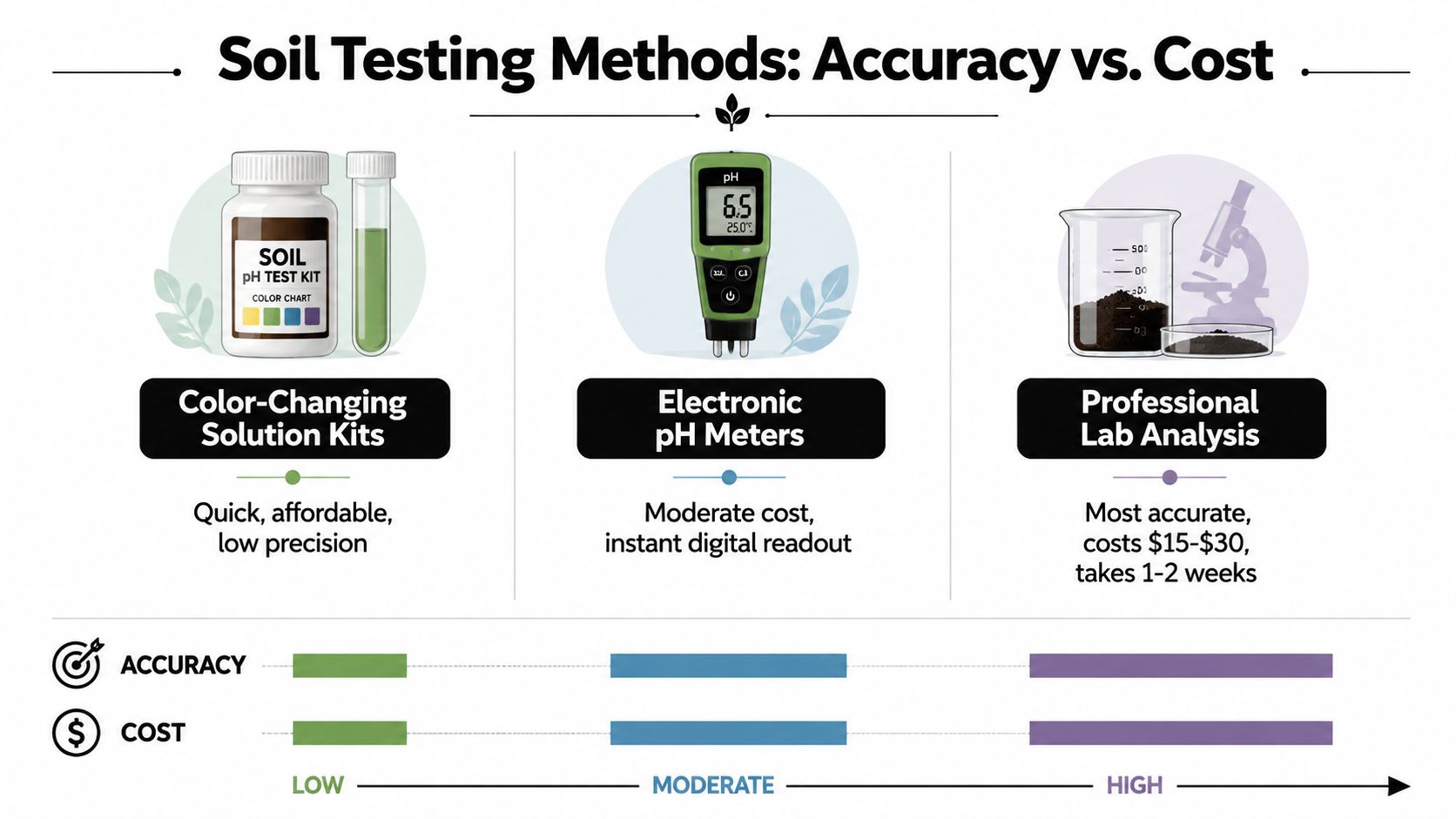
A visual walkthrough can make the testing process less intimidating:
Lowering Soil pH Safely for Blue Blooms
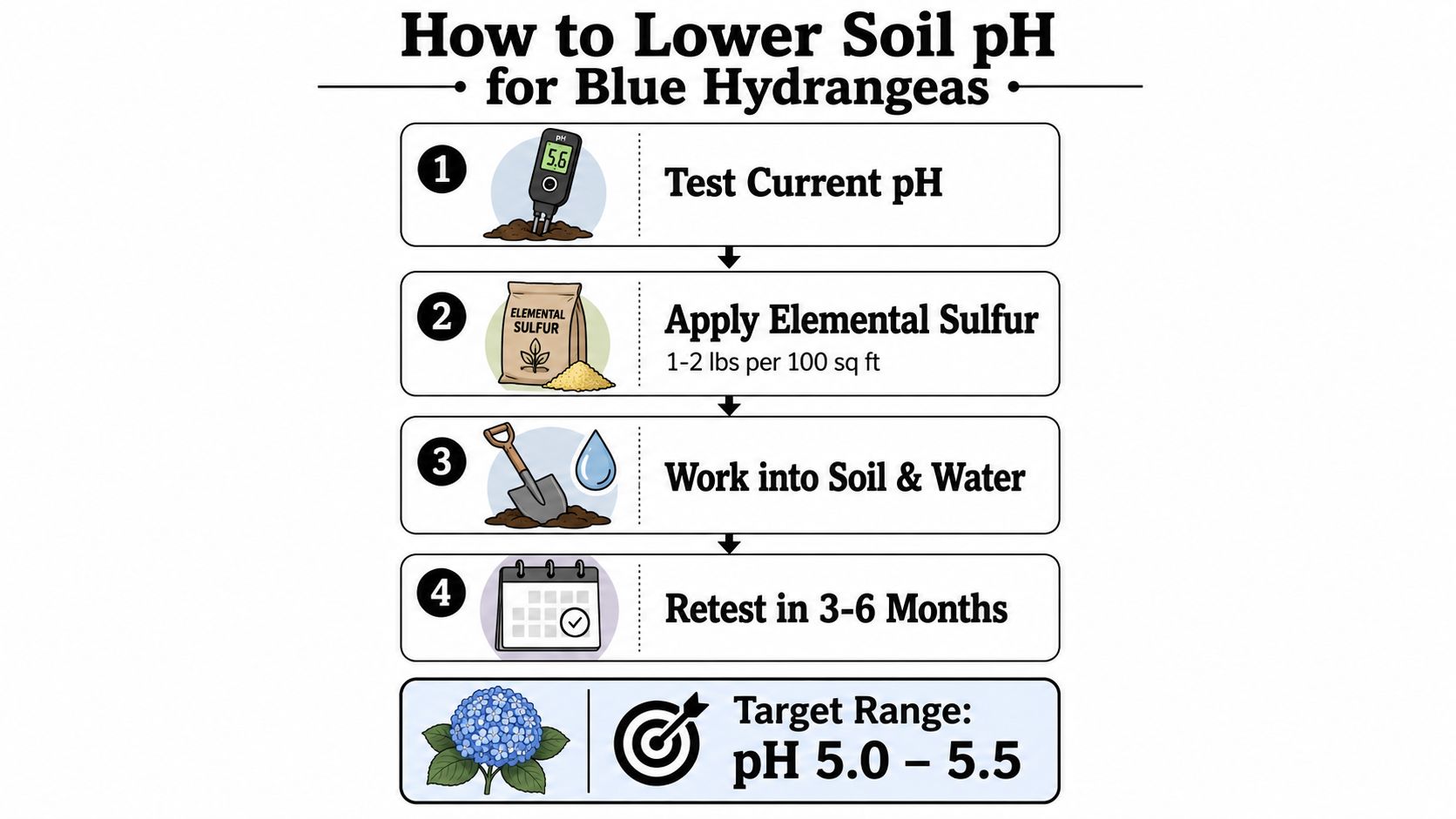
Once testing shows that the soil is too alkaline, lower the pH gradually. The practical target for blue bigleaf hydrangeas is pH 5.0 to 5.5, but the right amendment depends on how quickly you need a change and how closely you can monitor the root zone.
Start with elemental sulfur
Elemental sulfur is usually the slower, gentler choice. Soil bacteria convert it over time into compounds that acidify the soil, so it won't create an immediate color change. For a measured application, use 1 to 2 pounds per 100 square feet, work it into the top 4 inches of soil, and water thoroughly.
Sulfur works best when soil temperatures are above 55°F, and results can take 3 to 6 months. That makes it a useful option when you're planning ahead rather than trying to correct color during an active bloom period. Heavy clay soil may also need patience because amendments move gradually through dense soil.
Use aluminum sulfate for a faster adjustment
Aluminum sulfate can act more quickly because it contributes acidity while also supplying aluminum. Clemson's guidance recommends applying it when new growth emerges in April. A commonly cited solution is 1 tablespoon per gallon of water, applied as a root-zone drench every 2 to 3 weeks during the growing season. See the Clemson hydrangea care guidance for its blue-flower pH benchmark and seasonal timing.
Water the soil before applying aluminum sulfate, never apply it to dry soil, and watch the foliage for signs of stress. Keep your approach conservative because over-application can damage roots and make the soil too acidic.
Make safety part of the routine
Wear gloves and eye protection, avoid windy application days, follow the product label, and store amendments away from children and pets. Retest before each later application. Don't keep dosing because the flowers haven't responded yet.
A soil pH below the intended range can create its own problems, including excessive aluminum availability and root injury. Gentle adjustments, thorough watering, and repeat testing are safer than a heavy one-time treatment.
Choosing the Right Amendment for Your Garden
No single acidifier suits every garden. Elemental sulfur, aluminum sulfate, and acidifying fertilizers can all fit into a blue-hydrangea routine, but they differ in speed, precision, and how much attention they require.
| Amendment | Speed of Action | Longevity | Best For | Application Rate (per 10 sq ft) |
|---|---|---|---|---|
| Elemental sulfur | Slow | Longer-lasting once converted | Gardeners planning ahead and heavier soils | Follow the product label and base the amount on a soil test |
| Aluminum sulfate | Faster | Requires closer monitoring | A measured seasonal correction when aluminum availability is also a concern | Follow the product label and retest before repeating |
| Acidifying fertilizer | Gradual | Ongoing while included in feeding | Gardeners who prefer to combine feeding and gentle acidification | Follow the product label for the specific fertilizer |
Elemental sulfur is a good fit when you want a slower change and can wait through the conversion process. It's often easier to manage in an established bed because you're not trying to force the soil to change immediately.
Aluminum sulfate suits gardeners who need a more direct response, but it demands care. Because it can add soluble aluminum as well as acidity, overuse is more likely to create root stress. Apply only after testing, and avoid treating the product as a substitute for diagnosis.
Acidifying fertilizers, including products based on ammonium sulfate, provide a gradual option that can fit into a regular feeding schedule. They aren't a shortcut for severely alkaline soil, but they may help maintain a suitable root-zone environment after the main correction. Use a balanced plant-feeding routine, and consult this guide to organic fertilizer for plants if you prefer a gentler approach to overall soil care.
Containers need special attention because their root zones are smaller and amendments can concentrate more quickly. In-ground beds have more soil volume and may respond more slowly, especially when alkaline irrigation water or calcareous soil continually pushes pH upward. The best choice is the one you can apply lightly, monitor consistently, and adjust based on fresh test results.
Maintaining Blue Hydrangeas Year After Year
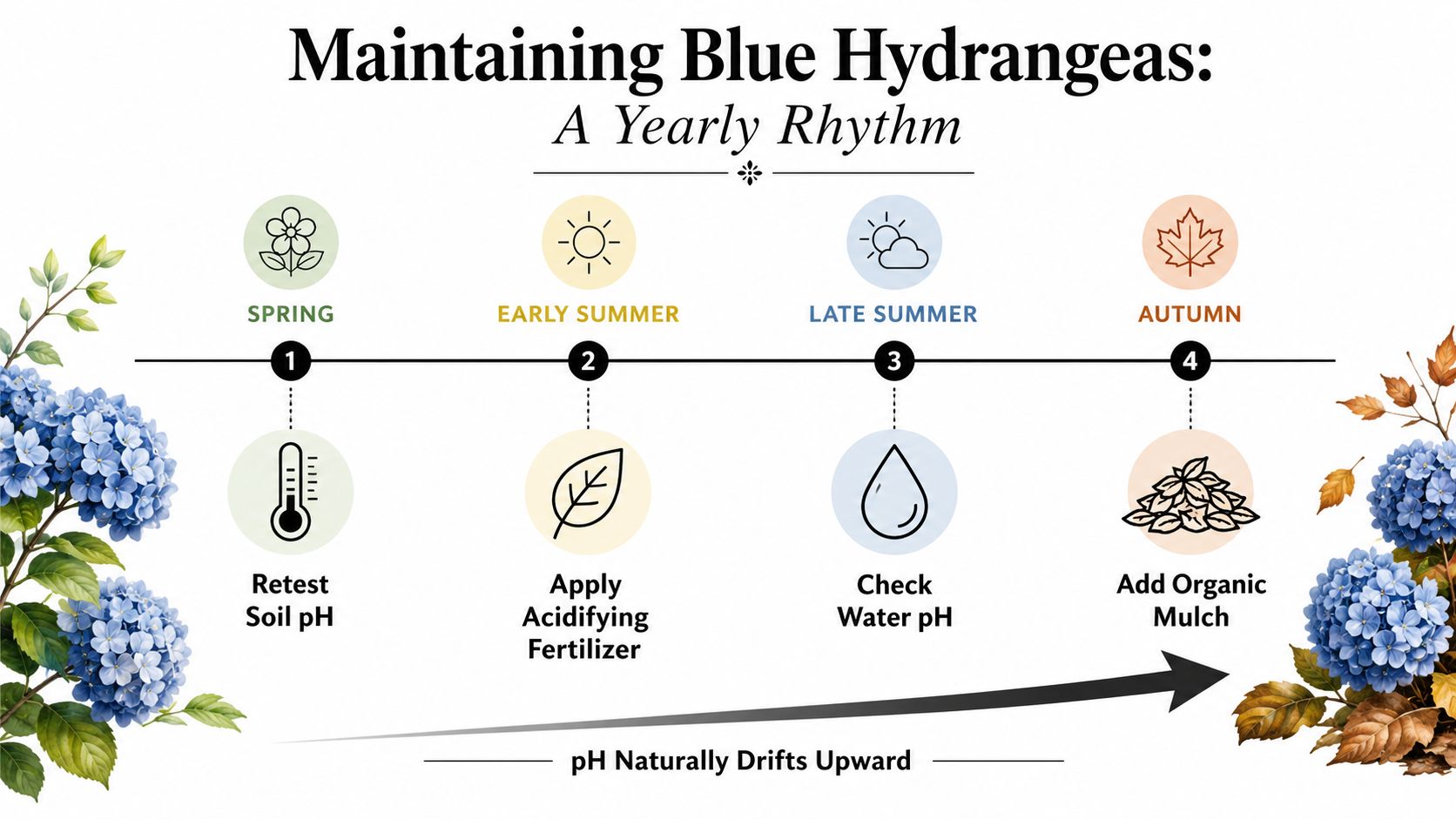
Blue color is a maintenance rhythm, not a one-time chemical fix. Soil pH can gradually rise, particularly where irrigation water is alkaline or the surrounding soil contains limestone. Even after a successful correction, the root zone needs occasional observation.
Build a simple seasonal pattern
Test in early spring before new growth emerges. If the reading has moved above your target, apply a light treatment of the amendment you've chosen, then retest during the growing season rather than repeating the application automatically.
Watering deserves equal attention. Consistent moisture helps roots absorb nutrients steadily and reduces the stress that can affect bloom quality. If your tap water is alkaline, collecting rainwater can reduce the amount of alkaline input reaching the root zone. Avoid adding household vinegar unless you're following reliable, plant-specific guidance, because an uneven dose can create a sharp local change instead of a stable improvement.
Let mulch support the root zone
Pine needles, oak leaves, and composted bark add organic matter, help retain moisture, and protect the soil surface from drying quickly. Mulch won't replace a soil test or correct a strongly alkaline bed by itself, but it can support a more buffered environment around the roots.
Avoid high-phosphorus fertilizers when blue color is your priority. Excess phosphorus can bind with aluminum, reducing the amount available for uptake even when the pH reading looks suitable.
Blue flowers come from stable conditions. A lightly maintained root zone usually serves the plant better than repeated strong corrections.
For apartment gardeners or frequent travelers, the same principle applies in a container. Use a well-drained mix, monitor moisture at the root zone, and make small, measured changes instead of leaving the plant alternately dry and saturated.
Common Mistakes That Prevent Blue Flowers
The biggest mistake is treating aluminum sulfate as a race. Adding more will not necessarily create bluer blooms, while excessive amendment can injure roots or make soil too acidic. Test first, water the soil, follow the label, and allow time for the root zone to respond.
Coffee grounds contribute organic matter, but they offer little control over soil pH. Use a measured soil test and a labeled amendment when you need a clearer path toward blue flowers.
High-phosphorus fertilizer can bind aluminum in the soil and interfere with color. Choose a suitable feeding routine, and avoid assuming extra phosphorus will improve blooms.
As noted earlier, only bigleaf and mountain hydrangeas respond to pH. Confirm your cultivar before investing in amendments. If the plant is not pH-responsive, changing the soil may affect nutrition without changing flower color.
Acidifying fertilizers work gradually and fit a regular feeding schedule rather than correcting severely alkaline conditions quickly. Retest after applications. If soil is already acidic but blooms are fading pink, check aluminum availability, irrigation water, cultivar response, and whether the plant was identified correctly.
Little Green Leaf offers decorative self-watering globes that release water gradually as soil dries, helping busy plant owners maintain steadier moisture between care days. Visit Little Green Leaf to explore practical glass watering globes for everyday plant care, travel, and thoughtful gifting.