

Glass Plant Decor: Which Pieces Also Water Your Plants
Most glass plant decor only displays a plant; a watering globe is the glass accessory designed to release water into soil as it dries. Choosing by color or shape alone misses the practical question: whether the piece supplies water, traps it, or merely holds a plant.
A globe can provide up to about two weeks per fill, but that's an upper limit, not a travel guarantee. Thirsty plants, large pots, warm rooms, and small bulbs shorten the interval, so the best purchase starts with the watering needs of each pot.
Table of Contents
- Which Glass Plant Decor Pieces Actually Water Plants
- How Long Does One Watering Globe Fill Last?
- How a Globe Evens Out Overwatering and Underwatering
- Which Plants Suit a Watering Globe and Which to Skip
- Globes vs Spikes, Drip and Self-Watering Pots
- How to Set Up a Little Green Leaf Globe in Dense Soil
- Frequently Asked Questions About Watering Globes
Which Glass Plant Decor Pieces Actually Water Plants
A glass object doesn't become a watering aid just because it contains water. The useful distinction is delivery versus display: does the piece move stored water into the root zone, or does someone still have to manage every watering?
The four pieces buyers commonly encounter
A watering globe is a hand-blown bulb with a long, narrow stem. The owner fills the bulb and inserts the stem into moist soil, where water releases gradually between checks. The visible reservoir also makes it easier to notice when the supply is running low, though the water level alone doesn't establish whether the plant needs more.
A glass terrarium encloses a plant and its growing medium. A closed enclosure can retain and recirculate moisture, but it isn't a reservoir that supplements an existing houseplant pot. Its owner still has to assess moisture, avoid excessive watering, and keep a sealed enclosure out of direct sun where heat can build.
A glass vase or cloche serves a different purpose again. A vase can hold water and cuttings, while a cloche covers a plant or arrangement; neither automatically meters water into a conventional root ball. Clear glass helps with visual inspection, but roots shouldn't be handled repeatedly just to judge moisture.
A glass cachepot conceals a nursery pot inside a decorative outer vessel. Without a drainage hole, the outer pot catches runoff, which must be emptied rather than left around the inner pot's base. A layer of decorative stones doesn't give excess water an exit.
Choose the watering function before the styling
For a room-level starting point, Lewis and Sheron Textiles' advice on getting started with interior decorating can help establish a coherent look. That visual plan still needs to leave room for lifting pots, inspecting soil, and reaching a globe for refilling.
The same practical filter applies when decorating with houseplants. A beautiful arrangement becomes inconvenient if every moisture check requires dismantling the display.
Buying test: A glass piece that holds a plant isn't necessarily a piece that waters it.
Any vessel without a drainage hole needs a drainage plan before it needs styling. For an established plant in a draining pot, the globe is the relevant glass watering accessory.
How Long Does One Watering Globe Fill Last?
One fill can last up to about two weeks at best, with shorter coverage for thirsty plants, warm conditions, and a reservoir that's small relative to the pot. Small pots can also dry quickly, so neither a compact container nor a large bulb guarantees a particular number of days.
Globe size, capacity and fill duration
These are starting matches, not pot-diameter specifications. A pot's water demand matters more than its decorative dimensions.
| Globe size | Best pot size | Duration per fill |
|---|---|---|
| 100 ml | Small pots | Shortest reserve under comparable conditions; soil and heat set the refill interval |
| 200 ml | Medium pots | Intermediate reserve under comparable conditions |
| 350 ml | Larger pots and hanging baskets | Longest reserve under comparable conditions; up to about two weeks at best |
There's no verified pot-diameter chart that turns these capacities into dependable day counts. A densely rooted container, an actively growing plant, and a warm window can use the available water faster than a similar-looking pot in a cooler room.
Washington State University Extension's houseplant guidance recommends watering according to plant need rather than a fixed calendar because plant type, container, temperature, humidity, and growth rate all affect demand. Roots also need air, so a full bulb isn't a reason to keep already-wet soil saturated.
Insertion angle can change release behavior too. That makes the first fill a test of the complete setup, not just the capacity printed on the bulb.
Establish the refill pattern before traveling
Record the first fill date, then note when the bulb empties and what the soil feels like at that point. Repeat under the conditions expected during the absence, rather than testing in a cool room and moving the plant to a hot balcony before departure.
- For a one-week trip: Arrange a midpoint check unless a home trial has already demonstrated adequate coverage. The check should include soil moisture, not just the visible reservoir.
- For a two-week trip: Arrange a check around day seven, with a refill only when the bulb and soil conditions justify it.
- For a longer absence: Assign someone to inspect the plant and replenish water as needed. A larger suitable globe extends the reserve but doesn't replace that plan.
A small globe in a large pot is a reserve mismatch, not a long-duration watering system.
An empty bulb with comfortably moist soil isn't an emergency. An empty bulb and a dry root zone indicate that the next inspection needs to happen sooner.
How a Globe Evens Out Overwatering and Underwatering
Underwatering often shows up as drooping leaves, dry or crispy edges, and a root ball that pulls away from the pot wall. These clues suggest a shortage, but they aren't permission to pour water into the pot without checking below the surface.
Overwatering can produce yellowing leaves, leaf drop, soggy soil, and wilting that looks surprisingly similar to drought. The critical difference is the root environment: when excess water replaces air in the growing medium, roots struggle to function, so adding more water can worsen the wilt.
Check moisture before interpreting the leaves
For many indoor plants, University of Maryland Extension recommends feeling the soil about 2 inches below the surface; dryness there indicates that watering is probably needed. The same guidance identifies wilting and gray-green foliage with excessive dryness, and yellowing or dropping leaves with excessive wetness.
The top layer can look dry while the lower root zone remains wet. Checking at depth helps prevent the familiar mistake of treating every dry-looking surface as a thirsty plant.
- Dry soil plus drooping foliage: Restore moisture, allow drainage, and then assess whether a globe could prevent another prolonged dry spell.
- Wet soil plus drooping foliage: Stop adding water and investigate drainage before installing or refilling a reservoir.
- Moist soil plus an empty bulb: Judge the plant's need first. The bulb doesn't have to remain full continuously.
What gradual release can improve
A globe can reduce the gap between a heavy catch-up watering and the next forgotten watering. It supplements moisture as the surrounding soil dries, rather than requiring the owner to deliver the whole reserve at once.
A globe doesn't water on a calendar; it responds to conditions in the soil.
That's a useful operating principle, not a promise of perfect moisture control. Soil contact, air entry, and a clear stem opening still matter, and capillary action in soil helps explain why moisture movement through the pot matters as much as the visible drip.
A globe can buffer inconsistent watering. It can't fix a pot that stays waterlogged, and it shouldn't be used to conceal that problem behind a more attractive routine.
Which Plants Suit a Watering Globe and Which to Skip
Skip succulents, cacti, and plants whose care instructions require complete drying between waterings. A decorative watering aid is the wrong purchase when its main function conflicts with the plant's preferred moisture cycle.
Minnesota Extension's cacti and succulent guidance recommends thorough watering, removal of excess water, and complete drying before watering again. Maintaining damp soil with a globe works against that approach and increases the risk of root damage.
Good matches are defined by water demand
Tropical foliage plants that repeatedly wilt after missed waterings are more plausible candidates. The useful distinction isn't tropical versus desert, however; it's whether the individual plant benefits from a steadier supply without remaining saturated.
Hanging baskets and outdoor containers can also benefit when they lose moisture quickly in heat and moving air. They need particularly careful testing because outdoor demand can change sharply between mild weather and a hot, windy spell.
Little Green Leaf Plant Watering Globes are hand-blown glass bulbs that provide automatic hydration after filling and insertion into soil, for suitable indoor and outdoor plants. The family includes 100 ml, 200 ml, and 350 ml capacities, plus a mixed-size option, allowing the reserve to be matched to the container rather than chosen solely for appearance.
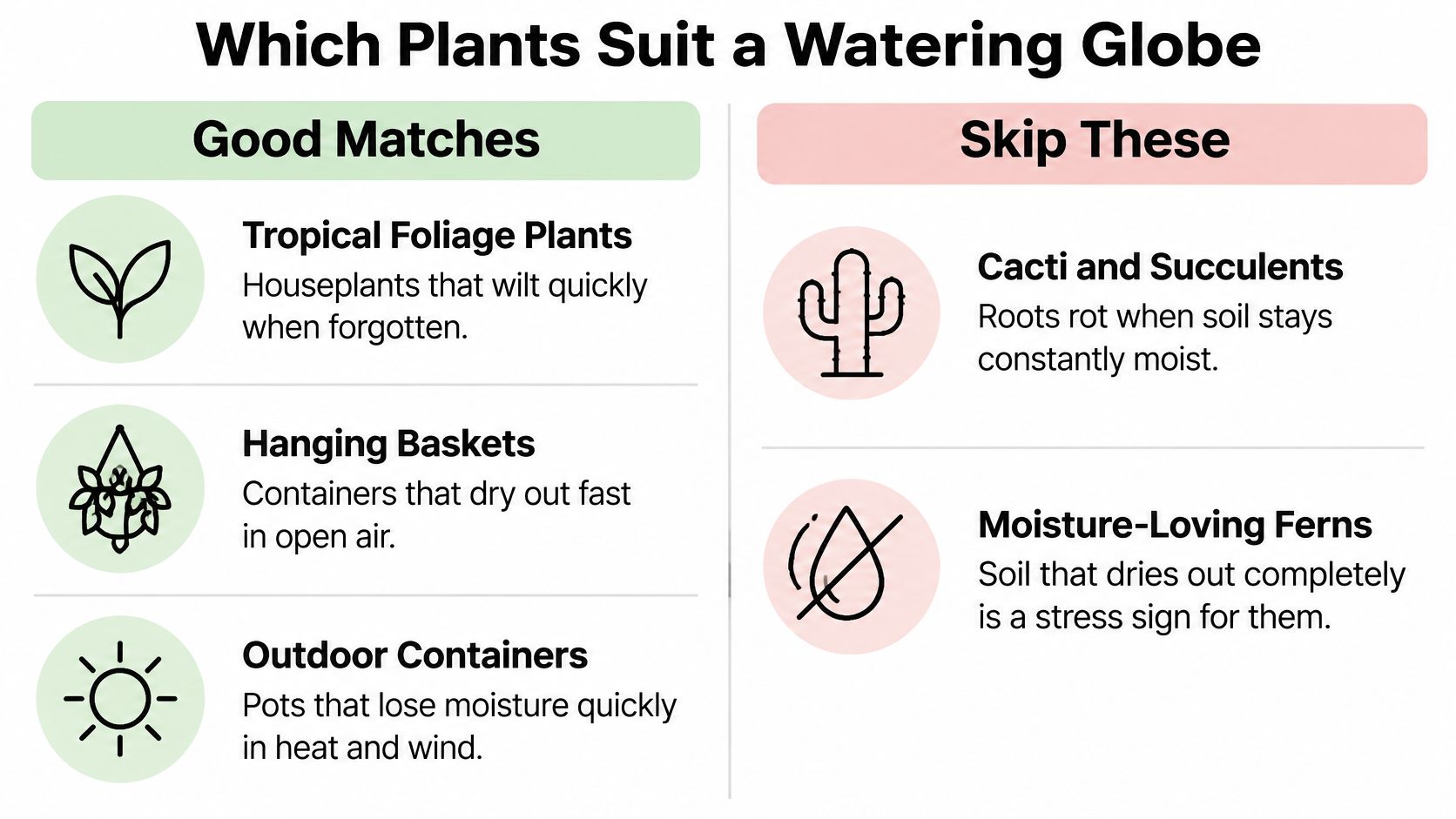
Moisture-loving ferns aren't an automatic exclusion. Where the graphic labels them under “Skip These,” the practical distinction is that drying completely stresses them; a suitable globe may help, provided it can meet demand without saturating the pot.
The practical advantages and limits
- Pro: A visible reserve can support a moisture-demanding plant between inspections, particularly when missed watering is the recurring problem.
- Pro: A globe occupies space inside the existing pot rather than requiring a separate display surface.
- Con: A single small reservoir isn't adequate evidence of coverage for a very large root ball.
- Con: A pot with poor drainage remains unsuitable, however attractive or generously sized the globe might be.
A traveler's shelf can contain plants with conflicting needs. Matching globes across the entire shelf for visual consistency is less useful than equipping only the plants that benefit from supplemental moisture.
For the styling side, Slone Brothers Furniture offers ideas to find houseplants to match your decor. Watering compatibility should determine which of those plants receives a globe.
Use this decision gate before setup
- Identify drought-adapted plants. A succulent, cactus, or care label calling for complete drying rules out routine globe use.
- Check the drainage hole. Without an exit for excess water, resolve the container arrangement first.
- Assess actual demand. Tropical foliage or a fast-drying container is a candidate, not an automatic approval.
- Match the reserve. A larger suitable pot or basket calls for the larger capacity, followed by a home trial.
- Plan absence checks. For a week or two away, arrange a midpoint inspection rather than assuming the globe will finish the trip unattended.
The final test is simple: if the plant must dry completely, skip the globe regardless of the room's style.
Globes vs Spikes, Drip and Self-Watering Pots
Every method on this list moves water into soil. The honest comparison is the attention each one demands per pot across a season, not which sounds most automatic.
Watering globe vs spike, drip and self-watering pot
| Method | How long one fill lasts | Setup and refill | Clogging | Works outdoors | Cost per plant |
|---|---|---|---|---|---|
| Watering globe | Up to about two weeks at best; shorter with high demand or heat | Fill bulb, insert into moist soil, inspect before refilling | Soil can obstruct the stem; a tip cover helps | Yes, in suitable containers | $12.45 for a single globe; $24.95 for a mixed-size 10-pack |
| Terracotta spike | Reservoir capacity and soil demand set coverage | Seat the spike and connect or fill its reservoir | Mineral deposits or soil contact can restrict delivery | Yes, with a suitable reservoir and secure installation | Spike plus whatever reservoir serves it, per plant |
| Drip system | Continues while a functioning water supply and controls remain available | Install tubing and emitters, adjust delivery, maintain the supply | Emitters can clog | Yes, with suitable components | Shared supply and controls, plus delivery parts for each pot |
| Self-watering pot | Ends when the usable reservoir is exhausted | Establish soil-to-reservoir contact and refill through the designed opening | Channels or wicks can become obstructed | Only when the design manages rain and overflow | Replacement container for each plant |
Globes are the easiest method here to price transparently: $12.45 covers one pot, and outfitting several at once drops the per-pot figure sharply. The alternatives bury their per-plant cost in extras. A spike needs the reservoir paired with it, drip needs tubing and controls before the first emitter runs, and a self-watering pot charges for a new container on top of the plant.
A globe asks for almost no infrastructure, but refilling many individual bulbs becomes a chore. A networked system takes more setup and may be easier to service across numerous pots.
Which situation favors each method?
- A suitable container during a short absence: A globe offers a compact, visible reserve without tubing. A completed home trial matters more than the appearance of a full bulb at departure.
- An individual plant with room for a separate reservoir: A spike can be practical when the reservoir arrangement is stable and convenient to refill. A spike alone doesn't establish how long the supply will last.
- A larger collection: Drip can distribute water across multiple pots, but the owner must balance delivery and check connections, emitters, and controls.
- A plant already suited to reservoir growing: A self-watering pot can make sense when its design, medium, and overflow arrangement match the plant.
The distinction between bulbs and other self-watering plant spikes matters most at the refill point: where the reserve sits, how it delivers water, and how easily the owner can inspect it.
Globes aren't always the answer. They win where one pot needs a modest, visible reserve for days at a time; the moment the job is a whole collection, a reservoir the plant feeds from directly, or hardware already in place, the better tool is the one built for that scale.
How to Set Up a Little Green Leaf Globe in Dense Soil
Dense soil needs a pilot hole made before the glass stem ever goes in. Forcing the stem through compacted medium can snap the glass, and a channel torn open under pressure tends to collapse and restrict flow. Before installing anything, confirm the pot has a drainage hole and a growing medium that releases excess water.
Excess water displaces air and limits oxygen around roots, causing damage and symptoms that can resemble drought, according to University of Minnesota Extension's watering guidance. A globe earns its place by buffering moisture between waterings; soil that never dries defeats the purpose.
Five setup steps for a dense-soil pot
- Water the plant first. Wet the root ball thoroughly and let the excess drain away. Start with evenly moist soil, since a bone-dry pot can drain the reservoir fast or shed water through cracks.
- Make a pilot hole with a pencil. Choose a spot near the root zone but away from the pot wall. Ease the pencil into the medium without levering against major roots, then remove it to leave a channel for the stem.
- Fill the bulb and fit the tip cover. Fill with clean water and add the plastic anti-clog sleeve if one is being used. Keep the opening clear rather than packing soil into it during preparation.
- Insert at a slight angle. Guide the stem into the pilot hole and settle the bulb so it sits stable. If resistance calls for real force, stop and widen or reposition the hole.
- Check after two days. Inspect the water level and feel below the surface, using the moisture check described earlier. Lift the pot if practical; a pot that still feels heavy is holding water, and the globe may not be releasing at all.
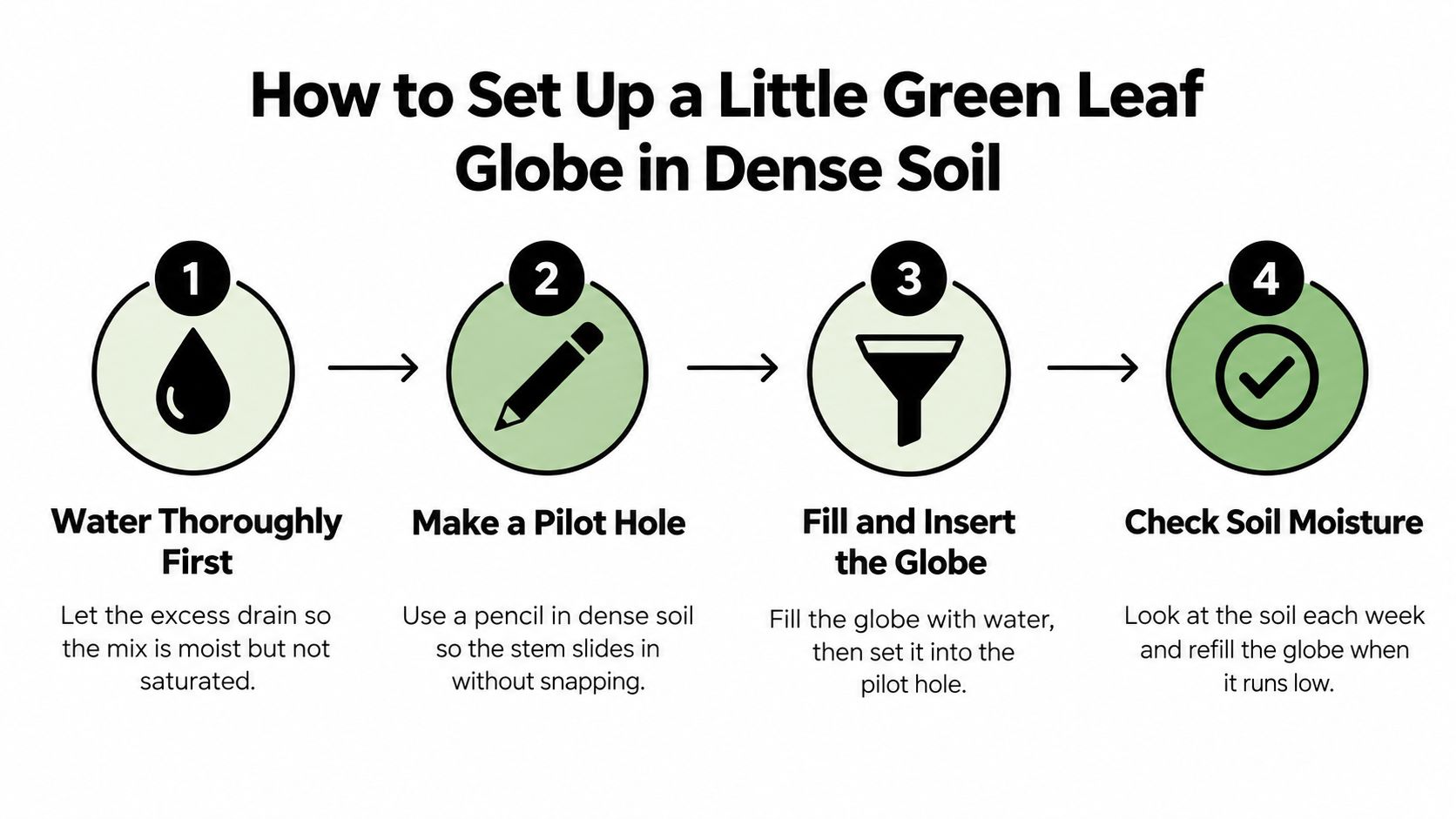
The working sequence stays fill, insert, and monitor. The pre-water and the pilot hole are what make that sequence safe in dense soil. The graphic groups filling and insertion together; treat its weekly inspection reminder as something that runs alongside the two-day check, since a clogged stem shows itself fastest right after setup.
Clogs, cleaning and glass safety
- Water stops moving while soil dries: Remove the globe, rinse the stem, and clear the opening before reinserting. A plastic tip cover keeps soil from entering, but flow still needs an occasional look.
- Residue develops inside: Empty the bulb and rinse it with warm water. A narrow, flexible bottle brush works where it fits freely; keep rigid brushes away from the stem.
- The globe leans toward the pot edge: Reposition it before it falls. Glass breaks on impact, and a hanging basket needs enough stability to keep the bulb from rocking loose.
- The bulb empties unusually quickly: Check whether the soil started too dry, the stem is seated securely, or the reserve is too small for the plant. Refilling sooner is not always the fix.
Clear and colored finishes change how a globe looks; the moisture check stays identical either way. The range covers multicolor and clear rainbow designs, 100 ml, 200 ml and 350 ml capacities, and 1, 2, 4, 6 and 10 packs, so match the count to the pots that genuinely want steady moisture. Before the first fill, dry-fit the stem in its pilot hole; a lean is far easier to correct while the bulb is still empty.
Frequently Asked Questions About Watering Globes
Should I choose a 100 ml or a 350 ml globe?
Match the reserve to the pot's size and the plant's draw. Little Green Leaf globes come in 100 ml, 200 ml and 350 ml sizes, plus a mixed size option that lets you trial capacities across several pots. The smallest globe that still covers your refill gap is the right pick; oversizing a small pot just leaves stale water sitting in the bulb.
Does the insertion angle change how fast it empties?
Yes. A stem inserted at a 90 degree angle makes it harder for air to escape, so the drip slows. At 45 degrees, water releases more easily. Treat the angle as your fine-tuning dial: steeper when a fill drains too fast, shallower when the soil wants more.
How do I check the water level without disturbing the roots?
Hand-blown glass shows the reserve at a glance, so read the bulb while it stays in the soil. Pair that visual check with a finger test at the stem base. A full bulb sitting above dry soil means water is not reaching the root zone, a different problem than an empty reserve.
Can one large pot take two globes?
A wide planter can run a second globe placed on the opposite side of the plant, provided the combined reserve matches what that plant actually drinks. Globes sell in packs of 1, 2, 4, 6 and 10, so multi-globe setups are practical, but only where the plant's demand justifies them.
Is glass plant decor safe for a pot with no drainage hole?
Not without a drainage plan, because water can collect at the base and keep roots excessively wet. A removable inner pot can be watered separately and allowed to drain before returning to the glass outer container.
Little Green Leaf offers hand-blown watering globes that combine a visible water reserve with decorative glass, in sizes suited to different containers. Visit Little Green Leaf to choose a globe for a moisture-compatible plant, then test the setup at home before relying on it during travel.